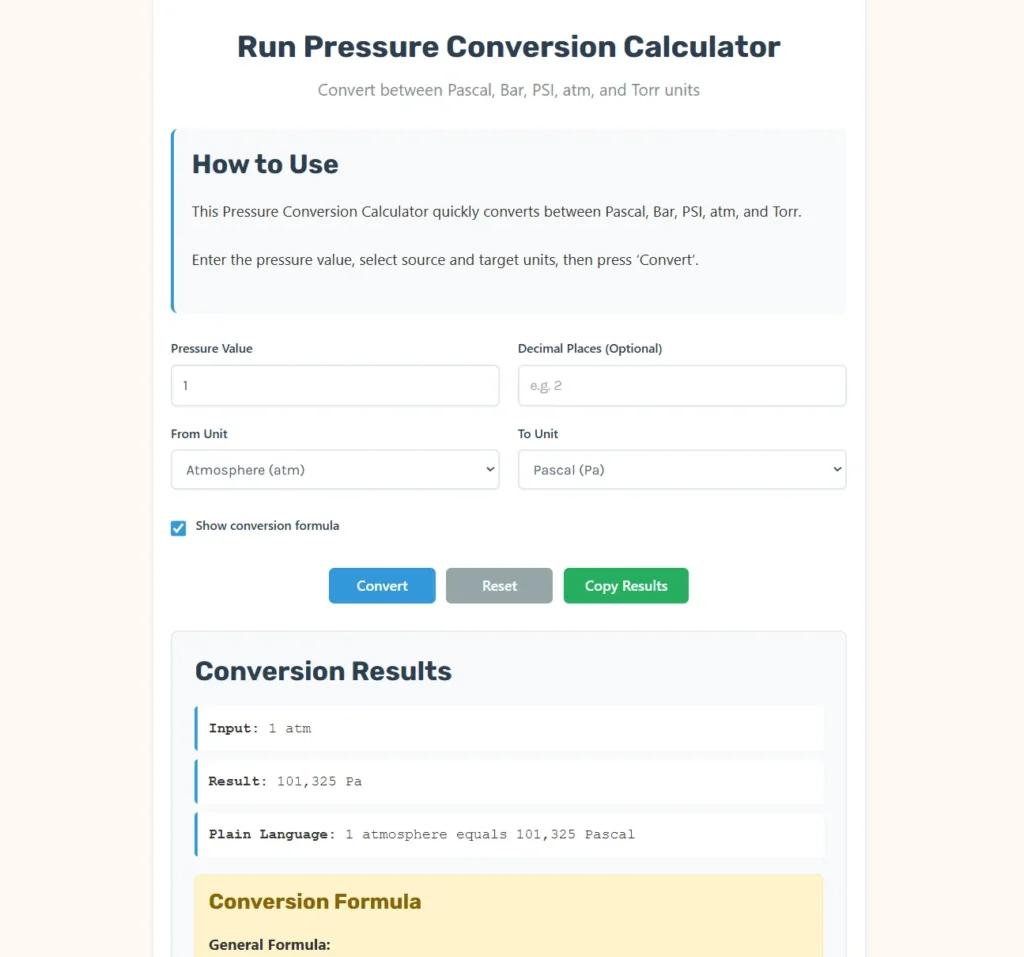
Run Pressure Conversion Calculator
Convert between Pascal, Bar, PSI, atm, and Torr units
How to Use
This Pressure Conversion Calculator quickly converts between Pascal, Bar, PSI, atm, and Torr.
Enter the pressure value, select source and target units, then press ‘Convert’.
Conversion Results
Conversion Formula
About Pressure Units
Pressure measures force per unit area. Common units include Pascal, Bar, PSI, atm, and Torr. Use the formulas above to convert accurately between them.
Input: 1 atm → Output: 101,325 Pa
Plain language: 1 atmosphere equals 101,325 Pascal
Guide to Pressure Unit Conversion: Physics, Mathematics, and Practical Applications
Pressure is one of the most fundamental physical quantities measured across science, engineering, meteorology, automotive design, aerospace, and industrial manufacturing. Because different fields developed specialized systems of measurement over centuries, professional environments frequently require accurate conversion between international metric standards, imperial system units, atmospheric references, and manometric fluid columns.
This technical guide explores the physical mechanics of pressure, provides the mathematical derivation of all major pressure units, details exact conversion algorithms, demonstrates worked step-by-step examples, and outlines industry-specific use cases for engineering precision.
Understanding Physical Pressure: Definitions and Fundamental Mechanics
In classical continuum mechanics and thermodynamics, pressure is defined as the scalar magnitude of normal force exerted perpendicularly per unit area over the boundary of a surface.
+-------------------------------------------------------------+
|                PHYSICAL PRESSURE SCHEMATIC                  |
|                                                             |
|                   Normal Force Vector (F)                   |
|                             ║                               |
|                             v                               |
|               +---------------------------+                 |
|               | Surface Boundary Area (A) |                 |
|               +---------------------------+                 |
|                                                             |
|             Formula: Pressure (P) = Force / Area            |
+-------------------------------------------------------------+
Mathematically, global pressure P is expressed through the differential relationship:
P = dF⊥ / dA
Where:
- dF⊥ represents the infinitesimal component of force acting normal (perpendicular) to the planar boundary.
- dA represents the infinitesimal element of surface area over which the force is distributed.
The Isotropic Nature of Fluid Pressure
Unlike tensile or shear stresses in solid mechanics, static fluid pressure is isotropic. According to Pascal’s Principle, an externally applied pressure on an incompressible static fluid is transmitted equally and undiminished in all directions throughout the fluid medium. Consequently, pressure at any specific point within a fluid at rest has no directional orientation; it acts equally in all vector orientations against any immersed surface area.
Hydrostatic pressure increases linearly with fluid depth due to gravitational field forces acting on fluid mass. This hydrostatic profile is calculated via:
P = P0 + (ρ × g × h)
Where:
- P0 represents atmospheric or surface pressure.
- ρ represents fluid mass density.
- g represents local acceleration due to gravity (approximately 9.80665 m/s2 at standard sea level).
- h represents the vertical depth of the fluid column.
Mathematical Profiles of Major Pressure Units
Modern engineering and industrial applications utilize several distinct pressure systems. Understanding the precise scientific definition of each unit ensures accurate parameter translation across global technical domains.
+-------------------------------------------------------------+
|              SUMMARY OF PRESSURE UNIT DEFINITIONS           |
|                                                             |
|  ➔ Pascal (Pa): 1 N/m² (Base SI Metric Unit)               |
|  ➔ Bar: Exactly 100,000 Pa (0.1 MPa Industrial Standard)    |
|  ➔ PSI: 1 lbf/in² (~6,894.76 Pa Imperial Standard)          |
|  ➔ atm: Exactly 101,325 Pa (Standard Atmospheric Constant)  |
|  ➔ Torr: Exactly 1/760 atm (~133.322 Pa Manometric Reference)|
+-------------------------------------------------------------+
1. Pascal (Pa) and Metric Multiples
The Pascal (symbol: Pa) is the official System International (SI) derived unit of pressure, named after the seventeenth-century French mathematician and physicist Blaise Pascal. One Pascal is defined precisely as one Newton of force applied uniformly over an area of one square meter:
1 Pa = 1 N / m2 = 1 kg / (m × s2)
Because one Pascal represents a very small pressure magnitude (roughly equivalent to the weight of a thin sheet of paper resting on a table), technical disciplines routinely employ decimal SI prefixes:
- Hectopascal (hPa): 1 hPa = 100 Pa = 102 Pa (widely used in meteorology).
- Kilopascal (kPa): 1 kPa = 1,000 Pa = 103 Pa (standard metric tire and HVAC rating).
- Megapascal (MPa): 1 MPa = 1,000,000 Pa = 106 Pa (used in structural steel and hydraulic material stress analysis).
- Gigapascal (GPa): 1 GPa = 1,000,000,000 Pa = 109 Pa (used in geophysics and diamond anvil cell research).
2. Bar
The Bar (symbol: bar) is a metric unit of pressure defined independently of the SI system but legally recognized for engineering and commercial use. Introduced in 1909 by the Norwegian meteorologist Vilhelm Bjerknes, the bar is defined as an exact decimal multiple of the Pascal:
1 bar = 100,000 Pa = 105 Pa = 100 kPa = 0.1 MPa
The bar is widely favored in European industrial engineering because one bar closely approximates average terrestrial atmospheric pressure at sea level (1.01325 bar), providing an intuitive reference scale for pneumatic, hydraulic, and compressed gas equipment.
3. Pound per Square Inch (PSI)
Pound per Square Inch (symbol: psi or lbf/in2) is the primary unit of pressure in the United States Customary and British Imperial systems. It is defined as the force resulting from one pound-force (lbf) applied over an area of one square inch (in2).
Using exact standard physical conversion constants:
- 1 pound-force (lbf) = 4.4482216152605 Newtons
- 1 square inch (in2) = 0.00064516 square meters
The conversion from PSI to Pascals is calculated directly:
1 psi = 4.4482216152605 N / 0.00064516 m2 ≈ 6,894.757293168361 Pa
In numerical software engines, this conversion constant is rounded to six significant figures: 1 psi ≈ 6,894.76 Pa.
4. Standard Atmosphere (atm)
The Standard Atmosphere (symbol: atm) is a international reference constant originally established to represent mean atmospheric pressure at sea level at a temperature of 0 degrees Celsius. In 1954, the 10th General Conference on Weights and Measures (CGPM) formally established the standard atmosphere as an exact fixed metric constant:
1 atm = 101,325 Pa = 1.01325 bar = 101.325 kPa
The standard atmosphere serves as the primary reference point in chemistry, thermodynamics, ideal gas law calculations, and aviation altimetry calibration.
5. Torr and Millimeter of Mercury (mmHg)
The Torr (symbol: Torr) is a manometric unit of pressure historically tied to fluid height displacements observed in mercury barometers, designed by Evangelista Torricelli in 1643.
The Torr was re-defined in the twentieth century as an exact fraction of a standard atmosphere:
1 Torr = 1 / 760 atm = 101,325 / 760 Pa ≈ 133.322368421 Pa
While historically considered identical to the millimeter of mercury (1 mmHg), modern physical metrology distinguishes between them slightly. One mmHg is defined based on the fluid static head density of mercury under standard gravity:
1 mmHg = ρHg × g × (0.001 m) ≈ 133.3223874 Pa
For nearly all practical engineering calculations and vacuum measurements, 1 Torr and 1 mmHg are treated as equivalent (133.322 Pa).
Gauge Pressure versus Absolute Pressure
A critical requirement when operating digital pressure conversion engines or evaluating engineering schematics is distinguishing between Absolute Pressure, Gauge Pressure, and Differential Pressure.
+-------------------------------------------------------------+
|             PRESSURE MEASUREMENT REFERENCE FRAMES           |
|                                                             |
|   Absolute Vacuum Line (0 Pa / 0 psia)                      |
|   -------------------------------------------------------   |
|     |                                                       |
|     |  Atmospheric Offset (~101,325 Pa / 14.7 psi)          |
|     v                                                       |
|   Ambient Sea-Level Pressure (1 atm / 0 psig / 0 bar g)     |
|   =======================================================   |
|     |                                                       |
|     |  Gauge Reading (P_gauge)                              |
|     v                                                       |
|   Measured System Pressure Line                             |
+-------------------------------------------------------------+
Absolute Pressure (Pabs)
Absolute pressure measures total pressure relative to a perfect, zero-pressure thermodynamic vacuum (0 Pa absolute). Absolute readings are strictly positive numbers. Scientific calculations involving gas laws, ideal gas equations (P × V = n × R × T), and vacuum physics always require absolute pressure inputs.
Gauge Pressure (Pgauge)
Gauge pressure measures pressure relative to the surrounding local ambient atmospheric pressure (typically around 101.325 kPa / 14.7 psi at sea level). A standard mechanical pressure gauge vented to ambient air reads zero when unpressurized.
The relationship between absolute and gauge pressure is defined by:
Pabs = Pgauge + Patm
Where Patm is the prevailing local atmospheric pressure.
- In Imperial notation, gauge pressure is designated as psig and absolute pressure as psia.
- In European metric notation, gauge pressure is designated as bar g and absolute pressure as bar a.
Differential Pressure (ΔP)
Differential pressure measures the direct difference in force per unit area between two separate pressure points in a fluid circuit, independent of ambient atmospheric levels. Differential pressure sensors are widely used to measure fluid flow rates across orifice plates, filter contamination levels, and cleanroom isolation enclosures.
Universal Pressure Conversion Factor Matrix
Because digital conversion calculators process arbitrary directional conversions, automated algorithms map input units into an un-scaled SI base unit (Pascal) before computing the target output.
| From / To | Pascal (Pa) | Bar (bar) | PSI (lbf/in2) | Atmosphere (atm) | Torr (mmHg) |
| 1 Pascal (Pa) | 1 | 10-5 | 1.45038 × 10⁻⁴ | 9.86923 × 10⁻⁶ | 7.50062 × 10⁻³ |
| 1 Bar (bar) | 100,000 | 1 | 14.5038 | 0.986923 | 750.062 |
| 1 PSI | 6,894.76 | 0.0689476 | 1 | 0.0680460 | 51.7149 |
| 1 atm | 101,325 | 1.01325 | 14.6959 | 1 | 760 |
| 1 Torr | 133.322 | 0.00133322 | 0.0193368 | 0.00131579 | 1 |
Architecture of Digital Pressure Conversion Engines
Modern web-based conversion tools implement normalized software workflows to perform multi-unit transformations seamlessly. Rather than storing static conversion factors for every pair permutation (which scales quadratically with N2 possible paths), software engines route calculations through a central SI normalization pivot.
                  +-----------------------------------+
                  |   DIGITAL CONVERTER ARCHITECTURE  |
                  +-----------------------------------+
                                    |
                                    v
                         +--------------------+
                         | INPUT VALUE (V_in) |
                         +--------------------+
                                    |
                                    v
                         +--------------------+
                         | MULTIPLY BY        |
                         | SOURCE FACTOR (K_s)|
                         +--------------------+
                                    |
                                    v
                         +--------------------+
                         | SI BASE VALUE      |
                         | (Pascal)           |
                         +--------------------+
                                    |
                                    v
                         +--------------------+
                         | DIVIDE BY          |
                         | TARGET FACTOR (K_t)|
                         +--------------------+
                                    |
                                    v
                         +--------------------+
                         | FINAL OUTPUT VALUE |
                         | (V_out)            |
                         +--------------------+
Algorithmic Execution Steps
- Validation Inspection: Parse raw user input strings to ensure numeric validity and verify that non-negative constraints are met for absolute scales.
- Normalization Stage: Convert input magnitude Vin from source unit Usrc into normalized Pascals PPa using conversion scalar Ksrc:PPa = Vin × Ksrc
- Target Scaling Stage: Divide intermediate value PPa by target conversion scalar Ktgt to yield output Vout:Vout = PPa / Ktgt
- Precision Formatting Stage: Format the floating-point result to the user-specified decimal depth or scientific notation parameter, applying standard IEEE 754 rounding rules.
Worked Mathematical Examples
Example 1: Converting Automotive Tire Inflation Pressure (PSI to Bar and kPa)
A vehicle manufacturer specifies a cold tire pressure of 32.00 PSI. Convert this value into Bar and Kilopascals for international service documentation.
Step A: Convert PSI to Base Pascals
- Input Value = 32.00 PSI
- Source Conversion Scalar KPSI = 6,894.76 Pa / PSI
PPa = 32.00 × 6,894.76 = 220,632.32 Pa
Step B: Convert Pascals to Bar
- Target Conversion Scalar KBar = 100,000 Pa / bar
VBar = 220,632.32 / 100,000 = 2.2063232 bar
- Formatted to two decimal places: 2.21 Bar
Step C: Convert Pascals to Kilopascals
- Target Conversion Scalar KkPa = 1,000 Pa / kPa
VkPa = 220,632.32 / 1,000 = 220.63232 kPa
- Formatted to two decimal places: 220.63 kPa
Example 2: Converting Laboratory High Vacuum Readings (Torr to Standard Atmosphere and Pascal)
A semiconductor plasma etching chamber operates at an ultra-low vacuum pressure of 0.005 Torr. Calculate the equivalent pressure in Standard Atmospheres and Pascals.
Step A: Convert Torr to Base Pascals
- Input Value = 0.005 Torr
- Source Conversion Scalar KTorr = 133.322 Pa / Torr
PPa = 0.005 × 133.322 = 0.66661 Pa
- Formatted to three decimal places: 0.667 Pa
Step B: Convert Pascals to Standard Atmosphere
- Target Conversion Scalar Katm = 101,325 Pa / atm
Vatm = 0.66661 / 101,325 ≈ 6.5789 × 10⁻⁶ atm
- Expressed in scientific notation: 6.58 × 10⁻⁶ atm
Example 3: Industrial Hydraulic System Evaluation (Bar to PSI)
A heavy industrial hydraulic pump delivers fluid at a rated line pressure of 250 Bar. Determine the system operating pressure in PSI.
Step A: Convert Bar to Base Pascals
- Input Value = 250 Bar
- Source Conversion Scalar KBar = 100,000 Pa / bar
PPa = 250 × 100,000 = 25,000,000 Pa (25 MPa)
Step B: Convert Pascals to PSI
- Target Conversion Scalar KPSI = 6,894.76 Pa / PSI
VPSI = 25,000,000 / 6,894.76 ≈ 3,625.9327 PSI
- Formatted to two decimal places: 3,625.93 PSI
Industry Applications and Real-World Use Cases
                  +-----------------------------------+
                  |   PRACTICAL INDUSTRY APPLICATIONS |
                  +-----------------------------------+
                                    |
         +--------------------------+--------------------------+
         |                                                     |
         v                                                     v
+------------------+                                 +------------------+
| AEROSPACE        |                                 | AUTOMOTIVE       |
| Altimetry &      |                                 | Turbo Boost &    |
| Cabin Controls   |                                 | Tire Systems     |
+------------------+                                 +------------------+
         |                                                     |
         v                                                     v
+------------------+                                 +------------------+
| METEOROLOGY      |                                 | VACUUM PHYSICS   |
| Barometric Trend |                                 | Semiconductor    |
| & Storm Tracking |                                 | Fabrication      |
+------------------+                                 +------------------+
1. Aerospace and Aviation
Aviation relies extensively on precise atmospheric pressure monitoring for barometric altimetry. Aircraft altimeters compute flight altitude above sea level by measuring ambient atmospheric pressure using pitot-static systems.
- Altimeter setting displays in North America use inches of mercury (inHg), whereas international aviation uses hectopascals (hPa) or millibars (mbar).
- Jet cabin pressurization systems regulate interior cabin altitudes to maintain a comfortable pressure differential (ΔP), monitoring interior pressures in PSI and Bar to prevent structural fuselage stress while ensuring crew and passenger oxygenation.
2. Automotive Engineering and Forced Induction
Automotive service specifications bridge US Imperial and European Metric standards:
- Tire Pressure Monitoring Systems (TPMS): North American vehicles report tire pressure in PSI (typically 30 to 35 psig), while European vehicle manuals specify values in Bar (2.0 to 2.5 bar) or Kilopascals (200 to 250 kPa).
- Engine Forced Induction: Turbocharger and supercharger boost pressures are measured above atmospheric pressure. Boost gauges track intake manifold pressure in PSI, Bar, or kPa. A turbocharger producing 14.7 PSI of boost is doubling intake air pressure by adding approximately 1.0 bar g above atmospheric levels.
3. Meteorology and Atmospheric Sciences
Barometric pressure is the foundational variable in weather forecasting and storm tracking:
- Standard sea-level pressure is established internationally as 1,013.25 hPa (or mbar).
- Falling barometric pressure indicates incoming low-pressure weather systems, cyclones, or tropical storms. Meteorologists monitor small atmospheric fluctuations in hectopascals or Torr to predict wind velocities and frontal movements.
4. Underwater Diving and Hyperbaric Medicine
Subsea environments experience rapid hydrostatic pressure increases due to water mass density:
- Hydrostatic pressure increases by approximately 1.0 atm (1.013 bar / 14.7 psi) for every 10 meters (33 feet) of seawater depth.
- Commercial and scuba divers calculate ambient environmental pressure in atmospheres absolute (ATA), combining depth hydrostatic pressure with surface atmospheric pressure. Diving gas blenders analyze partial pressures of oxygen, nitrogen, and helium in Bar or PSI to prevent hyperoxic oxygen toxicity and decompression sickness.
5. Vacuum Technology and Thin-Film Manufacturing
Semiconductor fabrication, electron microscopy, and thin-film coating require ultra-high vacuum (UHV) environments to eliminate gas particle interference:
- Rough vacuum ranges from atmospheric pressure down to 1 Torr.
- High vacuum (HV) operates between 10-3 Torr and 10-7 Torr.
- Ultra-high vacuum (UHV) operates below 10-9 Torr (~1.33 × 10⁻⁷ Pa).
- Physicists and vacuum engineers convert between Torr, Pascal, and mbar to calibrate turbomolecular pumps, ion pumps, and cold-cathode ionization gauges.
Best Practices for Precision Calibration and Measurement Accuracy
Achieving high measurement accuracy in pressure systems requires careful consideration of ambient environmental conditions and sensor characteristics.
Temperature Compensation
Gas pressure varies proportionally with thermodynamic temperature according to Gay-Lussac’s Law for fixed volumes:
P1 / T1 = P2 / T2
When calibrating pressure transducers or checking vehicle tire inflation, readings must account for thermal expansion. A tire inflated cold to 32.0 PSI can experience a pressure increase of 3 to 4 PSI as internal air temperature rises during high-speed highway driving.
Altitude and Barometric Adjustments
Local atmospheric pressure drops with increasing elevation above sea level according to the barometric formula:
P(z) = P0 × exp(−(M × g × z) / (R × T))
Where:
- z represents elevation above sea level.
- M represents the molar mass of dry air.
- R represents the universal gas constant.
Because local atmospheric pressure drops from 101.325 kPa at sea level to approximately 84 kPa at an elevation of 1,500 meters (5,000 feet), gauge pressure sensors operating at high altitudes must be zero-calibrated against local ambient conditions to prevent systematic offset errors.
User Interface and Interaction Best Practices for Web Calculators
Designing effective web tools for engineering applications requires balancing visual clarity, responsive performance, and interaction feedback.
+-------------------------------------------------------------+
|              BEST PRACTICES FOR CONVERTER UI/UX             |
|                                                             |
| ✔ Implement instant validation on numerical inputs.         |
| ✔ Render clear unit labels with explicit abbreviations.     |
| ✔ Provide step-by-step formula transparency toggles.        |
| ✔ Include a single-click copy feature with visual feedback. |
| ✔ Ensure full responsive scaling for mobile touch devices.   |
+-------------------------------------------------------------+
Key UI Features
- Dynamic Validation: Provide immediate visual warnings if non-numeric characters are entered, or if duplicate source and target units are selected.
- Formula Transparency: Allow users to display step-by-step calculation pathways showing intermediate SI base transformations, increasing educational and verification value.
- Clipboard Integration: Include a quick-copy mechanism that formats results cleanly into plain text strings, enabling rapid pasting into engineering logs, technical reports, or digital spreadsheets.
- Keyboard Navigation: Support full accessibility via tab-indexed form controls, allowing users to enter values and trigger conversions effortlessly using hardware keys.
Frequently Asked Questions (FAQ)
What is the difference between Bar and Bar g?
Bar measures absolute pressure relative to a total vacuum (0 Pa absolute). Bar g (Bar Gauge) measures pressure relative to prevailing ambient atmospheric pressure. For example, a system reading 2.0 bar g at standard sea level operates at an absolute pressure of approximately 3.013 bar a.
Why is 1 atmosphere defined as exactly 101,325 Pascals?
In 1954, the 10th General Conference on Weights and Measures (CGPM) formally adopted 101,325 Pascals (101.325 kPa) as a precise, standardized baseline definition for the standard atmosphere (atm). This eliminated minor regional discrepancies caused by local variations in temperature, humidity, and gravitational acceleration when measuring sea-level atmospheric pressure.
Is Torr identical to a millimeter of mercury (mmHg)?
For nearly all practical engineering and scientific applications, Torr and mmHg are functionally identical (1 Torr ≈ 133.322 Pa). However, metrological standards define Torr as exactly 1/760 of a standard atmosphere (101,325 / 760 Pa), whereas 1 mmHg is defined based on the hydrostatic pressure of a 1 mm column of mercury under standard gravity, resulting in a microscopic difference of less than 0.000015 percent.
How do I convert atmospheric pressure to PSI?
To convert atmospheres to PSI directly, multiply the atmosphere value by 14.6959. For example, 2.5 atm equals 2.5 × 14.6959 = 36.74 PSI.
Academic References and Official Standards
- National Institute of Standards and Technology (NIST). Guide for the Use of the International System of Units (SI). NIST Special Publication 811.
- International Bureau of Weights and Measures (BIPM). The International System of Units (SI) Brochure. 9th Edition, 2019.
- International Organization for Standardization (ISO). ISO 80000-4:2019 Quantities and Units — Part 4: Mechanics.
- Blaise Pascal’s Hydrostatic Treatises. Physical Metrology and Fluid Mechanics Foundations. Re-issued by Cambridge University Press.