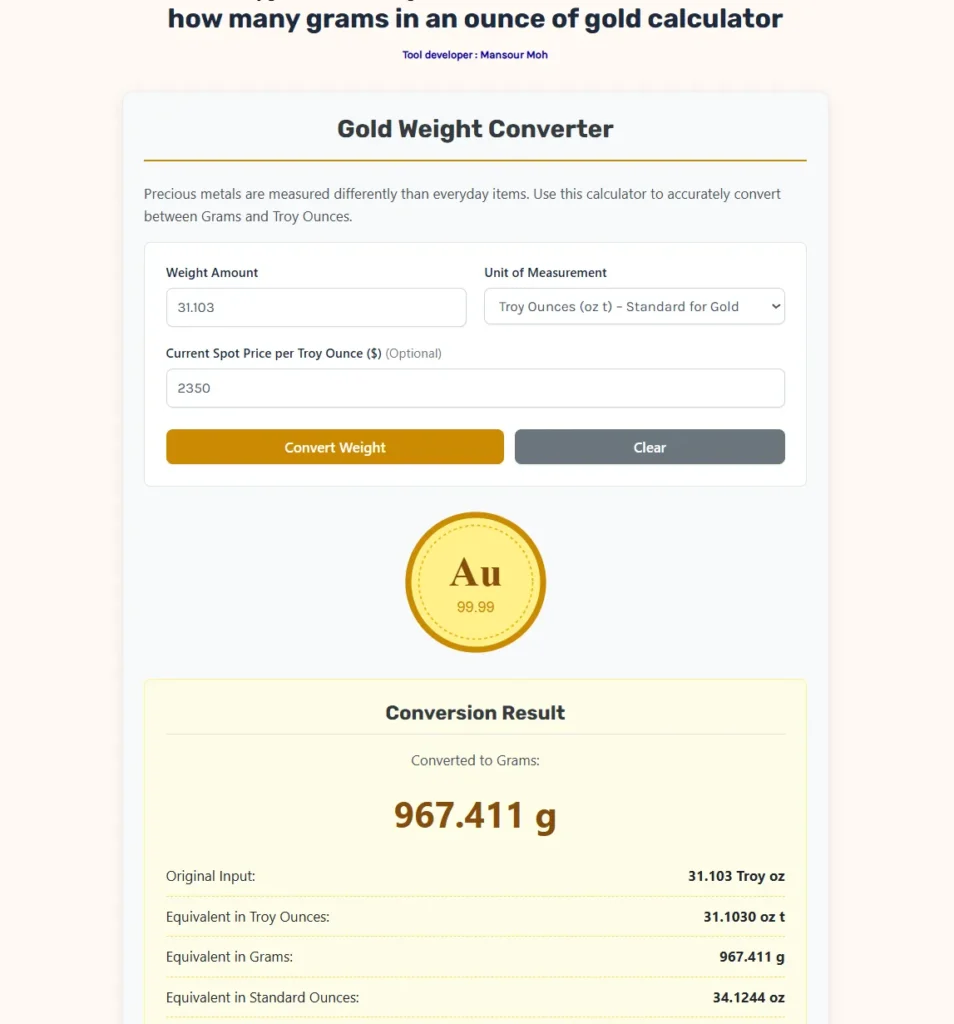
Gold Weight Converter
Precious metals are measured differently than everyday items. Use this calculator to accurately convert between Grams and Troy Ounces.
The Math Behind Gold Weights
Troy Ounces vs. Standard Ounces
Gold and other precious metals are weighed using the Troy system, which dates back to the Middle Ages. A Troy Ounce is heavier than the standard (Avoirdupois) ounce used for everyday items like sugar or flour.
- 1 Troy Ounce = 31.1034768 grams
- 1 Standard Ounce = 28.3495231 grams
Formula: Grams = Troy Ounces × 31.103
Quick Reference Guide
Gold Weight Metrology: Theoretical Foundations, Conversion Mechanics, and Precious Metals Valuation
In the global commodities markets, the precise measurement of precious metals is a critical requirement for trade, banking, and scientific analysis. Unlike base metals and everyday consumer items, which are measured using standard commercial mass systems, precious metals like gold, silver, platinum, and palladium are measured using a specialized historical system.
To build an accurate physical valuation model, financial analysts, jewelers, and central banks must understand the mathematical relationships between Troy Ounces, Grams, and Standard (Avoirdupois) Ounces. Converting raw mass across these distinct measurement systems requires absolute precision, as even small rounding errors can lead to significant financial discrepancies in high-value transactions. This guide examines the history, mathematics, and regulatory standards used in precious metals metrology.
Introduction to Precious Metals Metrology and Weight Systems
The coexistence of different mass systems in modern commerce is the result of centuries of historical development. When trading high-value commodities like gold, standard commercial measurements are replaced by specialized systems designed to prevent fraud and ensure consistency across international trade hubs.
To understand why gold is weighed differently than ordinary commodities, we must analyze the two primary mass systems used in the English-speaking world:
$\checkmark$ The Troy System: Originating in medieval Europe and officially adopted by the British Mint in the sixteenth century, this system is the international standard for weighing precious metals and gemstones.
$\checkmark$ The Avoirdupois System: The standard system of weights used in daily commerce for goods like food, shipping cargo, and industrial materials.
Because these two systems define the term “ounce” differently, using them interchangeably without converting the values correctly can lead to significant errors in valuation and reporting.
Clarifying the Metrology: Troy vs. Avoirdupois Systems
The primary difference between standard commercial weights and precious metal weights lies in the definition of their ounces and pounds.
1. Standard Avoirdupois Ounces
In the standard Avoirdupois system, a pound is divided into sixteen ounces. This system is designed for volume-based trade of everyday consumer goods. One standard Avoirdupois ounce is mathematically defined as exactly $28.349523125$ grams.
2. Troy Ounces
In the Troy system, a pound is divided into twelve ounces. This system is used exclusively for precious metals and gemstones. A single Troy ounce is heavier than a standard Avoirdupois ounce, weighing exactly $31.1034768$ grams.
This difference leads to a notable metrological paradox: while a Troy ounce is heavier than a standard ounce, a standard Avoirdupois pound is heavier than a Troy pound. This is because an Avoirdupois pound contains sixteen lighter ounces (totaling approximately $453.59$ grams), whereas a Troy pound contains only twelve heavier ounces (totaling approximately $373.24$ grams).
The table below illustrates the key differences between these two mass systems:
| Metrological Feature | Troy Mass System | Avoirdupois Mass System |
| Standard Unit of Measurement | Troy Ounce ($\text{oz t}$) | Standard Ounce ($\text{oz}$) |
| Ounces per Standard Pound | $12$ | $16$ |
| Exact Mass in Grams | $31.1034768\text{ g}$ | $28.349523125\text{ g}$ |
| Primary Commercial Use | Gold, silver, platinum, gems | Coffee, grain, steel, general cargo |
Deconstructing the Input Parameters of the Gold Converter
To convert weights accurately, an analyst must understand the four primary operational variables.
1. Weight Amount
The raw numerical mass input of the precious metal asset, which can be measured in grams, Troy ounces, or standard Avoirdupois ounces.
2. Unit of Measurement
The specific mass scale of the input weight, which determines the conversion factors needed to calculate equivalent weights in other systems.
3. Spot Price (Per Troy Ounce)
The current market price of one Troy ounce of pure, unalloyed gold. This price is determined by global commodity exchanges, such as the London Bullion Market Association (LBMA) and the New York Mercantile Exchange (COMEX).
4. Fineness and Purity (Karats)
Precious metal items are rarely composed of $100\%$ pure gold, as pure gold is too soft for practical use. Understanding purity allows analysts to separate the gross weight of an item from its fine gold content.
Mathematical Architecture of Gold Weight Conversion
To ensure these calculations are highly readable on mobile devices and small screen containers, all formulas are broken down into narrow, vertically stacked steps.
Converting Grams to Troy Ounces
To convert mass from grams to Troy ounces, divide the weight in grams by the standard Troy conversion constant.$$\text{W}_{\text{troy}} = \frac{\text{W}_{\text{grams}}}{\text{C}_{\text{troy}}}$$
Where:
- $\rightarrow$ $\text{W}_{\text{troy}}$ represents the weight of the metal in Troy Ounces.
- $\rightarrow$ $\text{W}_{\text{grams}}$ represents the input weight in Grams.
- $\rightarrow$ $\text{C}_{\text{troy}}$ represents the constant mass of a Troy Ounce ($31.1034768$ grams).
Converting Troy Ounces to Grams
To convert mass from Troy ounces to grams, multiply the weight in Troy ounces by the standard Troy conversion constant.$$\text{W}_{\text{grams}} = \text{W}_{\text{troy}} \times \text{C}_{\text{troy}}$$
Where:
- $\rightarrow$ $\text{W}_{\text{grams}}$ represents the calculated weight in Grams.
- $\rightarrow$ $\text{W}_{\text{troy}}$ represents the input weight in Troy Ounces.
- $\rightarrow$ $\text{C}_{\text{troy}}$ represents the constant mass of a Troy Ounce ($31.1034768$ grams).
Converting Standard Ounces to Grams
To convert mass from standard Avoirdupois ounces to grams, multiply the standard weight by the Avoirdupois conversion constant.$$\text{W}_{\text{grams}} = \text{W}_{\text{av}} \times \text{C}_{\text{av}}$$
Where:
- $\rightarrow$ $\text{W}_{\text{grams}}$ represents the calculated weight in Grams.
- $\rightarrow$ $\text{W}_{\text{av}}$ represents the input weight in Standard Ounces.
- $\rightarrow$ $\text{C}_{\text{av}}$ represents the constant mass of a standard ounce ($28.349523125$ grams).
Converting Grams to Standard Ounces
To convert mass from grams to standard Avoirdupois ounces, divide the weight in grams by the standard Avoirdupois conversion constant.$$\text{W}_{\text{av}} = \frac{\text{W}_{\text{grams}}}{\text{C}_{\text{av}}}$$
Where:
- $\rightarrow$ $\text{W}_{\text{av}}$ represents the weight in Standard Ounces.
- $\rightarrow$ $\text{W}_{\text{grams}}$ represents the input weight in Grams.
- $\rightarrow$ $\text{C}_{\text{av}}$ represents the constant mass of a standard ounce ($28.349523125$ grams).
Direct Conversion: Standard Ounces to Troy Ounces
To convert directly from standard Avoirdupois ounces to Troy ounces without converting to grams first, multiply the standard weight by the direct conversion factor.$$\text{W}_{\text{troy}} = \text{W}_{\text{av}} \times \text{F}_{\text{av}\rightarrow\text{tr}}$$
The conversion factor is derived as:$$\text{F}_{\text{av}\rightarrow\text{tr}} = \frac{\text{C}_{\text{av}}}{\text{C}_{\text{troy}}}$$$$\text{F}_{\text{av}\rightarrow\text{tr}} \approx 0.911458$$
Where:
- $\rightarrow$ $\text{W}_{\text{troy}}$ represents the calculated weight in Troy Ounces.
- $\rightarrow$ $\text{W}_{\text{av}}$ represents the input weight in Standard Ounces.
- $\rightarrow$ $\text{C}_{\text{av}}$ represents the standard Avoirdupois constant ($28.349523125$).
- $\rightarrow$ $\text{C}_{\text{troy}}$ represents the standard Troy constant ($31.1034768$).
- $\rightarrow$ $\text{F}_{\text{av}\rightarrow\text{tr}}$ represents the direct conversion scaling factor.
Direct Conversion: Troy Ounces to Standard Ounces
To convert directly from Troy ounces to standard Avoirdupois ounces, multiply the weight in Troy ounces by the inverse conversion factor.$$\text{W}_{\text{av}} = \text{W}_{\text{troy}} \times \text{F}_{\text{tr}\rightarrow\text{av}}$$
The conversion factor is derived as:$$\text{F}_{\text{tr}\rightarrow\text{av}} = \frac{\text{C}_{\text{troy}}}{\text{C}_{\text{av}}}$$$$\text{F}_{\text{tr}\rightarrow\text{av}} \approx 1.097143$$
Where:
- $\rightarrow$ $\text{W}_{\text{av}}$ represents the calculated weight in Standard Ounces.
- $\rightarrow$ $\text{W}_{\text{troy}}$ represents the input weight in Troy Ounces.
- $\rightarrow$ $\text{C}_{\text{troy}}$ represents the standard Troy constant ($31.1034768$).
- $\rightarrow$ $\text{C}_{\text{av}}$ represents the standard Avoirdupois constant ($28.349523125$).
- $\rightarrow$ $\text{F}_{\text{tr}\rightarrow\text{av}}$ represents the inverse conversion scaling factor.
Valuation Metrics: Calculating Total Commodity Value
To calculate the monetary value of a precious metal asset, multiply its weight in Troy ounces by the current spot price.
The valuation equation is:$$\text{V}_{\text{total}} = \text{W}_{\text{troy}} \times \text{P}_{\text{spot}}$$
Where:
- $\rightarrow$ $\text{V}_{\text{total}}$ represents the estimated market value of the asset in US Dollars.
- $\rightarrow$ $\text{W}_{\text{troy}}$ represents the total mass of the asset in Troy Ounces.
- $\rightarrow$ $\text{P}_{\text{spot}}$ represents the current market spot price per Troy Ounce.
The Mathematics of Purity: Fine Weight vs. Gross Weight
When evaluating gold jewelry or historical coins, the total weight of the item (the gross weight) includes other metals added to increase durability. To determine the financial value of the item, we must calculate the weight of the pure gold content (the fine weight).
Gold purity is measured using karats or millesimal fineness:
- Karats: A system that measures purity in parts of $24$, where $24\text{ Karat}$ is pure gold.
- Millesimal Fineness: A system that measures purity in parts per thousand, where $999$ or $999.9$ represents pure gold.
Calculating the Purity Factor from Karats
To find the decimal purity factor ($\text{F}_{\text{purity}}$) of an item from its karat rating ($\text{K}$):$$\text{F}_{\text{purity}} = \frac{\text{K}}{24}$$
Where:
- $\rightarrow$ $\text{F}_{\text{purity}}$ represents the decimal purity of the alloy.
- $\rightarrow$ $\text{K}$ represents the karat rating of the item (ranging from $0$ to $24$).
Calculating Fine Gold Weight
Once the purity factor is determined, multiply it by the gross weight of the item to calculate its fine weight.$$\text{W}_{\text{fine}} = \text{W}_{\text{gross}} \times \text{F}_{\text{purity}}$$
Where:
- $\rightarrow$ $\text{W}_{\text{fine}}$ represents the weight of the pure gold content.
- $\rightarrow$ $\text{W}_{\text{gross}}$ represents the total gross weight of the alloy.
- $\rightarrow$ $\text{F}_{\text{purity}}$ represents the decimal purity factor.
The table below outlines common karat ratings, their corresponding decimal purity factors, and standard industrial uses:
| Karat Rating | Millesimal Fineness | Decimal Purity Factor | Common Practical Applications |
| $24\text{ K}$ | $999$ or $999.9$ | $0.999$ | Investment bullion bars, official coins |
| $22\text{ K}$ | $916$ or $917$ | $0.9167$ | American Eagle bullion coins, luxury jewelry |
| $18\text{ K}$ | $750$ | $0.7500$ | Fine jewelry, luxury watches |
| $14\text{ K}$ | $583$ or $585$ | $0.5833$ | Standard retail jewelry, bridal rings |
| $10\text{ K}$ | $417$ | $0.4167$ | Durable jewelry, class rings, everyday accessories |
Comparative Mass Reference Matrix
The reference table below provides standard conversions for common weights of $99.9\%$ pure gold across all three measurement systems:
| Common Weight Unit | Weight in Grams (g) | Weight in Troy Ounces (oz t) | Weight in Standard Ounces (oz) |
| $1\text{ Gram}$ | $1.000\text{ g}$ | $0.0322\text{ oz t}$ | $0.0353\text{ oz}$ |
| $10\text{ Grams}$ | $10.000\text{ g}$ | $0.3215\text{ oz t}$ | $0.3527\text{ oz}$ |
| $1\text{ Standard Ounce}$ | $28.350\text{ g}$ | $0.9115\text{ oz t}$ | $1.0000\text{ oz}$ |
| $1\text{ Troy Ounce}$ | $31.103\text{ g}$ | $1.0000\text{ oz t}$ | $1.0971\text{ oz}$ |
| $100\text{ Grams}$ | $100.000\text{ g}$ | $3.2151\text{ oz t}$ | $3.5274\text{ oz}$ |
| $10\text{ Troy Ounces}$ | $311.035\text{ g}$ | $10.0000\text{ oz t}$ | $10.9714\text{ oz}$ |
| $1\text{ Kilogram}$ | $1000.000\text{ g}$ | $32.1507\text{ oz t}$ | $35.2740\text{ oz}$ |
Real-World Conversion Case Studies
To see how these formulas apply in practice, we can analyze two detailed operational scenarios: valuing a physical gold bar measured in grams and calculating the pure gold value of estate jewelry measured in standard ounces.
Case Study A: Valuing an Investment Gold Bar
A private investor holds a gold bullion bar stamped with a gross weight of $250.00$ grams and a guaranteed fineness of $99.9\%$.
- $\rightarrow$ Input Weight ($\text{W}_{\text{grams}}$) = $250.00$ grams
- $\rightarrow$ Metal Purity ($\text{F}_{\text{purity}}$) = $0.999$
- $\rightarrow$ Current Gold Spot Price ($\text{P}_{\text{spot}}$) = $\$2,350.00$ per Troy ounce
Step 1: Calculate the Fine Weight in Grams
Since the gold bar is $99.9\%$ pure, we apply the purity factor to find the weight of the pure gold:$$\text{W}_{\text{fine}} = 250.00 \times 0.999$$$$\text{W}_{\text{fine}} = 249.75\text{ grams}$$
Step 2: Convert the Fine Weight to Troy Ounces
Next, convert the weight in grams to Troy ounces:$$\text{W}_{\text{troy}} = \frac{249.75}{31.1034768}$$$$\text{W}_{\text{troy}} \approx 8.029649\text{ Troy ounces}$$
Step 3: Calculate the Total Financial Value
Finally, multiply the weight in Troy ounces by the spot price to determine the market value:$$\text{V}_{\text{total}} = 8.029649 \times 2,350.00$$$$\text{V}_{\text{total}} \approx \$18,869.68$$
Case Study B: Valuing Estate Jewelry
A jeweler evaluates an estate jewelry piece composed of $18\text{ Karat}$ gold. The scale registers the gross weight in standard Avoirdupois ounces.
- $\rightarrow$ Gross Weight ($\text{W}_{\text{av}}$) = $14.50$ standard ounces
- $\rightarrow$ Karat Rating ($\text{K}$) = $18\text{ K}$
- $\rightarrow$ Current Gold Spot Price ($\text{P}_{\text{spot}}$) = $\$2,350.00$ per Troy ounce
Step 1: Convert Gross Weight to Grams
First, convert the gross weight from standard ounces to grams:$$\text{W}_{\text{gross\_grams}} = 14.50 \times 28.349523125$$$$\text{W}_{\text{gross\_grams}} \approx 411.068085\text{ grams}$$
Step 2: Calculate the Purity Factor
Determine the purity factor of the $18\text{ Karat}$ gold alloy:$$\text{F}_{\text{purity}} = \frac{18}{24}$$$$\text{F}_{\text{purity}} = 0.7500$$
Step 3: Calculate the Fine Weight in Grams
Multiply the gross weight in grams by the purity factor to find the weight of the pure gold content:$$\text{W}_{\text{fine\_grams}} = 411.068085 \times 0.7500$$$$\text{W}_{\text{fine\_grams}} \approx 308.301064\text{ grams}$$
Step 4: Convert Fine Weight to Troy Ounces
Convert the weight of pure gold from grams to Troy ounces:$$\text{W}_{\text{troy}} = \frac{308.301064}{31.1034768}$$$$\text{W}_{\text{troy}} \approx 9.912110\text{ Troy ounces}$$
Step 5: Calculate the Total Melt Value
Finally, multiply the weight of pure gold in Troy ounces by the spot price to find the melt value of the gold:$$\text{V}_{\text{total}} = 9.912110 \times 2,350.00$$$$\text{V}_{\text{total}} \approx \$23,293.46$$
Best Practices for Precious Metals Management
To minimize errors, ensure legal compliance, and streamline transactions, businesses managing precious metals should implement several key practices:
- Use Verified Scales: Ensure all scales used for transactions are calibrated regularly and certified for commercial use by local weights and measures authorities.
- Verify Purity Independently: Do not rely solely on stamped karat markings. Use testing methods like acid testing or X-ray fluorescence (XRF) analysis to confirm the actual purity of an item.
- Account for Transaction Spreads: Spot prices represent the market rate for raw bullion. Be prepared for transaction spreads, as buying prices are typically slightly higher than spot, and selling prices are typically slightly lower.
- Keep Detailed Inventory Records: Maintain clear records of both the gross weight and the calculated fine weight of all inventory items. This ensures accurate financial reporting and simplified compliance audits.
Institutional Standards and Scientific Citations
This guide is built on the official metrology standards and commodity trading rules established by:
- National Institute of Standards and Technology (NIST). (2020). Handbook 44: Specifications, Tolerances, and Other Technical Requirements for Weighing and Measuring Devices. US Department of Commerce.
- For official rules on bullion trading, delivery, and international weight standards, consult the London Bullion Market Association (LBMA) technical resources.
Video explains how to use the tool
This video will walk you through the process of calculator: