Use Present Value of Cash Flows Calculator
Determine today’s value of future cash flows
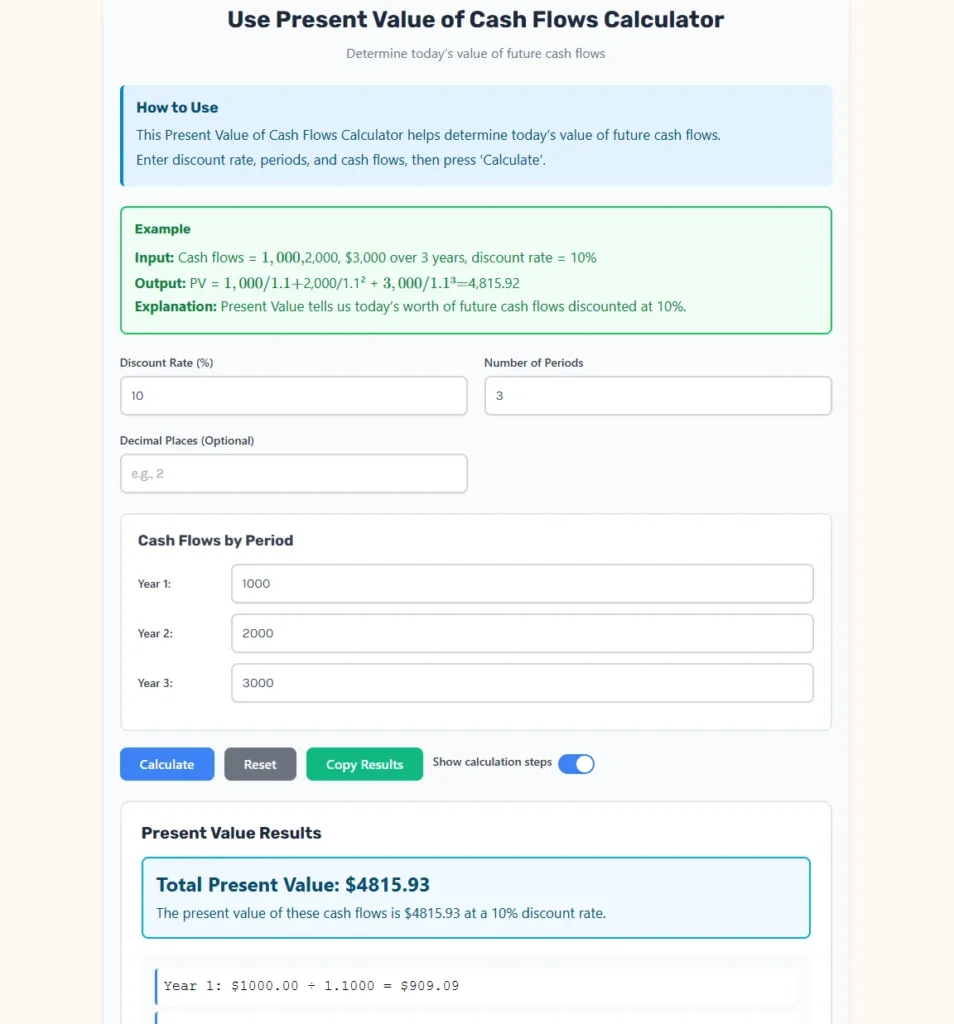
How to Use
This Present Value of Cash Flows Calculator helps determine today’s value of future cash flows.
Enter discount rate, periods, and cash flows, then press ‘Calculate’.
Example
Input: Cash flows = $1,000, $2,000, $3,000 over 3 years, discount rate = 10%
Output: PV = $1,000/1.1 + $2,000/1.1² + $3,000/1.1³ = $4,815.92
Explanation: Present Value tells us today’s worth of future cash flows discounted at 10%.
Present Value Results
Present Value of Cash Flows: Financial Mechanics, Mathematical Derivations, and Capital Allocation Strategies
The evaluation of capital investments, corporate acquisitions, real estate developments, and financial securities rests upon a single fundamental economic concept: the Time Value of Money (TVM). Present Value (PV) quantifies today’s monetary worth of a stream of cash flows expected to be received or paid in future periods.
Because purchasing power diminishes over time due to inflation, and because money available today can be deployed into yield-bearing opportunities, a dollar received in the future is intrinsically worth less than a dollar held today. The Present Value of Cash Flows Calculator converts future financial streams into a single consolidated baseline figure, enabling investors, corporate treasurers, and financial analysts to compare disparate investment options on an equivalent footing.
+-----------------------------------------------------------------------+
|                    TIME VALUE OF MONEY (TVM) FLOW                     |
|                                                                       |
|   Future Cash Flow (CF_t)  ➔   Discounting Engine   ➔   Present Value |
|      [ Received Year t ]        [ Factor: (1+r)^t ]       [ Today's $ ] |
|                                                                       |
|   Formula: PV = Sum of [ CF_t / (1 + r)^t ] over all periods t        |
+-----------------------------------------------------------------------+
Mathematical Foundations of Present Value Calculations
Discounting future monetary inflows into present values reverses the process of compound growth. Where future value compound interest projects how current capital expands over time, present value discounting determines how much principal must be invested today at a given rate to yield a specific future total.
Single Cash Flow Discounting Formula
For a single isolated cash outflow or inflow occurring at a specific future period t, the present value PV is expressed algebraically as:
PV = CFt / (1 + r)t
Where:
- PV represents the present value of the future cash flow expressed in current monetary terms.
- CFt represents the nominal cash flow magnitude expected at period t.
- r represents the periodic discount rate (expressed as a decimal fraction, where a 10% rate equals 0.10).
- t represents the specific time period in which the cash flow occurs (e.g., Year 1, Year 2, Year n).
Multiple Uneven Cash Flow Discounting Formula
In commercial projects and investment portfolios, cash inflows and outflows vary across periods. To determine the aggregate present value of an arbitrary series of uneven cash flows across n total time periods, individual discounted values are calculated for each period and summed together:
PV = ∑t=1n [ CFt / (1 + r)t ]
Expanding the summation notation into a full series yields:
PV = [ CF1 / (1 + r)1 ] + [ CF2 / (1 + r)2 ] + [ CF3 / (1 + r)3 ] + … + [ CFn / (1 + r)n ]
Discount Factor Representation
Financial modeling engines often isolate the periodic discount multiplier into a discrete metric called the Discount Factor (DF):
DFt = 1 / (1 + r)t
Substituting the discount factor into the present value equation simplifies calculation steps into linear multiplication:
PV = ∑t=1n (CFt × DFt)
PV = (CF1 × DF1) + (CF2 × DF2) + … + (CFn × DFn)
+-----------------------------------------------------------------------+
|                    DISCOUNT FACTOR DECAY PROFILE                      |
|                                                                       |
|   Discount Factor (DF) Value                                          |
|   1.0000 | ➔ Year 0 (DF = 1.0000)                                     |
|   0.9091 | ─── ➔ Year 1 at 10% (DF = 0.9091)                           |
|   0.8264 | ─────── ➔ Year 2 at 10% (DF = 0.8264)                       |
|   0.7513 | ─────────── ➔ Year 3 at 10% (DF = 0.7513)                   |
|   0.6830 | ─────────────── ➔ Year 4 at 10% (DF = 0.6830)               |
|   0.6209 | ─────────────────── ➔ Year 5 at 10% (DF = 0.6209)           |
+-----------------------------------------------------------------------+
Mechanics of the Digital Present Value Calculator Engine
Modern digital conversion engines compute complex present value models by transforming raw form inputs into validated numeric matrices and applying iterative discount loops.
                  +-----------------------------------+
                  |  PRESENT VALUE ENGINE FLOWCHART   |
                  +-----------------------------------+
                                    |
                                    v
                         +--------------------+
                         | PARSE USER INPUTS  |
                         | r (%), n, CF_1..n  |
                         +--------------------+
                                    |
                                    v
                         +--------------------+
                         | VALIDATE BOUNDS    |
                         | r > -100%, n >= 1  |
                         +--------------------+
                                    |
                                    v
                         +--------------------+
                         | ITERATIVE LOOP     |
                         | Compute DF_t & PV_t|
                         +--------------------+
                                    |
                                    v
                         +--------------------+
                         | AGGREGATE TOTAL PV |
                         | Sum all PV_t terms |
                         +--------------------+
                                    |
                                    v
                         +--------------------+
                         | FORMAT DISPLAY     |
                         | Currency & Precision|
                         +--------------------+
Algorithmic Execution Workflow
- Input Normalization Stage: Read user inputs for annual discount rate rpercentage, total periods n, and nominal cash flows CF1 through CFn. Convert percentage discount rates into decimal format: r = rpercentage / 100.
- Validation and Constraint Check: Ensure that n is a positive integer within valid system boundaries (typically 1 to 50 periods). Verify that the discount rate satisfies r > -1.0 (-100%) to prevent division-by-zero singularities.
- Iterative Vector Discounting: For each integer period index i from 1 to n:
- Extract corresponding cash flow CFi.
- Calculate exponential denominator: Denominatori = (1 + r)i.
- Determine period discount factor: DFi = 1 / Denominatori.
- Calculate present value component: PVi = CFi / Denominatori.
- Aggregate Summation Stage: Sum all period present values to form total present value: PVtotal = ∑ PVi.
- Precision Rendering Stage: Apply standard fixed-point rounding based on user-selected decimal preferences, outputting both period-by-period breakdowns and global totals.
Step-by-Step Worked Mathematical Examples
Example 1: Evaluating a Three-Year Project with Uneven Inflows
An investor considers purchasing an asset projected to yield cash flows over three years. The annual discount rate (required hurdle rate) is set at 10.00% per annum.
- Input Parameters:
- Discount Rate r = 10.00% = 0.10
- Period 1 Cash Flow (CF1) = $1,000.00
- Period 2 Cash Flow (CF2) = $2,000.00
- Period 3 Cash Flow (CF3) = $3,000.00
Step A: Calculate Period 1 Discount Factor and Present Value
- Denominator = (1 + 0.10)1 = 1.100000
- Discount Factor DF1 = 1 / 1.100000 = 0.909091
- Present Value PV1 = $1,000.00 / 1.100000 = $909.09
Step B: Calculate Period 2 Discount Factor and Present Value
- Denominator = (1 + 0.10)2 = 1.210000
- Discount Factor DF2 = 1 / 1.210000 = 0.826446
- Present Value PV2 = $2,000.00 / 1.210000 = $1,652.89
Step C: Calculate Period 3 Discount Factor and Present Value
- Denominator = (1 + 0.10)3 = 1.331000
- Discount Factor DF3 = 1 / 1.331000 = 0.751315
- Present Value PV3 = $3,000.00 / 1.331000 = $2,253.94
Step D: Aggregate Period Present Values
- Total PV = $909.09 + $1,652.89 + $2,253.94 = $4,815.92
Summary Table for Example 1:
| Period (t) | Nominal Cash Flow (CFt) | Discount Denominator (1+r)t | Discount Factor (DFt) | Present Value (PVt) |
| Year 1 | $1,000.00 | 1.100000 | 0.909091 | $909.09 |
| Year 2 | $2,000.00 | 1.210000 | 0.826446 | $1,652.89 |
| Year 3 | $3,000.00 | 1.331000 | 0.751315 | $2,253.94 |
| Total | $6,000.00 | — | — | $4,815.92 |
While the total nominal sum of cash flows is 6,000.00, discounting at 10% reveals that the true value of these cash flows today is 4,815.92.
Example 2: Commercial Real Estate Inflow Evaluation (5-Year Horizon)
A real estate firm evaluates lease cash flows from a commercial property over a five-year contract. The firm applies an 8.50% discount rate.
- Input Parameters:
- Discount Rate r = 8.50% = 0.085
- CF1 = $5,000.00
- CF2 = $7,500.00
- CF3 = $10,000.00
- CF4 = $12,500.00
- CF5 = $15,000.00
Mathematical Resolution:
- PV1 = $5,000.00 / (1.085)1 = $5,000.00 / 1.085000 = $4,608.29
- PV2 = $7,500.00 / (1.085)2 = $7,500.00 / 1.177225 = $6,370.91
- PV3 = $10,000.00 / (1.085)3 = $10,000.00 / 1.277289 = $7,829.08
- PV4 = $12,500.00 / (1.085)4 = $12,500.00 / 1.385859 = $9,019.68
- PV5 = $15,000.00 / (1.085)5 = $15,000.00 / 1.503657 = $9,975.68
Aggregated Total Present Value:
PVtotal = $4,608.29 + $6,370.91 + $7,829.08 + $9,019.68 + $9,975.68 = $37,803.64
The total nominal cash flow of 50,000.00 yields a present value of 37,803.64 when discounted at 8.50%.
Selecting and Calibrating the Discount Rate
Selecting an appropriate discount rate r is a critical input step in present value analysis. The discount rate represents the opportunity cost of capital, establishing the minimum acceptable return required to justify committing capital to a specific project.
+-----------------------------------------------------------------------+
|                   DISCOUNT RATE COMPONENT MATRIX                      |
|                                                                       |
|   Total Discount Rate (r) = Risk-Free Rate + Inflation + Risk Premium |
|                                                                       |
|   ➔ Risk-Free Rate (e.g., US Treasury Yields: Base TVM)               |
|   ➔ Expected Inflation Rate (Purchasing Power Decay Compensation)    |
|   ➔ Business & Credit Risk Premium (Asset Specific Uncertainty)       |
+-----------------------------------------------------------------------+
Key Frameworks for Setting Discount Rates
- Weighted Average Cost of Capital (WACC): Used by corporations evaluating capital expenditure projects. WACC blends the cost of equity (derived via the Capital Asset Pricing Model) and the after-tax cost of debt based on the firm’s capital structure proportions.
- Hurdle Rate: A corporate threshold rate set by investment committees to ensure projects clear internal profitability requirements, often incorporating risk adjustments for volatile markets.
- Risk-Free Benchmark plus Risk Premium: Used by individual investors and portfolio managers, combining sovereign debt yields (e.g., 10-year US Treasury bonds) with a risk premium reflecting business volatility, liquidity risk, and default risk.
Sensitivity Analysis and Discount Rate Dynamics
Because the discount rate sits in the mathematical denominator of the discounting equation, adjustments to r exert a non-linear effect on present value results.
Impact of Rate Increases:
   Higher Discount Rate (r ↑)  ➔  Larger Denominators  ➔  Lower Present Value (PV ↓)
   Lower Discount Rate (r ↓)   ➔  Smaller Denominators ➔  Higher Present Value (PV ↑)
Due to exponential compounding in (1 + r)t, cash flows occurring far in the future are significantly more sensitive to changes in discount rates than cash flows occurring in near-term periods.
Comparative Analysis of Core Valuation Metrics
Present value forms the basis for several related corporate finance and accounting metrics.
| Metric Name | Mathematical Definition | Financial Objective | Primary Decision Criteria |
| Present Value (PV) | Sum of discounted future cash inflows: ∑ [ CFt / (1 + r)t ] | Measures total current worth of future inflows | Establish baseline valuation of expected returns |
| Net Present Value (NPV) | Present value of inflows minus initial investment cost: PV – CF0 | Measures absolute net value creation | Accept project if NPV > 0 |
| Future Value (FV) | Principal compounded forward over time: PV × (1 + r)n | Measures growth of current capital over time | Evaluate terminal accumulated wealth |
| Internal Rate of Return (IRR) | Discount rate that forces NPV equal to zero: ∑ [ CFt / (1 + IRR)t ] – CF0 = 0 | Measures percentage return generated by project | Accept project if IRR > Hurdle Rate |
Industry Applications and Real-World Use Cases
                  +-----------------------------------+
                  |   PRACTICAL INDUSTRY APPLICATIONS |
                  +-----------------------------------+
                                    |
         +--------------------------+--------------------------+
         |                                                     |
         v                                                     v
+------------------+                                 +------------------+
| CAPITAL          |                                 | CORPORATE        |
| BUDGETING        |                                 | VALUATION        |
| Machine & Plant  |                                 | DCF Equity       |
| Investments      |                                 | Pricing          |
+------------------+                                 +------------------+
         |                                                     |
         v                                                     v
+------------------+                                 +------------------+
| REAL ESTATE      |                                 | BOND PRICING     |
| Commercial Lease |                                 | Fixed Coupon     |
| Income Streams   |                                 | Yield Discounting|
+------------------+                                 +------------------+
1. Capital Budgeting and Plant Expansion
Corporations utilize present value calculations when selecting between competing capital allocation projects. When deciding whether to construct a new manufacturing facility or upgrade software infrastructure, finance teams project multi-year operating cash flows, discount them using corporate WACC, and compare the resulting present values against upfront acquisition costs.
2. Corporate Equity Valuation (Discounted Cash Flow Models)
Equity research analysts evaluate corporate enterprise value using Discounted Cash Flow (DCF) models. By forecasting Unlevered Free Cash Flows (UFCF) over a 5-to-10-year projection horizon and discounting them back to the present, analysts determine intrinsic stock value independent of temporary equity market sentiment.
3. Commercial Real Estate and Property Lease Evaluation
Real estate firms evaluate commercial lease contracts containing escalation clauses, tenant improvement allowances, and rent holiday periods by discounting monthly or annual lease payments. Converting variable lease structures into present value terms allows landlords to evaluate competing tenant terms accurately.
4. Fixed Income and Bond Pricing
Fixed-income securities derive their market prices directly from present value mechanics. A bond’s fair market value equals the present value of its scheduled periodic coupon payments plus the present value of its principal face value repayment at maturity, discounted at prevailing market yield-to-maturity (YTM) rates.
5. Legal Structured Settlements and Injury Compensation
In legal litigation and insurance settlements, courts award structured compensation payments paid out over decades. Actuaries and forensic accountants compute present value figures to determine single lump-sum cash alternatives equivalent to multi-year structured annuity contracts.
User Interface and Interaction Best Practices for Financial Web Calculators
Designing financial tools requires balancing visual clarity, input responsiveness, and mathematical accuracy.
+-------------------------------------------------------------+
|              BEST PRACTICES FOR FINANCIAL UI/UX             |
|                                                             |
| ✔ Implement dynamic form fields that update based on inputs.|
| ✔ Format outputs using standard currency and decimal controls.|
| ✔ Provide clear formula visibility toggles for auditability. |
| ✔ Include explicit input validation for zero/negative bounds|
| ✔ Support copy-to-clipboard functionality for financial logs.|
+-------------------------------------------------------------+
Key Interface Features
- Dynamic Form Fields: Automatically generate or trim period cash flow input fields when the user updates the total period count parameter.
- Auditability and Step Visibility: Include an expandable calculation steps panel displaying explicit discount factors, denominators, and period present values to allow manual audit verification.
- Accessibility Controls: Implement full keyboard navigation (supporting Tab indexing, Enter key execution, and ARROW key traversal) alongside high-contrast focus states to ensure compliance with web accessibility standards.
- Copy-to-Clipboard Integration: Provide formatted text copying options, allowing users to paste results directly into spreadsheets, investment memos, or client reports.
Frequently Asked Questions (FAQ)
What is the fundamental difference between Present Value and Net Present Value?
Present Value (PV) measures the aggregate value of expected future cash inflows or outflows discounted to today’s terms. Net Present Value (NPV) subtracts the initial upfront investment cost (CF0) from the total present value: NPV = PV – CF0. While PV measures gross inflow value, NPV measures net value creation.
How does an increase in the discount rate affect Present Value?
An increase in the discount rate decreases the Present Value of future cash flows. Because the discount rate sit in the mathematical denominator, higher rates increase the discounting factor, reducing the current monetary value of future cash streams.
Why cannot cash flows from different years be added together directly?
Cash flows occurring in different time periods cannot be added together directly because they possess different purchasing power and opportunity values. Summing nominal dollars from Year 1 and Year 5 ignores interest accumulation, inflation, and risk, creating distorted financial totals. All cash flows must be converted to a common temporal baseline (present value) before addition.
Can Present Value calculations account for negative cash flows?
Yes. Present value equations process negative cash flows representing capital expenditures, maintenance outflows, or operational losses. Negative nominal cash flows yield negative present values for those specific periods, reducing the aggregate present value total accordingly.
What is the difference between nominal and real discount rates?
A nominal discount rate includes expected general price inflation alongside the real rate of return. A real discount rate removes inflation factors, discounting cash flows solely for risk and time preferences. To maintain mathematical consistency, nominal cash flows must be discounted using nominal rates, while real cash flows (adjusted for purchasing power) must be discounted using real rates.
Academic References and Authoritative Standards
- Brigham, E. F., & Ehrhardt, M. C. (2019). Corporate Finance: Linking Theory to Capital Allocation Decisions. 16th Edition. Cengage Learning.
- Damodaran, A. (2012). Investment Valuation: Tools and Techniques for Determining the Value of Any Asset. 3rd Edition. John Wiley & Sons.
- Bodie, Z., Kane, A., & Marcus, A