Run Pool Calculator
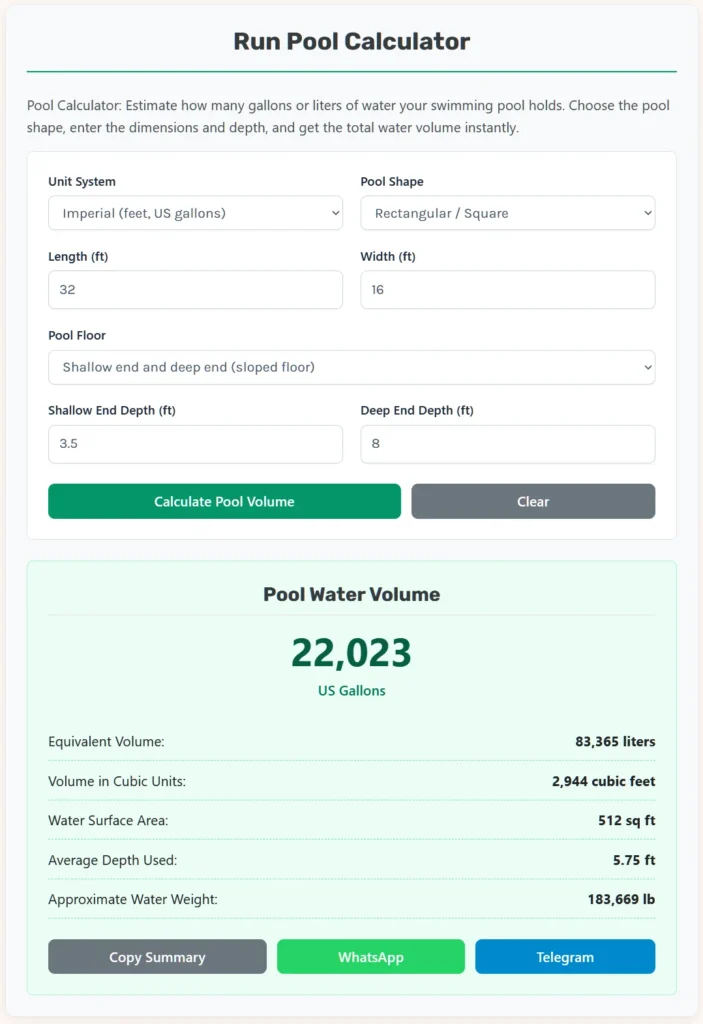
Pool Calculator: Estimate how many gallons or liters of water your swimming pool holds. Choose the pool shape, enter the dimensions and depth, and get the total water volume instantly.
Pool Volume Math Explained
How the Volume Is Calculated
The calculator finds the water surface area of the pool, multiplies it by the average water depth, and converts the cubic result into gallons or liters.
Rectangular: L × W × Depth
Round: π × (D ÷ 2)² × Depth
Oval: π × (L ÷ 2) × (W ÷ 2) × Depth
Pools With a Shallow End and a Deep End
For a sloped floor, the calculator uses the average depth: (Shallow + Deep) ÷ 2. A pool that is 3.5 ft deep at one end and 8 ft at the other has an average depth of 5.75 ft. One cubic foot holds about 7.48 US gallons, and one cubic meter holds 1,000 liters.
How Many Gallons Are in My Pool?
A pool calculator estimates how much water a swimming pool holds. You enter the shape of the pool, its length and width or diameter, and its water depth, and the calculator returns the volume in US gallons or liters.
Knowing the volume is the starting point for almost every pool maintenance task. Chemical products are dosed per 10,000 gallons or per cubic meter, pumps and filters are sized by how many gallons they must move, heaters are rated by how much water they can warm, and water companies bill you for every gallon used to fill the pool.
This pool calculator supports rectangular, square, round, and oval pools, with either a flat floor or a sloped floor that has a shallow end and a deep end. It works in imperial units (feet and US gallons) or metric units (meters and liters).
The sections below explain how the calculation works, how to measure your pool correctly, and how to use the result for chemical dosing, filling, and equipment sizing.
What Is a Pool Calculator?
A pool calculator is a volume calculator designed specifically for swimming pools, spas, and similar water containers. It converts the physical dimensions of the pool into the amount of water it holds.
The calculation itself is simple geometry: the area of the water surface multiplied by the average depth. What makes a dedicated pool calculator useful is that it handles the details automatically, including different pool shapes, sloped floors, unit conversion, and the conversion from cubic feet or cubic meters into gallons or liters.
The result is an estimate of water volume, not an exact measurement. Real pools have rounded corners, steps, benches, sloped walls, and curved transitions between the shallow and deep ends. For most maintenance purposes, a good estimate is all you need, because chemical doses are adjusted after testing the water anyway.
How Does the Pool Calculator Work?
The calculator follows three steps:
- Find the surface area: It calculates the area of the water surface based on the pool shape you select.
- Find the average depth: For a flat floor, it uses the depth you enter. For a sloped floor, it averages the shallow-end and deep-end depths.
- Convert to water volume: It multiplies area by average depth to get cubic feet or cubic meters, then converts the result into US gallons or liters.
The core formula is:
Pool Volume = Surface Area × Average Depth × Conversion Factor
The conversion factor depends on the unit system:
- Imperial: 1 cubic foot = 7.48052 US gallons
- Metric: 1 cubic meter = 1,000 liters
The calculator also shows the equivalent volume in the other unit system, the cubic volume, the surface area, the average depth used, and the approximate weight of the water.
Pool Volume Formulas by Shape
Each pool shape has its own surface area formula. Once the area is known, the volume calculation is the same for every shape.
Rectangular and Square Pools
Volume (ft³) = Length × Width × Average Depth
Gallons = Length × Width × Average Depth × 7.48052
A square pool is simply a rectangular pool with equal length and width, so the same formula applies.
Round Pools
Volume (ft³) = π × (Diameter ÷ 2)² × Average Depth
Gallons = π × (Diameter ÷ 2)² × Average Depth × 7.48052
Most above-ground pools are round, and they usually have a flat floor, so the depth is the water depth rather than the wall height.
Oval Pools
Volume (ft³) = π × (Length ÷ 2) × (Width ÷ 2) × Average Depth
Gallons = π × (Length ÷ 2) × (Width ÷ 2) × Average Depth × 7.48052
This formula treats the oval as a true ellipse. Some oval above-ground pools have straight sides with rounded ends instead. For those pools, the ellipse formula gives a slightly smaller estimate than the true volume, so you may want to treat the straight middle section as a rectangle and the two ends as one round pool.
| Pool Shape | Surface Area Formula | Inputs Needed |
|---|---|---|
| Rectangular / Square | L × W | Length, width, depth |
| Round | π × (D ÷ 2)² | Diameter, depth |
| Oval (ellipse) | π × (L ÷ 2) × (W ÷ 2) | Length, width, depth |
Why Gallons Per Cubic Foot Is 7.48
A cubic foot is a cube that measures 12 inches on each side, so it contains 12 × 12 × 12 = 1,728 cubic inches.
A US liquid gallon is defined as exactly 231 cubic inches.
1,728 ÷ 231 = 7.48052 US gallons per cubic foot
This is why pool volume formulas in the United States often include the number 7.48 or 7.5. Some quick rules of thumb round the factor to 7.5 for simplicity. The calculator uses the more precise value.
In metric units, the conversion is simpler because one cubic meter is exactly 1,000 liters.
| Unit | Equivalent |
|---|---|
| 1 cubic foot | 7.48052 US gallons |
| 1 US gallon | 3.78541 liters |
| 1 cubic meter | 1,000 liters |
| 1 cubic meter | 264.17 US gallons |
How to Calculate the Average Depth of a Pool
Depth is the measurement most likely to cause an error, because many in-ground pools are not the same depth everywhere.
Flat-Floor Pools
If the floor is level, measure from the floor to the actual water surface. Use the water level, not the height of the wall or the top of the coping. Water is normally kept partway up the skimmer opening, which is several inches below the top of the wall.
Sloped-Floor Pools
For a pool with a shallow end and a deep end, measure the water depth at both ends and average them:
Average Depth = (Shallow End Depth + Deep End Depth) ÷ 2
For example, a pool that is 3.5 feet deep at the shallow end and 8 feet deep at the deep end has an average depth of:
(3.5 + 8) ÷ 2 = 5.75 feet
Select Shallow end and deep end (sloped floor) in the calculator, and it will compute the average automatically.
Pools With a Hopper or Diving Well
Some pools have a long shallow section and a short, steep deep section. A simple two-point average assumes a constant slope, so it can overestimate the volume of these pools.
For a more accurate estimate, split the pool into sections, calculate each section with its own average depth, and add the volumes together.
Pool Volume Example: Rectangular In-Ground Pool
Suppose you have a rectangular in-ground pool that is 32 feet long and 16 feet wide, with a shallow end of 3.5 feet and a deep end of 8 feet.
Step 1: Surface area
32 × 16 = 512 square feet
Step 2: Average depth
(3.5 + 8) ÷ 2 = 5.75 feet
Step 3: Cubic volume
512 × 5.75 = 2,944 cubic feet
Step 4: Gallons
2,944 × 7.48052 ≈ 22,023 US gallons
The pool holds approximately 22,023 gallons, or about 83,365 liters.
Pool Volume Example: Round Above-Ground Pool
A round above-ground pool has a diameter of 24 feet and a water depth of 4 feet.
Step 1: Radius
24 ÷ 2 = 12 feet
Step 2: Surface area
π × 12² ≈ 452.39 square feet
Step 3: Cubic volume
452.39 × 4 ≈ 1,809.56 cubic feet
Step 4: Gallons
1,809.56 × 7.48052 ≈ 13,536 US gallons
Note that a pool with 52-inch walls does not usually hold 52 inches of water. Always use the real water depth.
Pool Volume Example: Oval Pool
An oval pool measures 30 feet long and 15 feet wide, with an average water depth of 4.5 feet.
Surface Area = π × (30 ÷ 2) × (15 ÷ 2) = π × 15 × 7.5 ≈ 353.43 square feet
Cubic Volume = 353.43 × 4.5 ≈ 1,590.43 cubic feet
Gallons = 1,590.43 × 7.48052 ≈ 11,897 US gallons
The pool holds approximately 11,897 gallons.
Pool Volume Example in Metric Units
A rectangular pool measures 10 meters by 5 meters, with a constant depth of 1.5 meters.
10 × 5 × 1.5 = 75 cubic meters
75 × 1,000 = 75,000 liters
Converted to US gallons, that is approximately 19,813 gallons.
When using metric units, enter every dimension in meters. If your measurements are in centimeters, divide them by 100 first. For example, 150 cm becomes 1.5 m.
How to Measure Your Pool Correctly
Accurate measurements produce an accurate volume. A few minutes of careful measuring can prevent large errors in chemical dosing.
- Measure the inside dimensions of the pool at the water line, not the outside of the deck or frame.
- For a rectangular pool, measure the longest length and the widest width.
- For a round pool, measure straight across the center from wall to wall to get the diameter.
- For an oval pool, measure the longest length and the widest width through the center.
- Measure depth from the floor to the water surface, not to the top of the wall.
- For sloped floors, measure the shallowest point and the deepest point.
- Use the same unit for every measurement.
- Write down each measurement before entering it into the calculator.
Converting Feet and Inches
The calculator expects decimal feet. Divide the inches by 12 and add the result to the feet.
| Feet and Inches | Decimal Feet |
|---|---|
| 4 ft 0 in | 4.00 |
| 4 ft 3 in | 4.25 |
| 4 ft 6 in | 4.50 |
| 4 ft 9 in | 4.75 |
| 5 ft 6 in | 5.50 |
A common mistake is entering 4 feet 6 inches as 4.6. The correct value is 4.5, because 6 inches is half a foot.
Why Pool Volume Matters for Chemical Dosing
Pool chemical labels usually state a dose per 10,000 gallons, per 1,000 gallons, or per cubic meter of water. Without knowing your pool volume, you cannot apply those instructions correctly.
To scale a label dose to your pool, divide your pool volume by the label volume and multiply by the label dose:
Dose for Your Pool = Label Dose × (Your Pool Gallons ÷ Label Gallons)
For example, if a product label gives a dose for 10,000 gallons and your pool holds 22,000 gallons, multiply the label dose by 2.2.
Underestimating the volume can cause underdosing, which may leave the water inadequately sanitized. Overestimating the volume can cause overdosing, which wastes product and can irritate skin and eyes.
The Centers for Disease Control and Prevention (CDC) advises residential pool owners to test chlorine and pH regularly and recommends keeping pool pH between 7.0 and 7.8. Volume tells you how much product to add; water testing tells you whether the dose was right.
Always follow the manufacturer’s label directions, add chemicals in the order and manner the label specifies, and retest the water after treatment.
How Long Does It Take to Fill a Pool?
Once you know the volume, you can estimate how long it will take to fill the pool:
Fill Time (minutes) = Pool Gallons ÷ Flow Rate (gallons per minute)
For example, if your hose delivers 10 gallons per minute and your pool holds 22,023 gallons:
22,023 ÷ 10 ≈ 2,202 minutes ≈ 36.7 hours
Garden hose flow varies widely with water pressure, hose diameter, and hose length. To measure your actual flow rate, time how long it takes to fill a bucket of known size, then divide the bucket volume by the time in minutes.
Using Pool Volume to Size a Pump and Filter
Pumps and filters are often selected based on turnover time, which is the time needed to circulate the entire volume of the pool through the filter once.
Required Flow Rate (GPM) = Pool Gallons ÷ (Turnover Hours × 60)
For a 22,023-gallon pool with an 8-hour turnover target:
22,023 ÷ (8 × 60) ≈ 45.9 gallons per minute
Turnover targets differ by pool type and local regulations. Commercial and public pools are often subject to specific code requirements, while residential pool owners typically follow equipment manufacturer guidance.
How Much Does Pool Water Weigh?
Water is heavy. One US gallon of water weighs about 8.34 pounds, and one liter of water weighs about 1 kilogram.
Water Weight (lb) = Pool Gallons × 8.34
A 22,023-gallon pool contains roughly 183,669 pounds of water, or about 92 US tons. This is why above-ground pools need a level, compacted base, and why decks and rooftop pools require structural engineering.
The calculator displays the approximate water weight for reference. It is an estimate based on fresh water at typical temperatures.
Quick Pool Volume Reference Tables
Rectangular Pools
| Pool Size (ft) | Average Depth (ft) | Approximate Gallons |
|---|---|---|
| 12 × 24 | 4.5 | 9,695 |
| 15 × 30 | 5 | 16,831 |
| 16 × 32 | 5 | 19,150 |
| 16 × 32 | 5.5 | 21,065 |
| 18 × 36 | 5.5 | 26,661 |
| 20 × 40 | 5.5 | 32,914 |
Round Pools at 4 Feet of Water
| Diameter (ft) | Approximate Gallons | Approximate Liters |
|---|---|---|
| 12 | 3,384 | 12,810 |
| 15 | 5,288 | 20,016 |
| 18 | 7,614 | 28,823 |
| 21 | 10,364 | 39,231 |
| 24 | 13,536 | 51,241 |
These values are calculated with the formulas above. Your actual pool may hold slightly more or less water because of steps, rounded corners, and the exact water level.
Common Pool Volume Calculation Mistakes
Using Wall Height Instead of Water Depth
Pools are never filled to the very top of the wall. Using the wall height overestimates the volume.
Entering Inches as Decimal Feet
Entering 4 feet 6 inches as 4.6 instead of 4.5 adds an error to every result. Convert inches by dividing by 12.
Confusing Diameter and Radius
The calculator asks for the diameter of a round pool, which is the full distance across. Entering the radius would make the result four times too small.
Using Outside Dimensions
Measurements taken from the outside of a frame or deck include material that does not hold water. Measure the inside of the pool.
Ignoring the Slope of the Floor
Using only the deep-end depth for a sloped pool can overestimate the volume significantly. Use the average depth.
Mixing Units
Entering length in feet and depth in meters, or width in inches and length in feet, produces meaningless results. Keep every measurement in the same unit.
Confusing US and Imperial Gallons
An imperial gallon used in the United Kingdom is larger than a US gallon. This calculator reports US gallons. If a product label uses imperial gallons or liters, convert accordingly.
Irregular and Freeform Pools
Kidney-shaped, L-shaped, and freeform pools do not fit a single geometric formula. The most reliable approach is to divide the pool into simpler shapes.
- Sketch the pool from above.
- Divide it into rectangles, circles, and ovals that approximate the outline.
- Measure each section and its average depth.
- Calculate the volume of each section separately.
- Add the section volumes together.
For example, an L-shaped pool can be treated as two rectangles. Calculate each rectangle with the pool calculator and add the two results.
If precision matters, such as when a professional needs an exact figure, a water meter reading during filling gives a direct measurement of how much water the pool actually holds.
Pool Calculator for Hot Tubs and Spas
The same geometry applies to hot tubs and spas. A round hot tub can be calculated with the round formula, and a square hot tub with the rectangular formula.
However, molded seats and footwells displace a significant share of the water in a spa, so the geometric result is an upper estimate. The manufacturer’s stated capacity is usually more accurate for spas.
How Accurate Is a Pool Volume Calculator?
A pool calculator is as accurate as the measurements and assumptions behind it. For simple rectangular and round pools with level floors, the result can be very close to the true volume. For pools with complex shapes or steep hoppers, the estimate may differ more.
The main sources of difference are:
- Rounded corners and curved wall-to-floor transitions
- Steps, benches, and swim-outs
- Non-linear floor slopes
- The actual water level compared with the measured depth
- Measurement errors
Because a percentage error in any dimension produces the same percentage error in volume, a 10% error in depth produces a 10% error in gallons. Careful depth measurement is especially important.
Frequently Asked Questions About Pool Calculators
How do I calculate how many gallons are in my pool?
Multiply the surface area of the pool by its average depth to get cubic feet, then multiply by 7.48052. For a rectangular pool: Length × Width × Average Depth × 7.48052 = gallons.
How many gallons are in a 24-foot round pool?
At a water depth of 4 feet, a 24-foot round pool holds approximately 13,536 US gallons. A deeper water level increases the volume proportionally.
How many gallons are in a 16 × 32 pool?
At an average depth of 5 feet, a 16 × 32 foot rectangular pool holds approximately 19,150 US gallons. At 5.5 feet, it holds about 21,065 gallons.
How do I find the average depth of my pool?
Add the shallow-end depth and the deep-end depth, then divide by two. A pool that is 3.5 feet and 8 feet deep has an average depth of 5.75 feet.
How many gallons are in a cubic foot?
One cubic foot holds approximately 7.48 US gallons. The exact factor is 7.48052, because a cubic foot is 1,728 cubic inches and a US gallon is 231 cubic inches.
How do I calculate pool volume in liters?
Measure the pool in meters, multiply the surface area by the average depth to get cubic meters, and multiply by 1,000. For example, 10 × 5 × 1.5 = 75 cubic meters, or 75,000 liters.
Can I use this calculator for an above-ground pool?
Yes. Select the round or oval shape, enter the diameter or dimensions, and use the actual water depth rather than the wall height.
Does the calculator work for kidney-shaped pools?
Not directly. Divide a kidney-shaped or freeform pool into simpler shapes, calculate each section, and add the results.
Why does my pool volume matter for chemicals?
Chemical labels give doses per a specific volume of water, such as per 10,000 gallons. Knowing your pool volume lets you scale the label dose correctly and avoid underdosing or overdosing.
How much does the water in my pool weigh?
Multiply the number of US gallons by about 8.34 pounds. A 20,000-gallon pool contains roughly 166,800 pounds of water.
Is the result exact?
No. The calculator gives an estimate based on standard geometric shapes. Steps, rounded corners, and uneven floors cause the real volume to differ somewhat from the estimate.
Does the calculator use US gallons or imperial gallons?
The calculator reports US gallons in imperial mode and liters in metric mode. An imperial gallon is about 20% larger than a US gallon.
What the Pool Calculator Does Not Determine
The pool calculator estimates water volume. It does not:
- Calculate chemical doses for specific products
- Measure or predict sanitizer, pH, or alkalinity levels
- Account for water displaced by steps, benches, or equipment
- Measure evaporation or water loss
- Replace manufacturer specifications or professional assessment
Use the volume as the foundation for these tasks, and combine it with product labels, water testing, and equipment documentation.
Best Practices for Using a Pool Calculator
- Measure the inside dimensions at the water line.
- Use the actual water depth, not the wall height.
- Use the sloped-floor option when the pool has a shallow end and a deep end.
- Convert inches to decimal feet before entering them.
- Record your pool volume and keep it with your maintenance notes.
- Recalculate if you change the water level significantly or renovate the pool.
- Always test the water after adding chemicals.
Scientific Basis and Reliable Sources
The calculator uses standard geometric area formulas and exact unit definitions. A US gallon is defined as 231 cubic inches, which produces the factor of 7.48052 gallons per cubic foot, and a cubic meter is defined as 1,000 liters.
Centers for Disease Control and Prevention — Home Pool and Hot Tub Water Treatment and Testing
The CDC provides guidance for residential pool owners on testing chlorine and pH levels to help protect swimmers from recreational water illnesses.
Final Pool Volume Checklist
Before relying on your pool volume for chemicals, filling, or equipment, confirm the following:
- The pool shape matches the shape selected in the calculator.
- All dimensions are inside measurements.
- Depth reflects the actual water level.
- Sloped floors use the average of the shallow and deep ends.
- All measurements use the same unit.
- Inches have been converted to decimal feet.
With accurate inputs, the pool calculator gives you a reliable volume estimate in seconds, so you can maintain your pool with confidence.