Run Cat Age Calculator
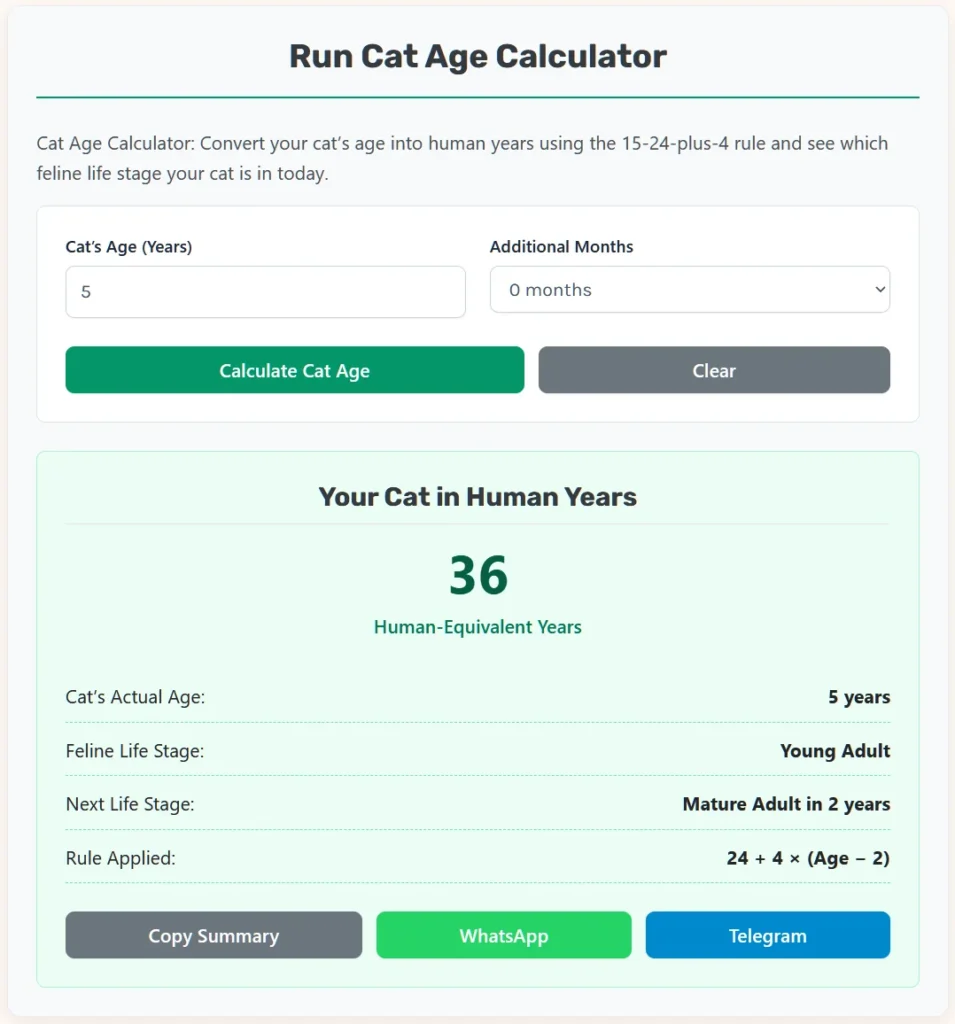
Cat Age Calculator: Convert your cat’s age into human years using the 15-24-plus-4 rule and see which feline life stage your cat is in today.
Cat Age Math Explained
The 15-24-Plus-4 Rule
Cats mature very quickly. The first year of a cat’s life is roughly equal to 15 human years, the second year adds about 9 more (24 in total), and every year after that adds about 4 human years.
Age ≤ 1: 15 × Age
1 < Age ≤ 2: 15 + 9 × (Age − 1)
Age > 2: 24 + 4 × (Age − 2)
Feline Life Stages
Kitten: birth to 1 year. Young adult: 1 to 6 years. Mature adult: 7 to 10 years. Senior: 10 years and older. These stages help you plan age-appropriate veterinary care.
How Old Is My Cat in Human Years?
A cat age calculator converts your cat’s age in calendar years into an approximate “human-equivalent” age. It answers a question almost every cat owner asks: if my cat were a person, how old would they be?
The popular idea that one cat year equals seven human years is a myth. Cats grow up much faster than that at the start of life and then age more slowly. A one-year-old cat is already physically similar to a teenager, and a two-year-old cat is comparable to a young adult in their mid-twenties.
This calculator uses the widely used 15-24-plus-4 conversion and also shows your cat’s life stage based on the feline life stage framework used by veterinarians: kitten, young adult, mature adult, and senior.
Below you will find the formula, a complete cat-to-human age chart, worked examples, and practical guidance on what each life stage means for your cat’s care.
What Is a Cat Age Calculator?
A cat age calculator is a simple conversion tool. You enter how long your cat has been alive, in years and months, and it returns an equivalent human age plus the life stage your cat belongs to.
The human-equivalent age is not a medical measurement. It is a way of describing your cat’s physical and behavioral maturity in terms people intuitively understand. Saying a 12-year-old cat is “about 64 in human years” immediately communicates that the cat is entering its senior years.
The life stage, on the other hand, is directly useful. Veterinary care, nutrition, and screening recommendations change as a cat moves from kitten to young adult, to mature adult, and finally to senior.
How Does the Cat Age Calculator Work?
The calculator follows four steps:
- Convert to decimal years: It adds the extra months to the years, so 2 years and 6 months becomes 2.5 years.
- Choose the correct rule: It checks whether the cat is in its first year, its second year, or older than two.
- Apply the formula: It calculates the human-equivalent age for that age range.
- Assign the life stage: It compares the age with the feline life stage boundaries and reports the current stage and the next one.
The formula has three parts because cats age at three different speeds:
Age ≤ 1 year: Human Years = 15 × Age
1 year < Age ≤ 2 years: Human Years = 15 + 9 × (Age − 1)
Age > 2 years: Human Years = 24 + 4 × (Age − 2)
These three pieces connect smoothly: a cat is 15 at exactly one year and 24 at exactly two years, whichever formula you use at the boundary.
Why the “7 Cat Years” Rule Is Wrong
The seven-year rule assumes that cats age at the same rate throughout life. In reality, the first two years are a period of extremely rapid development.
- By about 6 months, many cats are capable of reproducing.
- By 12 months, most cats are close to their adult size.
- By 24 months, cats are socially and physically mature adults.
Under the seven-year rule, a one-year-old cat would be “7”, which badly underestimates its maturity. Under the same rule, a 15-year-old cat would be “105”, which overstates how old most healthy 15-year-old cats behave. The 15-24-plus-4 rule matches real feline development far better at both ends of life.
The Feline Life Stages
Veterinary organizations group a cat’s life into four age-related stages, plus an end-of-life stage that can occur at any age. The calculator uses the four age-related stages:
| Life Stage | Cat Age | Human-Equivalent Age |
|---|---|---|
| Kitten | Birth to 1 year | 0 to 15 |
| Young Adult | 1 to 6 years | 15 to 40 |
| Mature Adult | 7 to 10 years | 44 to 56 |
| Senior | 10 years and older | 56 and older |
The American Association of Feline Practitioners (AAFP) describes these stages in the 2021 AAHA/AAFP Feline Life Stage Guidelines, which veterinarians use to plan age-appropriate preventive care.
Note that the stages overlap slightly at their edges. A cat that has just turned 10 sits at the boundary between mature adult and senior. The calculator classifies a cat as senior from its tenth birthday onward.
Cat Years to Human Years Chart
The following chart is calculated with the same formula the calculator uses:
| Cat Age | Human Years | Life Stage |
|---|---|---|
| 3 months | 3.75 | Kitten |
| 6 months | 7.5 | Kitten |
| 9 months | 11.25 | Kitten |
| 1 year | 15 | Young Adult |
| 18 months | 19.5 | Young Adult |
| 2 years | 24 | Young Adult |
| 3 years | 28 | Young Adult |
| 4 years | 32 | Young Adult |
| 5 years | 36 | Young Adult |
| 6 years | 40 | Young Adult |
| 7 years | 44 | Mature Adult |
| 8 years | 48 | Mature Adult |
| 9 years | 52 | Mature Adult |
| 10 years | 56 | Senior |
| 11 years | 60 | Senior |
| 12 years | 64 | Senior |
| 13 years | 68 | Senior |
| 14 years | 72 | Senior |
| 15 years | 76 | Senior |
| 16 years | 80 | Senior |
| 18 years | 88 | Senior |
| 20 years | 96 | Senior |
Charts published by different organizations can differ by a year or two, especially for the first year of life. The general pattern, however, is consistent: fast aging early, then about four human years per cat year.
Cat Age Example: A 5-Year-Old Cat
Suppose your cat is exactly 5 years old.
Step 1: Check the age range
5 years is older than 2, so the third rule applies.
Step 2: Apply the formula
Human Years = 24 + 4 × (5 − 2)
Human Years = 24 + 4 × 3 = 24 + 12 = 36
Step 3: Find the life stage
A 5-year-old cat is a young adult. It will move into the mature adult stage at 7 years, which is 2 years away.
Your 5-year-old cat is roughly comparable to a 36-year-old person.
Cat Age Example: An 8-Month-Old Kitten
For an 8-month-old kitten, enter 0 years and 8 months.
Age = 0 + 8 ÷ 12 ≈ 0.667 years
Human Years = 15 × 0.667 ≈ 10
An 8-month-old kitten is roughly equivalent to a 10-year-old child in development terms, although many kittens are already sexually mature at this point, which is one reason veterinarians discuss spaying and neutering early.
The kitten will become a young adult at 12 months, which is 4 months away.
Cat Age Example: A 14-Year-Old Senior Cat
Human Years = 24 + 4 × (14 − 2) = 24 + 48 = 72
A 14-year-old cat is about 72 in human years and firmly in the senior life stage. Senior cats benefit from more frequent check-ups, because many age-related conditions develop gradually and are easier to manage when found early.
How to Calculate Your Cat’s Age Manually
You do not need a calculator to estimate your cat’s human age. Use this shortcut:
- If your cat is 2 or older, subtract 2 from its age.
- Multiply the result by 4.
- Add 24.
For example, for a 9-year-old cat: (9 − 2) × 4 + 24 = 28 + 24 = 52.
For a cat younger than one year, multiply its age in years by 15. Six months is 0.5 years, so 0.5 × 15 = 7.5. For a cat between one and two years old, use 15 + 9 × (Age − 1).
What If I Don’t Know My Cat’s Exact Age?
Many adopted and rescued cats arrive without a birth date. In that case, a veterinarian can estimate the age from physical signs. Common clues include:
- Teeth: Kittens get adult teeth at around 4 to 6 months. Tartar buildup and wear increase with age.
- Eyes: Older cats may develop a slight cloudiness of the lens.
- Coat: Senior cats may have coarser fur or some gray hairs.
- Muscle and body shape: Older cats often lose muscle mass along the spine and hips.
- Activity: Very young cats are typically more playful and energetic.
An estimate such as “around 3 years” is enough for the calculator. Enter the best estimate and treat the result as approximate.
Why Knowing Your Cat’s Life Stage Matters
The human-age number is fun, but the life stage is what guides practical care decisions.
Kitten (Birth to 1 Year)
Kittens need a vaccination schedule, parasite control, socialization, and food formulated for growth. This is also the stage when spaying or neutering is usually discussed.
Young Adult (1 to 6 Years)
Young adult cats are typically at their healthiest. Annual wellness visits, dental care, weight monitoring, and environmental enrichment are the main priorities.
Mature Adult (7 to 10 Years)
Mature adults may start to show subtle changes in weight, activity, and dental health. Many veterinarians begin baseline screening tests during this stage so that future changes can be compared against a healthy reference.
Senior (10 Years and Older)
Senior cats are more likely to develop chronic conditions. Veterinarians commonly recommend more frequent examinations, closer attention to weight and appetite, and adjustments to the home environment, such as easier access to litter boxes and resting places.
Do Indoor and Outdoor Cats Age Differently?
The conversion formula is the same for every cat. A 10-year-old indoor cat and a 10-year-old outdoor cat are both about 56 in human years.
What differs is life expectancy and risk. Outdoor cats face more hazards, including traffic, fights, predators, and infectious disease. Indoor cats often live longer, which means more of them reach the senior stage. The calculator describes age, not expected lifespan.
Do Cat Breeds Age Differently?
Unlike dogs, domestic cats vary relatively little in body size, so a single conversion formula works reasonably well across breeds. Some breeds have breed-specific health tendencies, and individual cats age at different rates depending on genetics, nutrition, weight, and health history.
Use the calculator’s result as a general guide. Your veterinarian can tell you how your individual cat is aging.
Common Mistakes When Converting Cat Age
Using the 7-Year Rule
Multiplying by 7 underestimates young cats and overestimates old cats. Use the 15-24-plus-4 rule instead.
Entering Months as Decimal Years
Two years and 6 months is 2.5 years, not 2.6 years. The calculator avoids this mistake by asking for months separately.
Confusing Human Years With Life Stage
A cat that is “56 in human years” is a senior cat, even though 56 may not feel old for a person. Life stage is based on cat age, not on the human-equivalent number.
Treating the Result as a Health Assessment
Two cats of the same age can be in very different health. The calculator does not measure health, body condition, or life expectancy.
Quick Reference: Cat Age Conversion
| Rule | Formula | Example |
|---|---|---|
| First year | 15 × Age | 6 months → 7.5 |
| Second year | 15 + 9 × (Age − 1) | 18 months → 19.5 |
| After two years | 24 + 4 × (Age − 2) | 10 years → 56 |
Frequently Asked Questions About Cat Age
How do I calculate my cat’s age in human years?
For cats older than two, subtract 2 from the cat’s age, multiply by 4, and add 24. For a kitten under one year, multiply its age in years by 15. Between one and two years, use 15 + 9 × (Age − 1).
How old is a 1-year-old cat in human years?
A 1-year-old cat is about 15 in human years. Cats reach near-adult size and sexual maturity during their first year.
How old is a 10-year-old cat in human years?
A 10-year-old cat is about 56 in human years and is considered a senior cat.
How old is a 15-year-old cat in human years?
A 15-year-old cat is about 76 in human years.
Is one cat year equal to seven human years?
No. The seven-year rule is a myth. Cats age much faster during their first two years and then add about four human years per calendar year.
When is a cat considered a senior?
In the current feline life stage framework, cats are considered seniors from 10 years of age onward.
What are the feline life stages?
Kitten (birth to 1 year), young adult (1 to 6 years), mature adult (7 to 10 years), and senior (10 years and older). An end-of-life stage can occur at any age.
How old is a 6-month-old kitten in human years?
A 6-month-old kitten is about 7.5 in human years using the first-year rule of 15 × Age.
Can I use this calculator if I only know my cat’s approximate age?
Yes. Enter your best estimate. The result will be approximate, just like the age you entered.
Does the calculator predict how long my cat will live?
No. It converts age and identifies life stage. Lifespan depends on genetics, environment, health care, and many other factors.
What the Cat Age Calculator Does Not Determine
- Your cat’s health status or body condition
- Your cat’s life expectancy
- Nutritional requirements or portion sizes
- Medical screening schedules for your individual cat
- The age of a cat whose birth date is unknown
Use the life stage as a conversation starter with your veterinarian rather than as a medical conclusion.
Scientific Basis and Reliable Sources
The calculator uses the commonly cited feline age conversion in which a cat reaches about 15 human years at age one, about 24 at age two, and adds roughly four human years for each additional year. Life stages follow the 2021 AAHA/AAFP Feline Life Stage Guidelines.
American Association of Feline Practitioners — Updated Feline Life Stage Guidelines
The AAFP and AAHA describe the four age-related feline life stages (kitten, young adult, mature adult, senior) and the end-of-life stage used in veterinary preventive care planning.
Final Cat Age Checklist
- Enter whole years in the years box and the remainder in the months box.
- Use 0 years for kittens under one year old.
- Remember that the result is an approximation, not a health assessment.
- Use the life stage to plan age-appropriate care with your veterinarian.
- Recalculate on your cat’s birthday to follow its progress through the life stages.
With the cat age calculator, you can understand your cat’s age in familiar terms and plan the right care for every stage of its life.