Play Kakuro Math Puzzle
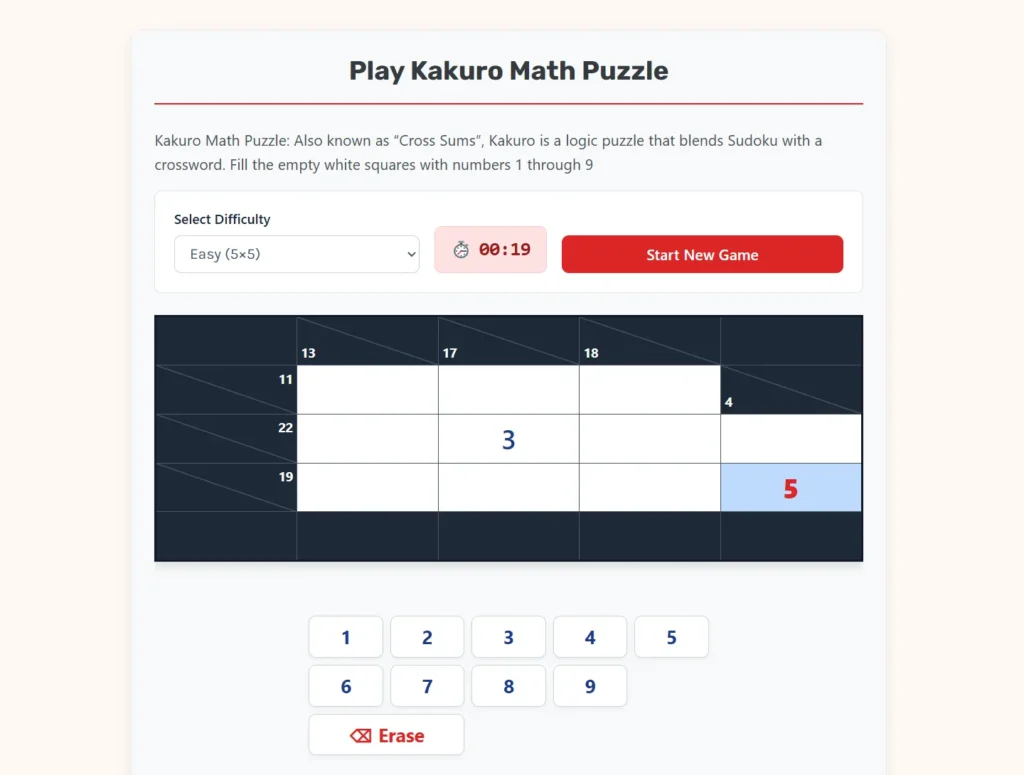
Kakuro Math Puzzle: Also known as “Cross Sums”, Kakuro is a logic puzzle that blends Sudoku with a crossword. Fill the empty white squares with numbers 1 through 9
How to Play
The Rules of Kakuro
- Fill all empty white squares with numbers from 1 to 9.
- The number in the top right of a black square is the horizontal sum (the sum of the white squares directly to its right).
- The number in the bottom left of a black square is the vertical sum (the sum of the white squares directly below it).
- CRITICAL RULE: You cannot use the same number more than once in a single run! (For example, to get a sum of 4 in 2 squares, you must use 1 and 3. You cannot use 2 and 2).
Controls
Desktop Users: Click a white cell to select it, then type a number on your keyboard. Use the Arrow Keys to seamlessly jump between white squares!
Mobile Users: Tap a white cell to select it, then use the onscreen keypad below the board to place a number.
⚠️ Error Warning: If you type a duplicate number in a line, or if a line is full but the sum is mathematically incorrect, the numbers will turn red to warn you!
Understanding Kakuro: Definition, History, and Mathematical Logic
Kakuro, historically published under the title Cross Sums, is a discrete numerical logic puzzle that combines the structural framework of a crossword puzzle with the arithmetic constraints of restricted integer combinations. Instead of verbal clues pointing to linguistic terms, Kakuro utilizes numerical clues situated within partitioned diagonal cells. These numerical clues dictate the exact sum that must be achieved by a contiguous line of unshaded playable cells directly to the right or directly below the clue cell.
Originating in North America during the mid-twentieth century, the puzzle was created by Jacob E. Funk and published by Dell Magazines in 1950 under the name Cross Sums. The game experienced widespread international adoption after being introduced to Japan in the 1980s by Maki Kaji, the founder of the puzzle publisher Nikoli. Nikoli renamed the puzzle Kakuro, an abbreviated form of the Japanese phrase Kakkuru Krossu (meaning “addition cross”). Today, Kakuro is recognized globally alongside Sudoku and Nonograms as a premier constraint-satisfaction puzzle.
+-------------------------------------------------------------+
|                      KAKURO GRID SCHEMATIC                  |
|                                                             |
|   [ Black / Clue ]    [ White Cell ]     [ White Cell ]     |
|   [  \ 4 (Vert)  ] ➔  [   Digit    ]  +  [   Digit    ] = 4 |
|   [ 3 \  (Horiz) ] ➔  [   Digit    ]  +  [   Digit    ] = 3 |
+-------------------------------------------------------------+
The underlying principle of Kakuro relies entirely on deterministic arithmetic deduction. Every numerical clue represents a fixed target sum S that must be formed by adding together a specified number of positive integers k, corresponding to the number of playable cells in that continuous run. The fundamental rule governing all valid Kakuro puzzles is that no single digit may be repeated within any given sum run. Solvers must systematically analyze intersecting horizontal and vertical runs to deduce the precise placement of digits from the allowed set Sdigits = {1, 2, 3, 4, 5, 6, 7, 8, 9}.
The Combinatorial Mathematics of Kakuro
The resolution of Kakuro puzzles is grounded in partition theory, subset summation constraints, and arithmetic interval limits. Analyzing the mathematical parameters of a line allows solvers to eliminate non-viable combinations before entering a single number onto the grid.
Restricted Integer Partitions and Digit Sets
In number theory, an integer partition of a positive integer n is a way of expressing n as a sum of positive integers. Kakuro imposes two strict operational constraints on standard integer partitions:
- The set of allowed summands is strictly bounded by the single-digit domain {1, 2, 3, 4, 5, 6, 7, 8, 9}.
- All summands within a given partition must be distinct (strict partitions without repetition).
For a target sum S and a run length of k cells, the number of valid partition sets is denoted as P(S, k, 9), representing the restricted partitions of S into exactly k distinct parts with no part exceeding 9.
Extremal Bounds Formulas
For any run of length k, there exist strict theoretical limits regarding the minimum and maximum achievable sums. These extremal bounds dictate whether a given clue is mathematically solvable.
The absolute minimum sum Smin for a run length k is achieved by summing the smallest k distinct positive integers:
Smin(k) = ∑i=1k i = k(k + 1) / 2
The absolute maximum sum Smax for a run length k is achieved by summing the largest k distinct single digits:
Smax(k) = ∑i=0k-1 (9 – i) = k(19 – k) / 2
Any clue value S falling outside the closed interval [Smin(k), Smax(k)] is mathematically impossible and represents an invalid puzzle state.
Unique Partition Sets (Magic Combinations)
Certain combinations of clue sums S and run lengths k yield exactly one unique set of digits. These configurations, referred to by expert solvers as “Magic Combinations” or “Unique Partitions,” provide instant deductive anchors across the grid.
| Run Length (k) | Target Sum (S) | Unique Digit Partition Set | Structural Classification |
| 2 Cells | 3 | {1, 2} | Minimum Extremal Bound |
| 2 Cells | 4 | {1, 3} | Forced Odd Partition |
| 2 Cells | 16 | {7, 9} | Forced High Partition |
| 2 Cells | 17 | {8, 9} | Maximum Extremal Bound |
| 3 Cells | 6 | {1, 2, 3} | Minimum Extremal Bound |
| 3 Cells | 7 | {1, 2, 4} | Forced Low Partition |
| 3 Cells | 23 | {6, 8, 9} | Forced High Partition |
| 3 Cells | 24 | {7, 8, 9} | Maximum Extremal Bound |
| 4 Cells | 10 | {1, 2, 3, 4} | Minimum Extremal Bound |
| 4 Cells | 29 | {5, 7, 8, 9} | Forced High Partition |
| 4 Cells | 30 | {6, 7, 8, 9} | Maximum Extremal Bound |
| 5 Cells | 15 | {1, 2, 3, 4, 5} | Minimum Extremal Bound |
| 5 Cells | 35 | {5, 6, 7, 8, 9} | Maximum Extremal Bound |
| 6 Cells | 21 | {1, 2, 3, 4, 5, 6} | Minimum Extremal Bound |
| 6 Cells | 39 | {4, 5, 6, 7, 8, 9} | Maximum Extremal Bound |
| 7 Cells | 28 | {1, 2, 3, 4, 5, 6, 7} | Minimum Extremal Bound |
| 7 Cells | 42 | {3, 4, 5, 6, 7, 8, 9} | Maximum Extremal Bound |
| 8 Cells | 36 | {1, 2, 3, 4, 5, 6, 7, 8} | Minimum Extremal Bound |
| 8 Cells | 44 | {2, 3, 4, 5, 6, 7, 8, 9} | Maximum Extremal Bound |
| 9 Cells | 45 | {1, 2, 3, 4, 5, 6, 7, 8, 9} | Invariant Complete Set |
How Digital Kakuro Engines and Solvers Function
Online Kakuro applications translate discrete mathematical constraints into interactive, responsive visual environments. The underlying software engine relies on multi-stage algorithmic processing, matrix generation, structural permutation, and constraint propagation.
Grid Matrix Architecture
The core grid is modeled internally as a two-dimensional matrix M of dimensions R × C. Each element Mr, c stores a structured state object containing cell classification, clue values, user input, and validation flags:
Mr, c = { Type: BlockType, HClue: Integer, VClue: Integer, Value: Integer, Error: Boolean }
Where:
- Type ∈ { BlackClue, WhitePlayable }
- HClue represents the horizontal sum target (if applicable to a black cell)
- VClue represents the vertical sum target (if applicable to a black cell)
- Value ∈ {0, 1, 2, 3, 4, 5, 6, 7, 8, 9} (where 0 indicates an empty cell)
Matrix Coordinate Mapping:
M[0,0] = BlackClue (Solid)     M[0,1] = BlackClue (VClue: 4)    M[0,2] = BlackClue (VClue: 3)
M[1,0] = BlackClue (HClue: 3)  M[1,1] = WhitePlayable (Val: 1)  M[1,2] = WhitePlayable (Val: 2)
M[2,0] = BlackClue (HClue: 4)  M[2,1] = WhitePlayable (Val: 3)  M[2,2] = WhitePlayable (Val: 1)
Isomorphic Permutation Engine
To ensure an infinite variety of valid puzzles while guaranteeing logical solubility, modern engines utilize handcrafted topological templates paired with bijective digit permutations.
Given a structurally valid solution matrix S, the engine applies a randomized permutation function π: {1, …, 9} → {1, …, 9} generated via the Fisher-Yates shuffle algorithm. The transformation creates a new solution matrix S’ where:
S’r, c = π(Sr, c)
Because π is a bijective mapping, digit uniqueness within every row and column run is strictly preserved. Once the transformed matrix S’ is generated, the engine dynamically recalculates all horizontal and vertical sum clues HClue and VClue by summing the continuous segments of S’. This process yields fresh, fully playable puzzles with guaranteed single-solution validity.
Run Extraction and Real-Time Validation Algorithms
During gameplay, every user action triggers an evaluation sequence across all active runs containing the modified cell. A run object R consists of a target sum T and an ordered array of playable cell references Cells = [c1, c2, …, ck].
The validation algorithm executes three sequential verification tests for each run:
- Duplicate Inspection:Using a boolean array or bitmask, the engine checks whether any digit d > 0 appears more than once within Cells. If a duplicate is detected, all cells containing that digit are flagged with a visual error state.
- Partial Sum Bound Inspection:The engine computes the sum of all currently filled cells within the run, denoted as Sumcurrent. If Sumcurrent ≥ T while one or more cells in the run remain empty (value 0), the run is marked invalid because positive single digits cannot decrease the total.
- Complete Run Equity Inspection:When all k cells in run R contain non-zero digits, the engine verifies exact equality:∑i=1k Value(ci) = T
If this condition evaluates to true across all horizontal and vertical runs on the board, the win state is triggered.
Step-by-Step Guide to Solving Kakuro Puzzles
Solving Kakuro efficiently requires a structured approach that moves from immediate combinatorial deductions to advanced cross-referencing techniques.
+-----------------------------------------------------------------------+
|                       SOLVING STRATEGY ROADMAP                        |
|                                                                       |
| ➔ STEP 1: Scan for Magic Combinations (Unique Partitions).            |
| ➔ STEP 2: Analyze perpendicular intersections of constrained runs.    |
| ➔ STEP 3: Apply min/max threshold elimination on partial sums.         |
| ➔ STEP 4: Utilize shared candidate exclusion across adjacent lines.   |
| ➔ STEP 5: Apply parity constraints and regional grid conservation.    |
+-----------------------------------------------------------------------+
Fundamental Solving Techniques
1. Unique Partition Mapping
Begin by identifying all runs on the board that have only one possible digit set. For instance, a 2-cell run summing to 3 must consist of {1, 2}, while a 2-cell run summing to 17 must consist of {8, 9}. Pencil in these candidate sets immediately.
2. Cross-Referencing Intersections
The most common method for isolating exact digits involves intersecting two runs with distinct candidate sets. If a horizontal 2-cell run summing to 3 ({1, 2}) intersects a vertical 2-cell run summing to 4 ({1, 3}), the intersecting cell must contain the common element shared by both sets:
Candidate Set A (Horizontal Sum 3) = {1, 2}
Candidate Set B (Vertical Sum 4) = {1, 3}
Intersection: Candidate Set A ∩ Candidate Set B = {1}
Therefore, the shared cell must be 1. The remaining horizontal cell becomes 2 (3 – 1), and the remaining vertical cell becomes 3 (4 – 1).
3. Range Exclusion via Gap Analysis
When a run is partially filled, calculate the remaining sum R = T – Sumcurrent and the remaining open cells m. The value of any single open cell cannot exceed R – Smin(m – 1).
For example, if a 3-cell run summing to 15 has one cell filled with 8, the remaining two cells must sum to 7. The minimum possible digit in a 2-cell combination is 1, meaning neither of the remaining cells can contain a digit greater than 6 (7 – 1 = 6).
Advanced Solving Strategies
Shared Candidate Elimination (Phantom Combinations)
If all possible partitions for a clue run require a specific digit, and that digit can physically fit into only one specific cell along the run due to perpendicular constraints, that digit is forced into that position.
Conversely, if a candidate digit appears in every valid partition set for a horizontal run, that digit is guaranteed to exist somewhere within that run. Consequently, that digit cannot be placed in any intersecting vertical run outside the bounds of that specific horizontal segment.
Line Parity and Regional Total Conservation
In complex grids, the total sum of a closed regional group of cells can be calculated by summing the horizontal clues entering the region and subtracting the vertical clues exiting it.
Consider a isolated 2×2 grid block bounded entirely by clue cells. The sum of all horizontal clues feeding into those four cells must precisely equal the sum of all vertical clues feeding into those same four cells:
∑ CluesHorizontal = ∑ CluesVertical
If three of the four clues are known, the fourth clue or cell value can be deduced through simple arithmetic conservation.
Proof by Contradiction (Reductio ad Absurdum)
When simple intersection analysis reaches a plateau, select a cell with only two remaining candidate digits (e.g., 7 or 9). Hypothesize that the cell contains 7, and propagate standard line logic across intersecting runs. If this assumption eventually forces a duplicate digit in another run or causes a run sum to exceed its target, the original hypothesis is proven false. The alternative digit (9) is established with absolute certainty.
Worked Mathematical Examples
Example 1: Deducing a Dual-Intersection Cell Set
- Grid Configuration:
- Horizontal Clue: 2-cell run summing to 16
- Vertical Clue: 3-cell run summing to 7
- Target: Find the exact value of the intersecting cell (Row 1, Column 1).
- Step 1: Determine Candidate Sets:
- For Horizontal Sum 16 (2 cells): The only valid partition is {7, 9}.
- For Vertical Sum 7 (3 cells): The only valid partition is {1, 2, 4}.
- Step 2: Evaluate Set Intersection:
- SetHorizontal = {7, 9}
- SetVertical = {1, 2, 4}
- Intersecting Set = SetHorizontal ∩ SetVertical = {7, 9} ∩ {1, 2, 4} = ∅
- Analysis:The intersection evaluates to the empty set, indicating that a horizontal clue of 16 cannot directly intersect a vertical clue of 7 on a standard Kakuro grid. This mathematical proof alerts the solver or engine designer to an illegal grid topology.
- Corrected Scenario:
- Horizontal Clue: 2-cell run summing to 16 ({7, 9})
- Vertical Clue: 3-cell run summing to 23 ({6, 8, 9})
- Step 3: Evaluate Corrected Intersection:
- SetHorizontal ∩ SetVertical = {7, 9} ∩ {6, 8, 9} = {9}
- Conclusion:The intersecting cell must contain 9. The adjacent horizontal cell is uniquely determined as 7 (16 – 9). The remaining two cells in the vertical run must sum to 14 (23 – 9 = 14) using the remaining digits {6, 8}.
Visual Intersection Diagram:
                     [ Vert: 23 ]
                          |
[ Horiz: 16 ] ➔ [ Cell: 9 ] -- [ Cell: 7 ]
                          |
                    [ Cell: 8/6 ]
                          |
                    [ Cell: 6/8 ]
Example 2: Multi-Step Resolution of a 3×3 Subgrid
- Parameters:
- Row 1 Clue: 3-cell run summing to 6 ({1, 2, 3})
- Row 2 Clue: 3-cell run summing to 24 ({7, 8, 9})
- Column 1 Clue: 2-cell run summing to 8
- Column 2 Clue: 2-cell run summing to 10
- Column 3 Clue: 2-cell run summing to 12
- Step 1: Map Row Constraints:
- Row 1 contains digits {1, 2, 3} in some order.
- Row 2 contains digits {7, 8, 9} in some order.
- Step 2: Analyze Column Intersections:
- Column 1 Cell (Row 2, Col 1) = Col 1 Target – Row 1 Cell.Since Row 1, Col 1 ∈ {1, 2, 3}, then Row 2, Col 1 must equal 8 – {1, 2, 3} = {7, 6, 5}.However, Row 2 is strictly constrained to digits {7, 8, 9}.SetCalculated ∩ SetRow2 = {7, 6, 5} ∩ {7, 8, 9} = {7}.Therefore, Row 2, Col 1 must be 7.This forces Row 1, Col 1 to be 1 (8 – 7 = 1).
- Step 3: Resolve Column 2:
- Column 2 Cell (Row 2, Col 2) = Col 2 Target – Row 1 Cell.Row 1, Col 2 must be chosen from remaining digits {2, 3}.Row 2, Col 2 must equal 10 – {2, 3} = {8, 7}.Since 7 is already placed in Column 1, Row 2 cannot reuse digit 7.Therefore, Row 2, Col 2 must be 8.This forces Row 1, Col 2 to be 2 (10 – 8 = 2).
- Step 4: Resolve Column 3:
- The remaining digit for Row 1 is 3 (6 – 1 – 2 = 3).
- The remaining digit for Row 2 is 9 (24 – 7 – 8 = 9).
- Verification for Column 3: Row 1, Col 3 (3) + Row 2, Col 3 (9) = 12, perfectly matching the Column 3 clue.
Strategy Matrix and Grid Dimension Comparison
The complexity, computational overhead, and logical approaches required to solve Kakuro puzzles scale significantly with grid dimensions.
| Grid Size | Total Playable Cells | Average Run Length | Unique Combination Frequency | Primary Solving Strategy | Target Skill Level |
| 5 × 5 (Easy) | 9 to 12 | 2 to 3 cells | High (~40% of runs) | Direct magic set intersections | Beginner / Casual |
| 6 × 6 (Medium) | 16 to 22 | 2 to 4 cells | Moderate (~25% of runs) | Range exclusion and gap analysis | Intermediate |
| 7 × 7 (Hard) | 25 to 32 | 3 to 6 cells | Low (~10% of runs) | Phantom digit mapping, regional parity | Advanced / Expert |
| 10 × 10 (Master) | 55 to 70 | 3 to 8 cells | Very Low (<5% of runs) | Multi-line contradiction testing | Competitive Solvers |
UI/UX Optimization and Controls Strategy
Online Kakuro applications require clean interaction mechanics to prevent solver frustration and streamline arithmetic deduction.
+-------------------------------------------------------------+
|               BEST PRACTICES FOR KAKURO UI/UX               |
|                                                             |
| ✔ Use smart keyboard navigation to skip clue cells.         |
| ✔ Highlight duplicate digits in real time with red text.    |
| ✔ Provide clear numerical keypads for touch devices.        |
| ✔ Maintain dynamic timer displays for performance benchmarking.|
+-------------------------------------------------------------+
Navigational Efficiency
- Keyboard Arrow Mapping: Pressing directional keys (Up, Down, Left, Right) or standard WASD keys should move the selection cursor smoothly across the board, automatically jumping over non-playable black clue cells.
- Onscreen Numpad Layout: For mobile touchscreen interfaces, place an explicit 1-9 numerical pad directly below the board alongside an Erase key to eliminate input friction.
Real-Time Visual Feedback
- Error Identification: When a duplicate digit is placed within a run, or when a completed run sum fails to match its target clue, immediately shift the digit text color to dark red.
- Selection Highlighting: Apply a soft color highlight to the currently active cell, as well as light contextual shading across all horizontal and vertical cells belonging to the active runs.
Practical Applications of Kakuro Logic in Science and Technology
The algorithms and mathematical structures used to analyze and generate Kakuro puzzles extend into multiple technological fields:
                  +-----------------------------------+
                  | PRACTICAL SCIENTIFIC APPLICATIONS |
                  +-----------------------------------+
                                    |
         +--------------------------+--------------------------+
         |                                                     |
         v                                                     v
+------------------+                                 +------------------+
| COMPUTATIONAL    |                                 | AUTOMATED PROOF  |
| COMPLEXITY       |                                 | SAT Solvers and  |
| NP-Completeness  |                                 | Constraint Logic |
+------------------+                                 +------------------+
         |                                                     |
         v                                                     v
+------------------+                                 +------------------+
| OPERATIONS       |                                 | COGNITIVE        |
| RESEARCH         |                                 | NEUROSCIENCE     |
| Integer Linear   |                                 | Working Memory   |
| Programming      |                                 | and Numerical Logic|
+------------------+                                 +------------------+
1. Computational Complexity and NP-Completeness
In computer science literature, generalized Kakuro on an N × N grid belongs to the class of NP-complete problems (Seta, 2002). Determining whether an arbitrary Kakuro grid possesses a valid solution is computationally equivalent to solving the Boolean Satisfiability Problem (3-SAT). Algorithm developers use Kakuro as a benchmark testbed for evaluating the efficiency of backtracking routines, depth-first search optimization, and heuristics.
2. Constraint Satisfaction Problems (CSP) and SAT Solvers
Kakuro represents a quintessential Constraint Satisfaction Problem. Advanced artificial intelligence systems model Kakuro grids using Constraint Logic Programming (CLP) or Integer Linear Programming (ILP). Each cell is treated as a discrete variable xi, j ∈ {1, …, 9}, subjected to linear equality constraints (∑ x = T) and non-equality constraints (xi ≠ xj). Automated solvers leverage techniques such as hyper-arc consistency and domain reduction to solve complex boards in milliseconds.
3. Cognitive Enhancement and Mathematics Education
Educational researchers utilize Kakuro as an instructional tool for developing numerical literacy, mental arithmetic speed, and deductive reasoning in students. Playing logic puzzles regularly exercises working memory, enhances spatial-numerical processing in the parietal cortex, and reinforces basic integer partition mechanics without relying on repetitive drills.
Frequently Asked Questions (FAQ)
What is the primary difference between Kakuro and Sudoku?
While both puzzles require filling a grid with single digits from 1 to 9 without repetition, Sudoku is a pure positioning logic puzzle based on set exclusion across rows, columns, and 3×3 subgrids. Kakuro combines set exclusion with explicit arithmetic addition constraints. In Sudoku, replacing the numbers with letters or symbols leaves the puzzle identical; in Kakuro, the numerical values are fundamental to calculating line sums.
Can every valid Kakuro puzzle be solved without guessing?
Properly constructed Kakuro puzzles contain a single, unique mathematical solution that can be reached purely through step-by-step logical deduction. If a puzzle forces a player to make an arbitrary guess between two equally valid unconstrained digits, the puzzle is considered poorly designed or mathematically under-constrained.
Why are duplicate numbers prohibited within a single run?
The non-repetition rule is the foundational constraint that makes Kakuro logically deterministic. Without this rule, clue sums would have an overwhelming number of valid combinations (for instance, a sum of 4 in 2 cells could be formed by 2+2 as well as 1+3), destroying the unique intersection logic that allows solvers to deduce exact cell values.
What is a “Magic Combination” in Kakuro?
A Magic Combination is a specific sum and run-length pairing that can only be formed by one unique set of digits. For example, a 2-cell run summing to 3 must always use digits {1, 2}, and a 2-cell run summing to 17 must always use digits {8, 9}. Memorizing or recognizing these unique partitions allows solvers to quickly establish anchor positions across the board.
Academic References and Authoritative Sources
- Seta, T. (2002). The Complexity of Kakuro, Nonogram, and Other Logic Puzzles. Master’s Thesis, Department of Information Science, University of Tokyo.
- Simonis, H. (2005). Kakuro as a Constraint Satisfaction Problem. Workshop on Constraint Solving and Constraint Logic Programming (CSCLP), Springer, Lecture Notes in Computer Science.
- Eppstein, D. (2009). Computational Complexity of Games and Puzzles. Center for Discrete Mathematics and Theoretical Computer Science (DIMACS), Vol. 71, pp. 121–140.
- Batenburg, K. J., & Kosters, W. A. (2011). Solving Kakuro Puzzles by Constraint Logic Programming. Pattern Recognition Letters, 32(10), pp. 1423–1431. Elsevier.