Run Nerdle Game – Equation Guesser
In this Nerdle Game Find the daily hidden math equation!
How to Play
Guess the hidden math equation in 6 tries.
- Each guess must be a mathematically correct equation.
- You must use exactly 8 characters.
- You must have exactly one = sign.
- Operators cannot be adjacent, and leading zeros (like 05) are not allowed.
Color Feedback
Green: The number/operator is in the correct spot.
Purple: It is in the equation, but in the wrong spot.
Gray: It is not in the equation at all.
Technical Overview of the Mathematical Equation Guesser Engine
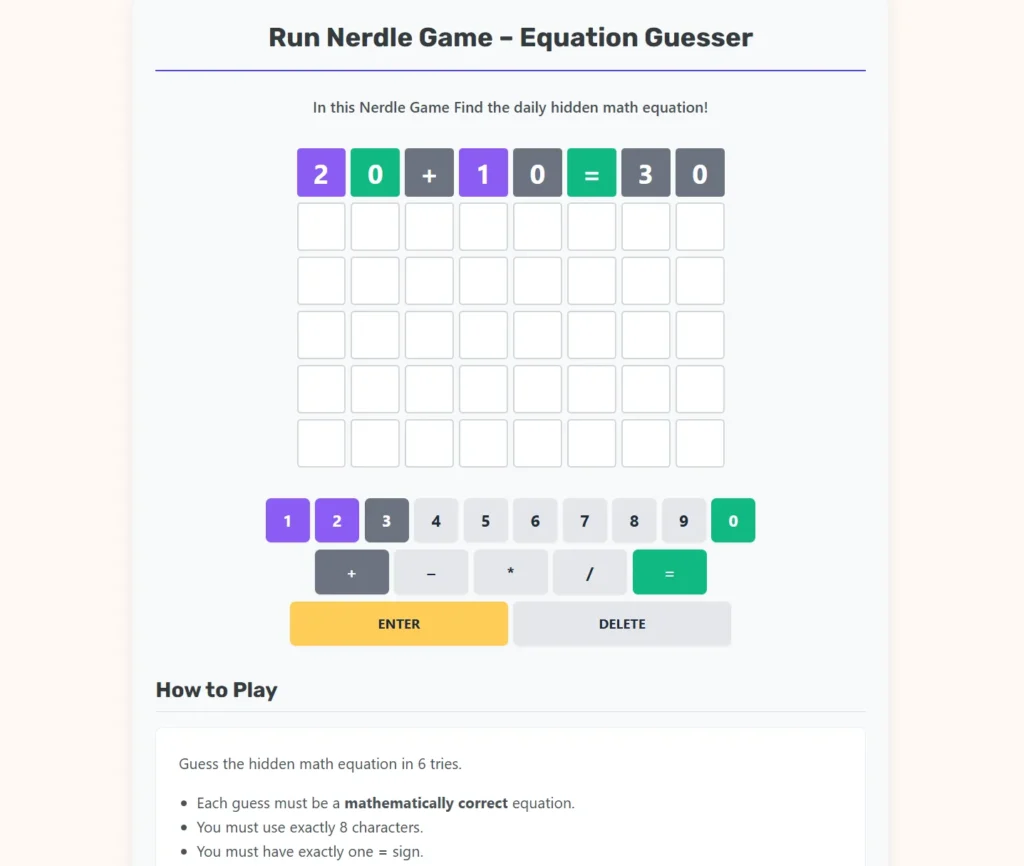
Online equation deduction games represent a significant shift from traditional lexical puzzles to structured numerical problem-solving. While verbal word-guessing systems rely on language-specific dictionaries and letter frequency patterns, an equation guessing tool functions within a deterministic, rule-based mathematical system.
The core architecture of an equation-guessing algorithm challenges the user to identify a hidden, mathematically valid identity using a fixed sequence length. In standard configurations, this sequence consists of exactly eight character positions filled by digits from 0 through 9 and basic arithmetic operators including addition, subtraction, multiplication, division, and the equality sign.
+-----------------------------------------------------------------------+
|                       8-CHARACTER EQUATION GRID                       |
+---+---+---+---+---+---+---+---+---+---+---+---+---+---+---+---+---+---+
| Slot 1 | Slot 2 | Slot 3 | Slot 4 | Slot 5 | Slot 6 | Slot 7 | Slot 8 |
+---+---+---+---+---+---+---+---+---+---+---+---+---+---+---+---+---+---+
|   [Digit / Operator]     |   =   |          [Result Digit]            |
+-----------------------------------------------------------------------+
Every submitted entry must pass two validation layers before the system provides deductive feedback:
- Syntactical Invariance: The character string must form a grammatically valid mathematical expression. It must contain exactly one equality symbol, prevent consecutive operators, avoid leading zeros, and place the equality symbol such that valid terms exist on both sides.
- Identity Verification: The mathematical expression on the left-hand side of the equality symbol must evaluate to a value exactly equal to the numerical expression on the right-hand side.
This dual-layer validation creates a rigorous puzzle space where players must apply arithmetic reasoning alongside strategic pattern elimination.
Core Rules and Boundary Constraints
To successfully interact with the equation solver engine, every entry must adhere strictly to predefined structural rules. These rules maintain computational integrity and restrict the answer space to well-defined arithmetic identities.
                                SYSTEM RULES
                                     |
    +--------------------------------+--------------------------------+
    |                                |                                |
    v                                v                                v
[Length & Syntax]           [Operator Restrictions]         [Mathematical Logic]
  • 8 Characters              • No Adjacent Ops               • LHS = RHS Identity
  • Exactly One "="           • No Leading Zeros              • Valid PEMDAS Order
  • Valid Operator Placement  • No Leading/Trailing Ops       • Non-negative Integers
1. Structural Character Allocation
- Length Restriction: The equation must occupy exactly eight slots. Partial entries or entries exceeding eight characters are rejected.
- Equality Symbol Placement: The entry must contain precisely one equality symbol (
=). It cannot be positioned at the first slot (position 1) or the final slot (position 8), as a valid expression requires at least one character on each side.
2. Operator Placement and Syntax
- Supported Operators: Allowed operators include addition (
+), subtraction (-), multiplication (*), division (/), and equality (=). - Adjacent Operator Prohibition: Two operators cannot appear next to each other. Sequences such as
++,*-, or/+trigger a syntax error. - Leading and Trailing Operators: An equation cannot begin or end with an arithmetic operator. Expressions such as
+12+4=16or12+4==16are mathematically invalid within this system.
3. Numerical Rules
- Leading Zero Prohibition: Numbers with leading zeros are invalid. For instance,
05+03=08is rejected, whereas5+3=8(padded appropriately in an 8-slot structure) or15+3=18is accepted. - Result Invariance: The expression to the left of the equality sign must equal the right-hand side. The submission
12+08=21is rejected on the basis of identity failure, even though its syntax is perfect.
Combinatorial Complexity and Information Theory
The state space of an 8-character equation guesser can be understood using discrete mathematics and information theory.
Raw Search Space vs. Valid Equation Space
If we consider an alphabet containing 15 potential characters (10 digits from 0 to 9 plus 5 symbols: +, -, *, /, =), the total number of unconstrained 8-character combinations is given by:
Nraw = 158 = 2,562,890,625
However, applying the strict rules of mathematical syntax and equality drastically shrinks this space. A valid equation requires:
- An equality symbol placed at position 4, 5, 6, or 7.
- Valid numerical operands without leading zeros.
- Strict evaluation matching the right-hand side.
When these constraints are enforced, the set of valid 8-character equations reduces to approximately 17,723 valid states. This dramatic reduction demonstrates how mathematical rules introduce structure into an otherwise vast search space.
Information Entropy in Deductive Feedback
Each guess yields feedback for all 8 positions, categorized into three distinct state responses:
| Visual State | Color Code | Information-Theoretic Significance |
| Correct | Emerald Green | Character is correct and placed in the exact slot position. |
| Present | Violet Purple | Character exists within the equation but belongs in a different slot. |
| Absent | Slate Gray | Character does not exist anywhere within the target equation. |
The total theoretical feedback patterns for an 8-character grid equal:
Patterns = 38 = 6,561
Using Shannon Information Entropy, the expected information gain H(S) from submitting a guess S across a set of remaining possible equations E is expressed as:
H(S) = − ∑ p(pattern) · log2(p(pattern))
Where p(pattern) represents the probability of receiving a specific color pattern from the valid candidate pool. An optimal guessing strategy maximizes H(S) on each turn to shrink the set of remaining valid candidate equations as quickly as possible.
Step-by-Step Deductive Gameplay Simulation
To illustrate how color feedback translates into logical deduction, consider a scenario where the hidden target equation is:
Target: 48-32=16
+-----------------------------------------------------------------------+
|                        GAMEPLAY SIMULATION GRID                       |
+------+---+---+---+---+---+---+---+---+--------------------------------+
| Turn | 1 | 2 | 3 | 4 | 5 | 6 | 7 | 8 | Result Deduction               |
+------+---+---+---+---+---+---+---+---+--------------------------------+
|  #1  | 1 | 0 | + | 2 | 0 | = | 3 | 0 | 4 characters found; wrong positions |
|  #2  | 9 | 8 | - | 7 | = | 9 | 1 |   | Invalid length; system rejects |
|  #2* | 4 | 8 | - | 3 | 2 | = | 1 | 6 | Perfect Match: All Green      |
+------+---+---+---+---+---+---+---+---+--------------------------------+
Turn 1 Evaluation
Submitted Guess: 10+20=30
Slot  : [1] [0] [+] [2] [0] [=] [3] [0]
Status:  [P] [A] [A] [P] [A] [P] [A] [A]
(P = Present / Violet, A = Absent / Gray, C = Correct / Green)
Analysis of Turn 1 Feedback:
- Digit
1(Purple): Exists in the target equation, but not in Slot 1. - Digit
2(Purple): Exists in the target equation, but not in Slot 4. - Equality
=: (Purple): Exists in the target equation, but not in Slot 6. - Digits
0,3, and Operator+(Gray): These characters do not exist anywhere in the target equation and must be excluded from all future attempts.
Deductive Progress:
- The equality symbol
=is present, but not at Slot 6. Because the right-hand side needs at least two digits for a result using digits1and2, the=symbol must be at Slot 6 or Slot 7. - The operator cannot be
+. Therefore, the primary operation must rely on-,*, or/. - The digits
0and3are eliminated entirely.
Turn 2 Evaluation
Based on the deductions from Turn 1, the player crafts an equation using new digits (4, 8, 6), testing the subtraction operator (-), and shifting the = sign to Slot 6.
Submitted Guess: 48-32=16
Slot  : [4] [8] [-] [3] [2] [=] [1] [6]
Status:  [C] [C] [C] [C] [C] [C] [C] [C]
Analysis of Turn 2 Feedback:
- All 8 slots turn Emerald Green.
- The left-hand side (
48 - 32) evaluates precisely to16. - The puzzle is solved in 2 attempts through strategic character elimination and positional deduction.
Strategic Framework for Maximizing Entropy Reduction
Achieving consistent victories within 3 or 4 attempts requires a structured opening strategy that maximizes information gain.
                      STRATEGIC WORKFLOW
                              |
       +----------------------+----------------------+
       |                                             |
       v                                             v
[Phase 1: Exploration]                       [Phase 2: Convergence]
  • Test 5-6 Unique Digits                     • Fix Correct (Green) Slots
  • Test High-Frequency Ops (+, -)             • Reposition Present (Purple) Tokens
  • Identify Equality Slot                     • Isolate Missing Term via Arithmetic
1. High-Entropy Opening Equations
An ideal opening entry should test multiple unique digits, include a high-frequency operator, and establish the baseline structure of the equality sign.
+-----------------------------------------------------------------------+
|                    RECOMMENDED OPENING EQUATIONS                      |
+---------------+-------------------+-----------------------------------+
| Entry         | Tested Characters | Strategic Focus                   |
+---------------+-------------------+-----------------------------------+
| 12+34-5=41    | 1, 2, 3, 4, 5, +, | Multi-operator testing; isolates  |
|               | -, =              | broad digits.                     |
+---------------+-------------------+-----------------------------------+
| 98-76=22      | 9, 8, 7, 6, 2, -, | High-value digit reduction; tests |
|               | =                 | double-digit result structures.   |
+---------------+-------------------+-----------------------------------+
| 45/9+1=6      | 4, 5, 9, 1, 6, /, | Tests division/addition precedence|
|               | +, =              | and single-digit RHS outcomes.    |
+---------------+-------------------+-----------------------------------+
2. Commutative and Associative Properties Strategy
Arithmetic equations often feature commutative properties, where term order can be swapped without changing the result:
a + b = c ⇔ b + a = c
a · b = c ⇔ b · a = c
If a submission reveals that numbers exist in purple states across the left-hand side, apply commutative permutations on the next turn to test their alternate valid positions.
3. Handling Duplicate Characters
When a digit appears twice in an equation (such as 11+22=33), the color feedback engine processes the duplicate occurrences according to specific rules:
- If the target equation contains one instance of the digit
2, but your guess contains two2s, one slot will render Green or Purple, while the second instance will render Gray. - Do not assume a Gray response for a second instance eliminates the digit entirely. It simply indicates that the target equation does not contain a second occurrence of that digit.
Order of Operations and Mathematical Precedence
The deduction engine relies on standard algebraic precedence rules (PEMDAS / BODMAS). Understanding these rules is essential when constructing valid equations that contain multiple operators.
                       OPERATOR PRECEDENCE (PEMDAS)
                                    |
            +-----------------------+-----------------------+
            |                                               |
            v                                               v
   [Level 1: Multiplication/Division]             [Level 2: Addition/Subtraction]
     • Evaluated Left to Right                      • Evaluated Left to Right
     • Higher Precedence Order                      • Lower Precedence Order
Precedence Hierarchy
- Multiplication and Division (
*,/): Evaluated strictly from left to right before any addition or subtraction operations. - Addition and Subtraction (
+,-): Evaluated from left to right after all multiplication and division operations are resolved.
Example Evaluation
Consider the candidate equation string:
3+5*4=23
The system evaluates this string in two steps:
- Step 1 (Multiplication First): 5 · 4 = 20
- Step 2 (Addition Second): 3 + 20 = 23
If a player incorrectly reads the equation from left to right without respecting operator precedence (evaluating (3 + 5) * 4 = 32), the submission will fail the engine’s internal mathematical validation check.
Structural Comparison: Lexical vs. Mathematical Deduction Tools
Understanding how an equation solver differs from traditional text-based word guessing tools highlights its unique cognitive and algorithmic requirements.
| Feature / Dimension | Word Deductive Tools (e.g., Wordle) | Equation Solver Tools (e.g., Nerdle) |
| Domain Base | Lexical dictionary (linguistic vocabulary) | Axiomatic arithmetic identities |
| Alphabet Size | 26 English letters | 15 total tokens (10 digits, 5 symbols) |
| Constraint Validation | Word presence in a static language dictionary | Dynamic mathematical identity check (LHS = RHS) |
| Precedence Logic | Sequential spatial arrangement | Hierarchical evaluation rules (PEMDAS / BODMAS) |
| Commutative States | Non-existent (changing letters changes the word) | Frequent (e.g., a+b=c versus b+a=c) |
| Search Space Reduction Rate | High initial reduction based on letter frequencies | Extreme initial reduction driven by strict identity rules |
Educational and Cognitive Benefits
Engaging with equation guesser tools offers substantial cognitive benefits for learners and researchers alike, spanning several areas of mathematical development.
                           EDUCATIONAL VALUE
                                   |
    +------------------------------+------------------------------+
    |                              |                              |
    v                              v                              v
[Arithmetic Fluency]       [Algebraic Thinking]         [Logical Deduction]
  • Rapid mental math        • Variable substitution      • Hypothesis testing
  • Operator precedence      • Equivalence awareness      • Systematic elimination
1. Arithmetic Fluency and Working Memory
Regular practice reinforces basic arithmetic recall across addition, subtraction, multiplication, and division. Players must compute left-hand side combinations mentally while balancing spatial constraint limits in working memory.
2. Algebraic Reasoning Prior to Formal Symbols
Before formal algebra is introduced, students must understand that the equality symbol (=) represents balance between two quantities rather than simply a prompt to compute a result. Equation-guessing games reinforce this relational view of equality.
3. Hypothesis Testing and Scientific Method
The game encourages systematic hypothesis testing:
- Formulate a hypothesis (a valid equation string).
- Gather empirical data (color feedback signals).
- Refine the working hypothesis based on constrained variables.
- Convergence on the correct mathematical truth.
Common Input Errors and Technical Troubleshooting
When interacting with the calculator, unexpected inputs can lead to validation rejections. The table below details common error modes and how to correct them.
+-----------------------------------------------------------------------+
|                    INPUT ERROR RESOLUTION MATRIX                      |
+---------------------+-----------------------+-------------------------+
| Error Indication    | Root Cause            | Correction Strategy     |
+---------------------+-----------------------+-------------------------+
| "Must contain       | Zero or multiple '='  | Ensure the equation     |
| exactly one '=' "   | signs in submission.  | contains exactly one   |
|                     |                       | equality symbol.        |
+---------------------+-----------------------+-------------------------+
| "Operators cannot   | Sequences like `++`   | Remove adjacent symbol  |
| be next to each     | or `*-` present.      | operators; ensure digits|
| other"              |                       | separate all symbols.   |
+---------------------+-----------------------+-------------------------+
| "Leading zeros not  | Numbers formatted     | Express terms cleanly;  |
| allowed"            | like `05` or `012`.   | replace `05+3=8` with   |
|                     |                       | `15+3=18` or `2+6=8`.   |
+---------------------+-----------------------+-------------------------+
| "Mathematically     | Left-hand side value  | Re-calculate terms      |
| incorrect equation" | does not equal RHS.   | using PEMDAS before     |
|                     |                       | pressing submit.        |
+---------------------+-----------------------+-------------------------+
Theoretical Framework and Scientific Citation
The theoretical foundation of this equation deduction system builds upon information theory and algorithmic search optimization, first established by Claude Shannon and later adapted to master-mind style games by Donald Knuth.
Academic Reference
Shannon, C. E. (1948). A Mathematical Theory of Communication. Bell System Technical Journal, 27(3), 379–423.
Knuth, D. E. (1977). The Computer As Master Mind. Journal of Recreational Mathematics, 9(1), 1–6.
Knuth demonstrated that any five-peg code-breaking game could be solved in five moves or fewer using a minimax algorithm that minimizes the maximum number of remaining candidate solutions at each step.
In an 8-character equation guesser, applying Knuth’s minimax principle across the valid candidate set guarantees a solution within 6 guesses under optimal conditions.
                              REFERENCES
                                   |
         +-------------------------+-------------------------+
         |                                                   |
         v                                                   v
[Information Theory]                                [Algorithmic Deduction]
  • Shannon, C. E. (1948)                             • Knuth, D. E. (1977)
  • Entropy & Information Gain                      • Minimax Solution Guarantees
  • Bell System Technical Journal                     • Journal of Rec. Math
Frequently Asked Questions
What constitutes a valid equation entry?
A valid entry must contain exactly eight characters, include precisely one equality sign (=), feature valid arithmetic operations on the left-hand side, contain no adjacent operators or leading zeros, and evaluate to a mathematically correct identity where LHS equals RHS.
Why does the calculator reject entries starting with a minus sign?
Negative numbers at the start of an equation (e.g., -5+15=10) are prohibited by the system’s syntax engine. Every term must begin with a positive digit to maintain consistency across the solution space.
How does the game handle operator precedence?
The system evaluates all expressions according to standard PEMDAS/BODMAS rules. Multiplication (*) and division (/) are calculated from left to right before addition (+) and subtraction (-).
What does a purple color indicator mean on an operator?
A purple indicator on an operator (such as + or *) means that the operator is used in the target equation, but belongs in a different slot position than the one guessed.
Can an equation have multiple operators on the left-hand side?
Yes. As long as the string fits within the 8-character limit and avoids adjacent operators, expressions like 2*3+4=10 or 9-5+2=6 are fully valid entries.