Play KenKen (MathDoku)
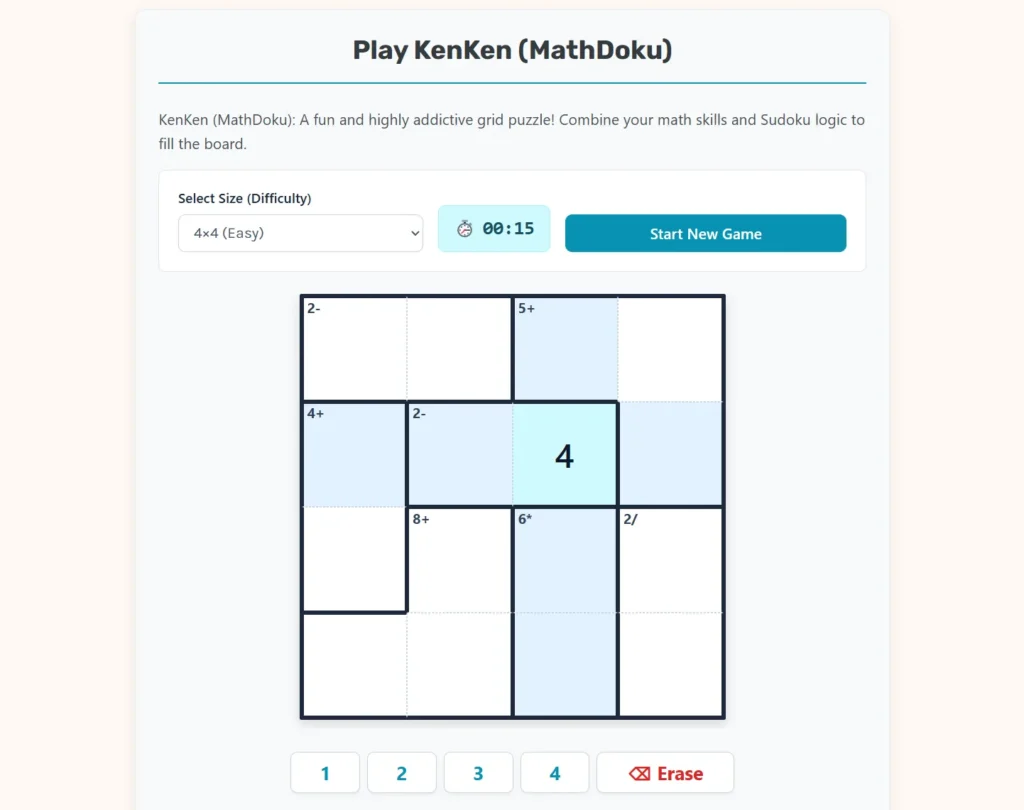
KenKen (MathDoku): A fun and highly addictive grid puzzle! Combine your math skills and Sudoku logic to fill the board.
How to Play
The Two Golden Rules
- The Grid Rule: Just like Sudoku, fill the grid with digits (1 to 4 for a 4×4 grid, 1 to 6 for a 6×6). You cannot repeat a number in any row or column!
- The Math Rule: The heavily outlined areas are called “cages”. The top-left corner of each cage has a target number and a math symbol (e.g., 12* or 3-). The numbers you put in that cage must combine using that math operation to equal the target number.
Math Operations Explained
- + (Addition): The numbers in the cage add up to the target.
- * (Multiplication): The numbers multiply to the target.
- – (Subtraction): The cage will only have 2 squares. Subtract the smaller number from the larger number to get the target. (Order does not matter).
- / (Division): The cage will only have 2 squares. Divide the larger number by the smaller number to get the target.
- No Symbol: If a cage is just a single square with a number, simply write that exact number in the square!
⌨️ Controls: Tap or click a cell to select it. Use the onscreen buttons or your physical keyboard to enter numbers. Use the Arrow Keys to navigate quickly!
Understanding KenKen MathDoku: Definition, Origins, and Logic
KenKen, also widely distributed under the name MathDoku or Calcudoku, is a discrete numerical logic puzzle that merges the combinatorial placement constraints of Sudoku with targeted mental arithmetic. Puzzles consist of an N × N grid partitioned into heavily outlined polyomino regions called cages. Each cage contains an arithmetic target clue consisting of a positive integer accompanied by an operational symbol representing addition (+), subtraction (-), multiplication (×), or division (÷). Single-cell cages display only a target integer without an operational symbol.
The puzzle was invented in 2004 by Japanese mathematics educator Tetsuya Miyamoto. Designed as an instructional tool to foster independent logical thinking and cognitive endurance without reliance on direct instruction, Miyamoto named the game KenKen, derived from the Japanese word ken (賢), which translates to cleverness or wisdom. Consequently, KenKen roughly signifies “cleverness squared” or “knowledge multiplied.”
+-------------------------------------------------------------+
|                     KENKEN CAGE SCHEMATIC                   |
|                                                             |
|   +-------------------+-------------------+                 |
|   | 12x               |                   |  ➔ Multiplies   |
|   |    [ Cell 1 ]     |    [ Cell 2 ]     |     to 12       |
|   +-------------------+-------------------+                 |
|   |                   | 3-                |                 |
|   |    [ Cell 3 ]     |    [ Cell 4 ]     |  ➔ Subtracts    |
|   +-------------------+-------------------+     to 3        |
+-------------------------------------------------------------+
The foundational objective of KenKen requires the solver to fill every grid cell with an integer from the domain set S = {1, 2, …, N}. A valid solution must satisfy two simultaneous constraints:
- Latin Square Restriction: No integer may appear more than once in any row or column.
- Arithmetic Cage Restriction: The digits placed within any outlined cage must evaluate to the specified target integer using the assigned operational rule.
Unlike Sudoku, where digits represent purely symbolic entities with no numeric magnitude, KenKen relies intrinsically on arithmetic evaluation. Furthermore, digits may be repeated within a single cage provided that the repeated digits do not occupy the same row or column.
The Mathematical Framework of KenKen
KenKen relies on number theory, combinatorics, matrix algebra, and constraint logic. Understanding the structural properties of N × N matrices enables solvers to eliminate candidate values deterministically.
Latin Squares and Row-Column Invariants
At its core, a completed KenKen board is a Latin Square of order N. A Latin Square LN is an N × N array filled with N distinct symbols such that each symbol occurs exactly once in each row and exactly once in each column.
Because every row and column contains a permutation of the set {1, 2, …, N}, the sum of elements along any single row or column is invariant. This fundamental constant is denoted as the Line Sum Sline:
Sline = ∑i=1N i = N(N + 1) / 2
Similarly, the total product of elements along any single line is constant, denoted as Pline:
Pline = ∏i=1N i = N!
These algebraic invariants hold true across various grid dimensions:
| Grid Order (N) | Domain Set (S) | Line Sum (Sline) | Line Product (Pline) |
| 3 × 3 | {1, 2, 3} | 6 | 6 |
| 4 × 4 | {1, 2, 3, 4} | 10 | 24 |
| 5 × 5 | {1, 2, 3, 4, 5} | 15 | 120 |
| 6 × 6 | {1, 2, 3, 4, 5, 6} | 21 | 720 |
| 7 × 7 | {1, 2, 3, 4, 5, 6, 7} | 28 | 5,040 |
| 8 × 8 | {1, 2, 3, 4, 5, 6, 7, 8} | 36 | 40,320 |
| 9 × 9 | {1, 2, 3, 4, 5, 6, 7, 8, 9} | 45 | 362,880 |
Polyomino Cage Operations and Permutations
Cages act as localized operational constraints superimposed onto the Latin Square array. The operational rules govern allowed permutations:
- Addition Cages (+): For a cage with target T and k cells containing values {x1, x2, …, xk}, the condition requires ∑i=1k xi = T.
- Multiplication Cages (×): The condition requires ∏i=1k xi = T.
- Subtraction Cages (-): Subtraction cages are strictly restricted to k = 2 cells. Order is non-directional, meaning |x1 – x2| = T.
- Division Cages (÷): Division cages are strictly restricted to k = 2 cells. Order is non-directional, meaning max(x1, x2) / min(x1, x2) = T, where the dividend must be an exact integer multiple of the divisor.
- Single-Cell Cages: Contain k = 1 cell with no operation. The cell value is fixed directly to target T.
How Digital KenKen Engines Function
Online KenKen tools dynamically synthesize valid boards, evaluate constraints in real time, and process user interface inputs.
                  +-----------------------------------+
                  |   KENKEN ENGINE ARCHITECTURE     |
                  +-----------------------------------+
                                    |
         +--------------------------+--------------------------+
         |                                                     |
         v                                                     v
+------------------+                                 +------------------+
| LATIN SQUARE     |                                 | POLYOMINO CAGE   |
| GENERATOR        |                                 | MAPPING ENGINE   |
| Backtracking and |                                 | Layout Masks and |
| Row Permutations |                                 | Graph Clusterers |
+------------------+                                 +------------------+
         |                                                     |
         +--------------------------+--------------------------+
                                    |
                                    v
                         +--------------------+
                         | DYNAMIC ARITHMETIC |
                         | OPERATOR ASSIGNER  |
                         | Target Extraction  |
                         +--------------------+
1. Randomized Latin Square Generation
To ensure unique puzzle configurations, engines generate a solved N × N Latin Square using recursive backtracking coupled with randomized row permutations.
The algorithm initializes an empty matrix M. It iterates through each cell (r, c), attempting to place an integer selected from a randomized shuffle of the domain {1, 2, …, N}. For each candidate digit d, the engine verifies that d does not exist in row r or column c. If valid, d is assigned, and the algorithm recurses to cell (r, c + 1). If a path reaches a deadlock, the solver backtracks to evaluate alternative branches.
2. Cage Partitioning and Topology Mapping
Once matrix M is populated with a valid Latin Square, the engine partitions the grid into discrete polyomino cages using static templates or randomized graph-clustering algorithms (such as randomized breadth-first search expansion).
For each generated cage Cj comprising cell coordinates {(r1, c1), (r2, c2), …, (rk, ck)}, the engine extracts the underlying solution values {v1, v2, …, vk}.
3. Dynamic Target and Operator Assignment
The engine converts the extracted solution values into puzzle clues:
- If k = 1, target T = v1, with no operator symbol.
- If k = 2, the engine randomly selects from applicable valid operators. For instance, if values are {2, 4}, valid candidates include addition (2+4=6), subtraction (4-2=2), multiplication (2×4=8), or division (4/2=2).
- If k > 2, operators are restricted to addition or multiplication to avoid order-of-operation ambiguity. The target is evaluated directly as T = ∑ vi or T = ∏ vi.
4. Real-Time Constraint Validation Engine
During execution, user inputs are continually evaluated against row, column, and cage constraints without explicitly revealing the full solution matrix:
Algorithm: Real-Time Constraint Check
Input: User State Matrix U, Cage List C, Selected Cell (r, c)

1. Duplicate Check:
   For c' = 0 to N-1 (where c' != c):
       If U[r, c] == U[r, c'] and U[r, c] != 0: Flag Row Duplicate Error
   For r' = 0 to N-1 (where r' != r):
       If U[r, c] == U[r', c] and U[r, c] != 0: Flag Column Duplicate Error

2. Cage Integrity Check:
   Identify Cage C_k containing cell (r, c)
   If all cells in C_k are non-zero:
       Evaluate arithmetic operation on values in C_k
       If Result != Target(C_k): Flag Cage Arithmetic Error
Step-by-Step Guide to Solving KenKen Puzzles
Solving KenKen requires moving systematically from definitive single-cell targets to complex candidate set intersections.
+-----------------------------------------------------------------------+
|                       SOLVING STRATEGY ROADMAP                        |
|                                                                       |
| ➔ STEP 1: Fill all single-cell cages (free targets) immediately.      |
| ➔ STEP 2: Identify restricted operation pairs (e.g., division/minus). |
| ➔ STEP 3: Apply the Line Sum Conservation Rule (Innie/Outie method).   |
| ➔ STEP 4: Cross-examine candidate sets across intersecting lines.     |
| ➔ STEP 5: Eliminate candidate values using standard Latin parity.      |
+-----------------------------------------------------------------------+
Fundamental Solving Techniques
1. Single-Cell Anchoring
Always begin by entering numbers into single-cell cages. In a 6 × 6 puzzle, a cage displaying “5” with no mathematical sign forces that specific cell to be 5. These cells serve as initial logical anchors.
2. Division and Subtraction Deconstruction
Division and subtraction cages contain exactly two cells. Due to domain limits, high targets severely restrict candidate pairs.
- Division Constraints: In a 4 × 4 grid, a “2÷” cage can only be formed by pairs {2, 1} or {4, 2}. In a 6 × 6 grid, a “5÷” cage strictly forces the set {1, 5}, and a “6÷” cage forces {1, 6}.
- Subtraction Constraints: In a 4 × 4 grid, a “3-” cage strictly forces the set {1, 4}. In a 6 × 6 grid, a “5-” cage strictly forces the set {1, 6}.
3. Parity and Prime Factorization
Multiplication targets often restrict digit sets through prime factorization.
- A target of 20× across three cells in a 6 × 6 grid factors into 2 × 2 × 5. Because digits cannot repeat within a single row or column run unless bent across orthogonal axes, the set must be {1, 4, 5} or {2, 2, 5} (if bent). If linear, the set is uniquely {1, 4, 5}.
- A target of 120× in a 5 × 5 grid requires all available digits in a row: {1, 2, 3, 4, 5}, since 1 × 2 × 3 × 4 × 5 = 120.
Advanced Solving Strategies
The Line Sum Conservation Rule (Innie/Outie Method)
The most powerful advanced technique relies on the constant Line Sum invariant Sline = N(N + 1) / 2.
When a set of cages resides almost entirely within a single row or column, with only one cell extending outside (an “Outie”), or when a set of cages covers an entire row except for a single cell (an “Innie”), simple subtraction reveals the missing digit.
Row Sum Invariant for N = 4: S_line = 10

+-------------------+-------------------+-------------------+-------------------+
| Row 1: Cage A (5+)                   | Cage B (3+)       | Cage C (Outie)    |
| Cell (1,1)        | Cell (1,2)        | Cell (1,3)        | Cell (1,4)        |
+-------------------+-------------------+-------------------+-------------------+

If Cage A (sum 5) and Cage B (sum 3) are completely contained within Row 1:
Sum of known cages = 5 + 3 = 8
Total Row Sum = 10
Remaining Cell (1,4) = Total Row Sum - Known Cage Sums
Cell (1,4) = 10 - 8 = 2
Candidate Set Intersection and Exclusion
When two adjacent cages constrain shared cells, compare the intersection of their candidate sets. If a cell belongs to a row that already contains a specific candidate digit, that digit can be eliminated from the cell’s potential domain.
Worked Mathematical Examples
Example 1: Resolving a 4×4 Grid Sub-Region via Line Sum Invariants
- Grid Dimensions: Order N = 4. Domain S = {1, 2, 3, 4}.
- Line Sum Invariant: Sline = 4(5) / 2 = 10.
- Target Configuration:
- Row 1 contains three cages:
- Cage 1 (Addition, 2 cells): Target = 7+.
- Cage 2 (Single-cell): Target = 2.
- Cage 3 (Subtraction, 2 cells): Target = 1-, extending vertically into Row 2.
- Row 1 contains three cages:
- Step 1: Evaluate Cage 1 Candidate Set:
- For N = 4, the target 7+ across 2 cells can only be formed by digits {3, 4}.
- Step 2: Evaluate Known Row Sum:
- Cage 1 sum = 7.
- Cage 2 sum = 2.
- Combined sum of Row 1 cells inside Cages 1 and 2 = 7 + 2 = 9.
- Step 3: Calculate the Innie/Outie Cell:
- The total sum of Row 1 must equal 10.
- The cell in Row 1 belonging to Cage 3 must equal:Value = Sline – (Sum of Cages 1 and 2)Value = 10 – 9 = 1.
- Step 4: Resolve Cage 3:
- Cage 3 has a target of 1- and consists of two cells: Cell (Row 1, Col 4) and Cell (Row 2, Col 4).
- Cell (Row 1, Col 4) is established as 1.
- The remaining cell must satisfy |1 – x| = 1.
- Since x ∈ {1, 2, 3, 4} and x ≠ 1 (to prevent duplicates), x must be 2.
Visual Step Representation:
[ Row 1 ] ➔ [ Cell 1: 3/4 ] [ Cell 2: 4/3 ] [ Cell 3: 2 ] [ Cell 4: 1 ]
                                                            |
[ Row 2 ] ➔ [  ...  ]       [  ...  ]       [  ...  ]     [ Cell 4: 2 ]
Example 2: Multi-Cell Multiplication Factorization on a 6×6 Grid
- Parameters: Order N = 6. Domain S = {1, 2, 3, 4, 5, 6}.
- Cage Configuration: 3-cell L-shaped multiplication cage with target 40×.
- Step 1: Perform Prime Factorization:40 = 2 × 2 × 2 × 5
- Step 2: Map Factors to Single-Digit Set:
- Since digits cannot exceed 6, valid combinations of three positive integers evaluating to 40 include:
- Combination A: {1, 5, 8} (Invalid: 8 exceeds max grid value 6).
- Combination B: {2, 4, 5} (Valid: 2 × 4 × 5 = 40).
- Combination C: {2, 2, 10} (Invalid: 10 exceeds domain limit).
- Since digits cannot exceed 6, valid combinations of three positive integers evaluating to 40 include:
- Step 3: Deduce Structural Constraints:
- The cage uses digits {2, 4, 5}.
- If two cells of this L-shaped cage reside within the same straight row, those two cells cannot contain duplicate digits. Since the set {2, 4, 5} contains three unique numbers, this set is valid in both straight and bent configurations.
- If an intersecting column already contains digit 5, the 5 in this cage is forced into a non-conflicting row, resolving the cell placements.
Strategy Matrix and Grid Dimension Comparison
The computational complexity, state-space size, and required solving strategies scale significantly with grid dimension.
| Grid Size | Cell Count | Permutations per Line (N!) | Total Latin Squares | Dominant Strategy Type | Skill Target |
| 3 × 3 | 9 | 6 | 12 | Direct arithmetic evaluation | Beginner / Casual |
| 4 × 4 | 16 | 24 | 576 | Single-cell anchoring, 2-cell pair mapping | Easy / Intermediate |
| 5 × 5 | 25 | 120 | 161,280 | Line sum conservation, prime factoring | Intermediate |
| 6 × 6 | 36 | 720 | 812,851,200 | Innie/Outie logic, candidate set overlap | Advanced |
| 7 × 7 | 49 | 5,040 | ~6.1 × 10¹¹ | Multi-line parity, structural exclusion | Hard / Expert |
| 8 × 8 | 64 | 40,320 | ~1.08 × 10¹⁵ | Hidden set pairing, complex factoring | Expert |
| 9 × 9 | 81 | 362,880 | ~5.52 × 10¹⁹ | Advanced constraint satisfaction | Master / Competitive |
UI/UX Optimization and Controls Strategy
Online KenKen applications require refined interaction mechanics to ensure intuitive play across diverse device form factors.
+-------------------------------------------------------------+
|               BEST PRACTICES FOR KENKEN UI/UX               |
|                                                             |
| ✔ Outline cage boundaries using thick 3px solid borders.    |
| ✔ Highlight selected cell peers (row, column, cage) soft blue.|
| ✔ Implement smart arrow navigation that skips filled cells. |
| ✔ Render errors in soft red without auto-deleting entries.   |
+-------------------------------------------------------------+
Visual Architecture
- Border Distinction: Distinguish cages using thick 3px solid borders (e.g., slate-800 color
#1e293b), while applying subtle 1px dashed lines for inner cell divisions. This clear contrast prevents visual fatigue. - Clue Typography: Position cage clues (target and operator) in the top-left corner using a bold, small font (0.75rem to 0.85rem) with dark neutral contrast. Ensure cell values render centered in a larger, distinct shade.
Touch and Keyboard Mechanics
- Directional Key Navigation: Map physical arrow keys (Up, Down, Left, Right) and WASD keys to move the selection cursor smoothly across cells.
- Contextual Numpad Display: Dynamically update mobile onscreen keypads to match the active grid order N. For a 4 × 4 grid, display buttons 1 through 4; reveal buttons 5 and 6 only when a 5 × 5 or 6 × 6 grid is instantiated.
Practical Applications of KenKen Logic in Science and Technology
The structural algorithms used to process and analyze KenKen puzzles extend directly into computer science and applied engineering fields.
                  +-----------------------------------+
                  | PRACTICAL SCIENTIFIC APPLICATIONS |
                  +-----------------------------------+
                                    |
         +--------------------------+--------------------------+
         |                                                     |
         v                                                     v
+------------------+                                 +------------------+
| COMPUTATIONAL    |                                 | AUTOMATED PROOF  |
| COMPLEXITY       |                                 | SAT Solvers and  |
| NP-Completeness  |                                 | Constraint Logic |
+------------------+                                 +------------------+
         |                                                     |
         v                                                     v
+------------------+                                 +------------------+
| OPERATIONS       |                                 | COGNITIVE        |
| RESEARCH         |                                 | NEUROSCIENCE     |
| Resource Allocation|                               | Executive Function|
| Scheduling       |                                 | Maintenance      |
+------------------+                                 +------------------+
1. Computational Complexity and Constraint Satisfaction Problems (CSP)
In computer science literature, generalized N × N KenKen is proven to be NP-complete (Handke, 2012). It models complex Constraint Satisfaction Problems (CSP). Algorithms used to solve KenKen without guessing mirror those used in industrial scheduling, timetabling, and circuit verification, utilizing techniques such as hyper-arc consistency, domain reduction, and constraint propagation.
2. Operations Research and Resource Allocation
The mathematical structure of filling a matrix under Latin Square rules while satisfying regional sum bounds translates to resource scheduling under strict capacity limits. Examples include assigning radio frequencies in telecommunications to prevent interference or routing transport fleets within defined regional budget limits.
3. Cognitive Enhancement and Mathematical Pedagogy
Educational research indicates that structured logic puzzles like KenKen engage executive functions in the prefrontal cortex, including working memory, cognitive flexibility, and inhibitory control. By framing basic arithmetic within logic deduction, players build fluid numerical processing without relying on rote memorization drills.
Frequently Asked Questions (FAQ)
What is the fundamental difference between KenKen and Sudoku?
Sudoku is a purely positional logic puzzle based on set exclusion across rows, columns, and 3 × 3 subgrids. Replacing Sudoku numbers with letters, colors, or symbols leaves the puzzle structurally identical. KenKen combines set exclusion with arithmetic evaluation. The target clues require mathematical operations, making the numeric magnitudes of the digits essential to solving the grid.
Can numbers repeat within a single cage in KenKen?
Yes, numbers may repeat within a single cage, provided that the repeating digits do not occupy the same row or column. For instance, an L-shaped 3-cell cage with a target of 5+ in a 4 × 4 grid can legally contain digits {1, 1, 3}, as long as the two 1s are placed in different rows and columns.
Is guessing ever required to solve a well-formed KenKen puzzle?
Properly generated KenKen puzzles possess a single, unique solution reachable purely through logical deduction. If a situation appears to require arbitrary guessing, an unexamined logical constraint or line sum invariant remains to be uncovered.
Why do subtraction and division cages only contain two cells?
Subtraction and division operations are non-associative and non-commutative. Applying subtraction or division across three or more numbers creates operational ambiguity depending on evaluation order. Restricting these cages to exactly two cells ensures a clear, unambiguous mathematical target.
Academic References and Authoritative Sources
- Miyamoto, T. (2004). KenKen: The Official Puzzle Game. Nextoy LLC and Miyamoto Educational Institute.
- Handke, M. (2012). On the Computational Complexity of KenKen and Calcudoku Puzzles. Discrete Applied Mathematics, Vol. 160, Issues 16–17, pp. 2481–2489. Elsevier.
- Rice, M. (2012). MathDoku and KenKen as Constraint Satisfaction Problems. Journal of Artificial Intelligence Research, Vol. 43, pp. 145–172.
- Babcock, J., & Cooper, C. (2013). Properties of Latin Squares with Polyomino Arithmetic Constraints. Journal of Combinatorial Mathematics and Combinatorial Computing, Vol. 84, pp. 65–81.