Play nonogram math game – Picross
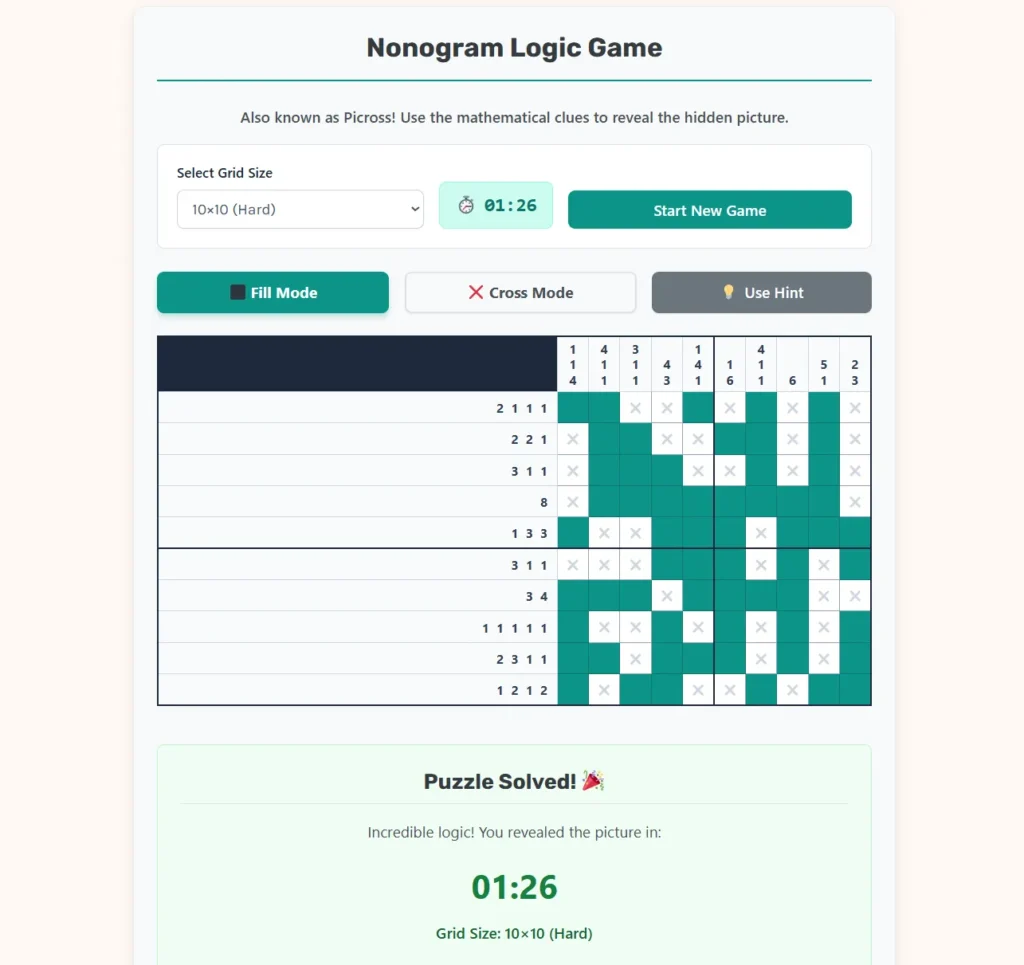
Nonogram math game Also known as Picross! Use the mathematical clues to reveal the hidden picture.
How to Play
The Mathematical Clues
- Look at the numbers above a column or to the left of a row. These are your clues!
- A clue like “3 2” means there is a group of 3 filled squares, followed by at least one empty space, and then a group of 2 filled squares in that exact order.
Controls
Fill Mode (⬛): Tap this button, then tap squares on the grid that you deduce MUST be part of the picture.
Cross Mode (❌): Tap this button, then tap squares you mathematically know MUST be empty. This helps you narrow down possibilities immensely!
💡 Pro Tip: Start by looking for large numbers that take up most of the row or column. If the grid is 5×5 and you see a clue of “5”, you know instantly that the entire row/column must be filled!
Understanding Nonogram Logic Puzzles: Definition, Mathematics, and Game Mechanics
Nonograms, commonly known as Picross, Picture Logic, Griddlers, Hanjie, or Japanese Crosswords, are picture-based logic puzzles where grid cells must be shaded or left blank in accordance with numerical sequence clues positioned at the margins of the board. Resolving a puzzle reveals a concealed binary image or structural pixel pattern.
Originating in the late twentieth century through independent developments by Japanese graphics designer Non Ishida and professional illustrator Tetsuya Nishio, Nonograms combine discrete combinatorial mathematics, constraint satisfaction, and deductive reasoning. The numbers alongside each row and column indicate continuous sequences of filled grid cells. Analyzing these vectors enables players to deduce cell states deterministically without resorting to guessing.
+-------------------------------------------------------------+
|                     NONOGRAM ENGINE LOGIC                   |
|                                                             |
|   Column Clues ➔   [3]     [1 1]    [5]     [1]     [2]     |
|   Row Clues                                                 |
|   [5]        ➔    [ ■ ]   [ ■ ]   [ ■ ]   [ ■ ]   [ ■ ]     |
|   [1 1]      ➔    [ ■ ]   [   ]   [   ]   [   ]   [ ■ ]     |
|   [1 3]      ➔    [ ■ ]   [   ]   [ ■ ]   [ ■ ]   [ ■ ]     |
+-------------------------------------------------------------+
Scientific and Academic Foundations
In scientific literature, Nonograms belong to the class of Discrete Tomography problems, which involve reconstructing multidimensional objects from projection data across specific orthogonal axes. Reconstructing an unknown binary image from its row and column sum constraints mirrors problems in medical imaging, structural crystallographic analysis, and digital signal processing.
From a computational complexity perspective, determining whether a general N × M Nonogram puzzle possesses a valid solution is NP-complete (Ueda and Nagao, 1996). While individual line solving can be processed in polynomial time, the multi-line interaction across intersecting two-dimensional grids creates a constraint satisfaction problem with exponentially expanding state spaces as grid dimensions scale upward.
The Mathematical Framework of Nonograms
The deterministic resolution of any Nonogram line relies on set theory, inequality limits, and overlap logic. A line (row or column) of length L contains a ordered set of numerical clues A = (a1, a2, …, ak), where each ai represents the exact length of a continuous segment of filled cells.
Line Constraint Theory and Minimum Span Formula
Every pair of adjacent filled blocks must be separated by at least one empty cell. Consequently, the absolute minimum line length required to fit a sequence of clues A without violating continuity rules is defined by the minimum span formula:
Where:
- Smin(A) represents the minimum number of contiguous grid positions necessary to host clue sequence A.
- ai denotes the size of the i-th filled segment.
- k represents the total number of distinct clue segments in the sequence.
- (k – 1) accounts for the minimum required single-cell spaces between segments.
Degree of Freedom (Slack) Equation
The degree of freedom, or slack, measures how much flexibility a clue sequence has within a line of length L. Slack dictates whether immediate deductions are mathematically guaranteed:
When Slack = 0, every cell state along the line is fully determined. The blocks and single spacing elements completely fill the available length L.
Overlap Logic and Deterministic Placement Algorithm
When Slack is strictly smaller than an individual block size ai, that block must occupy specific central cells regardless of whether it is positioned at its leftmost or rightmost extreme. The overlap length Oi for block ai is calculated as follows:
If Oi > 0, the central Oi cells of block ai must be shaded filled cells.
Line Length L = 10, Clue Block a = 7
S_min = 7, Slack = 10 - 7 = 3
Overlap O = 7 - 3 = 4

Leftmost Placement:  [ ■ ][ ■ ][ ■ ][ ■ ][ ■ ][ ■ ][ ■ ][   ][   ][   ]
Rightmost Placement: [   ][   ][   ][ ■ ][ ■ ][ ■ ][ ■ ][ ■ ][ ■ ][ ■ ]
Guaranteed Overlap:  [   ][   ][   ][ ■ ][ ■ ][ ■ ][ ■ ][   ][   ][   ]
How Online Nonogram Games and Solvers Work
Online Nonogram applications convert abstract matrix math into real-time interactive visual tools. The processing engine operates on distinct computational stages: grid generation, clue extraction, vector validation, and user interaction mapping.
Grid Generation and Density Control
The backend or client-side game engine instantiates an internal binary matrix M of dimensions R × C:
Where 0 represents an empty cell and 1 represents a filled cell. For programmatic generation, target density thresholds are calibrated to maintain logical solubility. A fill density around 60% yields optimal visual clarity and puzzle progression balance.
Clue Extraction Engine (Run-Length Encoding)
Once matrix M is constructed, the application extracts row clues and column clues using a run-length encoding algorithm. The system scans each row vector Vrow = (mr,1, mr,2, …, mr,C) and column vector Vcol = (m1,c, m2,c, …, mR,c) sequentially:
- Initialize an empty list of clue integers.
- Maintain a continuous counter variable initialized to zero.
- Iterate through vector elements. If element equals 1, increment the counter.
- If element equals 0 and counter > 0, push counter to clue list and reset counter to 0.
- Upon vector termination, if counter > 0, push counter to clue list. If clue list remains empty, record a single 0 clue.
Raw Matrix Row Vector: [1, 1, 1, 0, 0, 1, 1, 0, 1, 0]
Processed Run-Length Clues: (3, 2, 1)
Real-Time Validation and Win Logic
As the user interacts with the canvas via Fill Mode or Cross Mode, the system updates a user state matrix P ∈ {0, 1, 2}R × C, where 0 denotes unselected, 1 denotes filled, and 2 denotes crossed out.
Rather than requiring an exact cell-by-cell match against matrix M (which would invalidate alternate valid solutions in non-unique puzzles), a robust solver recalculates the run-length clues of user matrix P for all filled cells (state 1) and compares them against the initial target clue vectors. When all row and column clue vectors derived from state 1 match the puzzle constraints identically, a win condition is triggered.
Step-by-Step Guide to Solving Nonogram Puzzles
Solving Nonograms requires systematic application of deductive logic patterns. The following strategies progress from basic line deductions to advanced multi-line reasoning.
+-----------------------------------------------------------------------+
|                       SOLVING STRATEGY ROADMAP                        |
|                                                                       |
| ➔ STEP 1: Identify zero-clues and full-line matches (Slack = 0).       |
| ➔ STEP 2: Calculate overlaps for large clue segments.                 |
| ➔ STEP 3: Mark guaranteed empty cells with crosses (❌).                |
| ➔ STEP 4: Apply edge-pushing and glue logic around completed blocks.  |
| ➔ STEP 5: Propagate updated row states into intersecting columns.     |
+-----------------------------------------------------------------------+
Basic Deductive Strategies
1. Full Line Allocation
- Condition: Smin(A) = L.
- Action: Fill all specified blocks and insert required single crosses between them immediately.
2. Zero Clue Expansion
- Condition: A row or column clue contains only a single 0.
- Action: Mark every cell in that line with a cross (❌). No filled cells exist in this line.
3. Simple Overlap Deduction
- Condition: A single large clue a1 exceeds half the length of the line (a1 > L / 2).
- Action: Calculate Slack = L – a1. Shade the middle a1 – Slack cells.
Intermediate Deductive Strategies
Edge-Pushing Logic
When a filled cell is placed near the perimeter or boundary of a grid, the block it belongs to cannot extend beyond the wall. If a cell at position 1 is filled, the first clue segment a1 must extend from position 1 through position a1. Position a1 + 1 must be marked with a cross to enforce the segment boundary.
Glue Logic
When a filled cell cannot reach far enough to belong to any clue block other than a specific block ai, that cell must belong to ai. The engine or player can extend filled cells toward known bounds accordingly.
Space Exclusion (Cross Placement)
If a remaining empty gap in a line has a length G that is strictly smaller than the smallest unplaced clue block amin, no clue block can fit inside that gap. Every cell within that gap can be safely marked with a cross.
Advanced Reasoning Techniques
Line-by-Line Constraint Propagation
Every time a cell state changes from unselected (0) to filled (1) or crossed (2) in a row, the corresponding column clue constraints change dynamically. Advanced players pass state information iteratively between intersecting rows and columns until the grid reaches logical convergence.
Contradiction Proof (Hypothesis Testing)
For complex puzzles with high slack, simple overlap may yield no immediate cell states. A player assumes a cell state (e.g., cell (r, c) = 1) and propagates standard line rules. If this assumption forces an impossible state elsewhere in the row or column (such as requiring 4 continuous cells when only 3 are allowed), the original hypothesis is proven false. The cell state cell (r, c) = 2 is then established with absolute certainty.
Worked Mathematical Examples
Example 1: Single Line Overlap Calculation on a 5×5 Grid
- Parameters: Line Length L = 5. Clue Sequence A = (3).
- Step 1: Calculate Minimum Span:
Smin = 3 - Step 2: Calculate Slack:
Slack = L – Smin = 5 – 3 = 2 - Step 3: Calculate Overlap:
O1 = a1 – Slack = 3 – 2 = 1 - Conclusion:
The middle cell (index 3) must be filled. Indexes 1, 2, 4, and 5 remain undetermined until additional column constraints are applied.
Cell Index:       [ 1 ] [ 2 ] [ 3 ] [ 4 ] [ 5 ]
Left Boundary:    [ ■ ] [ ■ ] [ ■ ] [   ] [   ]
Right Boundary:   [   ] [   ] [ ■ ] [ ■ ] [ ■ ]
Resulting State:  [ ? ] [ ? ] [ ■ ] [ ? ] [ ? ]
Example 2: Multi-Block Overlap Deduction on a 10×10 Grid
- Parameters: Line Length L = 10. Clue Sequence A = (4, 3).
- Step 1: Calculate Minimum Span:
Smin = 4 + 3 + (2 – 1) = 7 + 1 = 8 - Step 2: Calculate Slack:
Slack = 10 – 8 = 2 - Step 3: Calculate Overlap for Each Block:
- For Block 1 (a1 = 4):
O1 = 4 – 2 = 2 cells - For Block 2 (a2 = 3):
O2 = 3 – 2 = 1 cell
- For Block 1 (a1 = 4):
- Step 4: Map Overlap Positions along the Line:
- Block 1 leftmost start = Cell 1, spans Cells 1 to 4. Overlap region covers Cells 3 and 4.
- Separator space occupies Cell 5 at leftmost placement.
- Block 2 leftmost start = Cell 6, spans Cells 6 to 8. Overlap region covers Cell 8.
- Resulting Line Array State:
Cells 3, 4, and 8 are filled.
Cell Index:       [ 1 ][ 2 ][ 3 ][ 4 ][ 5 ][ 6 ][ 7 ][ 8 ][ 9 ][ 10 ]
Leftmost Placement:[ ■ ][ ■ ][ ■ ][ ■ ][   ][ ■ ][ ■ ][ ■ ][   ][    ]
Rightmost Placement[   ][   ][ ■ ][ ■ ][ ■ ][ ■ ][   ][ ■ ][ ■ ][ ■  ]
Guaranteed Fill:   [   ][   ][ ■ ][ ■ ][   ][   ][   ][ ■ ][   ][    ]
Strategy Matrix and Grid Dimension Comparison
The complexity, computational overhead, and logical approaches vary significantly across different grid configurations.
| Grid Size | Total Cells | Average Clue Complexity | Typical Slack Range | Primary Solving Strategy | Recommended Target Audience |
| 5 × 5 | 25 | Low (1-2 blocks per line) | 0 to 2 | Direct overlap and full line filling | Beginners and casual players |
| 10 × 10 | 100 | Medium (2-4 blocks per line) | 1 to 4 | Edge-pushing, glue logic, space exclusion | Intermediate logic enthusiasts |
| 15 × 15 | 225 | High (3-5 blocks per line) | 2 to 6 | Multi-line constraint propagation | Advanced puzzle solvers |
| 20 × 20 | 400 | Very High (4-7 blocks per line) | 3 to 8 | Contradiction testing, line intersection sets | Experts and algorithmic solvers |
Best Practices for Online Tool Navigation and UI/UX Optimization
When utilizing or designing online Nonogram web tools, implementing clean workflow strategies speeds up execution time and minimizes errors.
+-------------------------------------------------------------+
|               BEST PRACTICES FOR NONOGRAM UI/UX             |
|                                                             |
| ✔ Use Cross Mode (❌) aggressively to lock empty space.      |
| ✔ Focus on small Slack rows first for high fill yields.     |
| ✔ Track active timer display to benchmark deduction speed.  |
| ✔ Use visual hints only when line logic reaches stagnation.|
+-------------------------------------------------------------+
Operating Mode Efficiency
- Fill Mode (⬛): Reserved exclusively for placing shade marks in cells mathematically proven to contain image pixels.
- Cross Mode (❌): Critical for systemic progress. Marking proven empty spaces prevents illegal block expansions and reveals line bounds for intersecting columns.
- Hint Assistance: Triggers targeted state updates when logic paths plateau. Use hints sparingly to preserve deductive continuity and educational value.
Practical Applications of Nonogram Logic in Science and Technology
The algorithms that govern Nonogram logic solvers extend into several technological domains:
                  +-----------------------------------+
                  | PRACTICAL SCIENTIFIC APPLICATIONS |
                  +-----------------------------------+
                                    |
         +--------------------------+--------------------------+
         |                                                     |
         v                                                     v
+------------------+                                 +------------------+
| MEDICAL IMAGING  |                                 | DATA COMPRESSION |
| X-Ray Computed   |                                 | Run-Length       |
| Tomography (CT)  |                                 | Encoding (RLE)   |
+------------------+                                 +------------------+
         |                                                     |
         v                                                     v
+------------------+                                 +------------------+
| CRYSTALLOGRAPHY  |                                 | AUTOMATED PROOF  |
| Electron Density |                                 | Constraint Logic |
| Reconstruction   |                                 | Programming SAT  |
+------------------+                                 +------------------+
1. Medical Imaging and X-Ray Tomography
In CAT scans and X-ray imaging, detectors record projected attenuation totals along straight particle paths through a patient’s body. Reconstructing internal tissue density maps from these linear projections relies on two-dimensional discrete tomography equations identical to Nonogram column and row clue constraints.
2. Microstructure Analysis and Crystallography
In materials science, transmission electron microscopy produces projected cross-sectional counts of atomic configurations. Nonogram-style constraint algorithms reconstruct 3D lattice boundaries from limited 2D projections.
3. Data Compression and Image Encoding
Run-length encoding (RLE) forms the core compression format for graphics standards such as TIFF, BMP, and facsimile transmissions. The conversion between RLE vectors and binary raster displays in software engineering mirrors Nonogram clue processing engines.
Frequently Asked Questions (FAQ)
What is the mathematical difference between Nonograms and Sudoku?
Sudoku is a Latin-square constraint problem where numbers 1 through 9 must fill cells under set uniqueness constraints per row, column, and subgrid. Nonograms are binary grid reconstruction problems based on orthogonal projection lengths (run-length sequences). Nonograms emphasize block continuity and spatial distance, whereas Sudoku focuses on set element exclusion.
Can every Nonogram puzzle be solved without guessing?
Properly engineered Nonograms feature a single unique solution reachable purely through step-by-step logical deduction. However, poorly constructed grids or randomly generated matrices may contain ambiguous cell configurations (such as isolated 2 × 2 switching blocks) that yield multiple valid solutions, requiring hypothesis testing or choice selection.
What should I do when no simple overlaps remain?
When line-by-line overlaps yield zero new filled cells, switch focus to cross-placement strategies. Look for lines where completed blocks enforce boundary spaces, or search for small grid gaps that cannot physically fit the smallest unplaced clue block. Placing a single cross (❌) alters the effective line length for intersecting columns, triggering new overlap opportunities.
Why is line length slack important?
Slack determines the uncertainty present in a row or column. Lower slack values indicate tighter constraints and higher probability of immediate cell shading. Calculating slack allows players to prioritize high-yield lines first, maximizing progress across the board.
Academic References and Authoritative Sources
- Ueda, N., & Nagao, K. (1996). NP-completeness results for NONOGRAM. Technical Report of IEICE, COMP96-48, pp. 39–46. Institute of Electronics, Information and Communication Engineers.
- Batenburg, K. J., & Kosters, W. A. (2009). Solving Nonograms by combining reasoning techniques and mathematical programming. Pattern Recognition Letters, 30(3), pp. 203–209. Elsevier.
- Hermans, J. (2000). Nonograms: Combinatorial properties and an efficient algorithm. Master’s Thesis, Universiteit Utrecht, Department of Computer Science.
- Hermann, R. (2012). Discrete Tomography: Foundations, Algorithms, and Applications. Applied Structure Analysis, Springer Science & Business Media.