Run Numberle Game Numberle Code Cracker
In this Numberle Game Crack the secret digital code!
How to Play
Your goal is to guess the secret numerical code in exactly 6 attempts.
- Type your guess using the onscreen keypad or your physical keyboard.
- The code can start with any digit, including zero!
- Digits can repeat in the secret code.
Color Clues
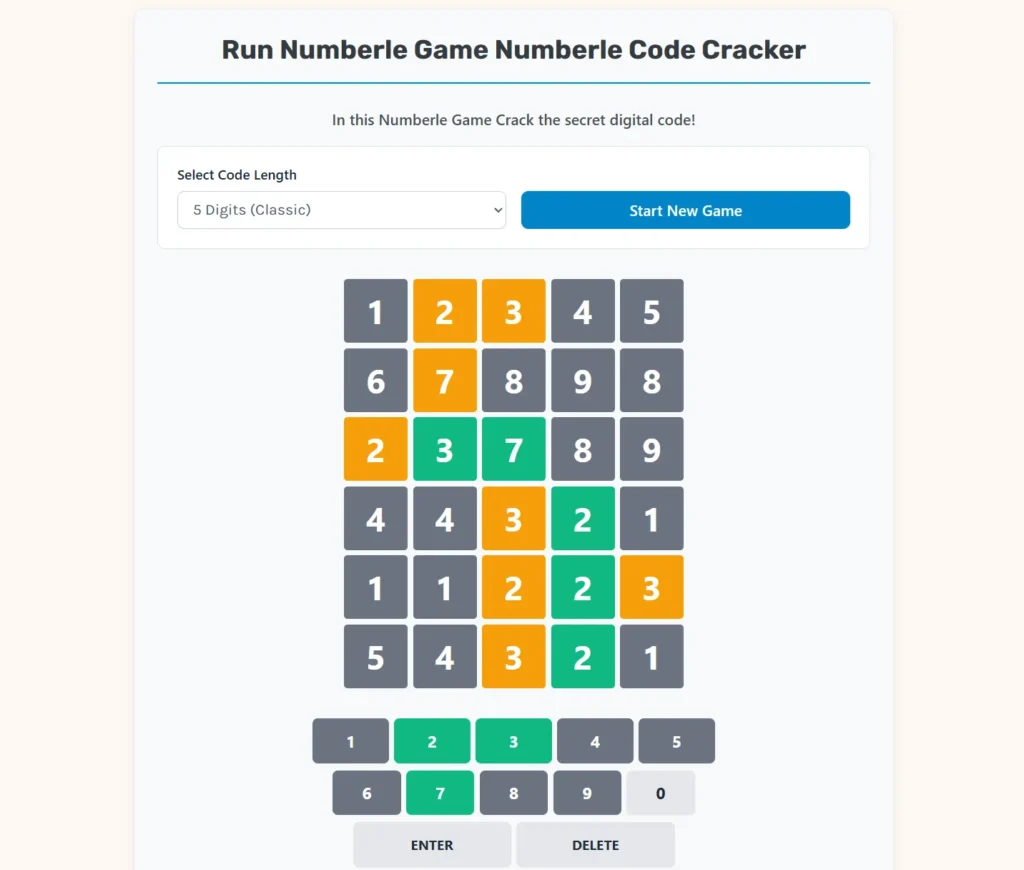
Green: The digit 4 is in the code and in the exact correct spot.
Yellow/Amber: The digit 5 is in the code, but it is currently in the wrong spot.
Gray: The digit 6 is completely absent from the secret code.
Technical Architecture of Numerical Deduction Engines
Online code-breaking applications represent a pure implementation of discrete combinatorial search and deductive logic. Unlike word-based deduction games that rely on static linguistic dictionaries, a numerical code solver operates within a bounded, fully deterministic mathematical state space.
The primary objective of a numerical code cracker is to identify a secret sequence of digits within a fixed maximum number of attempts, typically six turns. The underlying engine generates a hidden sequence based on a user-defined length parameter, creating an interactive system governed by probability theory and information reduction.
+-----------------------------------------------------------------------+
|                    NUMERICAL CODE GRID ARCHITECTURE                   |
+---+---+---+---+---+---+---+---+---+---+---+---+---+---+---+---+---+---+
| Position 1 | Position 2 | Position 3 | Position 4 | Position 5 (Mode) |
+---+---+---+---+---+---+---+---+---+---+---+---+---+---+---+---+---+---+
|   [Digit 0-9]   |   [Digit 0-9]   |   [Digit 0-9]   |   [Digit 0-9]   |
+-----------------------------------------------------------------------+
Every submitted sequence undergoes a deterministic two-pass evaluation process before the system delivers color-coded feedback to the player:
- Exact Positional Identification: The algorithm compares the submitted digit sequence against the secret sequence position by position. Matches in both digit value and index position are flagged as correct and consumed from further processing within that evaluation cycle.
- Permutational Presence Analysis: Unmatched digits in the guess are evaluated against the remaining unconsumed digits of the target sequence. Matches in digit value that occur at incorrect index positions are flagged as present, preventing duplicate feedback signals on repeated digits.
This dual-pass validation model guarantees mathematical consistency, eliminating ambiguity during state transitions.
Core Mechanics and System Rules
To interact effectively with the numerical code cracker engine, every submitted attempt must conform to strict structural and logical boundary conditions.
                                SYSTEM RULES
                                     |
    +--------------------------------+--------------------------------+
    |                                |                                |
    v                                v                                v
[Length Options]            [Zero Permissibility]           [Duplicate Processing]
  • 4 Digits (Easy)           • Leading Zeros Allowed         • First Pass: Exact Matches
  • 5 Digits (Classic)        • Range: 0000 to 9999           • Second Pass: Shifted Matches
  • 6 Digits (Hard)           • Equal Index Weighting         • Single-Use Consumption Rule
Structural Sequence Allocation
- Variable Sequence Length: Players can select sequence lengths of 4, 5, or 6 digits prior to initiating a game session. The length parameter directly determines the dimensions of the active guessing grid.
- Permissibility of Leading Zeros: Unlike standard arithmetic equations where leading zeros are mathematically invalid, numerical code cracking treats zero strictly as a positional digit symbol. Sequences such as
0042or01985are valid state entries. - Digit Recurrence: Digits may repeat within the target sequence without restriction. A target code may consist of distinct digits (such as
14920), partial repetitions (such as55120), or uniform repetitions (such as77777).
Algorithmic Feedback Priority
The system updates visual elements based on a strict priority hierarchy:
- Correct (Emerald Green): The digit exists within the secret sequence and occupies the exact evaluated slot position.
- Present (Amber Yellow): The digit exists within the secret sequence but is currently placed in an incorrect slot position.
- Absent (Slate Gray): The digit does not exist anywhere within the remaining unconsumed pool of the target code.
Combinatorial Search Space and Probability Analysis
The mathematical complexity of the numerical code cracker is governed by permutations with replacement. Because each position in the code can independently select any digit from the set {0, 1, 2, 3, 4, 5, 6, 7, 8, 9}, the search space size scaled by sequence length k is defined mathematically.
Search Space Cardinality
The total number of unique candidate codes S for a given length k is expressed as:
The table below highlights how increasing the sequence length exponentially expands the candidate state space and decreases the baseline probability of an initial unassisted correct guess.
| Mode / Length | Total Digits (k) | Total Search Space (S) | Initial Guess Probability |
| Easy | 4 | 104 = 10,000 | 1 / 10,000 = 0.0001 (0.01%) |
| Classic | 5 | 105 = 100,000 | 1 / 100,000 = 0.00001 (0.001%) |
| Hard | 6 | 106 = 1,000,000 | 1 / 1,000,000 = 0.000001 (0.0001%) |
Probability of Digit Recurrence
The probability that a randomly generated code contains at least one repeated digit increases significantly as sequence length grows. This relationship is calculated by subtracting the probability of selecting a code with completely unique digits from 1:
Where P(10, k) represents the number of k-permutations of 10 elements:
- For 4-Digit Sequences:
P(Unique) = (10 × 9 × 8 × 7) / 10,000 = 5,040 / 10,000 = 0.504
P(Recurrence) = 1 – 0.504 = 0.496 (49.60%) - For 5-Digit Sequences:
P(Unique) = (10 × 9 × 8 × 7 × 6) / 100,000 = 30,240 / 100,000 = 0.3024
P(Recurrence) = 1 – 0.3024 = 0.6976 (69.76%) - For 6-Digit Sequences:
P(Unique) = (10 × 9 × 8 × 7 × 6 × 5) / 1,000,000 = 151,200 / 1,000,000 = 0.1512
P(Recurrence) = 1 – 0.1512 = 0.8488 (84.88%)
Consequently, in the Classic 5-digit mode, nearly 70% of all secret codes contain at least one duplicate digit, making double-digit management a core component of optimal play.
Information Theory and Entropy Reduction
The deduction process can be systematically evaluated using Claude Shannon’s Information Entropy. Each submitted sequence acts as an information query that partitions the remaining valid candidate space into feedback subsets.
Shannon Entropy Formula
The theoretical information entropy H(X) measured in bits for a set of possible feedback outcomes X is given by:
Where:
- N represents the total number of possible feedback patterns for a sequence length k, bounded by 3k.
- p(xi) represents the probability of receiving feedback pattern xi from the set of active valid candidate codes.
Feedback Partitioning in 5-Digit Mode
In 5-digit mode, there are 35 = 243 theoretical feedback permutations. An optimal guess maximizes expected entropy gain H(X), dividing the remaining code candidates into equal-sized partitions to eliminate the largest possible number of invalid states per turn.
                      SEARCH SPACE REDUCTION FLOW
                                   |
         +-------------------------+-------------------------+
         |                                                   |
         v                                                   v
[Initial Space: 100,000]                            [Guess #1 Partition]
  • High Uncertainty                                  • Maximize Unique Digits
  • Entropy = 16.61 bits                             • Information Gain ≈ 5.2 bits
                                                             |
                                                             v
                                                    [Remaining: ~2,700]
Step-by-Step Deductive Code-Cracking Simulation
To demonstrate how visual indicators translate into mathematical certainty, consider a 5-digit game where the hidden target sequence is:
+-----------------------------------------------------------------------+
|                        GAMEPLAY SIMULATION GRID                       |
+------+---+---+---+---+---+--------------------------------------------+
| Turn | 1 | 2 | 3 | 4 | 5 | Deductive Progress Summary                 |
+------+---+---+---+---+---+--------------------------------------------+
|  #1  | 1 | 2 | 3 | 4 | 5 | Digits 4, 5 Green; Digit 2 Yellow          |
|  #2  | 6 | 2 | 7 | 4 | 5 | Digits 4, 5 Green; Digits 2, 7 Yellow       |
|  #3  | 7 | 0 | 2 | 4 | 5 | Perfect Match: All Green                   |
+------+---+---+---+---+---+--------------------------------------------+
Turn 1 Evaluation
Submitted Sequence: 1 2 3 4 5
Slot   : [1]   [2]   [3]   [4]   [5]
Guess  :  1     2     3     4     5
Status : [A]   [P]   [A]   [C]   [C]
(C = Correct / Green, P = Present / Yellow, A = Absent / Gray)
Analysis of Turn 1 Feedback:
- Digits
4and5(Green): Slots 4 and 5 are permanently locked. - Digit
2(Yellow): Exists in the code, but cannot occupy Slot 2. It must be located in Slot 1 or Slot 3. - Digits
1and3(Gray): Eliminated completely from the active candidate pool.
Search Space Impact:
The feedback reduces the candidate set from 100,000 possibilities down to sequences matching the pattern [?][non-2][?][4][5], where 2 is present in slot 1 or 3, and digits 1 and 3 are excluded. The remaining search space shrinks to approximately 126 candidates.
Turn 2 Evaluation
The player introduces fresh digits (6, 7) while testing digit 2 in Slot 2’s adjacent space (Slot 2 to Slot 2 shift checked in Slot 2’s position).
Submitted Sequence: 6 2 7 4 5
Slot   : [1]   [2]   [3]   [4]   [5]
Guess  :  6     2     7     4     5
Status : [A]   [P]   [P]   [C]   [C]
Analysis of Turn 2 Feedback:
- Digits
4and5(Green): Retained in Slots 4 and 5. - Digit
2(Yellow): Proved absent from Slot 2. Because it was also proven absent from Slot 2 on Turn 1, digit2must occupy Slot 3. - Digit
7(Yellow): Exists in the target code, but not in Slot 3. - Digit
6(Gray): Eliminated.
Deductive State Convergence:
- Slot 4 is
4. - Slot 5 is
5. - Slot 3 must be
2(since Slots 2 and 3 yielded Yellow feedback for2). - Digit
7exists and must occupy Slot 1 or Slot 2. - Slot 1 and Slot 2 must be formed from digit
7and an unassigned valid digit.
Turn 3 Evaluation
Testing digit 7 in Slot 1, placing 2 in Slot 3, and introducing digit 0 in Slot 2.
Submitted Sequence: 7 0 2 4 5
Slot   : [1]   [2]   [3]   [4]   [5]
Guess  :  7     0     2     4     5
Status : [C]   [C]   [C]   [C]   [C]
All 5 slots return Emerald Green. The code is solved in three moves using elimination logic.
Strategic Framework for High-Efficiency Code Cracking
Achieving consistent victories within three to four turns requires a structured approach that maximizes information gain per attempt.
                      STRATEGIC WORKFLOW
                              |
       +----------------------+----------------------+
       |                                             |
       v                                             v
[Phase 1: Exploration]                       [Phase 2: Convergence]
  • Sweep Unique Digits                        • Lock Correct (Green) Slots
  • Minimize Initial Repetitions               • Shift Present (Yellow) Tokens
  • Eliminate 50%+ of Digit Pool               • Test Unassigned Open Positions
1. Broad Digit Sweeping in Early Turns
The primary objective during turns 1 and 2 is digit coverage rather than immediate position locking.
- Opening Guess 1: Submit five unique, mid-frequency digits (such as
1 2 3 4 5). - Opening Guess 2: Submit the remaining five unused digits (such as
6 7 8 9 0).
By evaluating ten unique digits across the first two turns, the player establishes the precise list of present digits required to assemble the secret code, reducing the puzzle to a pure positional permutation problem by Turn 3.
2. Handling Duplicate Digit Feedback Rules
When a target code contains fewer instances of a digit than the player’s guess, the engine applies consumption rules:
Target Code : 1 - 2 - 9 - 4 - 2  (Two 2s present)
Player Guess: 2 - 2 - 2 - 8 - 3  (Three 2s guessed)

Evaluation Results:
- Slot 1 (Guess '2'): Yellow (Matches 2 in Slot 5)
- Slot 2 (Guess '2'): Green  (Exact match with 2 in Slot 2)
- Slot 3 (Guess '2'): Gray   (No third '2' exists in target)
A Gray indicator on a duplicate digit does not mean the digit is absent from the entire code. It indicates that the target code does not contain additional instances of that digit beyond those already accounted for by Green or Yellow indicators.
Comparative Analysis: Code Deduction vs. Lexical/Arithmetic Puzzles
Understanding how numerical code cracking differs from word-guessing and arithmetic-equation tools illustrates its computational characteristics.
| Dimension | Lexical Puzzles (Wordle) | Arithmetic Puzzles (Nerdle) | Code Crackers (Numberle) |
| Domain Base | Natural language lexicon | Axiomatic equations (LHS = RHS) | Pure positional digit sequences |
| Alphabet Size | 26 English letters | 15 tokens (10 digits, 5 symbols) | 10 digital symbols (0 through 9) |
| Structural Logic | Phonetic / Orthographic | Mathematical equality / PEMDAS | Positional permutations |
| Leading Zeros | Not applicable | Strictly prohibited | Fully permitted (0123) |
| Search Constraints | Static word list dictionary | Mathematical balance equations | Unconstrained digit positions |
| Recurrence Rules | Linguistic letter frequencies | Arithmetic identity constraints | Uniform positional probability |
Cognitive Development and Applied Learning
Engaging with numerical code breaking tools supports working memory and structural problem-solving abilities.
                           EDUCATIONAL VALUE
                                   |
    +------------------------------+------------------------------+
    |                              |                              |
    v                              v                              v
[Working Memory]              [Combinatorial Logic]         [Hypothesis Testing]
  • Track active digits         • Spatial permutations        • Scientific method
  • Retain position constraints • Probability calculation     • Systematic state reduction
1. Enhancing Working Memory Capacity
Players must mentally retain multiple constraints simultaneously:
- Digits confirmed as present but unplaced.
- Positions explicitly ruled out for specific digits.
- Digits completely eliminated from the candidate pool.
This process strengthens working memory and spatial tracking skills.
2. Practical Application of the Scientific Method
Each guess functions as a controlled experiment:
- Formulate Hypothesis: Construct a sequence based on prior feedback.
- Execute Test: Submit the sequence to the engine.
- Analyze Empirical Data: Interpret the resulting color pattern.
- Refine Model: Adjust positional assumptions for the next turn.
Input Validation and Technical Troubleshooting Matrix
The table below outlines common user input issues, operational triggers, and corrective steps.
| Issue Indication | Root Cause | System Behavior | Resolution Strategy |
| “Not enough digits” Toast | Attempting to press Enter before filling all active grid slots. | Submission blocked; row state preserved. | Complete all empty slot boxes using the onscreen or physical keypad before submitting. |
| Unexpected Gray on Repeated Digit | Guess contains more instances of a digit than exist in the target code. | Surplus instances render Gray; valid instances render Green/Yellow. | Recognize that previous Green or Yellow indicators account for all valid instances of that digit. |
| Keyboard Color Override | Higher-priority state replacing a lower-priority state. | Key color upgrades from Gray or Yellow to Green. | Use the onscreen keypad to track the highest confirmed state for each digit. |
| Grid Column Shift on Option Change | User changed digit count setting mid-game. | Active session resets; grid rebuilds to new column dimension. | Select the desired digit length (4, 5, or 6) prior to entering initial guesses. |
Academic Foundations and Scientific References
The algorithms powering code deduction games draw upon information theory and discrete optimization techniques published in scientific literature.
Knuth, D. E. (1977). The Computer As Master Mind. Journal of Recreational Mathematics, 9(1), 1–6.
Shannon, C. E. (1948). A Mathematical Theory of Communication. Bell System Technical Journal, 27(3), 379–423.
Stuckman, J., & Zhang, G. (2012). Mastermind Revisited: Satisfiability and Complexity of Combinatorial Games. Computer Science Review, 6(5), 163–178.
Donald Knuth demonstrated that four-marker code-breaking puzzles with six color options can be solved in five attempts or fewer using a minimax strategy that minimizes the maximum size of the remaining candidate pool. Applying Knuth’s algorithm to a ten-digit, five-position game guarantees a solution within six turns under optimal play.
Frequently Asked Questions
Can a secret code start with the digit zero?
Yes. In this numerical code cracker, zero is treated as a valid positional symbol rather than an arithmetic magnitude indicator. Codes such as 0123 or 00895 are fully valid target states.
How does the system evaluate duplicate digits in a guess?
The evaluation uses a two-pass algorithm. The first pass identifies and locks exact positional matches (Green), consuming those digits from both the target and guess arrays. The second pass evaluates remaining unmatched digits from left to right, marking present instances (Yellow) until the pool of unconsumed target digits is exhausted. Any additional guess instances render Gray.
What is the difference between Easy, Classic, and Hard modes?
Modes differ by code length:
- Easy Mode (4 Digits): Offers a search space of 10,000 possibilities.
- Classic Mode (5 Digits): Offers a search space of 100,000 possibilities.
- Hard Mode (6 Digits): Offers a search space of 1,000,000 possibilities.
All modes grant six attempts to deduce the secret code.
Why did a digit turn Yellow on my previous guess but Gray on my latest guess?
A digit turns Gray if your current guess includes more instances of that digit than exist in the secret code, provided the valid instances were already matched by other positions in the same turn.
What is the optimal opening strategy for 5-digit mode?
The most effective opening strategy tests ten unique digits across the first two turns (for example, guessing 1 2 3 4 5 on Turn 1 and 6 7 8 9 0 on Turn 2). This eliminates all absent digits and identifies the exact set of present digits required to solve the code.