2048 Game
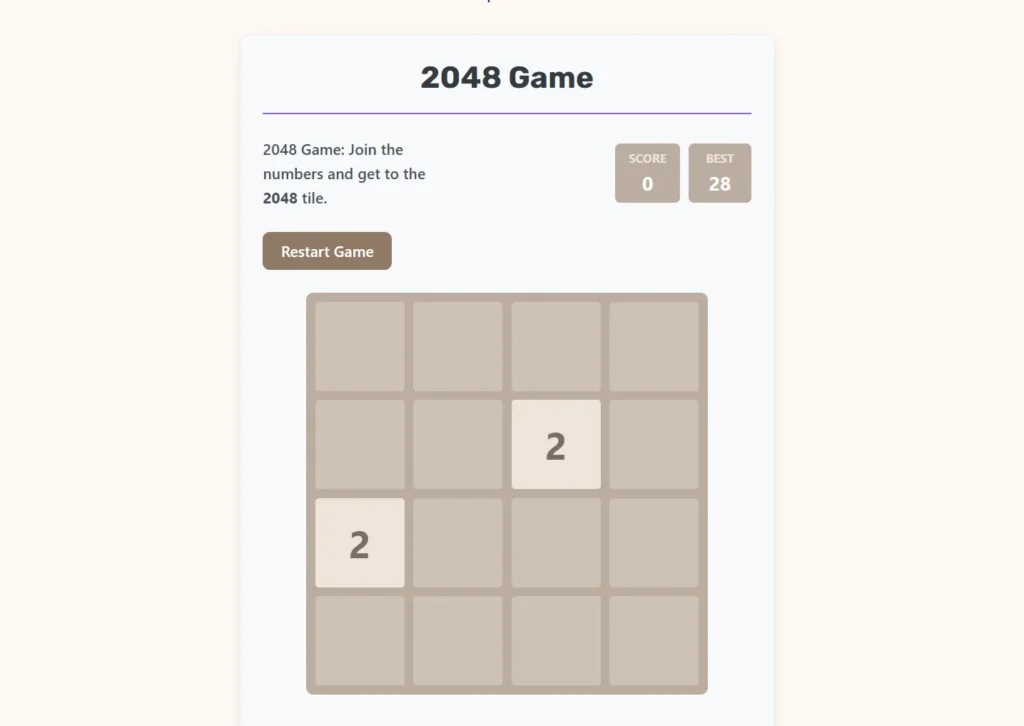
2048 Game: Join the numbers and get to the 2048 tile.
How to Play
Controls
Desktop: Use your Arrow Keys or W, A, S, D to move the tiles.
Mobile: Swipe across the game board in the direction you want the tiles to slide.
The Rules
- Tiles with the same number merge into one when they touch.
- When two tiles merge, their values add together (e.g., 2 + 2 = 4).
- Add them up to reach 2048!
- The game ends when the board is full and no more tiles can merge.
Comprehensive Guide to 2048: Mathematics, Strategic Optimizations, and Algorithmic Analysis
The game of 2048 is a mathematically structured, single-player sliding tile puzzle that serves as a profound model for state transition logic, probability theory, and discrete optimization. While it is widely enjoyed as a recreational puzzle, computer scientists and mathematicians analyze the grid as a finite state Markov Decision Process (MDP). This manual outlines the historical context, mathematical proofs, programmatic mechanics, and advanced strategic systems required to master the puzzle and understand its underlying algorithmic complexity.
Conceptual Definition and Origin of the Game
The game of 2048 was designed in March 2014 by Italian web developer Gabriele Cirulli. It was built as a single-weekend project in JavaScript and published as open-source software on GitHub. Cirulli based his design on two earlier mobile games: Asher Vollmer’s puzzle Threes and the clone 1024 by Ve聯evo. The puzzle captured global attention, accumulating millions of plays within its first week of release due to its clean visual feedback, simple control set, and deceptively challenging strategic depth.
At its core, 2048 operates as a discrete-time, grid-based numerical calculator. The playing field consists of a 4 × 4 matrix where tiles slide in one of four cardinal directions. The mathematical goal is to execute a sequence of directional slides that forces matching tiles to combine, systematically doubling their values until a tile containing the integer 2048 is produced.
The Mathematical Foundations of 2048
To analyze the behavior of the grid on a scientific level, we must formalize its elements using algebraic properties, probability distributions, and geometric series.
1. Inductive Proof of Tile Values
Every tile that appears on the board is a power of 2. This rule governs the entire game and can be mathematically verified through mathematical induction.
Theorem: For any tile value v present on the board at any state, v = 2k, where k is a positive integer.
- Base Case: At the start of the game, the board is initialized with two tiles. By default, these initial spawns are valued at either 2 or 4. Since 2 = 21 and 4 = 22, the theorem holds true for the initial state.
- Inductive Hypothesis: Assume that at a given turn t, all tiles on the board are represented by powers of 2, such that any tile x satisfies the equation x = 2p for some positive integer p.
- Inductive Step: To transition from turn t to turn t + 1, the player makes a slide. Only two mathematical operations can introduce or modify tile values on the board during this transition:
- A new tile is spawned by the engine in an empty cell. The game rules dictate this tile must be either a 2 (21) or a 4 (22), both of which are powers of 2.
- Two existing adjacent tiles of identical value, y1 and y2, collide and merge into a single tile Y.
2. Probability Distribution of Random Spawns
The stochastic complexity of the game is driven by the random tile generator. After every valid move, the board engine selects an open coordinate uniformly at random and inserts a new tile. The probability distribution of the value of this new tile is defined as:
This split introduces a crucial risk factor for strategic planning. While players can predict that a 2 will appear 90 percent of the time, they must maintain a buffer to absorb the unexpected appearance of a 4, which can break ascending numerical chains.
3. Theoretical Upper Limits of the Board
A common inquiry in computational combinatorics is determining the absolute maximum tile value that can be physically achieved on a standard 4 × 4 board.
To calculate this, we assume an ideal scenario where the player systematically builds a perfect chain across all 16 cells. Let the cell values be arranged in a continuous geometric progression from the smallest possible tile to the largest.
If the board is completely full and no further merges are possible, the values of the cells must all be distinct and sequential to prevent merging. If we get extremely fortunate and the final tile spawned on the board is a 4, the progression of the 16 cells would look as follows:
This sequence shows that under absolute best-case conditions, the maximum achievable tile on a standard 4 × 4 board is 217, which equals 131,072. If the final spawned tile is a 2 instead of a 4, the maximum possible tile is 216, which equals 65,536.
Step-by-Step Transition Analysis
The core mechanic of the game revolves around sliding a row or column vector. When a player commands a slide, the tiles in each vector move as far as possible toward the target edge. They slide over empty spaces, and if they impact a tile of identical value, they merge.
To ensure clarity for programmers and researchers developing solvers, let us examine a detailed step-by-step vector compression. We will analyze a single row vector of length 4 under a “Left Slide” command.
Initial Row State
Below is the initial configuration of the row, containing empty spaces (represented by 0) and active numerical values.
+--------+--------+--------+--------+
|   2    |   0    |   2    |   4    |
+--------+--------+--------+--------+
Step 1: Shift Phase (Zero Removal)
The engine first compresses the vector by shifting all non-zero elements to the left, removing the gap.
+--------+--------+--------+--------+
|   2    |   2    |   4    |   0    |
+--------+--------+--------+--------+
Step 2: Merge Phase (Left-to-Right Evaluation)
The engine evaluates adjacent elements starting from the left index. It checks if the first element equals the second element:
- Cell 1 (value 2) and Cell 2 (value 2) match.
- They merge to form a single tile of value 4.
- The second cell is temporarily marked as empty (0).
- The third cell (value 4) is not merged because the merge operation does not cascade recursively in a single turn.
+--------+--------+--------+--------+
|   4    |   0    |   4    |   0    |
+--------+--------+--------+--------+
Step 3: Final Shift Phase (Re-alignment)
The engine runs a secondary compression pass to eliminate the newly created empty space in the second cell, pulling the remaining 4 to the left.
+--------+--------+--------+--------+
|   4    |   4    |   0    |   0    |
+--------+--------+--------+--------+
This sequence is highly structured to prevent triple merges from combining into a single massive value in one turn. For example, if a row is filled with [2, 2, 2, 2] and pushed left, it collapses into [4, 4, 0, 0] in a single turn, rather than collapsing into [8, 0, 0, 0].
Scoring Calculations and Move Statistics
In our game engine, scores are not arbitrary. They are calculated based on the cumulative value of all merged tiles.
Merge Value Formulas
When two tiles of value v merge to form a new tile of value 2v, the player’s cumulative score increases by exactly 2v.
For example, merging two 2-tiles adds 4 points to the score. Merging two 1024-tiles adds 2048 points to the score. Tiles that spawn directly onto the board (the initial 2s and 4s) do not contribute to the score.
The total score required to build a single tile of value 2n can be calculated using summation. Because every merge of a tile of value 2k requires two tiles of value 2k – 1, we can define the total points S accumulated in creating a single tile of value 2n starting purely from 2-spawns:
Using algebraic simplification, we arrive at a clean expression for the point value of a single high-tier tile:
Using this formula, we can calculate the exact cumulative merge scores required to build popular milestone tiles:
| Target Tile Value | Exponent (n) | Theoretical Minimum Merge Score Required |
| 16 | 4 | (4 – 1) × 16 = 48 points |
| 64 | 6 | (6 – 1) × 64 = 320 points |
| 256 | 8 | (8 – 1) × 256 = 1,792 points |
| 1024 | 10 | (10 – 1) × 1024 = 9,216 points |
| 2048 | 11 | (11 – 1) × 2048 = 20,480 points |
| 4096 | 12 | (12 – 1) × 4096 = 45,056 points |
💡 Note: The actual score displayed during a game will be slightly lower if some of the constituent tiles spawned as 4s instead of 2s, as those 4s did not require an initial merge of two 2s.
Move Count Metrics
Statistical models show that to successfully build a 2048 tile, a player must survive a long series of moves. Because each turn introduces a value of either 2 or 4 (with an expected average spawn value of 2.2 per turn), we can estimate the minimum number of moves required to achieve a win.
To reach a total board value of 2048, the average number of moves required is approximately 938.8. This demonstrates that winning 2048 is a marathon of consistency, requiring the player to maintain a clean board layout over hundreds of state transitions without a single catastrophic error.
Strategic Play and Optimization Frameworks
Achieving the 2048 tile consistently requires moving away from random swiping and adopting structured, deterministic play styles. Expert players and AI models use three primary strategic pillars to manage the grid.
1. The Corner Anchor Strategy
This is the most critical strategic rule in 2048. The player must choose one of the four corners of the board (for example, the bottom-right corner) and ensure that the highest-valued tile remains locked in that exact cell throughout the entire game.
Anchoring the maximum tile in a corner provides two major structural benefits:
- → It restricts the movement of your most valuable assets, preventing them from wandering into the center of the board where they can easily get trapped or surrounded by small values.
- → It maximizes the number of available adjacent cells for building smaller tiles, which can then be funneled into the main corner tile.
+--------+--------+--------+--------+
|   2    |   4    |   8    |   16   |
|   4    |   8    |   16   |   128  |
|   8    |   16   |   64   |   512  |
|   16   |   32   |   256  |  [1024]|  <-- Anchor Cell (Bottom-Right)
+--------+--------+--------+--------+
To maintain this anchor, you must select two primary directional moves that match your corner. If your anchor is in the bottom-right, your primary directional controls are Down and Right.
By restricting your inputs to these directions, you ensure that the tiles are pushed toward the anchor, leaving the opposite edges open to receive new, low-value spawns.
2. Monotonicity and the Serpentine Flow Pattern
Monotonicity refers to keeping the values on your board organized in a strictly descending or ascending order along a continuous, snake-like path. This path, known as a serpentine flow, starts at your anchor cell and twists across the rows of the board.
+--------+--------+--------+--------+
|   2    |   0    |   0    |   0    |  <-- Path starts here with low values
+--------+--------+--------+--------+
|   4    |   8    |   16   |   32   |
+--------+--------+--------+--------+
|   256  |   128  |   64   |   32   |  <-- Flow reverses direction
+--------+--------+--------+--------+
|  [512] |  [1024]|  [2048]|  [4096]|  <-- High value row ending at anchor
+--------+--------+--------+--------+
When your board maintains strict monotonicity, slides resolve in clean, predictable merges that cascade down the chain. For example, if a 2 merges with a 2 to form a 4, that 4 is already adjacent to an existing 4, allowing it to merge into an 8, which is adjacent to an 8, and so on. This prevents isolated tiles from becoming blocked by higher-valued neighbors.
3. The Perils of the Forbidden Direction
If you anchor your highest tile in the bottom-right corner, your forbidden direction is Up. Swiping in this direction can ruin a promising run.
If you are forced to swipe Up because your other directions are temporarily locked, every tile on the board is lifted off the bottom row. The immediate consequence is that the bottom row becomes completely open.
Because the engine spawns a new tile after every valid move, a 2 or a 4 will likely appear in your bottom-right anchor cell. Your high-value tile is now trapped in the second row, blocked by a low-value tile beneath it, which severely limits your ability to merge and organize the board.
Algorithmic Implementations and AI Solvers
The simplicity of 2048 makes it an excellent benchmark for testing computational optimization algorithms and search heuristics.
Expectimax Search
Because 2048 is a game of perfect information with random spawns, it cannot be modeled using a standard Minimax search, which assumes an active opponent trying to minimize your score. Instead, AI solvers use the Expectimax algorithm to calculate optimal moves.
An Expectimax agent builds a multi-level search tree of possible future states. It evaluates nodes by alternating between two types of turns:
- Player Nodes: The algorithm searches the four possible sliding directions (Left, Right, Up, Down) and chooses the branch that maximizes the heuristic score of the board.
- Chance Nodes: The algorithm simulates all possible spawn positions for new tiles. It calculates the expected score of each board layout by averaging the outcomes, weighting them by spawn probabilities:
By evaluating several moves ahead, Expectimax agents can achieve the 2048 tile with a success rate of over 99 percent, often reaching the 16,384 and 32,768 tiles.
Reinforcement Learning
Modern research often compares Expectimax with Deep Reinforcement Learning models, such as Deep Q-Networks (DQNs). While DQNs learn to play by trial and error, they struggle with the long-term planning required in 2048. This is because the reward signal (the merge score) is highly sparse, making it difficult for the network to connect early-game decisions with late-game gridlock.
Cognitive and Educational Benefits
Playing 2048 is more than a way to pass the time. It offers several cognitive and educational benefits:
- ✓ Logistical Planning: Players must evaluate their choices several steps ahead, which helps develop spatial planning and working memory.
- ✓ Risk Assessment: Managing the 10 percent chance of a 4 spawn teaches players to plan for unexpected events and manage risks effectively.
- ✓ CS Pedagogy: The game is widely used in introductory computer science classes to teach array manipulation, matrix transposition, queue-based merges, and recursive tree searches.
Frequently Asked Questions
How does a 2048 calculator determine if a move is valid?
A move is considered valid if sliding the tiles in a chosen direction changes the state of the board. This change occurs if at least one tile can slide into an empty cell, or if two adjacent tiles of equal value can merge. If a slide would not change the position or value of any tile, the engine ignores the input and does not spawn a new tile.
Is it possible to win 2048 without using a corner strategy?
While it is theoretically possible to win through random play or alternative strategies, the probability of success drops significantly. Without a stable corner anchor, high-value tiles wander into the center of the grid, where they are easily cut off and surrounded by low-value spawns, quickly leading to gridlock.
Why does the game sometimes spawn a 4 instead of a 2?
The 10 percent chance of spawning a 4 is designed to disrupt predictable, repetitive play patterns. It forces players to stay alert and keep their board organized with a safety buffer, rather than relying on automated sliding routines.
Scientific and Academic References
- ✓ Lees-Miller, J. (2018). The Mathematics of 2048: Optimal Play with Markov Decision Processes. An in-depth analysis of game states using Markov chain models to calculate the expected move count of 938.8.
- ✓ Mehta, N., & Goga, A. (2025). A Comparative Study of Deep Reinforcement Learning and Expectimax Search for the Game 2048. Stanford University CS224R Research. This paper demonstrates that expectimax search agents consistently outperform deep reinforcement learning models in stochastic puzzle environments.
- ✓ Cirulli, G. (2014). 2048 Original Source Code and Game Specification. Published open-source on GitHub, establishing the standard rules for row and column merges.