Run Free Sudoku Game
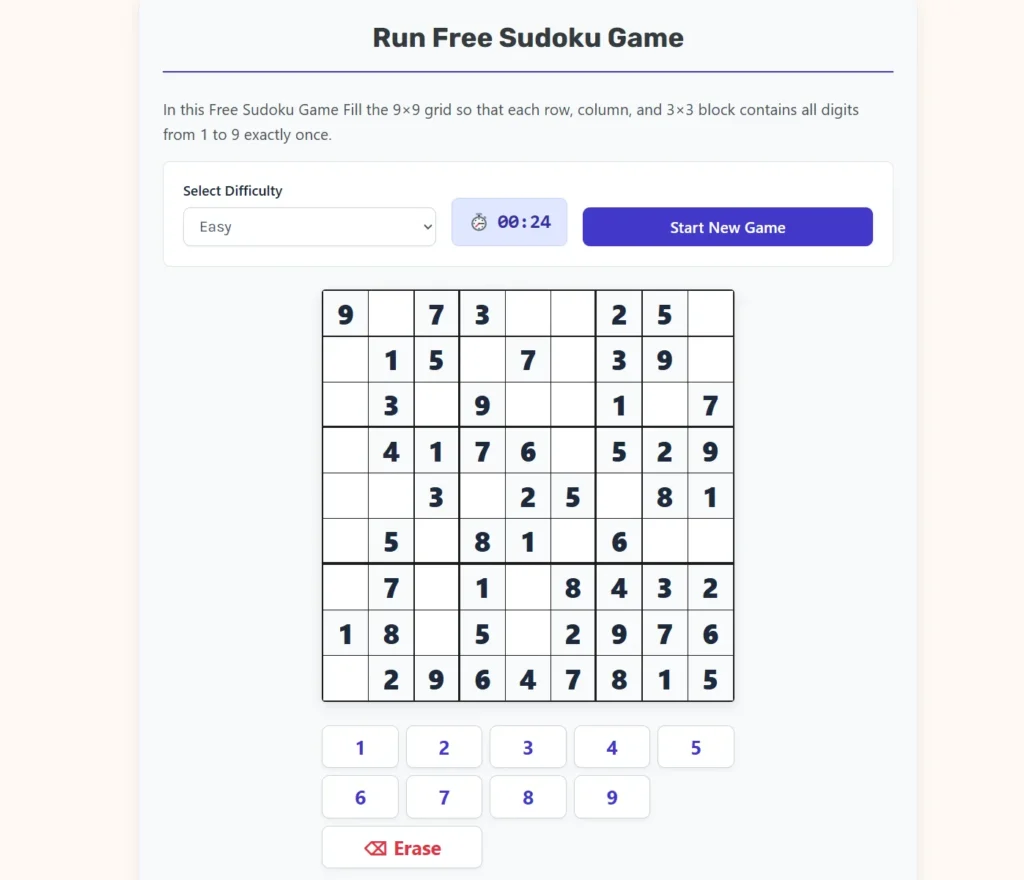
In this Free Sudoku Game Fill the 9×9 grid so that each row, column, and 3×3 block contains all digits from 1 to 9 exactly once.
How to Play
The Rules of Sudoku
- The grid consists of 81 squares divided into nine 3×3 blocks.
- Each of the 9 blocks must contain all the numbers 1 through 9.
- Each row must contain the numbers 1 through 9 exactly once.
- Each column must contain the numbers 1 through 9 exactly once.
Controls
Desktop Users: You can click on a cell and type a number using your keyboard. Use the Arrow Keys to quickly navigate around the board, and Backspace/Delete to clear a cell.
Mobile Users: Tap a cell to select it, then tap a number on the keypad below the board to place it.
💡 Pro Tip: If you enter a number that violates the rules (already exists in that row, column, or block), it will turn Red.
Guide to Sudoku: Mathematics, History, and Advanced Logic
Sudoku is one of the most popular logic-based puzzle games in modern history. Millions of players engage with its structured grid daily to stimulate mental activity, practice pattern recognition, or experience the satisfaction of structural order. Despite its reliance on numbers, the game does not involve arithmetic calculations. It is a game of pure deductive logic, structural constraints, and systematic elimination.
This manual details the entire scope of Sudoku, covering historical antecedents, mathematical grid structures, programmatic generation algorithms, and solving strategies ranging from basic visual scans to complex advanced elimination schemes. Whether you are a beginner looking to solve your first puzzle or a mathematics enthusiast analyzing grid constraints, this guide provides a structured, comprehensive foundation.
The Conceptual Origins and History of Sudoku
The structural ancestor of the modern Sudoku grid is the Latin Square, which was extensively studied by the Swiss mathematician Leonhard Euler in the late eighteenth century. A Latin Square of order n is an n × n grid filled with n distinct symbols, such that each symbol appears exactly once in each row and exactly once in each column.
While Euler laid the mathematical foundation for these grids, the game played today emerged much later. In 1979, an American puzzle architect named Howard Garns designed and published the first modern grid in Dell Pencil Puzzles and Word Games under the name “Number Place”. Garns introduced a critical refinement to Euler’s Latin Square: he divided the 9 × 9 grid into nine independent 3 × 3 subgrids, adding a third spatial constraint to the game.
The puzzle gained international status when it was introduced to Japanese audiences by Nikoli in 1984 under the name “Sūji wa dokushin ni kagiru”, which translates to “the digits must remain single”. This phrase was eventually shortened to “Sudoku”, which has become the universal term for this deductive challenge.
Historical Milestone: Euler’s Magic Squares Research
In 1782, Leonhard Euler published his seminal paper Recherches sur une nouvelle espèce de quarrés magiques. This work established the principles of orthogonal Latin squares, which dictate the rule structures used in modern constraint-satisfaction games.
The Mathematical Formulation of Sudoku
To understand the game on a formal level, we can model a Sudoku grid as a matrix. Let M be a 9 × 9 matrix where the cell at row r and column c is denoted as Mr, c. The value inside each cell must belong to the set of integers S = {1, 2, 3, 4, 5, 6, 7, 8, 9}.
A completed Sudoku grid must satisfy three simultaneous mathematical conditions:
1. Row Uniqueness Constraint
For any row r, every element in that row must be distinct. Formally:
Mr, c1 ≠ Mr, c2 for all c1 ≠ c2 where c1, c2 ∈ {1, 2, 3, 4, 5, 6, 7, 8, 9}
An algebraic consequence of this uniqueness is that the sum and product of any given row must equal the sum and product of the set S:
Σc=19 Mr, c = 45 and ∏c=19 Mr, c = 362,880
2. Column Uniqueness Constraint
For any column c, every element in that column must be distinct. Formally:
Mr1, c ≠ Mr2, c for all r1 ≠ r2 where r1, r2 ∈ {1, 2, 3, 4, 5, 6, 7, 8, 9}
Similarly, this implies:
Σr=19 Mr, c = 45 and ∏r=19 Mr, c = 362,880
3. Subgrid (Nonet) Uniqueness Constraint
Let the 9 × 9 grid be divided into nine 3 × 3 subgrids, which we refer to as nonets. Each nonet is indexed by a block coordinate (br, bc) where br, bc ∈ {0, 1, 2}. The cells belonging to nonet (br, bc) are defined as:
M3br + i, 3bc + j for all i, j ∈ {1, 2, 3}
All nine values within this set must be distinct and contain every element of the set S.
Combinatorics and Grid Complexity
The number of valid, distinct 9 × 9 Sudoku solution grids is surprisingly large. In 2005, researchers Bertram Felgenhauer and Frazer Jarvis calculated this exact value to be:
6,670,903,752,021,072,936,960
This value can be written in scientific notation as approximately 6.67 × 10²¹. When we eliminate symmetrical variations (such as rotations, reflections, and number relabeling), we arrive at 5,472,730,538 geometrically unique solutions. This immense search space is what allows generators to produce virtually endless distinct puzzles.
How Online Sudoku Puzzles are Generated
Creating a valid Sudoku puzzle requires two distinct computational stages: board generation and board carving.
| Generation Phase | Computational Action | Objective |
| 1. Grid Solvability | Randomized backtracking algorithms seed values across a blank matrix. | To produce a fully solved, mathematically valid 9 × 9 board. |
| 2. Solitary Seeding | Specific coordinates are targeted and cleared according to selected difficulty. | To reduce the board to a playable, unique puzzle state. |
| 3. Logical Sufficiency | Checks are performed to ensure the remaining clues support a single unique solution path. | To prevent ambiguous boards that have multiple valid completions. |
The Backtracking Algorithm
To generate a full, valid board, the game software uses a recursive depth-first search algorithm known as backtracking. The generator scans the grid cell by cell:
- → It attempts to place a random number from 1 to 9 in the current cell.
- → It verifies whether the placement satisfies the row, column, and subgrid constraints.
- → If the placement is valid, it proceeds recursively to the next cell.
- → If a conflict arises later in the grid, the algorithm backtracks to the previous cell, clears the value, and tries the next available candidate.
This recursive approach guarantees that the resulting board is completely resolved and structurally perfect.
The Minimum Clue Limit
Once a complete board is generated, cells are systematically removed (or “carved”) to create the puzzle. A critical mathematical question in Sudoku theory is: What is the absolute minimum number of clues required to yield a single, unique solution?
In 2012, an exhaustive academic study led by Gary McGuire at University College Dublin used high-performance computing to solve this problem. The researchers proved that a 9 × 9 Sudoku puzzle must contain at least 17 clues to have a unique solution. Any puzzle with 16 clues or fewer will inevitably yield multiple valid solutions, rendering it invalid under standard competitive rules.
Academic Reference
McGuire, G., Bastian, B., & Civario, G. (2014). There is no 16-clue Sudoku: Solving the Sudoku minimum number of clues problem via exhaustive search. Journal of Computational Combinatorics. This paper confirmed that 17 remains the structural threshold for uniqueness.
Step-by-Step Strategic Play Guide
Solving a Sudoku puzzle is a process of eliminating candidates until only one possible number remains for each cell. Below is a structured collection of the most effective solving strategies, organized by difficulty level.
Beginner Techniques
These foundational strategies rely on direct visual scans of rows, columns, and subgrids to locate immediate placements.
Sole Candidate (Naked Single)
A Sole Candidate occurs when a specific cell has only one possible candidate remaining because the other eight numbers in the set are already present in its row, column, or nonet.
+---+---+---+
| 1 | 2 | 3 |  <- Row contains: 1, 2, 3, 4, 5, 6, 7, 8
| 4 | 5 | 6 |
| 7 | 8 |[X]|  <- Cell [X] must be 9
+---+---+---+
To locate Naked Singles, focus on dense areas of the board where a row, column, and block intersect, and list the numbers already ruled out by those structures.
Unique Candidate (Hidden Single)
A Unique Candidate occurs when a number can theoretically fit into several cells within a unit, but there is only one specific cell where it is permitted because all other candidate cells are blocked by constraints in neighboring rows or columns.
This is identified by scanning parallel rows or columns. If columns 1 and 2 already contain a 5, then the 5 in the first block of column 3 must fit into the remaining open cell in that block.
Intermediate Techniques
When simple visual scans do not yield results, you must examine the interactions between neighboring groups of cells.
Naked Pairs
A Naked Pair is formed by two cells within the same unit (row, column, or block) that contain exactly the same two candidate numbers, and no others. Because these two numbers must occupy those two cells in some order, they can be safely eliminated as candidates from all other cells in that same unit.
Cell A: {2, 7}  |  Cell B: {2, 7}  <- Located in the same row.
Result: Eliminate 2 and 7 as candidates from all other cells in this row.
Applying this strategy simplifies the candidate list of surrounding cells, often revealing a chain of Naked Singles.
Pointing Pairs
Pointing Pairs occur when candidate positions for a specific number within a 3 × 3 block are aligned entirely along a single row or column. Since the number must be placed within one of those cells to satisfy the block constraint, it cannot appear anywhere else in that entire row or column outside of that block.
By identifying Pointing Pairs, you can eliminate candidates from neighboring blocks along that shared line of sight.
Advanced Techniques
These methods involve complex, multi-unit constraint mapping, used to break through difficult blocks in expert-level puzzles.
The X-Wing Strategy
The X-Wing is a powerful elimination strategy that targets four cells forming a perfect rectangle across parallel columns and rows.
To use this strategy, look for two parallel rows where a specific candidate number can only appear in exactly two columns. When you align these points, they form the corners of a rectangle.
Row 2:   . . [A] . . . [B] . .  <- Candidate '9' only fits in Col 3 or Col 7
Row 6:   . . [C] . . . [D] . .  <- Candidate '9' only fits in Col 3 or Col 7
------------------------------
Result: Eliminate '9' from all other cells in Column 3 and Column 7
Because of the diagonal nature of the options (either A and D are true, or B and C are true), the candidate number is locked into these columns. Thus, you can safely eliminate that candidate from any other cell in those two columns.
Difficulty Classification Matrix
The playability and challenge of a Sudoku puzzle depend on the number of starting clues and the specific logical tactics required to solve them.
| Difficulty | Average Starting Clues | Primary Solving Tactics Required | Target Solving Time |
| Easy | 36 to 46 clues | Sole Candidates, Unique Candidates, simple scanning. | 3 to 7 minutes |
| Medium | 32 to 35 clues | Naked Pairs, Pointing Pairs, candidate tracking. | 7 to 15 minutes |
| Hard | 22 to 27 clues | X-Wing, Swordfish, advanced candidate elimination. | 15 to 30 minutes |
The Cognitive Benefits of Playing Sudoku
Beyond entertainment, regular engagement with Sudoku offers several physiological and cognitive benefits:
- ✓ Working Memory Training: Tracking candidates across multiple rows and columns exercises short-term memory and spatial reasoning.
- ✓ Improved Executive Function: Designing systematic strategies and testing logical hypotheses strengthens problem-solving pathways in the brain.
- ✓ Stress Reduction: The high level of focus required for structural deduction provides a meditative escape, helping to lower heart rate and reduce stress.
Frequently Asked Questions
Is there any math involved in solving Sudoku?
No arithmetic is involved. The digits 1 to 9 are simply symbols used to represent distinct states. You could easily play the game using letters, geometric shapes, or colors. The underlying system is entirely logical and structural.
Can a Sudoku puzzle have more than one valid solution?
A mathematically valid Sudoku puzzle must have exactly one unique solution. Puzzles generated with multiple solutions are considered flawed. Our application runs comprehensive verification checks to ensure that every puzzle generated has a single, mathematically sound solution.
How do I get faster at solving Sudoku?
Speed increases with practice as your brain learns to recognize visual cues. Focus on tracking blocks with high clue density first, maintain a clean and organized candidate list, and practice identifying pointing pairs to quickly eliminate options.
Scientific and Academic References
- ✓ Reference 1: Euler, L. (1782). Recherches sur une nouvelle espèce de quarrés magiques. Verhandelingen uitgegeven door het zeeuwsch Genootschap der Wetenschappen te Vlissingen, 9, 85-239.
- ✓ Reference 2: Crook, J. F. (2009). A Pen-and-Paper Algorithm for Solving Sudoku Puzzles. Notices of the American Mathematical Society, 56(4), 460-468.
- ✓ Reference 3: Felgenhauer, B., & Jarvis, F. (2006). Mathematics of Sudoku I. Mathematical Spectrum, 39, 15-22.