Bonus Calculator
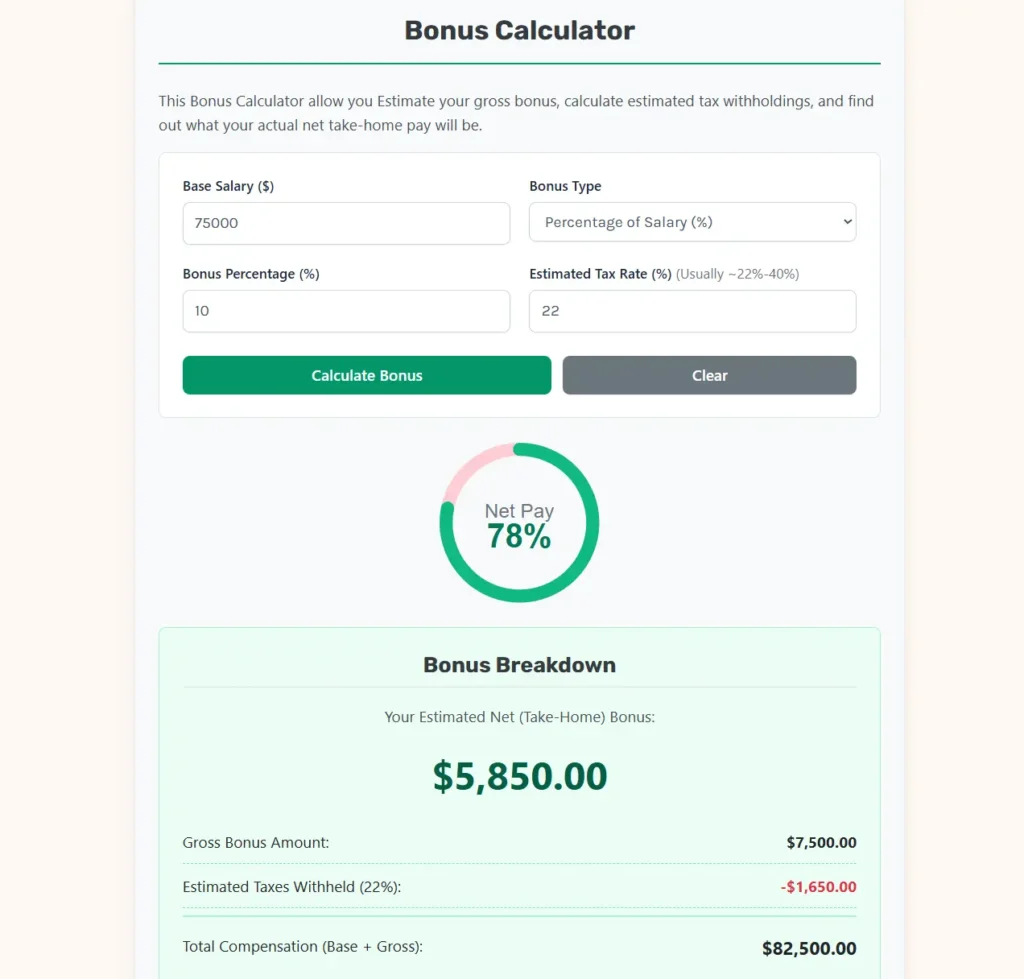
This Bonus Calculator allow you Estimate your gross bonus, calculate estimated tax withholdings, and find out what your actual net take-home pay will be.
Understanding Bonus Taxes
Why are bonuses taxed so heavily?
In many regions (like the US), bonuses are considered Supplemental Income. Because it is extra income outside your regular salary, employers are often required to withhold a flat supplemental tax rate (commonly 22% federally in the US), plus standard state, local, and payroll taxes (like Social Security/Medicare).
Formula: Net Bonus = Gross Bonus − (Gross Bonus × Tax Rate %)
The Two Withholding Methods
- Percentage Method: The employer withholds a flat rate (e.g., 22%) strictly on the bonus amount. This is the most common.
- Aggregate Method: The employer adds your bonus to your regular paycheck, calculates the tax on the total as if it were your normal salary, subtracts what was already withheld from your base, and withholds the rest. This often results in a higher initial withholding.
Mechanics of Gross-to-Net Bonus Calculations
The implementation of performance-based bonuses serves as a powerful tool to align employee incentives with organizational performance. While regular salaries provide stable, predictable financial support for staff, variable bonuses allow companies to reward outstanding achievements, hit strategic milestones, and distribute financial success.
For employees and human resource professionals alike, understanding how a gross bonus translates into net take-home pay is vital. Bonuses are classified under distinct tax codes compared to regular base salaries, which frequently leads to confusion when taxes are withheld. This guide provides a detailed breakdown of the mathematical, financial, and regulatory frameworks of bonus tax withholdings, ensuring clear guidance for both wage earners and payroll administrators.
Understanding the Strategic Importance of Variable Compensation
To evaluate the mathematical models used to calculate bonuses, we must first look at the strategic purpose of these compensation packages. Bonuses are not merely late-year gifts; they are structured incentives designed to drive specific performance behaviors.
These compensation plans typically serve several key business functions:
$\checkmark$ Performance Alignment: Linking a portion of an employee’s annual earnings to company revenue, profit, or department milestones ensures that personal productivity directly supports corporate goals.
$\checkmark$ Talent Retention: Well-structured bonus programs help retain high-performing employees by offering total compensation packages that outpace industry averages when performance targets are met.
$\checkmark$ Financial Flexibility: By using variable bonuses, companies can keep fixed operating costs (base salaries) lower during market downturns, while still rewarding employees generously during prosperous years.
The Regulatory Definition of Supplemental Wages
From a regulatory and accounting perspective, bonuses are classified as supplemental wages. The United States Internal Revenue Service (IRS) defines supplemental wages as compensation paid to an employee that is not regular, recurring base pay.
This classification covers several types of payments:
- Discretionary and Non-Discretionary Bonuses: Payments awarded either at management’s discretion or based on pre-established performance contracts.
- Commissions and Sales Incentives: Transaction-based rewards paid to sales teams for hitting volume targets.
- Overtime Pay and Shift Differentials: Extra compensation paid for working additional hours or less desirable shifts.
- Severance and Accumulated Sick Leave Pay: Lump-sum payouts distributed when an employee leaves the organization.
Because these payments are irregular and often quite large, tax agencies require employers to use different withholding methods to ensure that taxes are collected reliably.
Decoupling Withholding Rates from Final Tax Liability
The most common source of confusion regarding bonuses is the assumption that they are taxed at a higher rate than regular income. This is a misunderstanding based on the difference between tax withholding and final tax liability.
1. Tax Withholding Defined
Withholding is the temporary estimate of taxes that your employer is required by law to deduct from your paycheck and send to the government. It acts as an advance payment toward your annual tax bill.
2. Final Tax Liability Defined
Your final tax liability is the actual total tax you owe for the year, calculated when you file your annual tax return (such as IRS Form 1040).
At the end of the fiscal year, all your income—base salary, hourly wages, bonuses, and investment gains—is combined into a single figure known as your Adjusted Gross Income (AGI). The progressive tax brackets are then applied to this total.
If your employer withheld too much from your bonus, the excess is returned to you as a tax refund. If they withheld too little, you must pay the difference. Therefore, while your bonus might feel heavily taxed when you receive it, it is ultimately taxed at the exact same rate as your regular salary once your annual tax return is finalized.
The Two Primary Tax Withholding Methodologies
Employers generally choose between two primary methods when withholding federal taxes from supplemental wages. The method chosen can significantly impact the size of your take-home pay.
1. The Percentage (or Flat) Method
The percentage method is the most common way to calculate taxes on bonuses, especially when the bonus is paid as a separate check. Under this system, the federal government requires employers to withhold a flat, non-progressive tax rate directly from the gross bonus.
- Under $1 Million: In the United States, supplemental wages under $\$1,000,000$ are taxed at a flat rate of $22\%$.
- Over $1 Million: Any supplemental wages exceeding $\$1,000,000$ are taxed at the highest marginal rate, currently $37\%$.
This flat rate is easy to calculate and prevents your regular wages from being pushed into a temporarily higher tax bracket.
2. The Aggregate Method
The aggregate method is typically used when your bonus is added directly to your regular paycheck. Under this system, the payroll software combines your base pay and your bonus, then calculates withholding using standard progressive tax tables as if that combined amount were your normal rate of pay for the entire year.
This approach can lead to significant over-withholding:
- Combining a $\$5,000$ monthly salary with a $\$10,000$ one-time bonus creates a single paycheck of $\$15,000$.
- The payroll system assumes your annual earnings are $\$180,000$ ($\$15,000 \times 12$ months), rather than your actual expected income of $\$70,000$ ($\$60,000\text{ base} + \$10,000\text{ bonus}$).
- The software applies a much higher marginal tax rate to the entire paycheck, resulting in a significantly lower net payout. You will eventually recover this overpaid amount as a refund when you file your tax return, but it reduces your immediate cash flow.
Primary Variables in Bonus Modeling
To run accurate gross-to-net bonus calculations, an analyst must evaluate five primary variables.
1. Base Salary
The fixed annual or hourly wages earned by an employee, which serves as the baseline for percentage-based bonus calculations.
2. Bonus Type
The method used to define the bonus amount, which can be a flat dollar amount or a percentage of the base salary.
3. Tax and Operating Deductions
The estimated percentage of wages deducted for income taxes, local taxes, social security, and health insurance.
4. Payroll Taxes (FICA)
In the United States, employees are subject to Federal Insurance Contributions Act (FICA) taxes, which include Social Security and Medicare:
- Social Security Tax: $6.2\%$ of wages up to the annual maximum wage limit.
- Medicare Tax: $1.45\%$ of all wages, plus an additional $0.9\%$ for wages exceeding $\$200,000$.
5. Net (Take-Home) Pay
The final cash amount deposited into the employee’s bank account after all taxes and deductions are removed from the gross bonus.
Mathematical Architecture of Bonus and Tax Mechanics
To ensure clear display on mobile devices and small screen containers, these equations are broken down into narrow, vertically stacked steps.
Gross Bonus Calculation: Percentage Method
If a bonus is structured as a percentage of the employee’s base salary, the gross bonus is calculated by first converting the percentage into a decimal factor.$$P_{b} = \frac{p}{100}$$
Where:
- $\rightarrow$ $P_{b}$ represents the decimal bonus multiplier.
- $\rightarrow$ $p$ represents the raw bonus percentage input.
Next, multiply the base salary by the decimal bonus multiplier to find the gross bonus:$$B_{g} = S_{b} \times P_{b}$$
Where:
- $\rightarrow$ $B_{g}$ represents the calculated Gross Bonus.
- $\rightarrow$ $S_{b}$ represents the employee’s Base Salary.
- $\rightarrow$ $P_{b}$ represents the decimal bonus multiplier.
Gross Bonus Calculation: Flat Method
If the bonus is structured as a flat dollar amount, the Gross Bonus is equal to that flat amount directly:$$B_{g} = A_{f}$$
Where:
- $\rightarrow$ $B_{g}$ represents the Gross Bonus.
- $\rightarrow$ $A_{f}$ represents the input Flat Bonus amount.
Tax Withholding Calculation
To find the estimated tax withholding, convert the estimated tax rate into a decimal factor.$$R_{t} = \frac{r}{100}$$
Where:
- $\rightarrow$ $R_{t}$ represents the decimal tax rate.
- $\rightarrow$ $r$ represents the estimated tax percentage input.
Next, multiply the gross bonus by the decimal tax rate to find the total tax withheld:$$T_{w} = B_{g} \times R_{t}$$
Where:
- $\rightarrow$ $T_{w}$ represents the total Estimated Taxes Withheld.
- $\rightarrow$ $B_{g}$ represents the calculated Gross Bonus.
- $\rightarrow$ $R_{t}$ represents the decimal tax rate.
Net Take-Home Bonus Calculation
The net take-home bonus is the gross bonus minus the total taxes withheld.$$B_{n} = B_{g} – T_{w}$$
Where:
- $\rightarrow$ $B_{n}$ represents the net take-home bonus amount.
- $\rightarrow$ $B_{g}$ represents the Gross Bonus.
- $\rightarrow$ $T_{w}$ represents the total Estimated Taxes Withheld.
Total Combined Compensation
To find the employee’s total gross compensation, combine their base salary and their gross bonus.$$C_{t} = S_{b} + B_{g}$$
Where:
- $\rightarrow$ $C_{t}$ represents the Total Combined Compensation.
- $\rightarrow$ $S_{b}$ represents the Base Salary.
- $\rightarrow$ $B_{g}$ represents the Gross Bonus.
Comparative Tax Withholding Reference Matrix
The reference table below outlines typical tax withholding ranges for supplemental wages across various regions and income brackets, including federal, state, and payroll obligations.
| Tax Jurisdiction | Withholding Method | Standard Supplemental Rate | Key Payroll Components |
| United States (Federal) | Percentage (Flat) | $22.00\%$ | Applies to bonuses under $\$1,000,000$ |
| United States (High-Income) | Percentage (Flat) | $37.00\%$ | Applies to bonuses over $\$1,000,000$ |
| FICA (Social Security) | Fixed Percentage | $6.20\%$ | Applied up to the annual wage limit |
| FICA (Medicare) | Fixed Percentage | $1.45\%$ | Applies to all wages without a limit |
| Canada (Federal) | Aggregate Method | Progressive | Blended into regular payroll brackets |
| United Kingdom (PAYE) | Aggregate Method | Progressive | Rounded into standard income tax bands |
Real-World Calculation Case Studies
To see how these formulas apply in practice, we can analyze two detailed operational scenarios: an annual performance bonus structured as a percentage of salary, and a corporate sales incentive structured as a flat cash payment.
Case Study A: Percentage-Based Performance Bonus
An operations manager earns a base salary of $\$85,000$ and is awarded a $12\%$ performance bonus at the end of the year. The payroll department uses a flat tax withholding estimate of $22\%$ for federal taxes, plus FICA payroll taxes.
- $\rightarrow$ Base Salary ($S_{b}$) = $\$85,000.00$
- $\rightarrow$ Bonus Percentage ($p$) = $12.00\%$
- $\rightarrow$ Estimated Tax Rate ($r$) = $22.00\%$
- $\rightarrow$ FICA Tax Rate = $7.65\%$ ($6.2\% + 1.45\%$)
Step 1: Calculate the Gross Bonus
First, convert the bonus percentage into a decimal factor:$$P_{b} = \frac{12.00}{100} = 0.12$$
Next, multiply the base salary by the decimal factor to find the gross bonus:$$B_{g} = 85,000.00 \times 0.12$$$$B_{g} = 10,200.00$$
Where:
- $\rightarrow$ $B_{g}$ is the Gross Bonus.
Step 2: Calculate the Combined Tax Withholding
Combine the supplemental withholding rate and the FICA payroll tax rate:$$\text{Combined Rate} = 22.00\% + 7.65\% = 29.65\%$$
Convert this combined rate into a decimal factor:$$R_{t} = \frac{29.65}{100} = 0.2965$$
Multiply the gross bonus by the combined decimal tax rate to find the total tax withheld:$$T_{w} = 10,200.00 \times 0.2965$$$$T_{w} = 3,024.30$$
Where:
- $\rightarrow$ $T_{w}$ is the total Estimated Taxes Withheld.
Step 3: Calculate the Net Take-Home Bonus
Subtract the taxes withheld from the gross bonus:$$B_{n} = 10,200.00 – 3,024.30$$$$B_{n} = 7,175.70$$
Where:
- $\rightarrow$ $B_{n}$ is the net take-home bonus.
Step 4: Calculate Total Combined Compensation
Finally, combine the base salary and the gross bonus to find the total gross compensation:$$C_{t} = 85,000.00 + 10,200.00$$$$C_{t} = 95,200.00$$
Where:
- $\rightarrow$ $C_{t}$ is the Total Combined Compensation.
Case Study B: Flat-Rate Corporate Sales Incentive
An account executive earns a base salary of $\$110,000$ and receives a flat-rate corporate sales incentive check of $\$15,000$ for hitting a critical sales milestone.
- $\rightarrow$ Base Salary ($S_{b}$) = $\$110,000.00$
- $\rightarrow$ Gross Bonus ($B_{g}$) = $\$15,000.00$
- $\rightarrow$ Estimated Tax Rate ($r$) = $22.00\%$
- $\rightarrow$ FICA Tax Rate = $7.65\%$
Step 1: Calculate the Combined Tax Withholding
Combine the federal tax rate and the FICA payroll tax rate:$$\text{Combined Rate} = 22.00\% + 7.65\% = 29.65\%$$
Convert this combined rate into a decimal factor:$$R_{t} = \frac{29.65}{100} = 0.2965$$
Multiply the gross bonus by the combined decimal tax rate to find the total tax withheld:$$T_{w} = 15,000.00 \times 0.2965$$$$T_{w} = 4,447.50$$
Where:
- $\rightarrow$ $T_{w}$ is the total Estimated Taxes Withheld.
Step 2: Calculate the Net Take-Home Bonus
Subtract the taxes withheld from the gross bonus:$$B_{n} = 15,000.00 – 4,447.50$$$$B_{n} = 10,552.50$$
Where:
- $\rightarrow$ $B_{n}$ is the net take-home bonus.
Step 3: Calculate Total Combined Compensation
Combine the base salary and the gross bonus to find the total gross compensation:$$C_{t} = 110,000.00 + 15,000.00$$$$C_{t} = 125,000.00$$
Where:
- $\rightarrow$ $C_{t}$ is the Total Combined Compensation.
Best Practices for Maximizing Take-Home Bonus Values
While tax rates are determined by law, employees and payroll managers can use several strategic practices to manage the tax impact on bonuses:
- Decline the Aggregate Method: When possible, request that your payroll department pay your bonus as a separate check using the percentage method. This prevents your regular pay from being subjected to temporarily higher marginal tax brackets.
- Leverage Pre-Tax Retirement Accounts: Consider contributing a portion of your bonus directly to a pre-tax retirement account, such as a traditional 401(k) or 403(b). This reduces your gross taxable income for the year, lowering your overall tax liability.
- Utilize Health Savings Accounts (HSAs): Deferring part of your bonus into a Health Savings Account can provide tax-free growth and tax-free withdrawals for medical expenses, while lowering your current taxable income.
- Time Your Bonus Payments: If you expect your income to change significantly from one year to the next, work with your employer to time the bonus payment. Receiving a bonus in a lower-income year can reduce the progressive tax rate applied to those earnings.
Regulatory Standards and Official Citations
The guidelines and tax rules discussed in this document are built on the official publications and tax codes established by:
- Internal Revenue Service. (2024). Publication 15 (Circular E): Employer’s Tax Guide. US Department of the Treasury.
- For official regulatory guidelines, tax bracket updates, and employer withholding rules, consult the United States Internal Revenue Service (IRS) database.