Uses Official NIST Conversion Factor: 1 Troy Ounce = 31.1034768 Grams exactly.
Run Troy Weight Ounces Conversion Calculator
Convert Troy Ounces to Grams, Grains & Ounces using the official NIST standard (1 troy oz = 31.1034768 g). Instant, 100% exact converter for gold & silver.
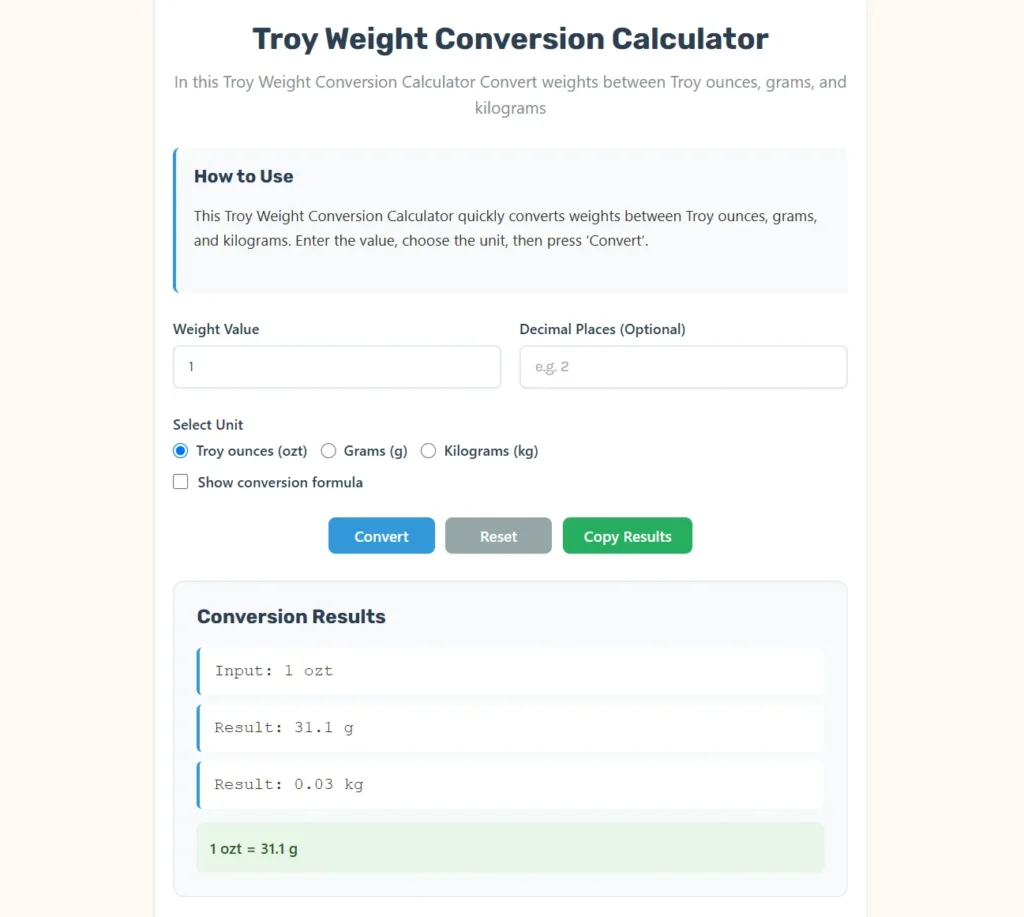
How to Use
This Troy Weight Conversion Calculator quickly converts weights between Troy ounces, grams, and kilograms. Enter the value, choose the unit, then press ‘Convert’.
Conversion Results
Example & Explanation
Example: Input 1 ozt → 31.1035 g
Explanation: Troy weight is a traditional system of units used mainly for precious metals. One Troy ounce equals exactly 31.1035 grams, which is different from the standard avoirdupois ounce (28.35 grams).
Guide to Troy Weight Conversion and Mass Measurement
In the global marketplace, mass determination relies on standardized units to facilitate commerce, scientific research, and financial transactions. However, when trading precious metals such as gold, silver, platinum, and palladium, standard everyday scales can lead to significant financial discrepancies. Standard consumer trade uses the avoirdupois system, where a single ounce equals roughly 28.35 grams. In contrast, international bullion markets operate under the troy weight system, where a troy ounce equals exactly 31.1034768 grams.
This conversion tool bridges the gap between traditional precious metal measurements and standard metric system units (grams and kilograms). Understanding the nuances of troy mass measurement ensures accurate financial evaluation, proper refinery calculations, and transparent trading across international borders.
Fundamental Concepts and Historical Background
The troy weight system is one of the few medieval measurement frameworks that remains legally mandated in modern global commerce. To fully grasp its application, one must examine its historical origins, technical definitions, and operational distinctions from standard measurement frameworks.
Historical Evolution of Troy Weight
The term troy originates from the trade city of Troyes in Champagne, France. During the Middle Ages, Troyes served as an important commercial hub where international merchants required a unified weight standard for precious metals and raw spices. The system was established on the weight of a single grain of barley, which formed the foundational building block for larger units.
In 1527, King Henry VIII officially adopted the troy system for gold and silver coinage in England. By the 19th century, the United States Parliament and Treasury formally codified the troy ounce as the legal standard for bullion valuation and official coinage. While the metric system replaced troy units across most scientific disciplines, major commodity exchanges—including the London Bullion Market Association (LBMA) and the Commodity Exchange (COMEX)—continue to quote spot prices exclusively in troy ounces per fine mass.
Troy System Units vs. Avoirdupois System Units
The most frequent mistake in precious metals trading involves confusing an avoirdupois ounce with a troy ounce.
- Avoirdupois Ounce (oz): The standard ounce used in North America for food products, parcel shipping, and body weight measurement.
- Troy Ounce (ozt): The official unit reserved exclusively for precious metals, gunpowder, and gemstones.
- The Weight Discrepancy: A troy ounce is approximately 9.714% heavier than an avoirdupois ounce.
A critical structural difference exists at the pound level:
- Avoirdupois Pound: Composed of 16 avoirdupois ounces, equivalent to 453.59237 grams.
- Troy Pound: Composed of only 12 troy ounces, equivalent to 373.24172 grams.
Consequently, while a troy ounce is heavier than an avoirdupois ounce, a troy pound is lighter than an avoirdupois pound. Because the troy pound created confusion in commercial settings, modern metal markets generally avoid troy pounds altogether, preferring to state larger inventories in troy ounces, kilograms, or metric tonnes.
+-----------------------------------------------------------------------------------------+
|                                 SYSTEM COMPARISON SUMMARY                               |
+--------------------------+------------------------------+-------------------------------+
| Feature                  | Troy System                  | Avoirdupois System            |
+--------------------------+------------------------------+-------------------------------+
| Primary Unit             | Troy Ounce (ozt)             | Avoirdupois Ounce (oz)        |
| Standard Gram Mass       | 31.1034768 g                 | 28.349523125 g                |
| Ounces per Pound         | 12 ozt per Troy Pound        | 16 oz per Avoirdupois Pound   |
| Total Grams per Pound    | 373.24172 g                  | 453.59237 g                   |
| Primary Application      | Gold, Silver, Platinum, Gems | Consumer Goods, Food, Freight |
+--------------------------+------------------------------+-------------------------------+
Mathematical Equations and Conversion Formulas
Precise mass conversions rely on exact multiplication factor constants established by international standards organizations. The foundational reference constant defines one troy ounce as exactly 31.1034768 grams.
Conversion Constants
- 1 Troy Ounce (ozt) = 31.1034768 Grams (g)
- 1 Troy Ounce (ozt) = 0.0311034768 Kilograms (kg)
- 1 Gram (g) = 0.0321507465686 Troy Ounces (ozt)
- 1 Kilogram (kg) = 32.1507465686 Troy Ounces (ozt)
- 1 Avoirdupois Ounce (oz) = 0.91145833 Troy Ounces (ozt)
Mathematical Formulas (Standard HTML Formatting)
To execute manual calculations without dedicated digital tools, use the following core formulas:
Converting Troy Ounces to Grams:
Mass in Grams (g) = Mass in Troy Ounces (ozt) × 31.1034768
Converting Grams to Troy Ounces:
Mass in Troy Ounces (ozt) = Mass in Grams (g) ÷ 31.1034768
or
Mass in Troy Ounces (ozt) = Mass in Grams (g) × 0.0321507466
Converting Kilograms to Troy Ounces:
Mass in Troy Ounces (ozt) = Mass in Kilograms (kg) × 32.1507466
Converting Troy Ounces to Kilograms:
Mass in Kilograms (kg) = Mass in Troy Ounces (ozt) ÷ 32.1507466
or
Mass in Kilograms (kg) = Mass in Troy Ounces (ozt) × 0.0311034768
Auxiliary Precious Metal Sub-Units
In jewelry making and workshop assays, smaller subdivisions of the troy ounce are frequently referenced:
- Pennyweight (dwt): Equal to 1/20th of a troy ounce (1.55517384 grams).
- Grain (gr): The foundational historical unit where 1 troy ounce equals 480 grains (0.06479891 grams per grain).
+-----------------------------------------------------------------------------------------+
|                              SUB-UNIT CONVERSION MULTIPLIERS                            |
+-----------------------+--------------------+--------------------+-----------------------+
| Unit                  | Equivalent in ozt  | Equivalent in g    | Equivalent in gr      |
+-----------------------+--------------------+--------------------+-----------------------+
| 1 Grain (gr)          | 0.00208333 ozt     | 0.06479891 g       | 1.00 gr               |
| 1 Pennyweight (dwt)   | 0.05000000 ozt     | 1.55517384 g       | 24.00 gr              |
| 1 Troy Ounce (ozt)    | 1.00000000 ozt     | 31.10347680 g      | 480.00 gr             |
| 1 Kilogram (kg)       | 32.15074657 ozt    | 1000.00000000 g    | 15432.35835 gr        |
+-----------------------+--------------------+--------------------+-----------------------+
Step-by-Step Practical Calculation Examples
To illustrate how these formulas perform in realistic commercial situations, consider three detailed scenarios step-by-step.
Example 1: Valuation of a Gold Bar (Grams to Troy Ounces)
A jeweler receives a cast gold bar weighing exactly 250.00 grams on an analytical balance. The current spot market price for gold is quoted at $2,350.00 per troy ounce. What is the fine weight in troy ounces and the total base value?
- Step 1: Identify the input mass: 250.00 grams.
- Step 2: Apply the gram-to-troy ounce formula:
Mass in ozt = 250.00 g ÷ 31.1034768 = 8.037687 ozt - Step 3: Round appropriately: 8.038 troy ounces (to three decimal places).
- Step 4: Calculate total market value:
Total Value = 8.037687 ozt × $2,350.00 = $18,888.56
Example 2: Institutional Vault Inventory (Kilograms to Troy Ounces)
An bullion vault holding manager receives a shipment of commercial silver bars containing 15.50 kilograms of 0.999 fine silver. How many troy ounces must be entered into the accounting ledger?
- Step 1: Identify input mass: 15.50 kilograms.
- Step 2: Apply the kilogram-to-troy ounce conversion factor:
Mass in ozt = 15.50 kg × 32.1507465686 - Step 3: Perform multiplication:
Mass in ozt = 498.33657 ozt - Step 4: Audit check via gram step:
15.50 kg = 15,500 grams
15,500 g ÷ 31.1034768 = 498.33657 ozt - Result: The ledger entry is recorded as 498.337 troy ounces.
Example 3: Estimating Pure Content from Scrap Jewelry (Purity Adjustment)
An estate buyer acquires 85.00 grams of 18-karat gold scrap jewelry. Gold purity for 18-karat gold is 18/24 (75.0% pure gold). How many troy ounces of pure 24-karat gold are contained in the lot?
- Step 1: Determine pure gold mass in grams:
Pure Gold (g) = 85.00 g × (18 ÷ 24) = 85.00 g × 0.75 = 63.75 grams - Step 2: Convert pure gold grams to troy ounces:
Pure Gold (ozt) = 63.75 g ÷ 31.1034768 = 2.04961 ozt - Result: The lot contains approximately 2.050 troy ounces of pure fine gold.
How the Troy Weight Conversion Calculator Works
The online calculator provided on this page streamlines complex multi-step conversions using an engineered logic workflow.
Mathematical Pipeline
- Input Parsing: The user enters a numerical weight value and selects the input unit (troy ounces, grams, or kilograms).
- Base Normalization: The input value is converted to a base metric unit (grams) using the exact conversion constants.
- If input is in troy ounces: Grams = Value × 31.1034768
- If input is in kilograms: Grams = Value × 1000
- If input is in grams: Grams = Value
- Target Calculation: The base gram value is calculated simultaneously across all remaining target units.
- Precision Formatting: Results are rounded based on the decimal precision specified by the user (defaulting to 2 decimal places).
- Formula Rendering: When enabled, the tool renders the step-by-step mathematical substitution to show users exactly how the output was calculated.
+-----------------------------------------------------------------------------------------+
|                                CALCULATOR PROCESSING LOGIC                              |
+-----------------------------------------------------------------------------------------+
|  [ User Input Value ]  ──➔  [ Unit Selection: ozt / g / kg ]                            |
|                                         │                                               |
|                                         ▼                                               |
|                    [ Internal Conversion to Base Grams (g) ]                             |
|                                         │                                               |
|                   ┌─────────────────────┼─────────────────────┐                         |
|                   ▼                     ▼                     ▼                         |
|           [ Target: ozt ]        [ Target: Grams ]     [ Target: Kilograms ]            |
|                   │                     │                     │                         |
|                   └─────────────────────┼─────────────────────┘                         |
|                                         ▼                                               |
|                      [ Apply Decimal Precision Rounding ]                               |
|                                         │                                               |
|                                         ▼                                               |
|                     [ Render Display Cards & Formula Steps ]                            |
+-----------------------------------------------------------------------------------------+
Real-World Use Cases and Industry Applications
Accurate conversion tools are essential across various professional fields and personal finance scenarios.
Precious Metals Investors and Coin Collectors
Investors purchasing physical gold bullion coins (such as American Gold Eagles, Canadian Maple Leafs, or South African Krugerrands) often deal with 1 ozt coins. However, fractional coins or secondary European mint products are frequently weight-marked in metric grams (e.g., 10g or 50g mint bars). Using conversion tools enables instant comparison between spot market ticker prices ($/ozt) and retail store product weights.
Jewelry Manufacturers and Artisans
Metalsmiths order raw grain, wire, and solder measured in grams or pennyweights from refiners, but list finished gold and silver components by gross weight. Precise conversion prevents underestimating material costs and ensures accurate alloy calculations during casting processes.
Pawn Shops and Scrap Gold Buyers
Pawn shop operators evaluate customer jewelry daily using precision benchtop balances set to grams. Because resale prices are indexed to troy ounce spot pricing, buyers use instant conversion formulas to determine payout rates based on metal karat purity.
Institutional Auditing and Central Banks
Central bank reserves (such as holdings at Fort Knox or the Federal Reserve Bank of New York) store gold reserves in 400 troy ounce “Good Delivery” bars. National balance sheets record these reserves in kilograms or metric tonnes. Converting these reserves requires absolute mathematical precision to prevent multi-million dollar accounting discrepancies.
Best Practices for Accurate Weight Determination
Achieving trustworthy mass readings requires adhering to strict laboratory and metrological standards.
Scale Selection and Class Standards
Standard bathroom or kitchen scales are incapable of measuring precious metals accurately. Commercial trade requires certified scales:
➔ NTEP Class II Scales: National Type Evaluation Program certified scales designed specifically for precious metals, laboratory testing, and pharmacy compounding. They typically feature a readability resolution of 0.01g to 0.001g.
➔ Draft Shields: When weighing fine gold dust or high-value items, air currents caused by ventilation units can fluctuate readings by several hundredths of a gram. Analytical balances utilize transparent draft shields to maintain static air pressure inside the chamber.
Environmental and Physical Factors
- Leveling: Ensure the scale bubble indicator sits centered inside the alignment ring. Unlevel balances cause incorrect gravity vectors along load cells.
- Thermal Equilibrium: Allow electronic balances to warm up for at least 15 to 30 minutes prior to calibration. Internal electronic drift occurs when components expand due to heat.
- Static Electricity: Plastic containers or synthetic jewelry pouches carry static charges that displace scale platens. Use anti-static weigh boats or grounding mats.
Calculating Fine Weight vs. Gross Weight
Never confuse total weight with actual precious metal weight.
- Gross Weight: The total measured weight of an item including all alloy metals, gemstones, and binder materials.
- Fine Weight: The actual weight of pure precious metal contained inside the object.
Fine Mass Formula:
Fine Weight (ozt) = Gross Weight (ozt) × Metal Purity (Decimal Percentage)
Calculation Example: A silver alloy bowl weighs 12.00 troy ounces and is stamped “925 Sterling” (which represents 92.5% pure silver content).
Fine Silver Weight = 12.00 ozt × 0.925 = 11.10 troy ounces of pure fine silver.
Comprehensive Unit Conversion Matrix
The following reference table outlines conversion factors across major mass units.
+---------------------------------------------------------------------------------------------------+
|                                     MASS CONVERSION MATRIX                                        |
+----------------------+-------------------+-------------------+-------------------+----------------+
| Unit                 | Grams (g)         | Kilograms (kg)    | Troy Ounces (ozt) | Standard (oz)  |
+----------------------+-------------------+-------------------+-------------------+----------------+
| 1 Gram (g)           | 1.000000          | 0.001000          | 0.032151          | 0.035274       |
| 1 Kilogram (kg)      | 1000.000000       | 1.000000          | 32.150747         | 35.273962      |
| 1 Troy Ounce (ozt)   | 31.103477         | 0.031103          | 1.000000          | 1.097143       |
| 1 Standard Ounce (oz)| 28.349523         | 0.028350          | 0.911458          | 1.000000       |
| 1 Pennyweight (dwt)  | 1.555174          | 0.001555          | 0.050000          | 0.054857       |
| 1 Grain (gr)         | 0.064799          | 0.000065          | 0.002083          | 0.002286       |
+----------------------+-------------------+-------------------+-------------------+----------------+
Official Scientific Standards and Metrology References
To ensure absolute credibility, the values and unit definitions utilized by this calculator comply with primary metrology standards established by international governing bodies.
National Institute of Standards and Technology (NIST)
The United States Department of Commerce maintains legal commercial measurement guidelines through NIST Handbook 44 (Specifications, Tolerances, and Other Technical Requirements for Weighing and Measuring Devices) and NIST Special Publication 811 (Guide for the Use of the International System of Units).
Official Definition: NIST SP 811 explicitly defines the exact conversion factor for mass units:
1 Troy Ounce = 31.103 476 8 grams (exact).
1 Avoirdupois Ounce = 28.349 523 125 grams (exact).
International Bureau of Weights and Measures (BIPM)
The International Bureau of Weights and Measures governs the SI system (Le Système International d’Unités). The BIPM defines the kilogram as the fundamental unit of mass, against which all secondary units—including troy weight conversions—are calibrated through physical constants (specifically Planck’s constant $h$).
Frequently Asked Questions
Why is a troy ounce different from a regular ounce?
A troy ounce originates from medieval French trade systems designed specifically for high-value precious metals and gemstones, establishing a heavier standard (31.1034768 grams). A regular (avoirdupois) ounce originated from general agricultural trade for bulk goods, establishing a lighter standard (28.349523125 grams).
How many grams are in an ounce of gold?
An ounce of physical gold or gold bullion is always measured in troy ounces, meaning it contains 31.1035 grams (rounded to four decimal places). If someone weighs gold on a standard postal scale set to regular ounces, they will incorrectly read 28.35 grams, miscalculating the true mass by approximately 9.7%.
Can I weigh precious metals on a standard food scale?
While a food scale will display a reading in grams or regular ounces, standard kitchen scales lack the resolution, load-cell sensitivity, and calibration stability required for precious metals trading. Kitchen scales typically display rounding errors of 1 to 2 grams, which equates to significant monetary value when weighing gold. A certified Class II balance should be used instead.
What is the symbol for troy ounces in financial markets?
The internationally recognized abbreviation for troy ounces is ozt. On financial ticker exchanges, precious metal spot trading prices combine the currency code with the ISO 4217 currency code for the metal. For example, gold traded in US Dollars is listed as XAU/USD, where XAU represents one troy ounce of fine gold. Silver is designated as XAG, platinum as XPT, and palladium as XPD.
Is a troy pound heavier than a standard pound?
No. Although a troy ounce is heavier than a standard ounce, a troy pound contains only 12 troy ounces (373.24 grams). A standard avoirdupois pound contains 16 standard ounces (453.59 grams). Therefore, a troy pound is significantly lighter than a standard pound.
How do I convert pennyweights (dwt) to troy ounces?
Because 1 troy ounce contains exactly 20 pennyweights, divide your total pennyweight reading by 20. For example, if a scrap lot weighs 45.0 pennyweights, divide 45.0 by 20 to get 2.25 troy ounces.