Use Present Value of $1 Table (PVIF)
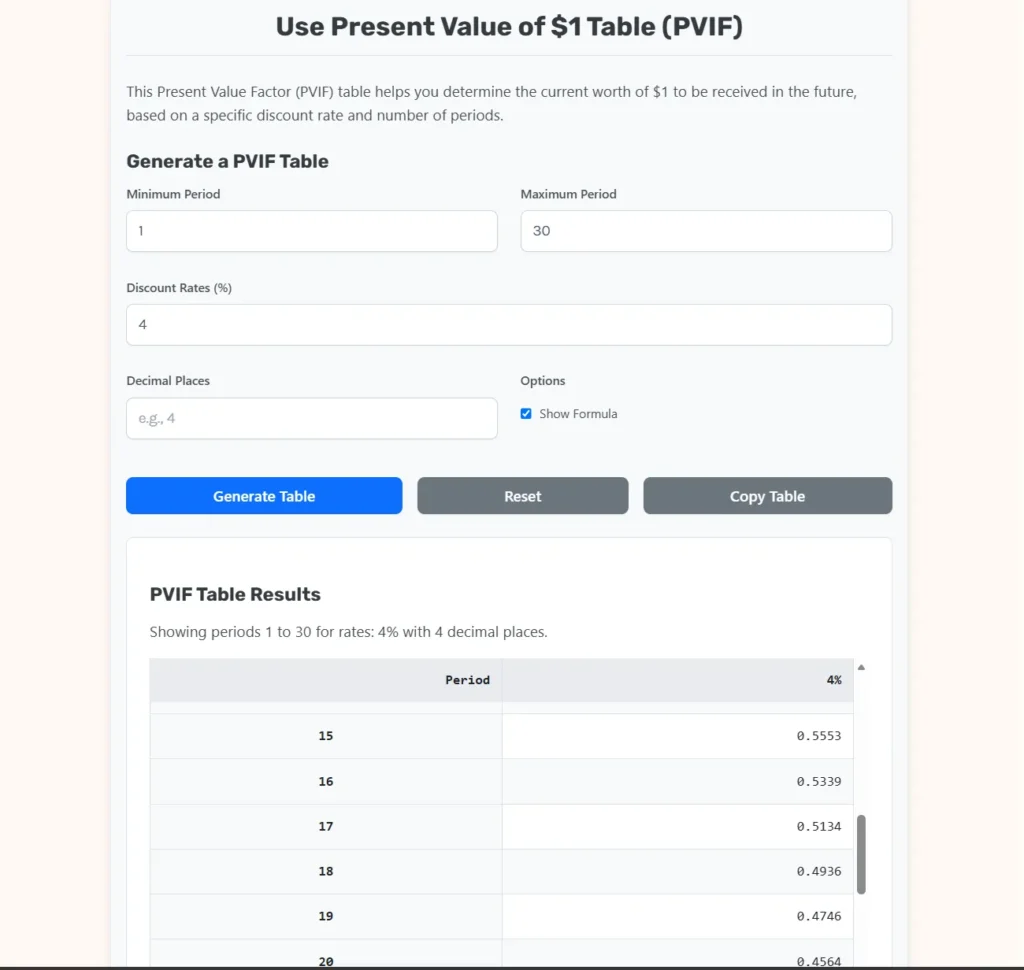
This Present Value Factor (PVIF) table helps you determine the current worth of $1 to be received in the future, based on a specific discount rate and number of periods.
Generate a PVIF Table
Understanding the PVIF Table
The Present Value Interest Factor (PVIF) is a multiplier used to calculate the present value of a single sum of money to be received in the future. It discounts the future amount back to today’s value. The formula is: PVIF = 1 / (1 + r)ᵗ.
How to Use It: A Worked Example
To find the present value of any future amount, you simply multiply it by the PVIF. For example, to find the present value of $500 to be received in 10 years with a 6% discount rate:
- Find the PVIF in the table for 10 periods at 6%. The factor is
0.5584. - Multiply your future amount by this factor:
$500 × 0.5584 = $279.20.
This means that 500 in 10 years is worth only 279.20 to you today, given a 6% annual discount rate.
Formula Substitution for Example
Present Value Interest Factor (PVIF) Table: Financial Mechanics, Mathematical Foundations, and Valuation Strategies
Determining the current monetary worth of a future single lump-sum payment represents a foundational discipline in corporate finance, investment banking, actuarial science, and asset pricing. The Present Value Interest Factor (PVIF)—often referred to as the Present Value of $1 Factor—quantifies the exact fraction of a dollar that a future sum is worth today when discounted at a specified periodic rate across a defined temporal horizon.
Because capital possesses earning capacity through interest accumulation, and because general price inflation erodes purchasing power across time, a nominal dollar scheduled for receipt in the future carries less economic value than a dollar held immediately. The Present Value of $1 Table Generator converts complex multi-variable discounting relationships into structured matrix outputs, allowing financial analysts, corporate treasurers, real estate developers, and wealth managers to evaluate isolated future cash flows against current capital commitments on an equivalent baseline.
+-----------------------------------------------------------------------+
|                    TIME VALUE OF MONEY (TVM) DISCOUNTS                |
|                                                                       |
|   Future Single Sum ($1.00)  ➔   Discounting Engine   ➔  Today's PV $ |
|      [ Received Year t ]        [ Factor: (1+r)^-t ]     [ Value < $1 ]|
|                                                                       |
|   Formula: PV = Future Value * PVIF(r, t)                             |
+-----------------------------------------------------------------------+
Fundamental Economic Principles of Present Value Discounting
The concept of present value discounting reverses the logic of compound interest growth. While compounding calculates how current principal expands forward into the future, present value discounting contracts future nominal cash flows backward to establish current intrinsic value.
PVIF calculations rest upon three core structural variables:
- Future Cash Flow Sum (FV): The nominal dollar amount scheduled for disbursement or receipt at a future time period t.
- Periodic Discount Rate (r): The opportunity cost of capital, hurdle rate, or required rate of return expressed as a decimal fraction per compounding interval.
- Total Elapsed Periods (t): The aggregate count of compounding intervals separating the evaluation baseline from the date of future cash flow realization.
Compounding (Forward Capital Growth):    PV ➔ Compound Engine (1+r)^t ➔ FV
Discounting (Backward Capital Valuation): FV ➔ Discount Engine (1+r)^-t ➔ PV
As either the discount rate r or the duration t increases, the resulting PVIF factor declines. This mathematical decay reflects the higher opportunity cost of delayed capital receipt and the compounded time value lost over extended durations.
Mathematical Foundations and Derivations
The mathematical derivation of PVIF stems directly from the standard compound interest expansion equation.
Derivation from Future Value Mechanics
The future value FV of an initial present principal PV invested at rate r for t periods is expressed as:
FV = PV × (1 + r)t
To isolate current present value PV as a function of future value FV, divide both sides of the equation by the compounding term (1 + r)t:
PV = FV / (1 + r)t
By separating the future nominal sum FV from the discount multiplier, the equation isolates the Present Value Interest Factor (PVIF):
PV = FV × [ 1 / (1 + r)t ]
Thus, the standard formula for PVIF at discount rate r and period count t is defined as:
PVIFr, t = 1 / (1 + r)t = (1 + r)−t
+-----------------------------------------------------------------------+
|                       UNIVERSAL PVIF FORMULA                          |
|                                                                       |
|                            1                                          |
|   PVIF(r, t) =  --------------------  =  (1 + r)^(-t)                 |
|                      (1 + r)^t                                        |
|                                                                       |
|   Where:                                                              |
|   PVIF = Present Value Interest Factor of $1                          |
|   r    = Periodic Discount Rate (Decimal Format)                      |
|   t    = Number of Compounding Periods                                |
+-----------------------------------------------------------------------+
Limiting Behaviors and Mathematical Boundary Conditions
Exclusion rules and asymptotic behaviors govern PVIF calculations across extreme parameter bounds:
- At Temporal Baseline (t = 0):PVIFr, 0 = (1 + r)0 = 1.0000. Money received today experiences zero discounting.
- At Zero Discount Rate (r = 0):PVIF0, t = (1 + 0)−t = 1.0000. In the absence of return opportunity or inflation decay, future money equals present money.
- As Time Approaches Infinity (t → ∞):lim (t → ∞) [ 1 / (1 + r)t ] = 0. Cash flows occurring in the infinitely distant future hold negligible economic value today.
- As Rate Approaches Infinity (r → ∞):lim (r → ∞) [ 1 / (1 + r)t ] = 0. Extremely high opportunity costs reduce the present value of future sums toward zero.
Architecture and Algorithmic Processing of the Table Engine
Digital PVIF generators convert user parameters into structured evaluation matrices using parsing algorithms, bound checks, dynamic array mapping, and string formatting routines.
                  +-----------------------------------+
                  |   PVIF MATRIX GENERATOR FLOW      |
                  +-----------------------------------+
                                    |
                                    v
                         +--------------------+
                         | PARSE USER INPUTS  |
                         | Min/Max t, Rate Array|
                         +--------------------+
                                    |
                                    v
                         +--------------------+
                         | VALIDATE BOUNDS    |
                         | Min t >= 0, r >= 0 |
                         +--------------------+
                                    |
                                    v
                         +--------------------+
                         | NORMALIZE RATES    |
                         | Sort & Convert to r|
                         +--------------------+
                                    |
                                    v
                         +--------------------+
                         | MATRIX OUTER LOOP  |
                         | Iterate Periods t  |
                         +--------------------+
                                    |
                                    v
                         +--------------------+
                         | MATRIX INNER LOOP  |
                         | Iterate Rates r    |
                         | PVIF = (1 + r)^-t  |
                         +--------------------+
                                    |
                                    v
                         +--------------------+
                         | RENDER DATA MATRIX |
                         | Fixed Decimals & UI|
                         +--------------------+
Algorithmic Execution Steps
- Input Array Parsing and Normalization: Read user inputs for minimum period tmin, maximum period tmax, comma-delimited discount rates array Rraw, and precision rounding digits d. Extract numerical components from Rraw, filter out non-numeric entries, divide percentages by 100 to yield decimal rates r, and sort rates in ascending numerical order.
- Parameter Validation: Verify that tmin ≥ 0 and tmax ≥ tmin. Ensure that all rate entries satisfy r ≥ 0.
- Header Construction: Build the table header row containing standard column designations:
Period (t)followed by each sorted discount rate formatted as percentage column headers (e.g.,2%,4%,6%). - Iterative Matrix Computation:
- Loop through period row index t from tmin to tmax.
- For each period t, loop through rate column index r.
- Calculate PVIF = (1 + r)−t.
- Round PVIF to user-defined decimal precision d (typically 4 decimal places for financial factor tables).
- DOM Generation and Export Formatting: Append calculated cells to a scrollable HTML display table with sticky headers for user inspection. Prepare plain text tab-delimited or CSV formatted strings for clipboard copying.
Step-by-Step Worked Mathematical Examples
Example 1: Evaluating a Zero-Coupon Corporate Bond Payment
An institutional investor evaluates a 5-year zero-coupon corporate bond with a face value repayment of $1,000.00 at maturity. The investor requires an annual yield (discount rate) of 8.00%.
- Input Parameters:
- Future Value (FV) = $1,000.00
- Discount Rate (r) = 8.00% = 0.08
- Maturity Horizon (t) = 5 years
Step A: Calculate Compounding Denominator
(1 + r)t = (1 + 0.08)5 = (1.08)5 = 1.469328
Step B: Determine the Present Value Interest Factor (PVIF)
PVIF0.08, 5 = 1 / 1.469328 = 0.680583 (or 0.6806 rounded)
Step C: Synthesize Total Present Value
PV = FV × PVIF0.08, 5
PV = $1,000.00 × 0.680583 = $680.58
Summary Table for Example 1:
| Period (t) | Nominal Payment (FV) | Compounding Term (1+r)t | PVIF Factor | Discounted Present Value |
| Year 0 | $0.00 | 1.000000 | 1.000000 | $0.00 |
| Year 1 | $0.00 | 1.080000 | 0.925926 | $0.00 |
| Year 2 | $0.00 | 1.166400 | 0.857339 | $0.00 |
| Year 3 | $0.00 | 1.259712 | 0.793832 | $0.00 |
| Year 4 | $0.00 | 1.360489 | 0.735030 | $0.00 |
| Year 5 | $1,000.00 | 1.469328 | 0.680583 | $680.58 |
Receiving 1,000.00 five years from today is economically equivalent to receiving 680.58 today when capital yields 8.00% annually.
Example 2: Comparing Multi-Rate Valuation Scenarios for Deferred Inheritance
A wealth beneficiary is scheduled to receive a lump-sum distribution of $10,000.00 in 10 years. Evaluate the present value across three distinct discount rate scenarios: 6.00%, 10.00%, and 12.00%.
- Input Parameters:
- Future Lump Sum (FV) = $10,000.00
- Time Horizon (t) = 10 years
Step A: Calculate Factor at 6.00% Discount Rate
PVIF0.06, 10 = (1 + 0.06)−10 = (1.06)−10 = 0.558395
PV6% = $10,000.00 × 0.558395 = $5,583.95
Step B: Calculate Factor at 10.00% Discount Rate
PVIF0.10, 10 = (1 + 0.10)−10 = (1.10)−10 = 0.385543
PV10% = $10,000.00 × 0.385543 = $3,855.43
Step C: Calculate Factor at 12.00% Discount Rate
PVIF0.12, 10 = (1 + 0.12)−10 = (1.12)−10 = 0.321973
PV12% = $10,000.00 × 0.321973 = $3,219.73
Comparative Impact Summary:
Increasing the hurdle rate from 6.00% to 12.00% reduces today’s valuation of the identical 10,000.00 future payment by 2,364.22 (a 42.34% reduction in present worth).
Rate Sensitivity Analysis and PVIF Decay Dynamics
Because time t sits as a negative exponent in the factor equation, PVIF values decrease non-linearly over time.
Factor Value Scale
1.0000 | ➔ Year 0 (PVIF = 1.0000)
0.8000 | ─── ➔ Year 3 at 5% (PVIF = 0.8638)
0.6000 | ─────── ➔ Year 10 at 5% (PVIF = 0.6139)
0.4000 | ─────────── ➔ Year 20 at 5% (PVIF = 0.3769)
0.2000 | ─────────────────── ➔ Year 30 at 5% (PVIF = 0.2314)
Comprehensive PVIF Sensitivity Reference Matrix
The matrix below illustrates standard PVIF multipliers rounded to four decimal places across durations (1 to 30 years) and discount rates (2.00% to 15.00%).
| Period (t) | r = 2.0% | r = 5.0% | r = 8.0% | r = 10.0% | r = 12.0% | r = 15.0% |
| 1 Year | 0.9804 | 0.9524 | 0.9259 | 0.9091 | 0.8929 | 0.8696 |
| 2 Years | 0.9612 | 0.9070 | 0.8573 | 0.8264 | 0.7972 | 0.7561 |
| 3 Years | 0.9423 | 0.8638 | 0.7938 | 0.7513 | 0.7118 | 0.6575 |
| 4 Years | 0.9238 | 0.8227 | 0.7350 | 0.6830 | 0.6355 | 0.5718 |
| 5 Years | 0.9057 | 0.7835 | 0.6806 | 0.6209 | 0.5674 | 0.4972 |
| 10 Years | 0.8203 | 0.6139 | 0.4632 | 0.3855 | 0.3220 | 0.2472 |
| 15 Years | 0.7430 | 0.4810 | 0.3152 | 0.2394 | 0.1827 | 0.1229 |
| 20 Years | 0.6730 | 0.3769 | 0.2145 | 0.1486 | 0.1037 | 0.0611 |
| 25 Years | 0.6095 | 0.2953 | 0.1460 | 0.0923 | 0.0588 | 0.0304 |
| 30 Years | 0.5521 | 0.2314 | 0.0994 | 0.0573 | 0.0334 | 0.0151 |
Comparative Analysis of Time Value of Money Metrics
The Present Value Interest Factor (PVIF) operates alongside three primary related Time Value of Money factor metrics.
                  +-----------------------------------+
                  |      CORE TVM FACTOR MATRIX       |
                  +-----------------------------------+
                                    |
         +--------------------------+--------------------------+
         |                                                     |
         v                                                     v
+------------------+                                 +------------------+
| SINGLE CASH FLOW |                                 | ANNUITY STREAM   |
| PVIF: (1+r)^-t   |                                 | PVIFA: [1-(1+r)^-t]/r|
| FVIF: (1+r)^t    |                                 | FVIFA: [(1+r)^t-1]/r|
+------------------+                                 +------------------+
| Metric Name | Mathematical Formula | Financial Target | Primary Corporate Use Case |
| Present Value Interest Factor (PVIF) | (1 + r)−t | Discounting an isolated future lump sum to today | Pricing zero-coupon bonds, deferred lump sums, terminal asset sales |
| Present Value Interest Factor of Annuity (PVIFA) | [ 1 − (1 + r)−t ] / r | Discounting an equal stream of recurring future cash flows | Valuing pension streams, mortgage liabilities, lease contracts |
| Future Value Interest Factor (FVIF) | (1 + r)t | Compounding an isolated current lump sum forward | Projecting single deposit principal growth |
| Future Value Interest Factor of Annuity (FVIFA) | [ (1 + r)t − 1 ] / r | Compounding recurring equal deposits forward | Sinking fund accumulation, 401(k) projection modeling |
Discount Rate Calibration and Capital Market Dynamics
Selecting an appropriate discount rate r is critical when applying PVIF factors. Because rate variations alter denominators exponentially, minor rate adjustments produce substantial changes in calculated valuations.
+-----------------------------------------------------------------------+
|                   DISCOUNT RATE COMPONENT MATRIX                      |
|                                                                       |
|   Total Discount Rate (r) = Risk-Free Rate + Inflation + Risk Premium |
|                                                                       |
|   ➔ Risk-Free Benchmark (Sovereign Debt Yields: Base TVM)            |
|   ➔ Inflation Compensation (Purchasing Power Erosion Offset)          |
|   ➔ Asset Risk Premium (Credit Risk, Liquidity, Market Volatility)    |
+-----------------------------------------------------------------------+
Rate Selection Frameworks
- Weighted Average Cost of Capital (WACC): Applied in corporate capital budgeting when evaluating corporate acquisitions, capital expansion projects, or divisional investments funded through debt and equity mix.
- Risk-Free Rate plus Spread: Applied in fixed-income portfolio management by combining benchmark sovereign yields (e.g., 10-year US Treasury rates) with credit-risk adjustments specific to the bond issuer.
- Real vs. Nominal Discount Rates:
- Nominal Rates: Incorporate general market inflation expectations alongside real capital yields. Used when discounting nominal cash flow projections.
- Real Rates: Remove inflation projections, focusing purely on purchasing power expansion. Used when discounting real, inflation-adjusted cash flow estimates.
Practical Industry Applications and Commercial Use Cases
                  +-----------------------------------+
                  |   COMMERCIAL INDUSTRY APPLICATIONS|
                  +-----------------------------------+
                                    |
         +--------------------------+--------------------------+
         |                                                     |
         v                                                     v
+------------------+                                 +------------------+
| CAPITAL BUDGETING|                                 | BOND VALUATION   |
| Terminal Value   |                                 | Principal Face   |
| Discounting      |                                 | Redemption       |
+------------------+                                 +------------------+
         |                                                     |
         v                                                     v
+------------------+                                 +------------------+
| REAL ESTATE LAND |                                 | MERGERS & ACQ.   |
| Deferred Site    |                                 | Earn-Out Clause  |
| Acquisitions     |                                 | Valuation        |
+------------------+                                 +------------------+
1. Capital Budgeting and Terminal Value Calculations
In Discounted Cash Flow (DCF) corporate valuation models, financial analysts forecast explicit free cash flows over a 5-to-10-year horizon. The residual worth of the business beyond the forecast period is captured as a single “Terminal Value.” Analysts apply PVIF multipliers corresponding to the final forecast year to discount the terminal sum back to present value.
2. Zero-Coupon Bond Pricing and Principal Valuation
Fixed-income securities that disburse zero intermediate coupon payments trade at a discount to par value. The intrinsic fair market value of a zero-coupon bond equals its face value at maturity multiplied by the PVIF factor corresponding to prevailing market yield-to-maturity (YTM) rates.
3. Mergers and Acquisitions (M&A) Earn-Out Structuring
Corporate acquisition contracts frequently include deferred consideration terms, known as “earn-outs.” If an acquired firm meets operational targets, the purchasing entity disburses a agreed lump sum 3 to 5 years after closing. Acquiring firms use PVIF factors to record the present liability value of deferred earn-out obligations on balance sheets.
4. Real Estate Land Banking and Deferred Site Development
Real estate investment trusts (REITs) evaluating options to purchase undeveloped land holdings scheduled for commercial construction decades in the future use PVIF multipliers to determine maximum acceptable acquisition bids today.
User Interface and Interaction Best Practices for Financial Factor Tables
Designing web-based financial factor generators requires balancing grid layout readability, parameter input validation, and data export capabilities.
+-------------------------------------------------------------+
|              BEST PRACTICES FOR FINANCIAL FACTOR UI         |
|                                                             |
| ✔ Implement sticky table headers and period index columns.   |
| ✔ Use tabular, fixed-width monospace font rendering.         |
| ✔ Provide one-click tab-delimited copying for Excel export.  |
| ✔ Expose formula substitution steps for manual auditability. |
| ✔ Enforce bounds checking on negative or invalid parameters. |
+-------------------------------------------------------------+
Key Functional UI Features
- Sticky Structural Headers: Freeze top row headers (rates) and left column headers (periods) during matrix scrolling to maintain context when inspecting large tables.
- Tabular Monospace Formatting: Render numeric data cells using tabular monospace fonts (e.g.,
SFMono-Regular,Consolas, orCourier New) to ensure precise vertical digit alignment across table rows. - Excel-Compatible Copy Integration: Format copy-to-clipboard outputs using tab-delimited characters (
\t) and newline separators (\n). This allows analysts to paste generated factor matrices directly into financial spreadsheet models without requiring manual reformatting. - Audit Transparency: Include an option to display explicit formula substitutions and arithmetic breakdowns for specific matrix cells to facilitate auditing by investment committees or academic reviewers.
Frequently Asked Questions (FAQ)
What is the primary difference between PVIF and PVIFA?
PVIF (Present Value Interest Factor) discounts a single isolated future cash payment to its present value today. PVIFA (Present Value Interest Factor of an Annuity) discounts a series of equal, recurring future payments received across consecutive periods. PVIF evaluates single lump sums, whereas PVIFA evaluates annuity streams.
Why does a higher discount rate decrease the PVIF value?
A higher discount rate represents a higher opportunity cost of capital or required return. When potential investment yields increase, receiving capital in the future becomes relatively less attractive compared to investing principal today. The denominator in the formula (1 + r)t expands, driving down the resulting PVIF factor.
How does compounding frequency impact PVIF factor calculations?
If interest compounds more frequently than annually (such as monthly or quarterly), the periodic discount rate and total period count must be converted to match the compounding frequency. Divide the nominal annual rate by the compounding frequency per year (r = Annual Rate / m) and multiply the duration in years by the compounding frequency (t = Years × m). More frequent compounding decreases the resulting PVIF factor.
Can PVIF factor values ever exceed 1.0000?
Under standard positive discount rates (r > 0) and positive durations (t > 0), PVIF values are strictly bounded between 0.0000 and 1.0000. A PVIF value exceeding 1.0000 occurs only under negative discount rates (r < 0), an unusual macroeconomic condition where general deflation or negative central bank interest rates make future dollars nominal worth more than present dollars.
How do financial analysts use PVIF tables alongside Excel or financial calculators?
While modern spreadsheet applications compute present values using built-in functions like =PV(), PVIF factor tables provide instant visual reference matrices for sensitivity testing, manual auditing, and educational demonstrations without requiring software execution.
Academic References and Authoritative Standards
- Brigham, E. F., & Ehrhardt, M. C. (2019). Corporate Finance: Linking Theory to Capital Allocation Decisions. 16th Edition. Cengage Learning.
- Damodaran, A. (2012). Investment Valuation: Tools and Techniques for Determining the Value of Any Asset. 3rd Edition. John Wiley & Sons.
- Fabozzi, F. J. (2015). Bond Markets, Analysis, and Strategies. 9th Edition. Pearson Education.
- Bodie, Z., Kane, A., & Marcus, A. J. (2021). Investments. 12th Edition. McGraw-Hill Education.
- Financial Accounting Standards Board (FASB). Statement of Financial Accounting Concepts No. 7: Using Cash Flow Information and Present Value in Accounting Measurements.