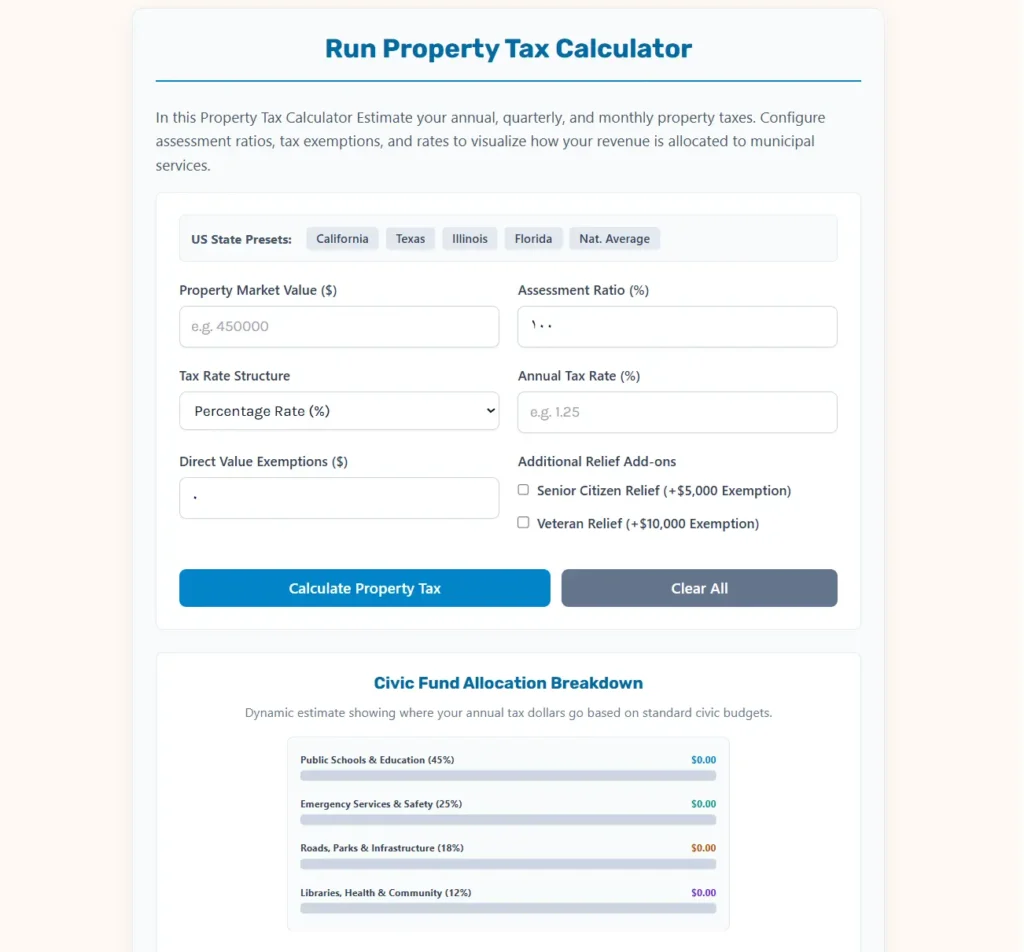
Run Property Tax Calculator
In this Property Tax Calculator Estimate your annual, quarterly, and monthly property taxes. Configure assessment ratios, tax exemptions, and rates to visualize how your revenue is allocated to municipal services.
Civic Fund Allocation Breakdown
Dynamic estimate showing where your annual tax dollars go based on standard civic budgets.
Property Taxation Explained
Assessed Value vs. Market Value
Property taxes are rarely calculated directly from the fair market value of a home. Instead, municipalities apply an Assessment Ratio to establish the assessed tax base value:
Assessed Value = Market Value × (Assessment Ratio / 100)
For example, if your market value is 300,000 and your municipal assessment ratio is 80%, your tax assessor only levies rates against 240,000.
Exemptions and Deductions
Tax relief limits help reduce assessment values. The primary tool is the homestead exemption, which reduces taxable thresholds for standard primary residences, often alongside special additional senior citizen or disabled military veteran benefits:
Taxable Value = Assessed Value – Total Exemptions
Millage Rate (Mills) vs. Percentages
Local authorities express rates in either percentages or Millage (Mills). A mill represents one-thousandth of a dollar. To resolve millage to an equation, taxation calculates as follows:
Annual Tax = Taxable Value × (Mill Rate / 1,000)
Alternatively, if written as a simple percentage rate:
Annual Tax = Taxable Value × (Percentage Rate / 100)
The Economics of Local Governance: A Comprehensive Guide to Property Tax Calculations
Property taxation is the foundational pillar of municipal finance in many nations, particularly the United States. Unlike federal or state income taxes, which are subject to macroeconomic volatility and labor market fluctuations, property tax represents a highly stable, non-portable, and predictable source of revenue. This stable tax base directly funds the essential services that define a community, including public education, emergency response systems, local road maintenance, and parks.
As an ad valorem levy—meaning a tax based directly on the assessed value of an asset—property tax requires a highly structured, objective system of appraisal, valuation, and legal mitigation to remain equitable. This guide provides property owners, real estate professionals, municipal planners, and tax attorneys with a deep analytical breakdown of how property taxes are calculated, how local tax rates behave, and how strategic exemptions and appeals can optimize an owner’s annual liability.
The Architecture of Ad Valorem Taxation
To understand how the calculator evaluates your annual tax liability, one must first explore the relationship between market value, assessed value, and taxable value. A common source of confusion among homeowners is the assumption that their property tax is levied directly against the price they paid for their home or its current fair market value. In practice, the taxation pipeline involves a series of mathematical reductions, adjustments, and exemptions.
       [ Property Fair Market Value (MV) ]
                     |
                     v (Multiplied by Assessment Ratio)
       [ Assessed Value (AV) ]
                     |
                     v (Subtracted by Total Exemptions & Reliefs)
       [ Taxable Value (TV) ]
                     |
                     v (Multiplied by Tax Rate: Percent or Millage)
       [ Annual Property Tax Liability ]
                     |
                     v (Civic Budget Allocation)
  +------------------+------------------+------------------+
  | (45%)            | (25%)            | (18%)            | (12%)
  v                  v                  v                  v
Schools            Safety             Infra            Community
This structural division ensures that local governments can manage their budgets while protecting vulnerable demographics—such as senior citizens, disabled veterans, and primary homeowners—from sudden real estate market spikes that could otherwise force them out of their homes.
Section 1: The Valuation Bridge – Market Value vs. Assessed Value
The starting point of any property tax calculation is the fair market value, which represents the estimated price a willing buyer would pay to a willing seller in an open market. However, local tax assessors rarely apply tax rates directly to this full market value. Instead, they calculate an Assessed Value by applying a statutorily defined assessment ratio.
1. The Assessed Value Formula
The Assessed Value serves as the preliminary taxable baseline before exemptions are processed.$$AV = MV \times \left( \frac{AR}{100} \right)$$
Variable Definitions:
➜ $AV$: The Assessed Value of the property in dollars.
➜ $MV$: The Fair Market Value of the property, as determined by the local tax assessor through mass appraisal or recent comparable sales.
➜ $AR$: The Assessment Ratio, expressed as a percentage, which is the legally mandated proportion of the market value subject to taxation (e.g., $100\%$ in many jurisdictions, but often significantly lower, such as $33.33\%$ in some Midwestern states).
2. The Role of Mass Appraisal and CAMA Systems
In the real world, tax assessors cannot individually inspect every home in their county each year. Instead, they employ Computer-Assisted Mass Appraisal (CAMA) software. These systems use spatial geographic databases, historical transaction records, building permits, and localized sales indexes to estimate the value of thousands of properties simultaneously.
Because mass appraisal can sometimes produce generalized results, understanding the difference between your home’s actual market value and the assessor’s estimated value is critical for potential tax appeals.
Section 2: Legal Mitigation – Deductions, Exemptions, and Tax Relief
Once the Assessed Value is established, local tax codes allow for various deductions and exemptions designed to reduce the net taxable value. These exemptions serve as vital economic policy tools, incentivizing owner-occupancy and offering financial relief to targeted demographics.
1. The Taxable Value Formula
The Taxable Value is the actual dollar amount to which the local tax rate or millage is applied.$$TV = \max\left(0, AV – \sum_{i=1}^{n} E_i\right)$$
Variable Definitions:
➜ $TV$: The final Taxable Value of the property in dollars.
➜ $AV$: The Assessed Value calculated in the previous step.
➜ $E_i$: The individual value of each exemption or deduction for which the owner qualifies.
➜ $n$: The total number of stacked exemptions applied to the property.
➜ $\max(0, \dots)$: A mathematical constraint ensuring that the taxable value can never drop below zero.
2. Standard Exemption Categories
✓ Homestead Exemption: The most common form of property tax relief, available exclusively to primary residences. It protects a portion of the home’s value from property taxes and often limits the rate at which an assessment can rise from year to year.
✓ Senior Citizen Relief: Designed to assist older homeowners on fixed incomes. It typically freezes the assessed value or adds a direct flat-dollar exemption.
✓ Disabled Veteran Exemption: Offered to veterans with service-connected disabilities, often providing substantial flat-dollar or percentage-based reductions in taxable value.
Section 3: Standardizing the Levy – Percentages vs. Millage Rates
Once the Taxable Value is determined, the local taxing authority applies the annual tax rate. Depending on regional custom and statutory requirements, this rate is expressed either as a standard percentage or as a Millage Rate (Mills).
1. Percentage-Based Calculation
In many Western and Southern states, property tax rates are expressed simply as a decimal percentage of the taxable value.$$T_{\text{annual}} = TV \times \left( \frac{R_{\text{pct}}}{100} \right)$$
Variable Definitions:
➜ $T_{\text{annual}}$: The estimated annual property tax liability in dollars.
➜ $TV$: The final Taxable Value of the property.
➜ $R_{\text{pct}}$: The annual tax rate expressed as a percentage (e.g., $1.25\%$).
2. Millage-Based Calculation
In the Northeast and parts of the Midwest, local authorities utilize the millage system. The term “mill” is derived from the Latin millesimum, meaning thousandth. One mill represents one dollar of tax for every one thousand dollars of assessed taxable value.$$T_{\text{annual}} = TV \times \left( \frac{R_{\text{mill}}}{1,000} \right)$$
Variable Definitions:
➜ $T_{\text{annual}}$: The estimated annual property tax liability in dollars.
➜ $TV$: The final Taxable Value of the property.
➜ $R_{\text{mill}}$: The annual tax rate expressed in mills (e.g., $35 \text{ mills}$ represents a tax of $\$35$ for every $\$1,000$ of taxable value).
To easily convert between the two systems, remember that one mill is mathematically equivalent to a percentage rate of $0.1\%$:$$R_{\text{pct}} = R_{\text{mill}} \times 0.1$$
Section 4: The Municipal Allocation Loop – Where Tax Dollars Go
Property tax is a purely localized form of finance. Unlike federal income taxes, which are pooled into national funds, property tax revenues are kept within the county, city, and school district where the property is located. This direct connection between taxation and local funding is why communities with high property values often have well-funded public services.
While specific allocations vary by municipality, standard civic budgets generally distribute property tax revenues across several key categories:
| Civic Service Category | Average Allocation | Typical Funded Programs |
| Public Schools & Education | $40\% – 50\%$ | K-12 teacher salaries, school construction, classroom technology, special education. |
| Public Safety & Emergency | $20\% – 30\%$ | Municipal police departments, fire stations, paramedic equipment, disaster response. |
| Public Infrastructure & Parks | $15\% – 20\%$ | Road resurfacing, municipal water lines, public parks, sewage treatment plants. |
| Libraries, Health & Community | $10\% – 15\%$ | Public libraries, county health clinics, senior community centers, local administration. |
Section 5: Step-by-Step Practical Sizing Examples
To demonstrate how the calculator compiles these values, we can examine three distinct regional scenarios under standard US assessment rules.
Example A: The Texas Homestead Scenario (Percentage Rate)
A family owns a primary residence in Harris County, Texas, with a market value of $\$400,000$. Texas assesses properties at $100\%$ of market value but offers a standard homestead exemption.
- Market Value ($MV$): $\$400,000$
- Assessment Ratio ($AR$): $100\%$
- Annual Tax Rate ($R_{\text{pct}}$): $1.85\%$
- Applied Homestead Exemption ($E_1$): $\$100,000$ (state-mandated school district exemption)
- Step 1: Calculate the Assessed Value ($AV$):
$$AV = 400,000 \times \left( \frac{100}{100} \right) = \$400,000$$ - Step 2: Calculate the Taxable Value ($TV$):
$$TV = AV – E_1 = 400,000 – 100,000 = \$300,000$$ - Step 3: Calculate the Annual Property Tax ($T_{\text{annual}}$):
$$T_{\text{annual}} = 300,000 \times \left( \frac{1.85}{100} \right) = \$5,550.00$$
The annual property tax for this home is $\$5,550.00$, which breaks down to a monthly equivalent of $\$462.50$.
Example B: The Illinois Millage Scenario (Fractional Assessment Ratio)
A homeowner resides in Cook County, Illinois, where properties are assessed at a fractional rate of $33.33\%$. The local tax rate is expressed in mills.
- Market Value ($MV$): $\$300,000$
- Assessment Ratio ($AR$): $33.33\%$
- Annual Millage Rate ($R_{\text{mill}}$): $65.0 \text{ mills}$
- Standard Exemption ($E_1$): $\$10,000$
- Step 1: Calculate the Assessed Value ($AV$):
$$AV = 300,000 \times \left( \frac{33.33}{100} \right) \approx \$99,990$$ - Step 2: Calculate the Taxable Value ($TV$):
$$TV = AV – E_1 = 99,990 – 10,000 = \$89,990$$ - Step 3: Calculate the Annual Property Tax ($T_{\text{annual}}$):
$$T_{\text{annual}} = 89,990 \times \left( \frac{65.0}{1,000} \right) \approx \$5,849.35$$
The annual property tax for this Cook County property is approximately $\$5,849.35$, which breaks down to a monthly equivalent of $\$487.45$.
Example C: The California Homestead Scenario with Senior and Veteran Stacked Relief
A retired veteran owns a home in San Diego County, California. California assesses at $100\%$ but allows for stacked exemptions.
- Market Value ($MV$): $\$600,000$
- Assessment Ratio ($AR$): $100\%$
- Annual Tax Rate ($R_{\text{pct}}$): $1.15\%$
- Homestead Exemption ($E_1$): $\$7,000$
- Stacked Senior Relief ($E_2$): $\$5,000$
- Stacked Disabled Veteran Relief ($E_3$): $\$10,000$
- Step 1: Calculate the Assessed Value ($AV$):
$$AV = 600,000 \times \left( \frac{100}{100} \right) = \$600,000$$ - Step 2: Calculate the Taxable Value ($TV$):
$$TV = AV – \sum E = \$578,000$$ - Calculations Breakdown:
- Total Deductible Expenses ($\sum E$): $7,000 + 5,000 + 10,000 = \$22,000$
- Taxable Value ($TV$): $600,000 – 22,000$
- Where:
- $TV$: Taxable Value (or Total Value)
- $AV$: Assessed Value ($600,000)
- $E_1, E_2, E_3$: Individual Exemptions/Expenses
- Step 3: Calculate the Annual Property Tax ($T_{\text{annual}}$):
$$T_{\text{annual}} = 578,000 \times \left( \frac{1.15}{100} \right) = \$6,647.00$$
With all three stacked exemptions applied, the final annual tax is $\$6,647.00$ (or $\$553.92$ monthly).
Section 6: Strategic Management – Tax Appeals, Escrow Audits, and Abatements
For many property owners, the annual tax bill is a major financial expense. Managing this cost requires a proactive approach to property assessments and escrow accounts.
➜ The Art of the Property Tax Appeal
Homeowners can appeal their property tax assessment, but it is important to understand what can and cannot be appealed. You cannot appeal the tax rate (which is set by local elected officials to fund the municipal budget). You can, however, contest the assessor’s valuation of your property.
To build a successful appeal:
✓ Review the Property Record Card: Request the official assessment card from your local county assessor’s office. Check for simple errors, such as an incorrect square footage count, a recorded third bathroom that does not exist, or a designated “finished basement” that remains raw concrete.
✓ Examine Comparable Sales (Comps): Identify at least three homes in your immediate neighborhood with similar square footage, age, and layout that sold within the past twelve months. If the assessed value of your home is significantly higher than the actual selling prices of these comparable properties, you have solid grounds for an appeal.
✓ Document Deferred Maintenance: Assessors assume your home is in standard condition. If your roof requires immediate replacement, or if you have structural foundation cracks, take photos and get professional contractor repair estimates. Presenting these to the board of appeals can help reduce your assessed value.
➜ Escrow Account Audits
If you have a mortgage, your lender likely requires an escrow account. They collect one-twelfth of your estimated annual property taxes and homeowners insurance with each monthly mortgage payment. This pool of funds is then used to pay your bills when they come due.
Lenders perform an annual escrow analysis. If local tax rates rise or your property is reassessed, your escrow account can run short, leading to an “escrow shortage.” The lender will then adjust your monthly mortgage payment upward to cover the shortfall and rebuild the mandatory safety cushion. Homeowners should review their annual escrow analysis closely to verify that the lender is using the correct, current tax rates.
Glossary of Crucial Property Tax Terminology
➜ Ad Valorem: A Latin phrase meaning “according to value,” indicating a tax levied in proportion to the estimated value of an asset.
➜ Assessed Value: The dollar value placed on a property by a public tax assessor for the purpose of levying annual taxes.
➜ Assessment Ratio: The statutory percentage of a property’s market value that is subject to taxation.
➜ Homestead Exemption: A legal provision that reduces the taxable assessed value of a primary residence and often limits annual assessment increases.
➜ Millage Rate (Mills): The tax rate expressed in tenths of a cent per dollar (or dollars per thousand), used to calculate property tax liabilities in certain jurisdictions.
➜ Taxable Value: The net assessed value of a property after all qualifying exemptions and deductions have been subtracted.
Scientific Reference and Institutional Standards
The mathematical models, assessment ratios, and valuation methodologies utilized in modern property taxation are governed by established standards of public finance and appraisal science.
Relevance: The IAAO is the leading global authority on property appraisal and assessment administration. Their standards establish the acceptable ratios, vertical equity parameters, and statistical checks used by professional tax assessors to ensure property valuations remain uniform, fair, and legally compliant. By following these international standards, this calculator provides an accurate, professional-grade representation of municipal tax assessments.
Final Summary Checklist for Property Owners
To ensure your property tax liability is managed effectively, incorporate the following steps into your regular financial planning:
✓ Verify that you have filed your homestead exemption with your local county appraiser’s office if the home is your primary residence.
✓ Review your annual “Notice of Assessed Value” as soon as it arrives, noting the deadline for filing an appeal (typically 30 to 60 days from the mailing date).
✓ Check your property record card for errors in square footage, room counts, or structural features.
✓ Keep a close eye on your annual mortgage escrow analysis to prepare for any potential monthly payment adjustments.
✓ Investigate whether your local municipality offers special tax abatements or freezes for home improvements, historic preservation, or solar energy installations.
By using this calculator and applying these structured financial principles in our Property Tax Calculator, you can transition from speculative budgeting to precise, data-driven planning. Understanding the mathematics of property taxation is the first step toward protecting your hard-earned home equity and ensuring your community’s investments remain fair and sustainable.