Run Prime Number Generator
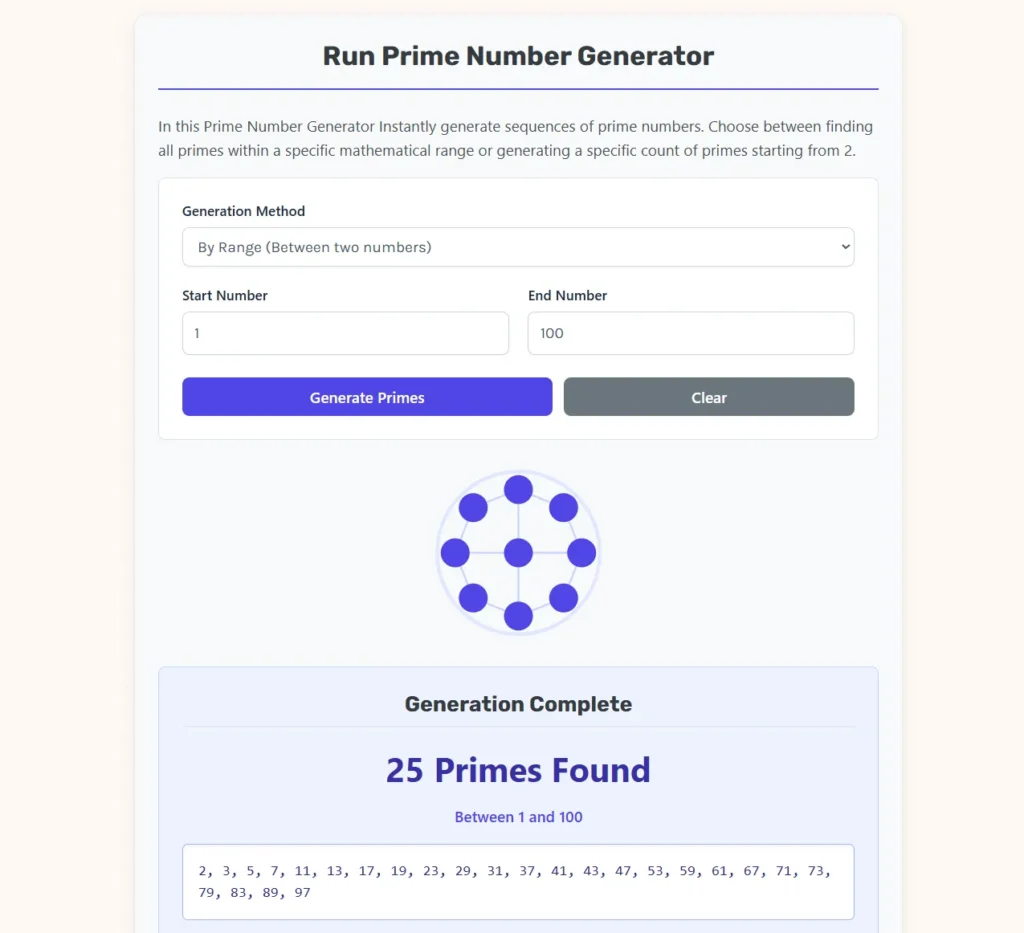
In this Prime Number Generator Instantly generate sequences of prime numbers. Choose between finding all primes within a specific mathematical range or generating a specific count of primes starting from 2.
Understanding Prime Numbers
What is a Prime Number?
A prime number is a whole number greater than 1 whose only divisors are 1 and itself. For example, 7 is a prime number because it cannot be divided evenly by anything other than 1 and 7. The number 8 is composite because it can be divided by 2 and 4.
- The number 2 is the only even prime number.
- The numbers 0 and 1 are neither prime nor composite.
- There is an infinite number of primes!
How does this calculator work?
This generator utilizes Trial Division optimized with a square root limit. To check if a number n is prime, the algorithm only tests divisors up to the square root of n ( √n ). If no divisors are found by that point, the number is mathematically guaranteed to be prime.
Guide to Prime Numbers and Algorithmic Generation
Prime numbers serve as the fundamental structural elements of arithmetic. In the domain of mathematics, digital security, and computational science, understanding how these values operate and how they can be effectively uncovered is essential. This document serves as an exhaustive reference text to accompany the online prime number generation tool, establishing a bridge between basic numerical concepts and advanced computer algorithms.
Core Concepts and Definitions
To understand the operational framework of a prime number generator, one must establish precise mathematical definitions. Every whole number can be classified based on its structural properties and the divisors that partition it.
Prime Numbers
A prime number is an integer strictly greater than 1 that possesses exactly two distinct positive divisors: 1 and the number itself. If an integer cannot be divided evenly by any other whole number except these two, it is deemed prime.
Composite Numbers
An integer greater than 1 that possesses more than two distinct positive divisors is classified as a composite number. Composite numbers can be broken down into a product of smaller integers. For instance, the number 12 is composite because its divisors include 1, 2, 3, 4, 6, and 12.
The Special Status of Zero and One
The integers 0 and 1 are explicitly excluded from the category of prime numbers.
- The number 0 is divisible by every integer, which violates the requirement of having exactly two distinct factors.
- The number 1 possesses only one distinct positive divisor, which is 1 itself. Excluding 1 from the prime category is necessary to preserve the clarity of broader mathematical laws.
The Unique Nature of Two
The number 2 occupies a rare position in number theory. It is the first prime number and the only even prime number in existence. Every subsequent even number is inherently a multiple of 2, which automatically disqualifies it from being prime.
The Mathematical Foundation of Primality
The behavior of prime numbers forms the bedrock of ancient and modern mathematics. Two main pillars govern how we understand their distribution and structural composition.
The Fundamental Theorem of Arithmetic
This theorem states that every integer greater than 1 is either a prime number itself or can be represented as a unique product of prime numbers, up to the order of the factors. This is why primes are referred to as the atoms of the numerical universe.
For example, consider the composite number 60:
60 = 2 × 2 × 3 × 5 = 22 × 3 × 5
No other combination of prime numbers can ever multiply together to produce exactly 60. This mathematical absolute ensures consistency across complex cryptographic algorithms and factorization models.
The Distribution of Prime Numbers
Prime numbers do not appear at regular intervals along the number line. As numbers grow larger, the density of prime numbers decreases. The Prime Number Theorem provides a way to estimate the total number of primes less than or equal to a given value, denoted as π(x).
The theorem establishes that:
π(x) ≈ x / ln(x)
Where ln(x) represents the natural logarithm of x. This means that if you choose a random integer near a large value x, the approximate probability that the number is prime is 1 / ln(x).
How the Online Prime Number Generator Operates
The script embedded in this online tool uses a highly optimized implementation of trial division to evaluate and display prime sequences without exhausting client-side computing resources.
The Core Evaluation Method
The application evaluates numbers sequentially based on mathematical shortcuts. To verify whether a specific number n is prime, a basic algorithm would check every single integer from 2 up to n – 1. This approach requires too much processing power for large inputs.
This generator relies on the square root limit principle. If a number n is composite, it can be factored into two numbers, a × b = n. If both a and b were greater than the square root of n, then their product would exceed n. Therefore, at least one factor must be less than or equal to the square root of n, written as √n.
The Modulo 6 Optimization Strategy
The tool further optimizes processing times by using a wheel factorization technique based on the number 6. Every single prime number greater than 3 can be expressed in one of two algebraic formats:
n = 6k – 1 or n = 6k + 1
Where k is a positive integer. By leveraging this rule, the algorithm eliminates a large percentage of potential composite numbers before conducting deep division checks. The logical workflow unfolds as follows:
- The script checks if the target number is less than or equal to 1. If true, it returns false.
- It validates if the number is less than or equal to 3. The numbers 2 and 3 return true.
- It filters out any number divisible by 2 or 3. This immediately removes a significant portion of non-prime values from processing.
- The engine initiates a loop starting at 5, incrementing by 6 during each phase (testing 5, 11, 17, 23, and so on).
- Within each loop step, it verifies if the target is divisible by i or by i + 2 (which covers the 6k + 1 position).
- The execution loop ceases the moment that i × i exceeds the target number.
This approach allows the generator to quickly scan ranges up to 1,000,000 numbers or generate lists of up to 50,000 distinct primes directly within the web browser.
Step-by-Step Computational Examples
To demonstrate how the internal logic of the tool processes numerical inputs, let us examine two practical test cases.
Example A: Verifying if 29 is Prime
Let us apply the steps of the calculator algorithm manually to the number 29.
- Step 1: Is 29 less than or equal to 1? No.
- Step 2: Is 29 less than or equal to 3? No.
- Step 3: Is 29 divisible by 2 or 3? 29 divided by 2 leaves a remainder of 1. 29 divided by 3 leaves a remainder of 2. Both checks fail.
- Step 4: Initialize the optimization loop at i = 5.
- Step 5: Evaluate the loop condition. Is i × i less than or equal to 29? 5 × 5 = 25, which is less than 29. The loop proceeds.
- Step 6: Test divisibility by i (5) and i + 2 (7). 29 divided by 5 leaves a remainder of 4. 29 divided by 7 leaves a remainder of 1.
- Step 7: Increment the loop by 6. The new value of i becomes 11.
- Step 8: Evaluate the loop condition again. Is 11 × 11 less than or equal to 29? 11 × 11 = 121, which is greater than 29.
- Step 9: The loop terminates. Because no exact divisors were found, 29 is confirmed as prime.
Example B: Verifying if 35 is Prime
Let us trace how the algorithm handles a composite number like 35.
- Step 1: Is 35 less than or equal to 1? No.
- Step 2: Is 35 less than or equal to 3? No.
- Step 3: Is 35 divisible by 2 or 3? 35 divided by 2 leaves a remainder of 1. 35 divided by 3 leaves a remainder of 2.
- Step 4: Initialize the optimization loop at i = 5.
- Step 5: Evaluate the condition. Is 5 × 5 less than or equal to 35? 5 × 5 = 25, which is less than 35. The loop proceeds.
- Step 6: Test divisibility by i (5). 35 divided by 5 yields 7 with a remainder of 0.
- Step 7: An exact divisor is found. The algorithm stops immediately and marks 35 as composite.
Comparative Analysis of Primality Testing Algorithms
While trial division enhanced by modulo 6 optimization is effective for real-time web applications, it represents just one of several techniques used in computer science.
| Algorithm Name | Complexity Class (Big O) | Ideal Operational Range | Primary Strengths | Notable Weaknesses |
| Trial Division (Basic) | O(n) | Numbers under 10,000 | Simple to design and verify | Highly inefficient for larger ranges |
| Optimized Trial Division | O(√n) | Numbers under 100,000,000 | Minimal memory footprint | Slows down when numbers grow very large |
| Sieve of Eratosthenes | O(n log(log n)) | Ranges up to 100,000,000 | Extremely fast for dense ranges | Significant RAM usage to hold arrays |
| Miller-Rabin Test | O(k log3 n) | Astronomical values (Cryptographic keys) | Extremely fast processing speeds | Probabilistic nature requires multiple passes |
| AKS Primality Test | O(log6 n) | Theoretical validations | First proven deterministic polynomial test | Complex implementation with high overhead |
Practical Applications and Real-World Use Cases
Prime numbers are far more than abstract mathematical puzzles. They provide the practical scaffolding for modern data management and infrastructure security.
Public-Key Cryptography
Modern digital communication security relies heavily on prime numbers. The RSA (Rivest-Shamir-Adleman) encryption standard uses the mathematical relationship between prime multiplication and prime factorization.
- It is computationally simple to take two large prime numbers, p and q, and multiply them to produce a massive composite number, N.
- If N is thousands of bits long, it is incredibly difficult for an external computer to reverse-engineer the value and determine the original values of p and q.
- This imbalance forms a digital “trapdoor function” that secures banking transactions, military communications, and private data networks across the globe.
Cyber Security and Hashing Protocols
Hash tables rely on prime numbers to distribute data uniformly across memory addresses. When mapping variable input keys into structural indexes, multiplying or applying modulo functions via prime values significantly minimizes data collisions, ensuring retrieval operations remain efficient.
Evolutionary Biology Cycles
In the natural world, prime numbers serve as an evolutionary survival mechanism. Periodic cicadas (Magicicada) spend most of their lifespans underground before emerging to mate. These insects emerge in cycles of exactly 13 or 17 years.
By choosing prime numbers for their life cycles, cicadas prevent predators with shorter, shifting life cycles from aligning with their emergence patterns. This reduces the risk of the insects being wiped out by a single predatory population explosion.
Step-by-Step User Manual and Operational Best Practices
This online interface offers two intuitive modes for generating prime number sequences.
Mode A: Generation by Specific Range
This option displays every single prime value situated between two specific numbers.
- Step 1: Select the option labeled By Range from the dropdown configuration menu.
- Step 2: Type your desired boundary value into the input field marked Start Number.
- Step 3: Provide your target boundary destination within the input field labeled End Number.
- Step 4: Click the action button labeled Generate Primes. The interface will display the total prime count alongside an exportable, comma-separated list.
Mode B: Generation by Exact Total Count
This option generates a specific number of primes, starting from the number 2.
- Step 1: Choose the option titled By Count within the configuration interface.
- Step 2: Define the precise quantity of primes you require inside the input field labeled How many primes?.
- Step 3: Click the Generate Primes action button to view the sequence.
Interface Constraints and Safeguards
To maintain browser stability and prevent system crashes, the calculator enforces strict processing thresholds:
- Range Limitation: The span between the starting and ending boundaries cannot exceed 1,000,000 units.
- Count Limit: Users can request a maximum sequence size of 50,000 prime numbers per calculation query.
- Numerical Bounds: The maximum number evaluated by the browser cannot exceed 10,000,000.
Data Export Capabilities
Once the generator completes a task, users can leverage integrated sharing options:
- Copy List: Copies the entire raw text sequence to your device clipboard.
- WhatsApp and Telegram Export: Opens an external link containing a summarized preview of your results, allowing you to share the data across messaging platforms without breaking URL character limits.
Historical Milestones and Advanced Mathematical Horizons
The study of prime numbers spans thousands of years of human history, connecting ancient scholars to modern computer scientists.
The Sieve of Eratosthenes
Developed in the third century BCE by the Greek scholar Eratosthenes of Cyrene, this manual technique remains one of the most elegant sorting methods in history. To locate primes, a mathematician creates a grid of numbers up to a specified limit. The number 2 is marked as prime, and all its subsequent multiples are crossed out. The next remaining number (3) is marked as prime, and its multiples are crossed out. This process repeats until only prime numbers remain.
Mersenne Primes
Named after the French polymath Marin Mersenne, these primes follow a specific algebraic structure:
Mp = 2p – 1
Where the exponent p must itself be a prime number. Mersenne primes are highly sought after by computational networks like the Great Internet Mersenne Prime Search (GIMPS). These collaborative efforts use global computing power to uncover extraordinarily large prime numbers.
The Riemann Hypothesis
Considered one of the most important unsolved problems in pure mathematics, the Riemann Hypothesis addresses the precise distribution of prime numbers. Formulated by Bernhard Riemann in 1859, the conjecture posits that the distribution of primes is closely tied to the behavior of the Riemann Zeta function:
ζ(s) = ∑ 1 / ns
If this hypothesis is eventually proven true, it will unlock a much deeper understanding of the hidden patterns underlying number theory.
Scientific and Academic Reference
For an authoritative, peer-reviewed scientific overview of the foundational concepts used by this tool, please consult the resources provided by the National Institute of Standards and Technology.
National Institute of Standards and Technology. Digital Library of Mathematical Functions. Chapter 27: Number Theory. Available at:https://dlmf.nist.gov/27
Frequently Asked Questions
What is the largest known prime number?
Because there are infinite prime numbers, there is no such thing as a final or maximum prime number. The largest primes discovered by modern computers are Mersenne primes, which span tens of millions of digits.
Why is the number 9 not considered a prime number?
The number 9 has three distinct positive divisors: 1, 3, and 9. Because it can be divided evenly by 3, it is classified as a composite number rather than a prime.
Can a negative number be classified as prime?
No, prime numbers are strictly defined as integers greater than 1. Negative numbers do not meet this basic requirement.
What are twin primes?
Twin primes are pairs of prime numbers that differ by exactly two units. Common examples include (3, 5), (11, 13), and (17, 19).
How can I use the data generated by this tool in other programs?
After running a calculation, click the Copy List button. This saves the entire sequence as a plain text, comma-separated string that can be pasted directly into programming environments, spreadsheets, or text editors.