Run Prime Factorization Calculator
Prime Factorization Calculator: Quickly break numbers into their prime components
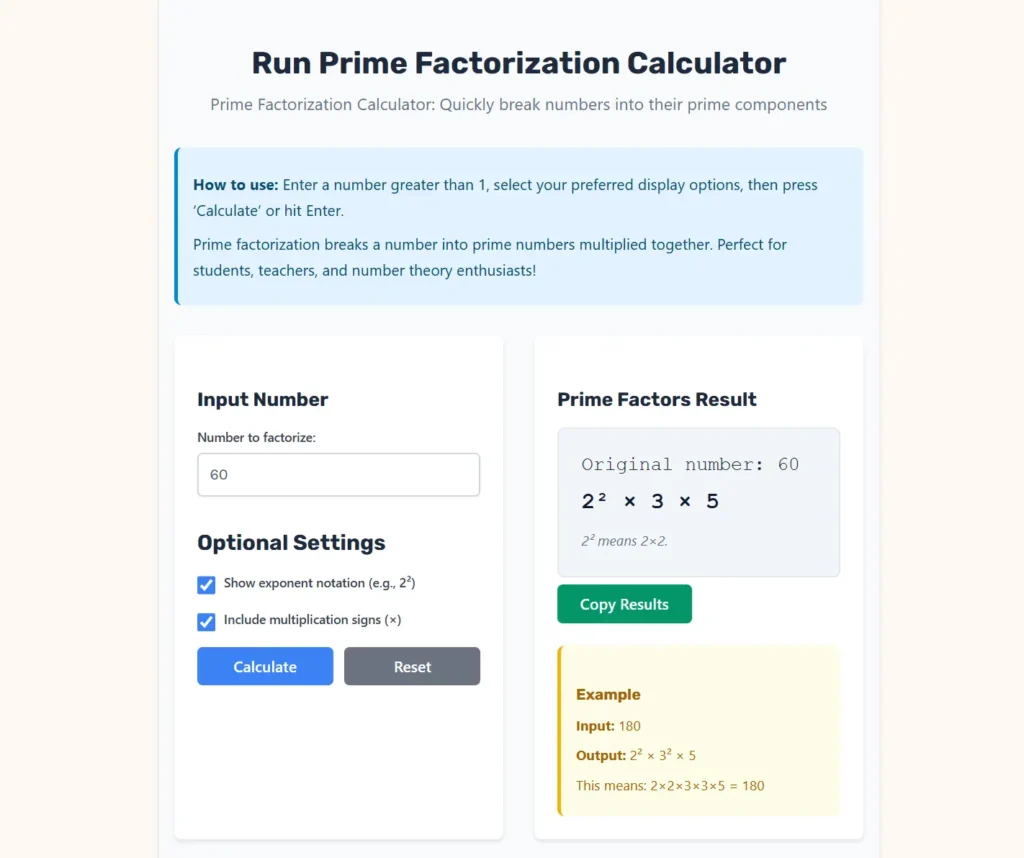
How to use: Enter a number greater than 1, select your preferred display options, then press ‘Calculate’ or hit Enter.
Prime factorization breaks a number into prime numbers multiplied together. Perfect for students, teachers, and number theory enthusiasts!
Input Number
Optional Settings
Prime Factors Result
Example
Input: 180
Output: 2² × 3² × 5
This means: 2×2×3×3×5 = 180
Understanding Prime Factorization: The Mathematical DNA of Numbers
Every composite integer in our numerical system possesses a unique identity card, a sequence of prime numbers that, when multiplied together, reconstructs the original number exactly. This process of breaking down a composite number into its raw, indivisible components is known as prime factorization.
To understand this concept, it is helpful to think of prime numbers as the chemical elements of the mathematical universe. Just as water molecule H2O is constructed from two hydrogen atoms and one oxygen atom, the number 12 is constructed from two units of the prime number 2 and one unit of the prime number 3. This exact combination of prime factors belongs solely to the number 12.
This online prime factorization calculator is designed to perform these computations instantly, displaying the results in a format that suits students, educators, and cryptographic researchers alike. Whether you are dealing with small homework problems or large computational integers up to 1,000,000, this guide details the mathematics, history, and algorithms behind the tool.
Core Definitions and Mathematical Foundations
To fully appreciate the mechanics of a prime factorization calculator, we must establish a clear vocabulary of the underlying number theory.
Prime Numbers
A prime number is an integer strictly greater than 1 that cannot be formed by multiplying two smaller natural numbers. In other words, its only positive divisors are 1 and itself. The sequence begins with 2, 3, 5, 7, 11, 13, 17, 19, 23, and continues infinitely.
Composite Numbers
A composite number is a positive integer that has at least one divisor other than 1 and itself. Any whole number greater than 1 that is not prime is, by definition, composite. For example, 4, 6, 8, 9, and 10 are composite numbers because they can be split into smaller integer factors.
Factors versus Prime Factors
A divisor, or factor, is any integer that divides another integer evenly without leaving a remainder. For instance, the factors of the number 12 are 1, 2, 3, 4, 6, and 12. However, the prime factors of 12 are only those factors that are also prime numbers, which are 2 and 3.
Why Zero and One are Excluded
The number 0 is divisible by all non-zero integers, so it does not meet the criteria of having exactly two positive divisors. The number 1 has only one positive divisor, which is 1 itself. Excluding 1 from the primes is not an arbitrary rule; it is required to preserve the validity of the Fundamental Theorem of Arithmetic. If 1 were considered prime, prime factorizations would lose their uniqueness, as we could write 12 as:
12 = 2 × 2 × 3 × 1 × 1 × 1…
This endless repetition would break the rules of unique prime decomposition.
The Fundamental Theorem of Arithmetic
The foundational principle supporting the calculations of our tool is the Fundamental Theorem of Arithmetic, sometimes called the Unique Factorization Theorem.
Theorem Statement: Every integer greater than 1 is either a prime number itself or can be represented as a unique product of prime numbers, up to the order of the factors.
This means that no matter what path you take to factorize a number, you will always arrive at the exact same set of prime factors. Whether you use a visual factor tree or sequential division, the final set of primes remains identical.
For example, let us look at the prime factorization of 60:
60 = 2 × 2 × 3 × 5
We can also express this using exponent notation, which groups identical prime factors together:
60 = 22 × 3 × 5
No other combination of prime numbers in the entire universe can be multiplied together to produce 60. This absolute predictability is what makes prime factorization a reliable tool in computational mathematics, key generation, and division logic.
Factors vs. Prime Factors: A Side-by-Side Comparison
To illustrate the difference between finding all divisors of a number and finding its unique prime factors, consider this comparative reference table:
| Target Number | All Positive Divisors (Factors) | Unique Prime Factors | Prime Factorization (Product Form) | Exponent Notation |
| 12 | 1, 2, 3, 4, 6, 12 | 2, 3 | 2 × 2 × 3 | 22 × 3 |
| 30 | 1, 2, 3, 5, 6, 10, 15, 30 | 2, 3, 5 | 2 × 3 × 5 | 2 × 3 × 5 |
| 45 | 1, 3, 5, 9, 15, 45 | 3, 5 | 3 × 3 × 5 | 32 × 5 |
| 97 | 1, 97 | 97 | 97 | 97 |
| 100 | 1, 2, 4, 5, 10, 20, 25, 50, 100 | 2, 5 | 2 × 2 × 5 × 5 | 22 × 52 |
| 1024 | 1, 2, 4, 8, 16, 32, 64, 128, 256, 512, 1024 | 2 | 2 × 2 × 2 × 2 × 2 × 2 × 2 × 2 × 2 × 2 | 210 |
How the Calculator Engine Works Under the Hood
The computer code running this calculator uses an optimized version of the Trial Division algorithm. While simple, this method is highly efficient for inputs under 1,000,000.
The Algorithm Step-by-Step
The script evaluates the user’s input $n$ using a system of loops:
- Initialization: The program takes the input number $n$ and initializes the first divisor at 2.
- Division Loop: It checks if the current divisor divides $n$ without a remainder (meaning $n$ modulo divisor is equal to 0).
- Reduction: If the divisor divides $n$ evenly, it is added to the list of prime factors. The program then updates the value of $n$ by dividing it by the divisor ($n = n / \text{divisor}$). This division is repeated until the divisor no longer divides the newly reduced $n$.
- Incrementing: The divisor is incremented by 1, and the division loop repeats.
- Termination Condition: The process continues as long as the square of the divisor is less than or equal to the remaining value of $n$ ($\text{divisor} \times \text{divisor} \le n$).
- Final Guard: If, after exiting the loop, the remaining value of $n$ is greater than 1, that remaining value is itself prime and is appended to the factor list.
Why the Square Root Limit Is Mathematically Guaranteed
The termination condition ($\text{divisor} \times \text{divisor} \le n$) is a critical optimization.
If a number $n$ is composite, it can be written as $a \times b = n$. If both $a$ and $b$ were greater than the square root of $n$ ($\sqrt{n}$), then their product $a \times b$ would be greater than $\sqrt{n} \times \sqrt{n} = n$, which is a contradiction. Therefore, every composite number $n$ must have at least one prime factor less than or equal to $\sqrt{n}$.
If our calculator loops all the way to $\sqrt{n}$ without finding any divisors, the remaining value of $n$ is guaranteed to be prime. This allows the tool to process large numbers almost instantaneously. For example, to factorize the number 999,997, the calculator only needs to test divisors up to 1,000, rather than checking every number up to 999,997.
Step-by-Step Calculation Examples
To show how the algorithm works, let us walk through three step-by-step examples.
Example 1: Finding the Prime Factors of 180
Let us manually trace how the calculator processes the number 180.
- Step 1: Set $n = 180$. Start with divisor $= 2$.
- Step 2: Does 2 divide 180? Yes.
- Save 2 as a factor.
- Reduce $n$: $180 / 2 = 90$.
- Step 3: Does 2 divide 90? Yes.
- Save 2 as a factor.
- Reduce $n$: $90 / 2 = 45$.
- Step 4: Does 2 divide 45? No, it leaves a remainder.
- Step 5: Increment the divisor to 3.
- Step 6: Does 3 divide 45? Yes.
- Save 3 as a factor.
- Reduce $n$: $45 / 3 = 15$.
- Step 7: Does 3 divide 15? Yes.
- Save 3 as a factor.
- Reduce $n$: $15 / 3 = 5$.
- Step 8: Does 3 divide 5? No.
- Step 9: Increment the divisor to 4.
- Step 10: Check the loop termination condition. Since $\text{divisor} \times \text{divisor} = 4 \times 4 = 16$, and 16 is greater than the remaining $n$ (5), the loop terminates.
- Step 11: Since the remaining $n$ (5) is greater than 1, we add it to our factor list.
The final list of prime factors: 2, 2, 3, 3, 5.
Formatted product output: 2 × 2 × 3 × 3 × 5
Exponent notation: 22 × 32 × 5
Example 2: Finding the Prime Factors of 997 (A Prime Number)
Now let us look at what happens when the input is a prime number.
- Step 1: Set $n = 997$. Start with divisor $= 2$.
- Step 2: The loop checks divisors 2, 3, 4, and so on.
- Step 3: None of these numbers divide 997 without a remainder.
- Step 4: The loop continues until the divisor reaches 32, since $32 \times 32 = 1024$, which is greater than 997.
- Step 5: The loop terminates because the square of the divisor exceeds the remaining $n$.
- Step 6: Since the remaining $n$ (997) is greater than 1, the calculator appends it to the factor list.
Result: 997 is prime. Its only prime factor is 997.
Example 3: Finding the Prime Factors of 1000
Let us trace the clean decimal structure of 1000.
- Step 1: Set $n = 1000$. Start with divisor $= 2$.
- Step 2: Does 2 divide 1000? Yes.
- Save 2. Reduce $n$: $1000 / 2 = 500$.
- Step 3: Does 2 divide 500? Yes.
- Save 2. Reduce $n$: $500 / 2 = 250$.
- Step 4: Does 2 divide 250? Yes.
- Save 2. Reduce $n$: $250 / 2 = 125$.
- Step 5: Does 2 divide 125? No.
- Step 6: Increment divisor to 3. Does 3 divide 125? No.
- Step 7: Increment divisor to 4. Does 4 divide 125? No.
- Step 8: Increment divisor to 5. Does 5 divide 125? Yes.
- Save 5. Reduce $n$: $125 / 5 = 25$.
- Step 9: Does 5 divide 25? Yes.
- Save 5. Reduce $n$: $25 / 5 = 5$.
- Step 10: Does 5 divide 5? Yes.
- Save 5. Reduce $n$: $5 / 5 = 1$.
- Step 11: Since $n$ is now 1, the loop finishes.
The final list of prime factors: 2, 2, 2, 5, 5, 5.
Formatted product output: 2 × 2 × 2 × 5 × 5 × 5
Exponent notation: 23 × 53
Comparison of Factorization Algorithms
While Trial Division is perfect for daily applications, computer science has produced a variety of algorithms designed for different scales of numbers.
| Algorithm | Computational Complexity | Best Use Case | Operational Mechanics |
| Trial Division | O(√n) | Numbers up to 1,000,000 | Systematically checks potential divisors starting from 2 up to the square root of the target number. |
| Fermat’s Factorization | Depends on factor proximity | Numbers whose factors are close to each other | Expresses an odd integer as the difference of two squares: n = x2 – y2. |
| Pollard’s Rho Algorithm | O(n1/4) | Medium-sized composite integers | Uses a pseudo-random sequence to find factors based on birthday paradox probabilities. |
| Quadratic Sieve | Sub-exponential | Numbers with 50 to 110 decimal digits | Locates squares that are congruent modulo n to construct factor matches. |
| General Number Field Sieve (GNFS) | Complex sub-exponential | Giant values (110+ decimal digits) | The most powerful known algorithm for factoring massive integers on distributed computing networks. |
Real-World Applications of Prime Factorization
Prime factorization is more than a classroom exercise; it is a vital component of modern technology, security, and industrial design.
Public-Key Cryptography (The RSA Standard)
The security of almost all online transactions, credit card processors, and secure messaging apps relies on prime factorization. The RSA encryption algorithm is a prime example of this.
- The Encryption Key: A computer chooses two incredibly large prime numbers, $p$ and $q$ (each hundreds of digits long), and multiplies them together to produce a giant composite number, $N = p \times q$.
- The Trapdoor Principle: It is very easy for a computer to multiply these two primes together. However, it is incredibly difficult for any computer in the world to reverse the process and find $p$ and $q$ just by looking at $N$.
- Security: Without knowing the original prime factors $p$ and $q$, an unauthorized user cannot decrypt the data. Breaking RSA encryption requires factoring these giant numbers, which would take classical supercomputers billions of years to complete.
Great Common Divisor (GCD) and Least Common Multiple (LCM)
In engineering, architecture, and basic algebra, finding the Great Common Divisor (GCD) and Least Common Multiple (LCM) is essential for scheduling tasks, designing gears, and balancing structural loads. Prime factorization provides the easiest way to calculate these:
- To find the GCD: Multiply the lowest power of all common prime factors together.
- To find the LCM: Multiply the highest power of all prime factors that appear in either number.
Hashing and Computer Database Storage
Database systems use hash tables to store and retrieve records instantly. To distribute data evenly across a storage system and avoid overlapping addresses (collisions), indexing engines use mathematical calculations based on prime factors. This keeps database searches fast and efficient.
User Manual: Best Practices for Using the Calculator
This interactive calculator is designed to be highly accessible and easy to use. Follow these guidelines to get the most out of your calculations:
- Choosing Your Input: Enter any positive integer greater than 1 in the input field. For the best performance, keep your entries below 1,000,000.
- Setting Display Preferences:
- Exponent Notation: Check this box to group repeated prime factors together using superscripts. This option is highly recommended for clean, readable homework solutions.
- Multiplication Signs (×): This option toggles the multiplication sign between the factors. If you uncheck this box, the factors will be displayed with spaces instead of mathematical signs.
- Exporting Your Work:
- Once the computation finishes, click the Copy Results button to copy the output directly to your device clipboard.
- This copies the original number, the formatted prime factors, and the step-by-step mathematical explanation, making it easy to paste into spreadsheets, word processors, or homework documents.
Scientific and Academic References
For a deeper dive into the number theory and algorithmic structures behind prime factorization, consult these authoritative academic resources:
Hardy, G. H., & Wright, E. M. (2008). An Introduction to the Theory of Numbers (6th ed.). Oxford University Press.
This text offers a comprehensive look at the Fundamental Theorem of Arithmetic and the mathematical properties of prime distribution.
Frequently Asked Questions
Why is 1 not considered a prime factor?
The number 1 is not considered a prime factor because it is not a prime number. If 1 were classified as a prime, the prime factorization of any number would lose its uniqueness. We could add an infinite number of 1s to any prime factorization product without changing the final value, which would break the Fundamental Theorem of Arithmetic.
What is the prime factorization of a prime number?
The prime factorization of any prime number is simply the number itself. Since a prime number cannot be divided by any smaller integers other than 1, its factorization process stops before it even begins. For example, the prime factorization of 13 is simply 13.
Can negative numbers be factored into primes?
No, prime factorization is defined specifically for positive integers greater than 1. For negative integers, mathematicians typically factor out -1 first (for example, $-30 = -1 \times 2 \times 3 \times 5$), but the prime factors themselves remain positive integers.
How does this calculator handle prime factorization differently than a factor tree?
This calculator uses a trial division algorithm to find factors sequentially, which is faster and more systematic than building a factor tree. However, both methods are mathematically identical and will always yield the exact same prime factors for any given number.
What is the difference between a prime factor and a prime divisor?
There is no difference. The terms “prime factor” and “prime divisor” refer to the same mathematical concept: a divisor of a target number that is also a prime number.