Use Punnett Square Calculator
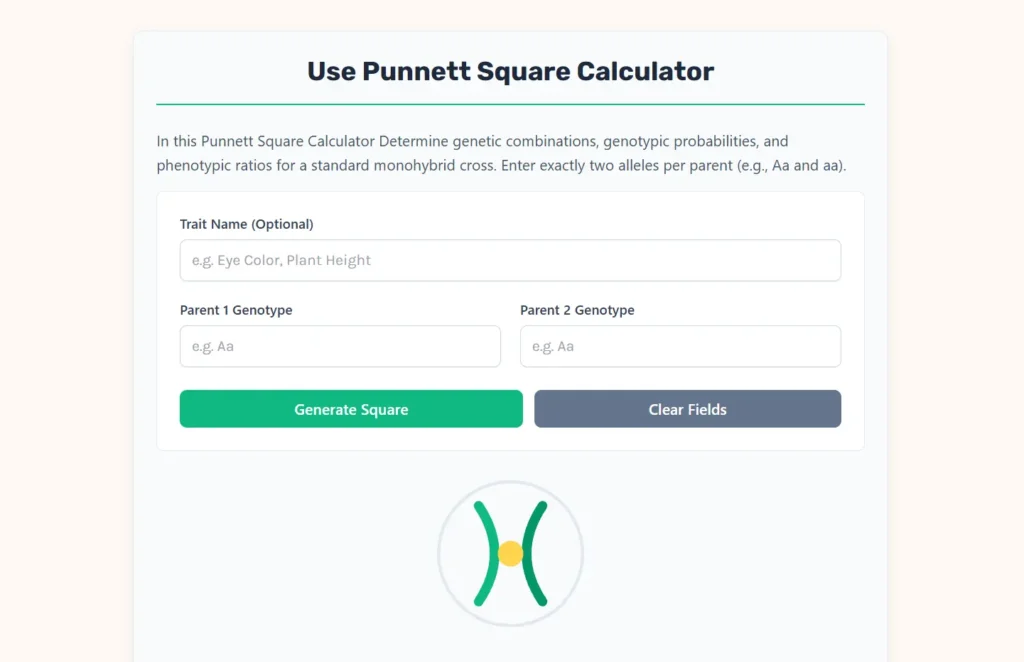
In this Punnett Square Calculator Determine genetic combinations, genotypic probabilities, and phenotypic ratios for a standard monohybrid cross. Enter exactly two alleles per parent (e.g., Aa and aa).
Understanding the Biology
Genotype vs. Phenotype
Genotype refers to the actual genetic makeup represented by the letters (e.g., Aa).
Phenotype refers to the observable physical trait that results from the genotype.
Dominant and Recessive Alleles
An uppercase letter (e.g., A) represents a dominant allele. If a dominant allele is present, that trait will be expressed.
A lowercase letter (e.g., a) represents a recessive allele. It requires two copies (aa) for the recessive trait to be expressed.
Calculating Frequencies
The grid represents the 4 possible combinations of offspring from the parents. Each square represents a 25% (or 1/4) chance of that specific genetic combination occurring in an offspring.
Punnett Squares and Mendelian Genetics
In biological sciences, genetics serves as the foundational framework for understanding how traits are transmitted across generations. From the color of a flower to the inheritance of complex human metabolic conditions, the transmission of genetic material is governed by predictable, mathematical laws of probability.
The primary analytical tool used to visualize and calculate these hereditary probabilities is the Punnett square. Invented in the early twentieth century by the English geneticist Reginald Punnett, this visual matrix acts as a predictive model. It maps the gametes of two parents to forecast the genotypic and phenotypic distributions of their potential offspring.
This Punnett Square Calculator serves as a high-precision educational and diagnostic utility. It translates the symbolic representation of parent genotypes into an interactive two-by-two grid, computing exact fractional ratios, percentages, and probability vectors. By automating this Mendelian analysis, this tool bridges the gap between classic qualitative genetic observations and modern quantitative statistical probability.
The Biological Foundations of Mendelian Inheritance
To properly interpret the results generated by this calculator, one must understand the basic biological mechanisms that occur during cellular division and sexual reproduction.
➜ DNA, Chromosomes, and Genes
Within the nucleus of every eukaryotic cell, deoxyribonucleic acid (DNA) is packaged into highly organized structures called chromosomes. A gene is a specific sequence of nucleotides located at a distinct physical position, or locus, on a chromosome. This sequence contains the instructions for synthesizing a particular protein, which in turn influences an organism’s physical traits.
➜ Alleles and Genetic Divergence
In sexually reproducing organisms, chromosomes exist in homologous pairs, meaning individuals inherit one set of chromosomes from each parent. Consequently, every individual possesses two copies of each gene. These copies are called alleles. Alleles are alternative versions of the same gene that differ by subtle nucleotide variations.
➜ Homozygous: An organism is homozygous at a specific locus when it inherits two identical alleles for a given gene (e.g., $AA$ or $aa$).
➜ Heterozygous: An organism is heterozygous when it inherits two different alleles for a given gene (e.g., $Aa$).
➜ Genotype versus Phenotype
A critical distinction in genetics is the difference between an organism’s genetic blueprint and its physical reality.
➜ Genotype: The specific genetic makeup of an organism, represented by symbolic letter combinations (e.g., $AA$, $Aa$, or $aa$).
➜ Phenotype: The observable physical, physiological, or behavioral characteristics of an organism, which are determined by the interaction of its genotype with the environment.
Gregor Mendel and the Laws of Heredity
The modern science of genetics began in the mid-nineteenth century with the quantitative experiments of Gregor Mendel, an Austrian monk. Through the systematic hybridization of the garden pea plant (Pisum sativum), Mendel formulated three fundamental laws of inheritance that form the logical core of this calculator.
1. The Law of Segregation
Mendel’s first law states that during the formation of gametes (sperm and egg cells), the two alleles for each gene segregate, or separate, from one another. Each gamete receives only one allele with equal probability. This physical separation occurs during meiosis, the specialized cell division that reduces the chromosome count by half.
2. The Law of Dominance
Mendel’s second law dictates that in a heterozygote, one allele will mask the phenotypic expression of another allele at the same locus.
➜ Dominant Allele: The allele that determines the phenotype of a heterozygote, symbolized by an uppercase letter (e.g., $A$).
➜ Recessive Allele: The allele whose physical expression is completely masked in a heterozygote, symbolized by a lowercase letter (e.g., $a$).
To express a recessive phenotype, an organism must be homozygous recessive, inheriting a copy of the recessive allele from both parents (genotype $aa$).
3. The Law of Independent Assortment
This law states that genes for different traits segregate independently of one another during gamete formation. While this law is vital for analyzing crosses involving multiple genes (dihybrid or trihybrid crosses), this monohybrid calculator focuses specifically on the segregation of a single gene locus.
The Mathematical Engine of the Punnett Square
A Punnett square is not merely a visual aid; it is a probability matrix. The mathematics of genetic crosses are rooted in probability theory, specifically the laws governing independent and mutually exclusive events.
1. The Product Rule for Independent Events
The product rule states that the probability of two independent events occurring simultaneously is the product of their individual probabilities. Gamete donation from Parent 1 and Parent 2 are independent events.
If Parent 1 is heterozygous ($Aa$), the probability ($P$) of donating the dominant allele $A$ is:$$P(A) = 0.50$$
If Parent 2 is also heterozygous ($Aa$), the probability of donating the dominant allele $A$ is also $0.50$. The probability of producing a homozygous dominant ($AA$) offspring is calculated as follows:$$P(AA) = P(A_{\text{Parent 1}}) \times P(A_{\text{Parent 2}})$$
Evaluating this product:$$P(AA) = 0.50 \times 0.50 = 0.25$$
This $0.25$ decimal represents a $25\%$ probability, or a $1/4$ chance, of producing an $AA$ genotype.
2. The Sum Rule for Mutually Exclusive Events
The sum rule states that the probability of any one of several mutually exclusive events occurring is the sum of their individual probabilities.
To obtain a heterozygous ($Aa$) offspring from heterozygous parents ($Aa \times Aa$), there are two mutually exclusive pathways:
- Parent 1 donates the dominant allele $A$ and Parent 2 donates the recessive allele $a$.
- Parent 1 donates the recessive allele $a$ and Parent 2 donates the dominant allele $A$.
The probability of each individual pathway is:
P(W_1) &= P(A) \times P(a) = 0.25 \
P(W_2) &= P(a) \times P(A) = 0.25
Where:
$P(A)$ / $P(a)$: Probability of inheriting allele $A$ or allele $a$ ($0.50$)
$P(W_1)$: Probability of Pathway 1 ($0.50 \times 0.50$)
$P(W_2)$: Probability of Pathway 2 ($0.50 \times 0.50$)
Using the sum rule to find the total probability of a heterozygous offspring:$$P(Aa) = P(\text{Pathway 1}) + P(\text{Pathway 2})$$$$P(Aa) = 0.25 + 0.25 = 0.50$$
This matches the $50\%$ probability calculated by the Punnett matrix.
3. Calculating Phenotypic Ratios
Under complete Mendelian dominance, both the homozygous dominant ($AA$) and heterozygous ($Aa$) genotypes express the dominant phenotype. Only the homozygous recessive ($aa$) genotype expresses the recessive phenotype.
The probability of expressing the dominant phenotype ($P_{\text{dominant}}$) is the sum of the probabilities of the genotypes that produce it:$$P_{\text{dominant}} = P(AA) + P(Aa)$$$$P_{\text{dominant}} = 0.25 + 0.50 = 0.75$$
This results in the classic $3\text{ to }1$ phenotypic ratio ($75\%$ dominant to $25\%$ recessive) observed in heterozygous monohybrid crosses.
Sizing and Probability Distribution of Monohybrid Crosses
This table outlines the genotypic and phenotypic outcomes of all possible monohybrid cross combinations using a single gene locus with alleles $A$ and $a$.
| Parent 1 Genotype | Parent 2 Genotype | Genotypic Ratio | Phenotypic Ratio (Dominant : Recessive) |
| Homozygous Dominant ($AA$) | Homozygous Dominant ($AA$) | $1.00 \text{ } AA$ | $100\% \text{ Dominant} : 0\% \text{ Recessive}$ |
| Homozygous Dominant ($AA$) | Heterozygous ($Aa$) | $0.50 \text{ } AA : 0.50 \text{ } Aa$ | $100\% \text{ Dominant} : 0\% \text{ Recessive}$ |
| Homozygous Dominant ($AA$) | Homozygous Recessive ($aa$) | $1.00 \text{ } Aa$ | $100\% \text{ Dominant} : 0\% \text{ Recessive}$ |
| Heterozygous ($Aa$) | Heterozygous ($Aa$) | $0.25 \text{ } AA : 0.50 \text{ } Aa : 0.25 \text{ } aa$ | $75\% \text{ Dominant} : 25\% \text{ Recessive}$ |
| Heterozygous ($Aa$) | Homozygous Recessive ($aa$) | $0.50 \text{ } Aa : 0.50 \text{ } aa$ | $50\% \text{ Dominant} : 50\% \text{ Recessive}$ |
| Homozygous Recessive ($aa$) | Homozygous Recessive ($aa$) | $1.00 \text{ } aa$ | $0\% \text{ Dominant} : 100\% \text{ Recessive}$ |
Step-by-Step Practical Genetic Examples
To demonstrate the mathematical accuracy of these formulas, let us walk through two real-world genetic scenarios.
Example 1: The Heterozygous Monohybrid Cross (Cystic Fibrosis Risk)
Cystic fibrosis is an autosomal recessive genetic disorder in humans. It is caused by mutations in the CFTR gene. Let the healthy, dominant allele be represented by $F$ and the recessive, disease-causing allele be represented by $f$.
Two parents are confirmed carriers of the cystic fibrosis gene, meaning they are both heterozygous ($Ff$) and do not display symptoms. They want to calculate the genetic risk for their future offspring.
1. Determine the parental gametes:
- Parent 1 produces gametes containing $F$ or $f$ with equal probability ($0.50$).
- Parent 2 produces gametes containing $F$ or $f$ with equal probability ($0.50$).
2. Populate the Punnett square matrix:
- Cell 1,1: $F$ from Parent 1 and $F$ from Parent 2 $\rightarrow FF$ (Homozygous healthy)
- Cell 1,2: $f$ from Parent 1 and $F$ from Parent 2 $\rightarrow Ff$ (Heterozygous carrier)
- Cell 2,1: $F$ from Parent 1 and $f$ from Parent 2 $\rightarrow Ff$ (Heterozygous carrier)
- Cell 2,2: $f$ from Parent 1 and $f$ from Parent 2 $\rightarrow ff$ (Homozygous affected)
3. Calculate the genotypic frequencies:$$FF = \frac{1}{4} = 25\%$$$$Ff = \frac{2}{4} = 50\%$$$$ff = \frac{1}{4} = 25\%$$
4. Calculate the phenotypic frequencies:
- Healthy Phenotype (includes $FF$ and $Ff$): $25\% + 50\% = 75\%$
- Affected Phenotype (strictly $ff$): $25\%$
5. Interpretation:
The clinical geneticist advises the parents that for each pregnancy, there is a $25\%$ chance the child will have cystic fibrosis, a $50\%$ chance the child will be a healthy carrier, and a $25\%$ chance the child will inherit two healthy copies of the gene.
Example 2: The Classical Genetic Test Cross (Agricultural Breeding)
A horticulturalist is breeding pea plants. They have a plant that produces yellow seeds, which is the dominant phenotype. However, because yellow seeds can result from either a homozygous dominant ($YY$) or heterozygous ($Yy$) genotype, the plant’s exact genetic makeup is unknown.
To determine the genotype, the breeder performs a test cross. They breed the yellow-seeded plant with a green-seeded plant, which must be homozygous recessive ($yy$).
Scenario A: The unknown parent is Homozygous Dominant ($YY \times yy$)
- All gametes from the unknown parent contain $Y$.
- All gametes from the green parent contain $y$.
- All resulting offspring will have the genotype $Yy$ and display yellow seeds.
- Phenotypic Ratio: $100\%$ Yellow.
Scenario B: The unknown parent is Heterozygous ($Yy \times yy$)
- Gametes from the unknown parent contain $Y$ or $y$ with equal probability ($0.50$).
- All gametes from the green parent contain $y$.
- Offspring combinations: $50\% \text{ } Yy$ (Yellow) and $50\% \text{ } yy$ (Green).
- Phenotypic Ratio: $50\%$ Yellow, $50\%$ Green.
Conclusion:
If even a single green-seeded offspring is produced from the cross, the breeder knows with mathematical certainty that the unknown parent plant was heterozygous ($Yy$).
Advanced Non-Mendelian Anomalies
While this monohybrid calculator is built upon Mendelian dominance, nature frequently displays complex variations that alter standard phenotypic ratios.
➜ Codominance
In codominance, both alleles in a heterozygote are fully expressed in the phenotype, without blending.
- Example: Human ABO blood typing. An individual inheriting the $I^A$ allele from one parent and the $I^B$ allele from the other has the blood type $AB$. Both antigens are expressed on the surface of the red blood cells.
➜ Incomplete Dominance
In incomplete dominance, the heterozygous phenotype is an intermediate blend of the homozygous dominant and homozygous recessive phenotypes.
- Example: Snapdragon flower color. Crossing a homozygous red flower ($RR$) with a homozygous white flower ($rr$) produces heterozygous offspring with pink flowers ($Rr$).
➜ Lethal Alleles
Some mutations result in alleles that are essential for survival. When an organism inherits two copies of a recessive lethal allele, it dies during embryonic development. This event skews the observed genotypic ratios of live offspring.
- Example: Manx cats. The gene for taillessness ($M$) is lethal in the homozygous state ($MM$). A cross between two heterozygous tailless cats ($Mm \times Mm$) yields a phenotypic ratio of $2$ tailless cats to $1$ normal-tailed cat among surviving offspring, rather than the standard $3\text{ to }1$ ratio.
Best Practices for Solving Genetic Crosses
When analyzing inheritance patterns using this calculator, consider the following biological guidelines:
- Maintain Letter Consistency: Always use the same letter family for a single trait. Use the uppercase form for the dominant allele and the lowercase form for the recessive allele (e.g., $B$ and $b$). Never mix letters (e.g., $B$ and $g$ for brown and green eye colors) as this violates the symbolic standards of monohybrid crosses.
- Define Alleles First: Before entering genotypes, explicitly state what each allele represents. For example, let $T = \text{tall}$ and $t = \text{short}$.
- List Gametes Methodically: Ensure that the alleles for Parent 1 are placed strictly along the top axis, and alleles for Parent 2 are placed along the left vertical axis of the grid.
- Observe Sample Size Limits: Remember that Punnett square ratios represent mathematical probabilities, not guarantees. In a small litter of animals, the actual ratio of offspring may deviate from the predicted values due to random fertilization. As sample sizes increase, the actual ratios will align more closely with the calculator’s predicted values, according to the Law of Large Numbers.
Glossary of Genetic and Biological Terms
➜ Allele: An alternative version of a gene situated at a specific locus on a chromosome.
➜ Autosome: Any chromosome that is not a sex chromosome. Autosomal traits are inherited equally by males and females.
➜ Gamete: A mature haploid male or female germ cell (sperm or egg) that is able to unite with another of the opposite sex in sexual reproduction.
➜ Heterozygous: Possessing two different alleles for a particular gene.
➜ Homozygous: Possessing two identical alleles for a particular gene.
➜ Locus: The specific physical location of a gene on a chromosome.
➜ Meiosis: A specialized type of cell division that reduces the chromosome number by half, producing four haploid gametes.
➜ Monohybrid Cross: A genetic cross between two individuals that focuses on the inheritance of a single gene locus.
Scientific Reference and Genetic Standards
The mathematical models and inheritance principles utilized in this calculator align with the long-standing principles of classical genetics established by the scientific community.
Relevance: Mendel’s quantitative analysis of trait inheritance in pea plants established the laws of segregation and dominance. These laws remain the mathematical foundation for modern genetics, agricultural breeding, and genetic counseling. By aligning with these standards, this calculator ensures that your genetic projections are mathematically robust, biologically accurate, and compliant with modern scientific protocols.
Punnett Square Guide E-book
You can download our full guide for Punnett Square here.
Final Summary Checklist for Genetics Students and Breeders
Before drawing conclusions based on your calculated results, verify the following parameters:
✓ Have the parental genotypes been entered using a consistent letter scheme?
✓ Do the inputs contain exactly two alleles per parent?
✓ Have you noted whether the trait in question follows complete dominance, codominance, or incomplete dominance?
✓ If analyzing a human genetic pedigree, have you verified if the condition is autosomal or sex-linked?
✓ Are you accounting for potential environmental factors that could influence the expression of the phenotype?
By applying these genetic standards and scientific best practices in our Punnett Square Calculator, you can ensure that your genetic crosses are biologically accurate, resource-efficient, and mathematically precise.