Run Pyramid Calculator
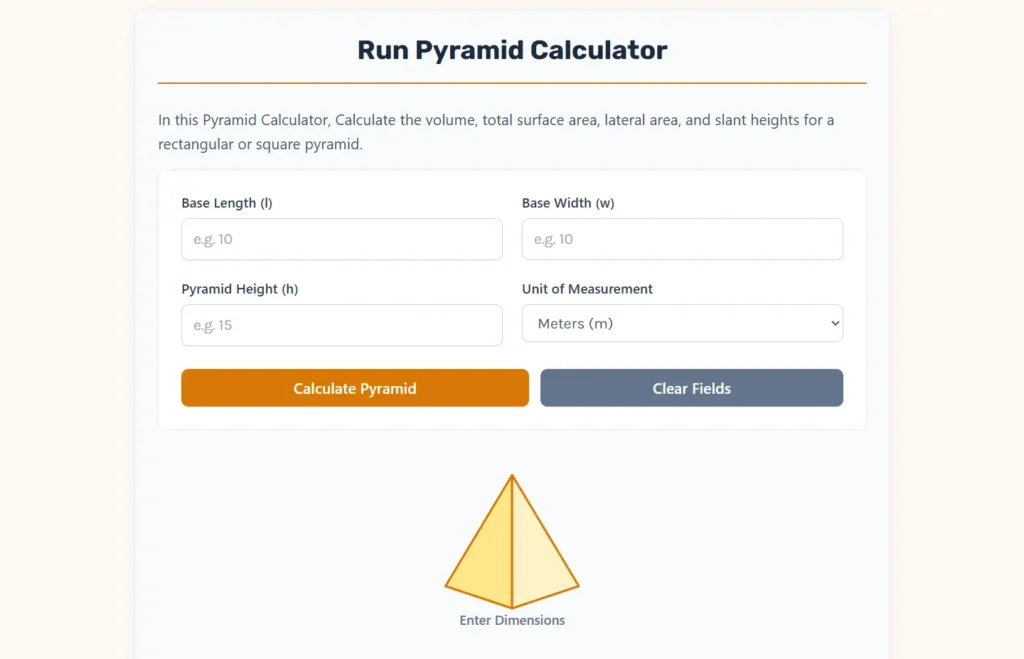
In this Pyramid Calculator, Calculate the volume, total surface area, lateral area, and slant heights for a rectangular or square pyramid.
Formulas Used
Volume (V)
V = (l × w × h) ÷ 3The volume of a pyramid is exactly one-third of the volume of a rectangular prism (box) that has the same base and height.
Base Area (Ab)
Ab = l × wSimply the length of the base multiplied by the width of the base.
Slant Heights (sl, sw)
sl = √((w ÷ 2)2 + h2)sw = √((l ÷ 2)2 + h2)Calculated using the Pythagorean theorem. A rectangular pyramid has two different slant heights (one resting on the base length, and one on the base width) unless the base is a perfect square.
Lateral Surface Area (AL)
AL = (l × sl) + (w × sw)The combined area of the four triangular sides of the pyramid.
Total Surface Area (AT)
AT = Ab + ALThe total area of all faces, calculated by adding the area of the base to the lateral surface area.
Mastering Pyramid Calculations
In the study of three-dimensional space, the pyramid represents one of the most structurally stable and historically significant polyhedrons. From the ancient monumental architecture of Egypt and Mesoamerica to modern glass structures and industrial hopper designs, the geometry of the pyramid remains a vital component of structural engineering, architecture, and mathematics.
Unlike a prism, which maintains a uniform cross-section throughout its height, a pyramid features a polygonal base that tapers uniformly to a single point called the apex. Calculating the physical dimensions of a pyramid requires a solid understanding of Euclidean geometry and the Pythagorean theorem.
This Pyramid Calculator serves as a precise geometric utility. It translates the raw linear dimensions of a square or rectangular base alongside the vertical height into key structural metrics, including total volume, lateral surface area, total surface area, and distinct slant heights. By calculating these properties, this tool bridges the gap between theoretical geometry and practical material procurement.
Understanding the Pyramidal Form
To properly calculate and construct a pyramid, one must understand the anatomy of the shape and how its various components relate to one another.
➜ The Base: The bottom face of the pyramid. While a pyramid can have any polygonal base, the calculator specifically analyzes rectangular and square bases, which are the most common in industrial and architectural applications.
➜ The Apex: The single peak point opposite the base where all the lateral triangular faces meet.
➜ Vertical Height ($h$): The perpendicular distance from the apex to the geometric center of the base. This is the height used to calculate the internal volume of the structure.
➜ Slant Height ($s$): The distance from the apex to the midpoint of one of the base edges, measured along the surface of a triangular face. This is the height of the triangular face itself, which is crucial for calculating surface area.
The Geometric Complexity of a Rectangular Base
A common point of confusion in geometry is the difference between a square pyramid and a rectangular pyramid.
When a pyramid has a perfect square base, the horizontal distance from the center of the base to the midpoint of any of the four sides is identical. As a result, the pyramid has a single, uniform slant height, and all four lateral triangular faces are congruent.
However, when the base is rectangular (where length is not equal to width), the distance from the center of the base to the midpoint of the length side is different from the distance to the midpoint of the width side. This introduces two distinct slant heights:
- A slant height resting on the length side ($s_l$)
- A slant height resting on the width side ($s_w$)
This means that the lateral surface area is composed of two pairs of non-congruent triangles. This calculator performs these separate calculations automatically to ensure absolute mathematical accuracy.
The Mathematical Engine: Formulas and Derivations
The calculations executed by this tool are rooted in fundamental geometric theorems. Below is the mathematical breakdown of each calculated metric.
1. Base Area ($A_b$)
The base area is the flat surface area occupied by the bottom of the pyramid. Since the base is assumed to be rectangular, the calculation is a simple product of the base length and width.$$A_b = l \times w$$
Variable Definitions:
- $A_b$: The total area of the pyramid base, expressed in square units.
- $l$: The horizontal length of the base.
- $w$: The horizontal width of the base.
2. Slant Height on Length ($s_l$)
To find the slant height that extends from the apex to the midpoint of the base length, we construct an imaginary right triangle inside the pyramid. The vertical height ($h$) forms the vertical leg, half of the base width ($w / 2$) forms the horizontal leg, and the slant height ($s_l$) forms the hypotenuse.
Using the Pythagorean theorem, the relationship is derived as follows:$$s_l = \sqrt{\left(\frac{w}{2}\right)^2 + h^2}$$
Variable Definitions:
- $s_l$: The slant height extending to the length edge of the base.
- $w$: The horizontal width of the base.
- $h$: The perpendicular vertical height of the pyramid.
3. Slant Height on Width ($s_w$)
Similarly, to calculate the slant height extending to the midpoint of the base width, we construct a right triangle using the vertical height ($h$) and half of the base length ($l / 2$) as the legs.$$s_w = \sqrt{\left(\frac{l}{2}\right)^2 + h^2}$$
Variable Definitions:
- $s_w$: The slant height extending to the width edge of the base.
- $l$: The horizontal length of the base.
- $h$: The perpendicular vertical height of the pyramid.
4. Lateral Surface Area ($A_L$)
The lateral surface area is the sum of the areas of the four triangular faces that form the sides of the pyramid. The area of a single triangle is half of its base multiplied by its height. Since opposing triangular faces are identical, the total lateral area is the sum of two pairs of matching triangles.$$A_L = \left(l \times s_l\right) + \left(w \times s_w\right)$$
Variable Definitions:
- $A_L$: The combined surface area of all four lateral triangular faces, expressed in square units.
- $l$: The horizontal length of the base.
- $s_l$: The slant height on the length side.
- $w$: The horizontal width of the base.
- $s_w$: The slant height on the width side.
5. Total Surface Area ($A_T$)
The total surface area represents the entire outer skin of the pyramid. This is calculated by summing the area of the flat base with the combined lateral surface area.$$A_T = A_b + A_L$$
Variable Definitions:
- $A_T$: The total surface area of all five faces, expressed in square units.
- $A_b$: The area of the rectangular base derived in Step 1.
- $A_L$: The lateral surface area derived in Step 4.
6. Volume ($V$)
The volume of a pyramid represents its three-dimensional capacity. Historically, mathematicians proved that the volume of any pyramid is exactly one-third of the volume of a rectangular prism with the same base area and vertical height.$$V = \frac{A_b \times h}{3}$$
This equation can be expanded to represent the individual base dimensions:$$V = \frac{l \times w \times h}{3}$$
Variable Definitions:
- $V$: The internal volume of the pyramid, expressed in cubic units.
- $l$: The horizontal length of the base.
- $w$: The horizontal width of the base.
- $h$: The perpendicular vertical height of the pyramid.
Step-by-Step Practical Sizing Examples
To demonstrate the mathematical accuracy of these formulas, let us walk through two real-world design scenarios.
Example 1: Sizing a Square Pyramidal Roof Peak
A builder is constructing a square pyramid roof cap for a gazebo. The square base has a length of $10\text{ feet}$, a width of $10\text{ feet}$, and the vertical height from the ceiling to the peak must be $12\text{ feet}$.
1. Calculate Base Area ($A_b$):$$A_b = 10 \times 10 = 100 \text{ sq ft}$$
2. Calculate Slant Heights ($s_l$ and $s_w$):
Since the base is a perfect square, both slant heights are identical:$$s_l = s_w = \sqrt{\left(\frac{10}{2}\right)^2 + 12^2}$$$$s_l = \sqrt{5^2 + 12^2} = \sqrt{25 + 144} = \sqrt{169} = 13 \text{ ft}$$
3. Calculate Lateral Surface Area ($A_L$):
$$A_L = 2(10 \times 13) = 260\text{ sq ft}$$
Where:
13: Slant height or length dimension (in feet)
$A_L$: Lateral Surface Area
10: Base or width dimension (in feet)
The builder knows they need exactly $260\text{ square feet}$ of plywood to sheet the triangular sides of the roof, before accounting for overlapping shingle margins.
4. Calculate Total Surface Area ($A_T$):$$A_T = 100 + 260 = 360 \text{ sq ft}$$
5. Calculate Volume ($V$):$$V = \frac{10 \times 10 \times 12}{3} = \frac{1200}{3} = 400 \text{ cubic ft}$$
Example 2: Sizing an Architectural Entry Canopy (Rectangular)
An architect wants to design a glass rectangular pyramid canopy over an entrance. The base length must be $12\text{ meters}$, the width must be $8\text{ meters}$, and the vertical height is set at $3\text{ meters}$.
1. Calculate Base Area ($A_b$):$$A_b = 12 \times 8 = 96 \text{ m}^2$$
2. Calculate Slant Height on Length ($s_l$):$$s_l = \sqrt{\left(\frac{8}{2}\right)^2 + 3^2}$$$$s_l = \sqrt{4^2 + 3^2} = \sqrt{16 + 9} = \sqrt{25} = 5 \text{ m}$$
3. Calculate Slant Height on Width ($s_w$):$$s_w = \sqrt{\left(\frac{12}{2}\right)^2 + 3^2}$$$$s_w = \sqrt{6^2 + 3^2} = \sqrt{36 + 9} = \sqrt{45} \approx 6.708 \text{ m}$$
4. Calculate Lateral Surface Area ($A_L$):$$A_L = (12 \times 5) + (8 \times 6.708)$$$$A_L = 60 + 53.664 = 113.664 \text{ m}^2$$
To order the structural glass panels for the canopy sides, the glazing contractor will use this lateral surface area value of approximately $113.7\text{ square meters}$.
5. Calculate Volume ($V$):$$V = \frac{12 \times 8 \times 3}{3} = 96 \text{ m}^3$$
Sizing and Industrial Applications
Beyond academic geometry, the mathematical models of the pyramid are used daily across several major industries.
➜ Roof and Structural Engineering
Pyramid roofs, or “hip roofs,” are highly valued in areas prone to high winds and hurricanes. Unlike flat vertical gables, the four sloping sides of a pyramid roof deflect wind currents from any direction, reducing the aerodynamic uplift forces acting on the structure. Roofers use the lateral surface area to calculate shingle quantities, underlayment rolls, and structural rafter lengths.
➜ Industrial Hoppers and Agricultural Silos
In manufacturing and agricultural processing, storage bins and hoppers are often designed as inverted rectangular pyramids. Raw materials (such as grain, plastic pellets, or sand) are loaded from the top and gravity-fed through a discharge gate at the bottom apex.
The vertical slope of the sides must be calculated using the slant heights to ensure they exceed the material’s natural “angle of repose.” If the slope is too shallow, the material will experience “bridging” or “rat-holing,” blocking the discharge gate.
➜ Packaging and Consumer Product Design
The volume-to-surface-area ratio of a pyramid is used in the packaging industry to create unique, eye-catching product containers that optimize shelf space while maintaining specific fluid or dry capacities.
Best Practices for Geometric Planning and Construction
When using these calculations to execute physical construction projects, consider the following technical guidelines:
- Account for the Waste Factor: When cutting sheet materials (such as plywood, drywall, or sheet metal) into the triangles required for a pyramid’s lateral faces, significant waste is generated due to the angled cuts. Always add a $15\%$ to $20\%$ material buffer to offset this waste.
- Verify the Plumb Line: In physical construction, ensuring the apex is perfectly aligned above the center of the base (making it a true “right pyramid”) is critical. If the apex is offset, the lateral triangular faces will no longer be symmetrical, which redistributes the structural load unevenly.
- Consider Overlapping Seams: If you are fabricating a sheet metal pyramid (such as a kitchen range hood or a chimney cap), the flat pattern template must include small overlapping seam allowances along the slant edges to allow for welding, riveting, or soldering.
Glossary of Pyramidal and Geometric Terms
➜ Apex: The single topmost point of a pyramid where all lateral faces meet.
➜ Base Area ($A_b$): The total two-dimensional space occupied by the polygonal bottom face of a pyramid.
➜ Congruent: Having identical shape and size, such as the triangular side faces of a square pyramid.
➜ Lateral Surface Area ($A_L$): The total combined surface area of all the triangular faces of a pyramid, excluding the base.
➜ Right Pyramid: A pyramid where the apex lies directly above the centroid of the base.
➜ Slant Height ($s$): The vertical altitude of a lateral triangular face, extending from the apex to the midpoint of a base side.
➜ Total Surface Area ($A_T$): The total combined area of all faces of a pyramid, including the base.
Scientific Reference and Geometric Standards
The mathematical models, geometric proofs, and formulas utilized in this calculator align with the long-standing principles of Euclidean solid geometry.
Source: Euclid. Elements, Book XII, Proposition 7.
Relevance: Euclid of Alexandria proved that any triangular prism can be decomposed into three pyramids of equal base and height, establishing the definitive mathematical proof for the $\frac{1}{3}$ volumetric scaling factor of pyramids. This geometric standard remains the mathematical foundation for modern computer-aided design (CAD) software, civil engineering structures, and architectural formulas globally.
Final Summary Checklist for Builders and Designers
Before ordering materials or fabricating components based on your calculated results, verify the following parameters:
✓ Have the base length, base width, and vertical height been measured from the same physical reference points?
✓ Are all input measurements entered using the same unit system (e.g., all meters or all inches) to avoid scaling errors?
✓ If constructing a rectangular pyramid, have you noted the two distinct slant heights ($s_l$ and $s_w$) to prevent cutting mismatched triangular side panels?
✓ Have you added an appropriate waste factor to your material order to account for the triangular angled off-cuts?
✓ Is the supporting structure designed to handle both the dead load (pyramid weight) and the lateral wind load acting on the sloping faces?
By applying these mathematical standards and structural best practices in our Pyramid Calculator, you can ensure that your design projects are structurally sound, resource-efficient, and geometrically precise.
Video walkthrough about using Pyramid Calculator
The full guide here: