Run Junction Box Sizing Calculator
Junction Box Sizing Calculator: Add up NEC box fill allowances for conductors, grounds, devices, and clamps to find the minimum electrical box volume you need.
Box Fill Math Explained
Volume Allowances
Each item in a box is assigned a volume based on conductor size: 14 AWG = 2.00 in³, 12 AWG = 2.25 in³, 10 AWG = 2.50 in³, 8 AWG = 3.00 in³, and 6 AWG = 5.00 in³.
Box Fill = Conductors + Grounds + Devices (2 each) + Clamps + Fittings
How Each Item Counts
Each insulated conductor counts once. All grounding conductors together count once (plus ¼ for each beyond four). Each device yoke counts twice the largest conductor connected to it. Clamps and each type of fitting count once at the largest conductor size in the box.
What Size Electrical Box Do I Need?
A junction box sizing calculator determines the minimum volume an electrical box must have for the wires, devices, and hardware inside it. This calculation is called box fill, and it is required by the National Electrical Code (NEC) for outlet, device, and junction boxes.
An overfilled box is a real safety problem. Conductors can be damaged when they are forced into a cramped box, insulation can be nicked by sharp edges, and heat has less room to dissipate. Overfilled boxes are also a common reason for failed electrical inspections.
This calculator adds up the standard volume allowances for conductors, grounding conductors, devices, internal clamps, and support fittings, then suggests the smallest standard metal box that meets the requirement.
The sections below explain each allowance, walk through examples, and highlight the mistakes that most often lead to undersized boxes.
What Is Box Fill?
Box fill is the total volume, in cubic inches, that the contents of an electrical box are deemed to occupy. Section 314.16 of the NEC assigns a volume allowance to each item based on conductor size. The total must not exceed the box’s volume.
The box volume comes from one of two places:
- Standard metal boxes have volumes listed in NEC Table 314.16(A).
- Nonmetallic boxes and other boxes are marked by the manufacturer with their volume in cubic inches.
The National Fire Protection Association (NFPA) publishes the NEC as NFPA 70. Most U.S. jurisdictions adopt an edition of the NEC, sometimes with local amendments.
Volume Allowance per Conductor
| Conductor Size | Volume Allowance (in³) | Volume Allowance (cm³) |
|---|---|---|
| 18 AWG | 1.50 | 24.6 |
| 16 AWG | 1.75 | 28.7 |
| 14 AWG | 2.00 | 32.8 |
| 12 AWG | 2.25 | 36.9 |
| 10 AWG | 2.50 | 41.0 |
| 8 AWG | 3.00 | 49.2 |
| 6 AWG | 5.00 | 81.9 |
These allowances are based on NEC Table 314.16(B). The calculator includes 14 AWG through 6 AWG, which covers typical branch circuits. Box fill rules in 314.16 apply to conductors 6 AWG and smaller.
How Does the Junction Box Sizing Calculator Work?
The calculator applies five allowance rules and adds them together:
- Conductor fill: Each insulated conductor that originates outside the box and terminates or is spliced inside counts once at its own size. A conductor that passes through the box without a splice also counts once.
- Grounding conductor fill: Up to four equipment grounding conductors together count as one allowance at the size of the largest. Under current NEC editions, each additional grounding conductor beyond four adds a quarter allowance.
- Device fill: Each yoke or strap holding a device, such as a switch or receptacle, counts as two allowances at the size of the largest conductor connected to that device.
- Clamp fill: One or more internal cable clamps count as one allowance at the size of the largest conductor in the box.
- Support fitting fill: Each type of fitting, such as a fixture stud or hickey, counts as one allowance at the size of the largest conductor in the box.
Total Box Fill = Conductors + Grounds + Devices + Clamps + Fittings
The calculator then compares the total with the standard metal box volumes and reports the smallest box that is large enough, plus the smallest square box option.
Junction Box Example: Single Receptacle
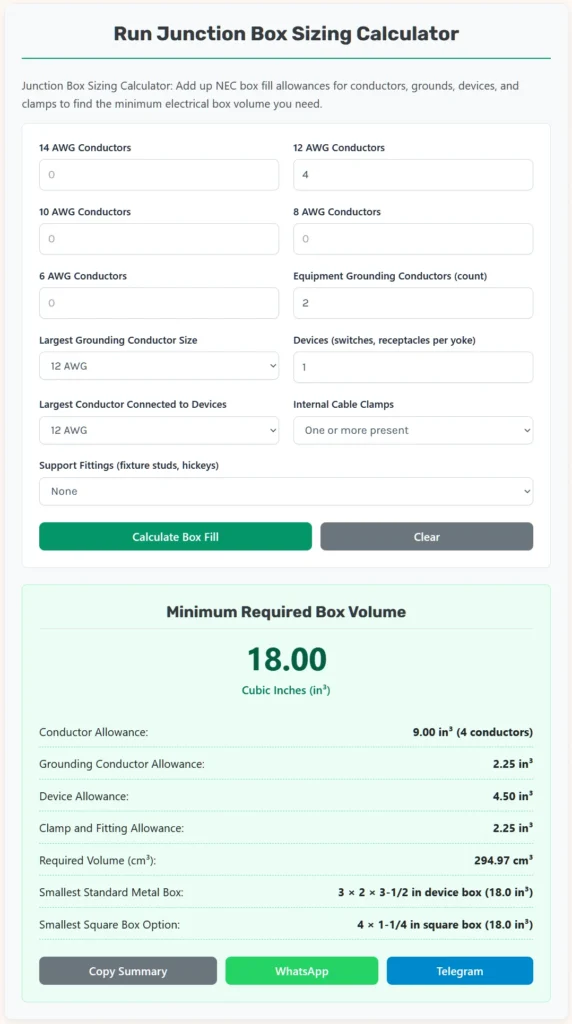
Consider a receptacle box fed by one 12/2 cable and continuing to the next outlet with another 12/2 cable. The box has internal clamps.
- Insulated conductors: two blacks and two whites = 4 × 12 AWG
- Grounding conductors: 2 bare 12 AWG grounds
- Devices: 1 receptacle on one yoke
- Clamps: present
Step 1: Conductors
4 × 2.25 = 9.00 in³
Step 2: Grounds
2 grounds count as 1 allowance: 1 × 2.25 = 2.25 in³
Step 3: Device
1 yoke × 2 × 2.25 = 4.50 in³
Step 4: Clamps
1 × 2.25 = 2.25 in³
Step 5: Total
9.00 + 2.25 + 4.50 + 2.25 = 18.00 in³
A box with at least 18.0 in³ is required, such as a 3 × 2 × 3-1/2 in device box or a 4 × 1-1/4 in square box. A shallower 3 × 2 × 2-3/4 in device box (14.0 in³) would be overfilled.
Junction Box Example: Two Switches
A two-gang box contains six 14 AWG insulated conductors, a 14 AWG ground bundle, and two single-pole switches, with no internal clamps.
- Conductors: 6 × 2.00 = 12.00 in³
- Grounds: 1 × 2.00 = 2.00 in³
- Devices: 2 × 2 × 2.00 = 8.00 in³
Total = 12.00 + 2.00 + 8.00 = 22.00 in³
A 4 × 1-1/2 in square box (21.0 in³) is slightly too small. The smallest listed metal box that works is a 4-11/16 × 1-1/4 in square box (25.5 in³). A two-gang nonmetallic box marked with 22.0 in³ or more would also work.
Junction Box Example: Larger Conductors
A box contains three 10 AWG conductors, one 10 AWG ground, and one device connected to the 10 AWG conductors.
- Conductors: 3 × 2.50 = 7.50 in³
- Ground: 1 × 2.50 = 2.50 in³
- Device: 1 × 2 × 2.50 = 5.00 in³
Total = 15.00 in³
The smallest listed metal box that meets this requirement is a 4 × 1-1/2 in round or octagonal box (15.5 in³), although a device box is usually used for a receptacle.
Standard Metal Box Volumes
| Box Trade Size | Volume (in³) |
|---|---|
| 3 × 2 × 1-1/2 in device | 7.5 |
| 3 × 2 × 2 in device | 10.0 |
| 3 × 2 × 2-1/4 in device | 10.5 |
| 3 × 2 × 2-1/2 in device | 12.5 |
| 3 × 2 × 2-3/4 in device | 14.0 |
| 3 × 2 × 3-1/2 in device | 18.0 |
| 4 × 1-1/4 in round/octagonal | 12.5 |
| 4 × 1-1/2 in round/octagonal | 15.5 |
| 4 × 2-1/8 in round/octagonal | 21.5 |
| 4 × 1-1/4 in square | 18.0 |
| 4 × 1-1/2 in square | 21.0 |
| 4 × 2-1/8 in square | 30.3 |
| 4-11/16 × 1-1/4 in square | 25.5 |
| 4-11/16 × 1-1/2 in square | 29.5 |
| 4-11/16 × 2-1/8 in square | 42.0 |
These are the volumes of standard metal boxes listed in NEC Table 314.16(A). Plaster rings, extension rings, and domed covers marked with their volume can add to the available space. Always check the volume stamped inside nonmetallic boxes.
What Counts and What Doesn’t
- Counts once: Each insulated conductor entering and ending or spliced in the box.
- Counts once: A conductor passing through unspliced.
- Counts as one allowance (plus ¼ for each beyond four): All equipment grounding conductors together.
- Counts twice: Each device yoke.
- Counts once per type: Internal clamps, and each type of support fitting.
- Does not count: A fixture wire or pigtail that does not leave the box, small fittings like locknuts and bushings, and wire connectors.
Note that many inspectors still count pigtails as part of the overall workmanship check even though they do not add a volume allowance. Leave room to fold the conductors neatly.
How to Count the Conductors in a Box
Counting is easiest if you work cable by cable:
- List every cable or raceway entering the box.
- For each cable, count the insulated conductors only. A 12/2 cable with ground has two insulated conductors (black and white) plus a bare ground. A 12/3 cable has three insulated conductors plus a ground.
- Count all bare or green grounds separately as a group.
- Count the devices, one per yoke. A duplex receptacle on one strap is one device.
- Check whether the box has internal clamps and whether any fixture studs or hickeys are present.
For example, a box with one 14/3 cable and one 14/2 cable contains 3 + 2 = 5 insulated 14 AWG conductors and 2 grounds that count as a single allowance.
When the Box Is Too Small
If the calculated fill exceeds the volume of the box you planned, you have several options:
- Choose a deeper or larger box, such as a 4-11/16 in square box instead of a 4 in square box.
- Add an extension ring or a marked plaster ring, which adds its marked volume to the box.
- Use a multi-gang box when several devices share a location.
- Split the wiring between two boxes, if the layout allows.
When combining a box with rings or covers, add their marked volumes to the box volume before comparing with the box fill.
Common Box Fill Mistakes
Counting Grounds Individually
All equipment grounding conductors together count as a single allowance (plus a quarter for each beyond four). Counting each one separately overestimates the fill.
Forgetting the Device Allowance
A switch or receptacle counts as two conductors. Leaving it out is the most common cause of undersized device boxes.
Using the Wrong Conductor Size for Devices
The device allowance uses the largest conductor connected to that device, not the smallest wire in the box.
Ignoring Internal Clamps
Many metal boxes have built-in clamps. They add one allowance based on the largest conductor in the box.
Assuming Box Size by Appearance
Two boxes that look similar can have different volumes. Use the listed or stamped volume, not an estimate.
Using an Old Code Edition
Grounding conductor rules changed in recent NEC editions. Check which edition your jurisdiction has adopted.
Why Box Fill Rules Exist
Box fill rules protect conductors and connections. Adequate space allows wires to be folded without excessive bending, keeps splices away from sharp edges, reduces the chance of damaged insulation when devices are pushed into place, and allows heat to dissipate.
An adequately sized box also makes future work safer and easier, because there is room to inspect, test, and modify connections.
Frequently Asked Questions About Junction Box Sizing
How do I calculate box fill?
Add the volume allowances for each insulated conductor, one allowance for the grounding conductors, two allowances for each device, and one allowance each for clamps and each type of support fitting. Compare the total with the box volume.
How many cubic inches does a 12 AWG wire need?
Each 12 AWG conductor requires 2.25 cubic inches.
How many cubic inches does a 14 AWG wire need?
Each 14 AWG conductor requires 2.00 cubic inches.
Do ground wires count in box fill?
Yes. All equipment grounding conductors together count as one allowance based on the largest one. Under current NEC editions, each grounding conductor beyond four adds a quarter allowance.
How much volume does a switch or receptacle take?
Each device yoke counts as two conductors of the largest size connected to that device. For 12 AWG wiring, that is 4.5 cubic inches.
Do wire nuts count toward box fill?
No. Wire connectors do not add a volume allowance under NEC 314.16.
What size box do I need for one receptacle with two 12/2 cables?
With internal clamps, the fill is 18.0 cubic inches, so a box of at least 18.0 cubic inches is needed.
Where do I find the volume of a plastic box?
Nonmetallic boxes are marked by the manufacturer with their volume, usually stamped inside the box.
Do pigtails count toward box fill?
A conductor that originates and ends entirely within the box, such as a pigtail, does not add an allowance.
Does this calculator replace an electrician or inspector?
No. It is an estimating tool. Final box selection must follow the NEC edition and local amendments in your area, and electrical work should be performed or verified by a qualified person.
What the Junction Box Sizing Calculator Does Not Determine
- Conduit bodies, pull boxes for conductors larger than 6 AWG, or raceway fill
- Volumes of extension rings, plaster rings, and covers
- Wire ampacity, circuit sizing, or breaker sizing
- Local code amendments or inspector requirements
- Whether a particular box is listed for your application
Best Practices for Sizing Electrical Boxes
- Count every insulated conductor carefully before choosing a box.
- Remember the device and clamp allowances.
- Choose a box with some extra room, not just the minimum.
- Check stamped volumes on nonmetallic boxes.
- Confirm the NEC edition adopted in your jurisdiction.
- Turn off power and follow safe work practices, or hire a licensed electrician.
Scientific Basis and Reliable Sources
The calculator applies the box fill method of NEC Section 314.16, including the conductor volume allowances of Table 314.16(B) and the standard metal box volumes of Table 314.16(A). One cubic inch equals 16.387 cubic centimeters.
National Fire Protection Association — NFPA 70, National Electrical Code (NEC)
NFPA 70 is the National Electrical Code. Article 314 covers outlet, device, pull, and junction boxes, and Section 314.16 sets the box fill requirements used by this calculator.
Final Junction Box Checklist
- All insulated conductors counted at the correct size
- Grounding conductors counted as one allowance (plus ¼ each beyond four)
- Two allowances for every device yoke
- Clamps and fittings included
- Box volume confirmed from the code table or the box marking
- Local code and inspector requirements checked
With the junction box sizing calculator, you can choose an electrical box with enough room for safe, code-compliant connections.