Run Concrete Slab Calculator
Concrete Slab Calculator: Estimate how many cubic yards or cubic meters of concrete and how many 40, 60, or 80 lb bags you need for a slab, including waste.
Concrete Slab Math Explained
Volume of a Slab
A slab is a rectangular box. Its volume is length × width × thickness, with all three measurements in the same unit.
Cubic Feet = L (ft) × W (ft) × (Thickness in ÷ 12)
Cubic Yards = Cubic Feet ÷ 27
Cubic Meters = L (m) × W (m) × (Thickness cm ÷ 100)
Bags and Waste
Premix bag yields are about 0.60 cu ft (80 lb), 0.45 cu ft (60 lb), and 0.30 cu ft (40 lb). The waste allowance covers uneven subgrade, spillage, and form variations.
How Much Concrete Do I Need for a Slab?
A concrete slab calculator tells you how much concrete a rectangular slab requires. You enter the length, width, and thickness, and the calculator returns the volume in cubic yards or cubic meters, the number of premix bags, and an estimate of the concrete’s weight.
Ordering the right amount matters. Ready-mix concrete is sold by the cubic yard or cubic meter, and running short in the middle of a pour can leave a cold joint in your slab. Ordering far too much wastes money.
This calculator includes an adjustable waste allowance so that your estimate covers the small losses that happen on every real job site.
The sections below explain the formula, show worked examples for patios and driveways, and list the most common mistakes people make when estimating concrete.
What Is a Concrete Slab Calculator?
A concrete slab calculator is a volume calculator for flat, rectangular pours such as patios, shed bases, garage floors, walkways, and driveway sections.
It converts your measurements into a consistent unit, multiplies them to find the volume, and converts that volume into the units suppliers use: cubic yards in the United States, cubic meters in most other countries, and bag counts for small jobs mixed by hand.
How Does the Concrete Slab Calculator Work?
- Convert the thickness: Inches are divided by 12 to get feet; centimeters are divided by 100 to get meters.
- Calculate the volume: Length × width × thickness.
- Convert to ordering units: Cubic feet are divided by 27 to get cubic yards.
- Add waste: The volume is multiplied by (1 + waste % ÷ 100).
- Count the bags: The total volume in cubic feet is divided by each bag’s yield and rounded up.
Cubic Feet = Length (ft) × Width (ft) × Thickness (in) ÷ 12
Cubic Yards = Cubic Feet ÷ 27
Cubic Meters = Length (m) × Width (m) × Thickness (cm) ÷ 100
Total With Waste = Volume × (1 + Waste % ÷ 100)
Bags = Total Cubic Feet ÷ Bag Yield, rounded up
Why Divide by 27?
A cubic yard is a cube measuring 3 ft on each side. Its volume is 3 × 3 × 3 = 27 cubic feet. To convert cubic feet to cubic yards, divide by 27.
A useful shortcut follows from this: a 4-inch slab is one-third of a foot thick, so 81 square feet of 4-inch slab equals one cubic yard (81 × 1/3 = 27 cubic feet).
Concrete Slab Example: 10 × 10 ft Patio
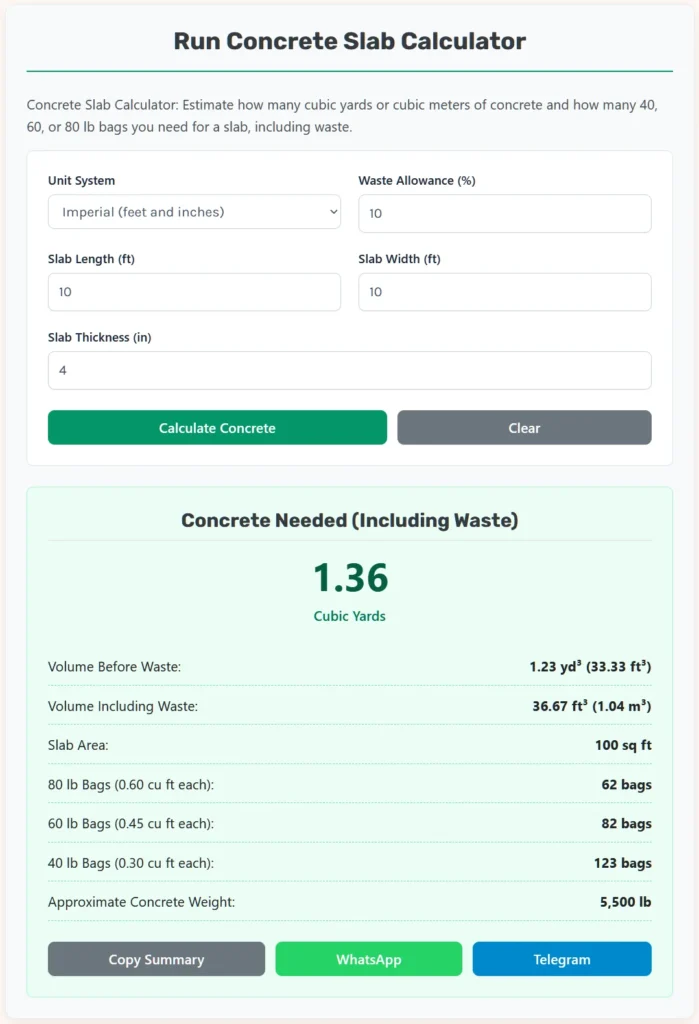
Suppose you are pouring a 10 ft × 10 ft patio, 4 inches thick, with a 10% waste allowance.
Step 1: Convert the thickness
4 in ÷ 12 ≈ 0.333 ft
Step 2: Calculate the volume
10 × 10 × 0.333 ≈ 33.33 cubic feet
Step 3: Convert to cubic yards
33.33 ÷ 27 ≈ 1.23 cubic yards
Step 4: Add 10% waste
33.33 × 1.10 ≈ 36.67 cubic feet ≈ 1.36 cubic yards
Step 5: Count the bags
- 80 lb bags: 36.67 ÷ 0.60 ≈ 61.1, rounded up to 62 bags
- 60 lb bags: 36.67 ÷ 0.45 ≈ 81.5, rounded up to 82 bags
- 40 lb bags: 36.67 ÷ 0.30 ≈ 122.2, rounded up to 123 bags
At roughly 1.4 cubic yards, this job is at the point where many people switch from bags to a small ready-mix delivery.
Concrete Slab Example: Garage Floor
A 20 × 20 ft garage floor, 6 inches thick, with 10% waste:
20 × 20 × (6 ÷ 12) = 200 cubic feet
200 ÷ 27 ≈ 7.41 cubic yards
With 10% waste: 220 cubic feet ≈ 8.15 cubic yards
A slab this size is clearly a ready-mix job. Mixing 367 bags of 80 lb concrete by hand is impractical.
Concrete Slab Example in Metric Units
A 5 m × 4 m slab, 10 cm thick, with 10% waste:
5 × 4 × (10 ÷ 100) = 2.0 cubic meters
With 10% waste: 2.0 × 1.10 = 2.2 cubic meters
That is about 2.88 cubic yards or 77.7 cubic feet. The calculator shows both metric and imperial values so you can compare quotes from any supplier.
How Thick Should a Concrete Slab Be?
Thickness depends on the load the slab must carry, the soil, reinforcement, and local codes. Common residential guidelines are:
| Application | Typical Thickness |
|---|---|
| Walkways and patios | 4 in (10 cm) |
| Shed and small outbuilding bases | 4 in (10 cm) |
| House floor slabs | 4 in (10 cm); code minimum often 3.5 in |
| Driveways for cars | 4–5 in (10–13 cm) |
| Garage floors and heavier vehicles | 5–6 in (13–15 cm) |
For homes, the International Code Council’s International Residential Code (Section R506) sets a minimum thickness of 3.5 inches for concrete slab-on-ground floors. Many builders pour 4 inches as standard practice. Always confirm requirements with your local building department.
Quick Reference: Cubic Yards for Common Slab Sizes
| Slab Size | 4 in Thick | 5 in Thick | 6 in Thick |
|---|---|---|---|
| 10 × 10 ft | 1.23 yd³ | 1.54 yd³ | 1.85 yd³ |
| 12 × 12 ft | 1.78 yd³ | 2.22 yd³ | 2.67 yd³ |
| 10 × 20 ft | 2.47 yd³ | 3.09 yd³ | 3.70 yd³ |
| 20 × 20 ft | 4.94 yd³ | 6.17 yd³ | 7.41 yd³ |
| 24 × 24 ft | 7.11 yd³ | 8.89 yd³ | 10.67 yd³ |
These values do not include waste. Multiply by 1.05 to 1.10 for a typical allowance.
How Many Bags of Concrete Do I Need?
Premixed concrete bags list their approximate yield on the package. Common yields are:
| Bag Size | Approximate Yield | Bags per Cubic Yard |
|---|---|---|
| 80 lb | 0.60 cu ft | 45 |
| 60 lb | 0.45 cu ft | 60 |
| 40 lb | 0.30 cu ft | 90 |
Because bags are sold whole, the calculator always rounds up. Check the yield printed on the brand you buy, as it may differ slightly.
Bags or Ready-Mix?
Bags are convenient for small pours such as post footings, steps, and small pads. For larger slabs, ready-mix concrete is faster, more consistent, and usually more economical.
- Under about 1 cubic yard: Bags are often practical.
- 1 to 2 cubic yards: Compare the cost and labor of bags with a short-load ready-mix delivery.
- Over 2 cubic yards: Ready-mix is usually the better choice.
Ask your supplier about minimum order quantities and short-load fees, which vary by region.
Why Add a Waste Allowance?
Real slabs almost always use more concrete than the theoretical volume. Common reasons include:
- Uneven or over-excavated subgrade
- Forms that bow outward slightly
- Spillage and material left in the truck or mixer
- Thickened edges or footings at the slab perimeter
A waste allowance of 5% to 10% is common for well-prepared sites. Uneven ground may justify more. The calculator lets you choose the percentage that fits your job.
How Much Does a Concrete Slab Weigh?
Normal-weight concrete weighs roughly 150 pounds per cubic foot, or about 2,400 kilograms per cubic meter. The 10 × 10 ft, 4-inch patio with waste weighs about 36.67 × 150 ≈ 5,500 lb.
The weight estimate helps when planning delivery access, wheelbarrow trips, or the load on a trailer when buying bags.
Example: Slab With a Thickened Edge
Many slabs have a thicker perimeter to support walls or vehicle loads. Calculate the main slab and the extra edge volume separately.
Suppose a 12 × 16 ft shed slab is 4 inches thick, with a perimeter edge that is 12 inches wide and an extra 8 inches deep.
Main slab: 12 × 16 × (4 ÷ 12) = 64 cubic feet
Perimeter length: 2 × (12 + 16) = 56 ft
Extra edge volume: 56 × 1 × (8 ÷ 12) ≈ 37.33 cubic feet
Total: 64 + 37.33 ≈ 101.33 cubic feet ≈ 3.75 cubic yards
The thickened edge adds more than half again to the volume of this slab. Ignoring it would leave you significantly short. (The corners are counted twice in this quick method, which adds a small safety margin.)
Estimating the Cost of a Concrete Slab
Once you know the volume, you can estimate material cost from your supplier’s prices:
Ready-Mix Cost = Cubic Yards × Price per Cubic Yard + Delivery Fees
Bagged Cost = Number of Bags × Price per Bag
For example, if ready-mix costs a hypothetical $150 per cubic yard, the 8.15 cubic yards for the 20 × 20 ft garage floor would cost about 8.15 × 150 ≈ $1,223 before delivery fees. Prices vary widely by location and season, so always request a current quote.
Remember that material is only part of the total. Forms, base material, reinforcement, finishing, and labor can exceed the cost of the concrete itself.
Estimating the Gravel Base
Most slabs sit on a compacted base of gravel or crushed stone. The same formula estimates the base volume: multiply the slab area by the base thickness.
Base Volume (yd³) = Length × Width × (Base Thickness in ÷ 12) ÷ 27
A 4-inch base under the 10 × 10 ft patio requires about 1.23 cubic yards of loose material before compaction. Because aggregate compacts, suppliers often recommend ordering extra; ask your supplier for their compaction factor.
Sidewalks and Long Narrow Slabs
For a walkway, the length is often much larger than the width. A 40 ft path that is 3 ft wide and 4 inches thick needs 40 × 3 × (4 ÷ 12) = 40 cubic feet, or about 1.48 cubic yards before waste. Long, narrow pours are especially sensitive to uneven subgrade, so a 10% allowance is a sensible minimum.
Common Concrete Estimating Mistakes
Forgetting to Convert Inches to Feet
Multiplying 10 × 10 × 4 gives 400, which is not a volume in any useful unit. Convert 4 inches to 0.333 ft first.
Forgetting to Divide by 27
Ready-mix is ordered in cubic yards. Ordering 33 “yards” instead of 33 cubic feet would be a costly mistake.
Ignoring Thickened Edges
Many slabs have thicker edges or integrated footings. Calculate those sections separately and add them.
Rounding Bag Counts Down
You cannot buy part of a bag. Always round up.
Assuming the Subgrade Is Perfect
Low spots in the base increase the actual slab thickness and the concrete required. Check the grade before ordering.
Calculating Irregular Slabs
For L-shaped or irregular slabs, divide the area into rectangles, calculate each one with the same thickness, and add the volumes. For a circular pad, use π × radius² × thickness instead of length × width.
Frequently Asked Questions About Concrete Slabs
How do I calculate concrete for a slab?
Multiply length by width by thickness, with all measurements in feet, to get cubic feet. Divide by 27 to get cubic yards, then add a waste allowance.
How many cubic yards are in a 10 × 10 slab?
A 10 × 10 ft slab that is 4 inches thick needs about 1.23 cubic yards before waste, or about 1.36 cubic yards with 10% waste.
How many 80 lb bags of concrete are in a cubic yard?
About 45 bags, because each 80 lb bag yields roughly 0.60 cubic feet and a cubic yard is 27 cubic feet.
How many bags do I need for a 10 × 10 slab?
For a 4-inch slab with 10% waste, about 62 bags of 80 lb concrete, 82 bags of 60 lb, or 123 bags of 40 lb.
How thick should a concrete patio be?
Most patios are poured 4 inches thick. Heavier loads or poor soil may require a thicker slab.
How much waste should I add?
Many estimators add 5% to 10%. Use more if the ground is uneven or the forms are complex.
How do I convert cubic feet to cubic yards?
Divide cubic feet by 27.
How do I calculate concrete in cubic meters?
Multiply length and width in meters by thickness in meters. Divide centimeters by 100 to convert thickness to meters.
How much does a cubic yard of concrete weigh?
Normal-weight concrete weighs about 150 lb per cubic foot, so one cubic yard weighs roughly 4,050 lb.
Does the calculator include rebar or gravel base?
No. It calculates concrete volume only. Gravel base, reinforcement, and vapor barriers are estimated separately.
What the Concrete Slab Calculator Does Not Determine
- Required slab thickness, strength, or reinforcement for your project
- Gravel base, sand, vapor barrier, or rebar quantities
- Footings, thickened edges, or other non-rectangular shapes
- Local code requirements and permits
- Concrete mix design or curing requirements
Best Practices Before Ordering Concrete
- Measure the forms after they are set, not just the plan dimensions.
- Check the subgrade for low spots and compaction.
- Confirm the slab thickness required by your plans or local code.
- Add a sensible waste allowance.
- Confirm the supplier’s minimum order and delivery access.
- Have a plan for small amounts of extra concrete, such as a small pad or post footings.
Scientific Basis and Reliable Sources
The calculator uses the rectangular volume formula, the exact conversions of 27 cubic feet per cubic yard and 35.3147 cubic feet per cubic meter, typical premix bag yields, and a typical normal-weight concrete density of about 150 lb/ft³ (2,400 kg/m³).
International Code Council — International Residential Code (IRC)
The ICC publishes the International Residential Code, whose Section R506 sets requirements for concrete slab-on-ground floors in residential buildings, including a 3.5-inch minimum thickness.
Final Concrete Slab Checklist
- Length and width measured in the same unit
- Thickness converted correctly from inches or centimeters
- Volume converted to cubic yards or cubic meters
- Waste allowance added
- Bag counts rounded up
- Thickened edges and footings calculated separately
With the concrete slab calculator, you can order the right amount of concrete with confidence and avoid both shortages and expensive leftovers.