Run Grams to Calories Conversion
Grams to Calories Conversion: Convert grams of protein, carbohydrate, fat, and alcohol into calories and see how much each macronutrient contributes.
Calorie Math Explained
Calories Per Gram
Each macronutrient supplies a different amount of energy. Nutrition labels use general factors: protein 4, carbohydrate 4, fat 9, and alcohol 7 calories per gram.
Calories = (Protein × 4) + (Carbs × 4) + (Fat × 9) + (Alcohol × 7)
Calories and Kilojoules
A food “calorie” is a kilocalorie (kcal). One kilocalorie equals 4.184 kilojoules (kJ), the unit used on labels in many countries.
How Many Calories Are in a Gram?
A grams to calories conversion turns the grams of protein, carbohydrate, fat, and alcohol in a food or meal into the amount of energy they provide. It is the same arithmetic used to calculate the calorie line on a Nutrition Facts label.
The key fact is that not all grams are equal. One gram of fat supplies more than twice as much energy as one gram of protein or carbohydrate, and alcohol sits in between.
This converter lets you enter grams for all four energy-providing components at once. It returns the total calories, the calories from each macronutrient, each one’s percentage of the total, and the equivalent in kilojoules.
The sections below explain the calorie factors, show worked examples, and explain why label values can differ slightly from a simple calculation.
What Is a Grams to Calories Converter?
A grams to calories converter multiplies the weight of each macronutrient by its energy factor. The factors are fixed numbers that describe how much usable energy the body obtains, on average, from one gram of each nutrient.
You can use it with the grams listed on a food label, with values from a nutrition database, or with the macro targets in a meal plan. The converter does not need to know what the food is; it only needs the grams.
The Calories Per Gram Factors
| Macronutrient | Calories per Gram | Kilojoules per Gram |
|---|---|---|
| Protein | 4 | 16.7 |
| Carbohydrate | 4 | 16.7 |
| Fat | 9 | 37.7 |
| Alcohol (ethanol) | 7 | 29.3 |
These are the general factors used in nutrition labeling. U.S. labeling regulations, published in the Electronic Code of Federal Regulations (21 CFR 101.9), allow labels to state that fat, carbohydrate, and protein provide 9, 4, and 4 calories per gram.
They are often called Atwater factors, after the nutrition scientist whose work in the late 1800s established the approach of assigning average energy values to each nutrient.
How Does the Converter Work?
- Read the grams: Empty fields are treated as zero, so you can enter only the nutrients you know.
- Multiply by the factors: Protein and carbohydrate × 4, fat × 9, alcohol × 7.
- Add the results: The sum is the total energy in kilocalories.
- Calculate the shares: Each nutrient’s calories are divided by the total to show its percentage.
- Convert to kilojoules: The total is multiplied by 4.184.
The complete formula is:
Total Calories = (Protein g × 4) + (Carbohydrate g × 4) + (Fat g × 9) + (Alcohol g × 7)
Grams to Calories Example: A Simple Meal
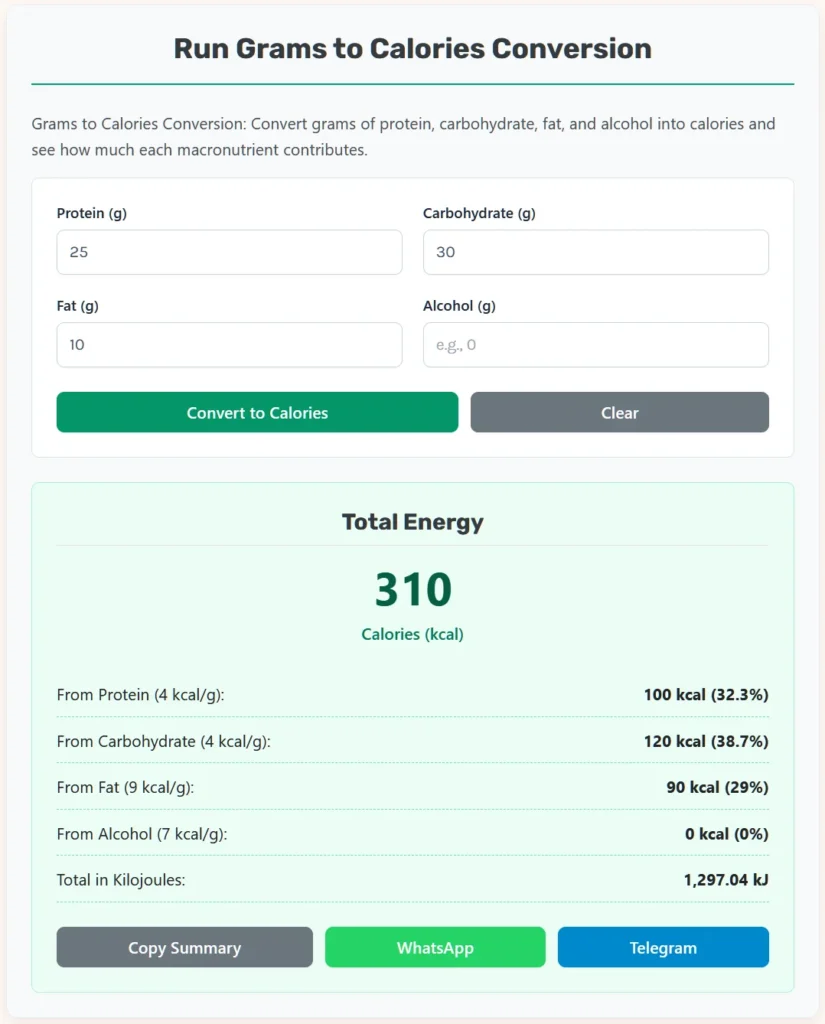
Suppose a meal contains 25 g of protein, 30 g of carbohydrate, and 10 g of fat.
Step 1: Protein
25 × 4 = 100 kcal
Step 2: Carbohydrate
30 × 4 = 120 kcal
Step 3: Fat
10 × 9 = 90 kcal
Step 4: Total
100 + 120 + 90 = 310 kcal
Step 5: Percentages
- Protein: 100 ÷ 310 ≈ 32.3%
- Carbohydrate: 120 ÷ 310 ≈ 38.7%
- Fat: 90 ÷ 310 ≈ 29.0%
Even though fat is the smallest number of grams in this meal, it supplies almost as many calories as the carbohydrate.
Example: Converting a Single Macronutrient
To convert grams of just one nutrient, enter that value and leave the other fields empty.
| Grams | Protein | Carbohydrate | Fat | Alcohol |
|---|---|---|---|---|
| 1 g | 4 kcal | 4 kcal | 9 kcal | 7 kcal |
| 5 g | 20 kcal | 20 kcal | 45 kcal | 35 kcal |
| 10 g | 40 kcal | 40 kcal | 90 kcal | 70 kcal |
| 20 g | 80 kcal | 80 kcal | 180 kcal | 140 kcal |
| 50 g | 200 kcal | 200 kcal | 450 kcal | 350 kcal |
| 100 g | 400 kcal | 400 kcal | 900 kcal | 700 kcal |
Example: Calories From Alcohol
In the United States, a standard drink contains about 14 g of pure alcohol.
14 × 7 = 98 kcal
That is the energy from the alcohol alone. Many drinks also contain carbohydrate from sugar or mixers, which adds 4 kcal per gram. To estimate a drink’s total, enter both its alcohol grams and its carbohydrate grams.
Calories vs. Kilocalories vs. Kilojoules
The “calories” on food labels are actually kilocalories. One food Calorie (sometimes written with a capital C) equals 1,000 small calories, or 1 kcal.
Many countries label food energy in kilojoules instead. The conversion is:
1 kcal = 4.184 kJ
So the 310-kcal meal above contains about 310 × 4.184 ≈ 1,297 kJ.
Why Fat Has 9 Calories Per Gram
Fat molecules contain more carbon-hydrogen bonds and less oxygen than carbohydrates or proteins. When the body oxidizes fat for energy, it releases more energy per gram. This is why fat is the body’s most compact form of energy storage.
It is also why foods rich in oils, butter, nuts, or cheese can be calorie-dense even in small portions.
Why Label Values Can Differ From the Calculation
If you add up a label’s macronutrients with the converter, the result may not exactly match the label’s calorie figure. There are several legitimate reasons:
- Rounding: Labels round grams and calories to set increments.
- Fiber: Dietary fiber is included in total carbohydrate, but it provides fewer usable calories than 4 per gram.
- Sugar alcohols: Polyols such as erythritol or sorbitol provide fewer calories per gram than sugar.
- Specific factors: Some foods are labeled using food-specific factors instead of the general 4-4-9 values.
- Other components: Organic acids and other minor components can add small amounts of energy.
For everyday purposes, the general factors are accurate enough to compare foods and plan meals. Small differences of a few percent are normal.
How to Use the Converter With a Food Label
- Find the serving size on the label.
- Read the grams of total fat, total carbohydrate, and protein for one serving.
- Enter those values into the converter.
- If you eat more or less than one serving, multiply the grams first.
- Compare the result with the label’s calorie line.
For example, if one serving of a snack has 8 g fat, 20 g carbohydrate, and 3 g protein, the estimate is (8 × 9) + (20 × 4) + (3 × 4) = 72 + 80 + 12 = 164 kcal.
Understanding Macronutrient Percentages
The percentages show where a food’s energy comes from. They are useful for comparing foods and for understanding meal composition.
Note that the percentages are based on calories, not on grams. A food with equal grams of carbohydrate and fat gets far more of its energy from fat, because each gram of fat carries 9 calories rather than 4.
| Food Example | Protein | Carbs | Fat | Total | Fat Share |
|---|---|---|---|---|---|
| Meal A (25/30/10 g) | 100 kcal | 120 kcal | 90 kcal | 310 kcal | 29.0% |
| Snack (3/20/8 g) | 12 kcal | 80 kcal | 72 kcal | 164 kcal | 43.9% |
| Meal B (50/60/20 g) | 200 kcal | 240 kcal | 180 kcal | 620 kcal | 29.0% |
Converting Calories Back to Grams
The converter works in one direction, but the same factors also work in reverse. To find how many grams of a nutrient supply a given number of calories, divide by the factor:
Grams = Calories ÷ Calories per Gram
- 200 kcal from protein ÷ 4 = 50 g of protein
- 200 kcal from carbohydrate ÷ 4 = 50 g of carbohydrate
- 180 kcal from fat ÷ 9 = 20 g of fat
- 70 kcal from alcohol ÷ 7 = 10 g of alcohol
This reverse calculation is useful when a plan is expressed in calories but foods are measured in grams.
Turning a Calorie Split Into Grams
Meal plans sometimes describe a target as a percentage split. For example, a 2,000-kcal day split 30% protein, 40% carbohydrate, and 30% fat converts to grams like this:
| Nutrient | Share | Calories | Factor | Grams |
|---|---|---|---|---|
| Protein | 30% | 600 kcal | 4 | 150 g |
| Carbohydrate | 40% | 800 kcal | 4 | 200 g |
| Fat | 30% | 600 kcal | 9 | 66.7 g |
You can check the result by entering 150, 200, and 66.7 g into the converter. The total returns to approximately 2,000 kcal. This example only demonstrates the arithmetic; it is not a recommendation for any individual.
Energy Density: Why Some Foods Have More Calories
Energy density describes how many calories a food provides per gram of total food weight. It depends on two things: how much fat the food contains and how much water it contains.
- High water content lowers energy density, because water adds weight but no calories. Many vegetables and fruits are low in energy density for this reason.
- High fat content raises energy density, because fat supplies 9 kcal per gram.
- Low water and high fat foods, such as oils, nuts, and many snack foods, are the most energy-dense.
Pure fat or oil is close to the theoretical maximum of about 9 kcal per gram of food. Pure sugar or starch is close to 4 kcal per gram. Most foods fall well below these values because they contain water, fiber, and minerals.
Using the Converter for Recipes
To estimate the energy of a homemade recipe, add the grams of protein, carbohydrate, and fat from each ingredient, then enter the totals into the converter. Divide the result by the number of servings to get calories per serving.
For example, if a recipe contains a total of 120 g protein, 240 g carbohydrate, and 60 g fat, the total is (120 × 4) + (240 × 4) + (60 × 9) = 480 + 960 + 540 = 1,980 kcal. Divided into 6 servings, each serving provides about 330 kcal.
Common Mistakes When Converting Grams to Calories
Using Food Weight Instead of Nutrient Grams
A 100 g chicken breast does not contain 100 g of protein. Use the grams of each nutrient, not the total weight of the food.
Applying 4 Calories Per Gram to Fat
Fat provides 9 calories per gram. Using 4 underestimates the energy of fatty foods by more than half.
Counting Sugar Twice
Sugars are already included in total carbohydrate. Do not add sugar grams separately.
Forgetting the Serving Size
Label values refer to one serving. If a package contains several servings, multiply accordingly.
Ignoring Alcohol
Alcohol is not a nutrient on most labels, but it provides energy. Include its grams when estimating the energy of drinks.
Quick Reference: Grams to Calories
| Conversion | Formula |
|---|---|
| Protein | grams × 4 |
| Carbohydrate | grams × 4 |
| Fat | grams × 9 |
| Alcohol | grams × 7 |
| Kilocalories to kilojoules | kcal × 4.184 |
| Calories to grams of fat | kcal ÷ 9 |
Frequently Asked Questions About Grams to Calories
How many calories are in 1 gram of protein?
One gram of protein provides about 4 calories (kilocalories).
How many calories are in 1 gram of carbohydrate?
One gram of carbohydrate provides about 4 calories.
How many calories are in 1 gram of fat?
One gram of fat provides about 9 calories, more than twice the energy of protein or carbohydrate.
How many calories are in 1 gram of alcohol?
One gram of alcohol provides about 7 calories.
How do I convert grams to calories?
Multiply the grams of protein and carbohydrate by 4, the grams of fat by 9, and the grams of alcohol by 7, then add the results.
How many calories are in 10 grams of fat?
10 × 9 = 90 calories.
Is a food calorie the same as a kilocalorie?
Yes. The calories listed on food labels are kilocalories (kcal). One kcal equals 4.184 kilojoules.
Why doesn’t my calculation match the label exactly?
Labels use rounding, and fiber, sugar alcohols, and food-specific factors can make the label value slightly different from the general 4-4-9 calculation.
Does fiber count as 4 calories per gram?
Fiber is part of total carbohydrate, but much of it is not fully digested, so it provides fewer calories per gram. The converter uses the general factor for total carbohydrate.
Can I convert calories back to grams?
Yes, by dividing. For example, 90 calories from fat equals 90 ÷ 9 = 10 grams of fat.
What This Converter Does Not Determine
- How many calories an individual person needs
- Whether a food or diet is appropriate for a specific health condition
- The calories from fiber or sugar alcohols specifically
- The nutrient content of a food you have not measured
For personal dietary needs, consult a registered dietitian or healthcare professional.
Scientific Basis and Reliable Sources
The converter uses the general energy factors of 4 kcal/g for protein and carbohydrate, 9 kcal/g for fat, and 7 kcal/g for alcohol, and the definition 1 kcal = 4.184 kJ.
Electronic Code of Federal Regulations — 21 CFR 101.9 Nutrition Labeling of Food
The U.S. nutrition labeling regulation describes how calories are declared on food labels and allows the statement that fat, carbohydrate, and protein provide 9, 4, and 4 calories per gram.
Final Grams to Calories Checklist
- Use grams of each nutrient, not total food weight.
- Apply 4 for protein and carbohydrate, 9 for fat, and 7 for alcohol.
- Adjust grams for the number of servings you eat.
- Expect small differences from label values due to rounding and fiber.
- Use percentages to compare where a food’s energy comes from.
With the grams to calories converter, you can quickly understand the energy content of any food or meal from its macronutrient grams.