Run Gallons Per Minute (GPM) Calculator
Gallons Per Minute (GPM) Calculator: Measure flow rate from a bucket test or from pipe size and water velocity, and convert GPM to L/min, GPH, and CFM.
Flow Rate Math Explained
Bucket Test
Flow rate is volume divided by time. Collect water for a measured time, then divide the volume by the minutes it took.
GPM = Gallons ÷ Minutes = Gallons × 60 ÷ Seconds
Pipe: GPM ≈ 2.448 × Diameter (in)² × Velocity (ft/s)
Unit Conversions
1 US gallon = 3.785 liters, so 1 GPM ≈ 3.785 L/min. One cubic foot holds 7.48 gallons, so 1 GPM ≈ 0.134 CFM.
How Do You Calculate Gallons Per Minute?
A gallons per minute (GPM) calculator measures how much water flows through a pipe, hose, faucet, or fixture in one minute. GPM is the standard flow rate unit for plumbing fixtures, pumps, irrigation systems, and well performance in the United States.
The simplest way to find GPM is a bucket test: time how long it takes to fill a container of known size. The calculator also offers a second method for engineers and installers: calculating flow from the inside diameter of a pipe and the velocity of the water.
Both methods give the result in GPM and convert it to liters per minute, gallons per hour, cubic feet per minute, and cubic meters per hour.
This guide explains both methods, shows worked examples, and covers practical uses such as checking a showerhead, sizing a pump, and estimating fill times.
What Is GPM?
Gallons per minute is a volumetric flow rate: the volume of liquid passing a point in one minute. One GPM means that one US gallon flows every minute.
Flow rate matters because almost every water system is designed around it. Showerheads and faucets have maximum flow ratings, pumps are rated by the GPM they can deliver at a given pressure, irrigation zones are sized by available flow, and wells are tested by how many gallons they can supply per minute.
How Does the GPM Calculator Work?
Method 1: Volume and Time
- Enter the volume collected and choose gallons or liters.
- Enter the time it took and choose seconds or minutes.
- The calculator converts liters to gallons and seconds to minutes if needed.
- It divides gallons by minutes to get GPM.
GPM = Gallons ÷ Minutes
GPM = Gallons × 60 ÷ Seconds
Method 2: Pipe Diameter and Velocity
Flow rate equals the cross-sectional area of the pipe multiplied by the velocity of the water. With the inside diameter in inches and the velocity in feet per second, the unit conversions combine into one constant:
GPM = 2.448 × Diameter (in)² × Velocity (ft/s)
The constant 2.448 comes from converting the area from square inches to square feet, seconds to minutes, and cubic feet to gallons: 7.48052 × 60 × π ÷ 4 ÷ 144 ≈ 2.448.
GPM Example: Bucket Test
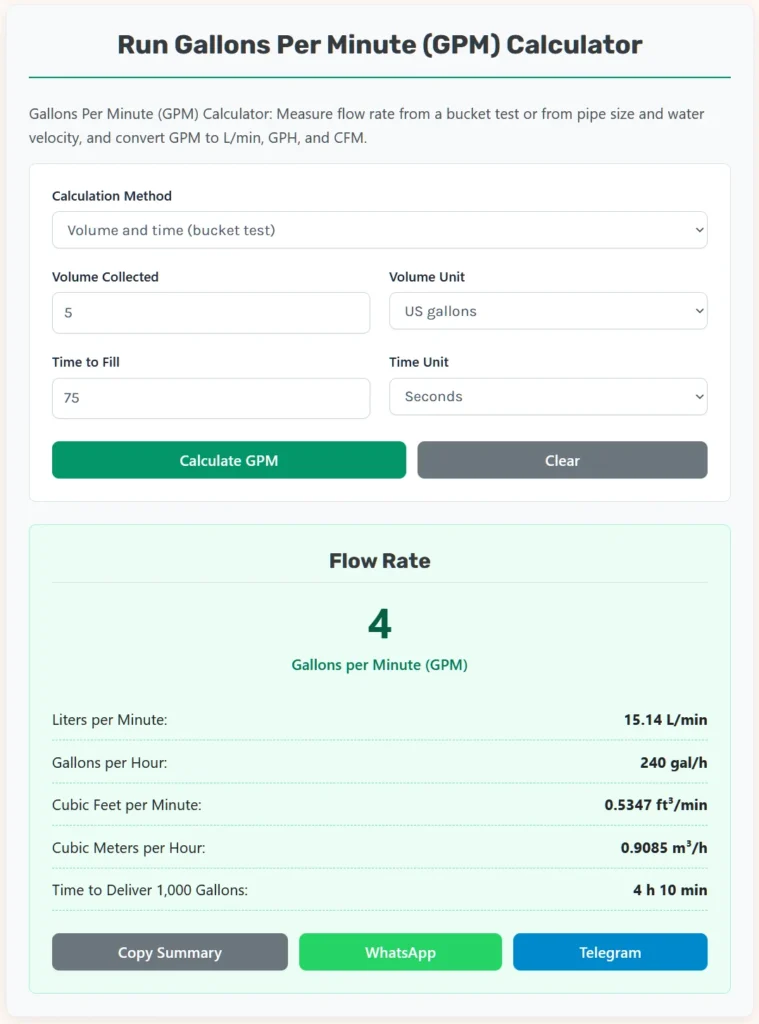
You fill a 5-gallon bucket from an outdoor faucet and it takes 75 seconds.
Step 1: Convert seconds to minutes
75 ÷ 60 = 1.25 minutes
Step 2: Divide volume by time
5 ÷ 1.25 = 4 GPM
Step 3: Convert units
- 4 × 3.785 ≈ 15.14 L/min
- 4 × 60 = 240 gallons per hour
- 4 ÷ 7.48 ≈ 0.53 cubic feet per minute
- At 4 GPM, delivering 1,000 gallons takes 250 minutes (4 h 10 min).
GPM Example: Pipe Flow
Water flows through a pipe with a 1-inch inside diameter at 5 feet per second.
GPM = 2.448 × 1² × 5 ≈ 12.24 GPM
For a 2-inch inside diameter at 4 feet per second:
GPM = 2.448 × 2² × 4 ≈ 39.17 GPM
Doubling the diameter multiplies the area, and therefore the flow at the same velocity, by four. Use the actual inside diameter, which can differ noticeably from the nominal pipe size.
GPM Example: Metric Bucket Test
A 10-liter bucket fills in 25 seconds.
Gallons = 10 ÷ 3.785 ≈ 2.64 gal
GPM = 2.64 × 60 ÷ 25 ≈ 6.34 GPM
That is 24 liters per minute. The calculator handles the unit conversion automatically when you choose liters.
How to Do an Accurate Bucket Test
- Use a container with a known, marked volume, such as a 5-gallon bucket or a measuring container.
- Open the faucet or fixture fully, or to the setting you want to measure, and let it run for a few seconds to stabilize.
- Start the timer as you place the container under the flow.
- Stop the timer the moment the container reaches its mark.
- Repeat the test two or three times and average the results.
For low-flow fixtures, a larger container gives a more accurate result because small timing errors matter less over a longer fill.
Typical Flow Rates
| Fixture or Source | Typical Flow |
|---|---|
| WaterSense showerhead | 2.0 GPM or less |
| Standard federal showerhead maximum | 2.5 GPM |
| Bathroom faucet | About 1.0–1.5 GPM |
| Kitchen faucet | About 1.5–2.2 GPM |
| Outdoor hose bib | Often 5–10 GPM, depending on pressure |
According to the U.S. Environmental Protection Agency’s WaterSense program, standard showerheads use 2.5 gallons per minute, while WaterSense labeled showerheads use no more than 2.0 gallons per minute. A bucket test is an easy way to check what your showerhead actually delivers.
Household values vary with water pressure, pipe size, and fixture design, so the faucet and hose figures above are typical ranges rather than standards.
GPM Unit Conversions
| From | To | Multiply By |
|---|---|---|
| GPM | Liters per minute | 3.785 |
| GPM | Gallons per hour | 60 |
| GPM | Cubic feet per minute | 0.1337 |
| GPM | Cubic meters per hour | 0.2271 |
| Liters per minute | GPM | 0.2642 |
Using GPM for Practical Calculations
Fill Time
Fill Time (minutes) = Volume (gallons) ÷ GPM
A 40-gallon tank filled at 4 GPM takes 10 minutes. The calculator shows the time to deliver 1,000 gallons as a quick reference.
Water Use
Water Used (gallons) = GPM × Minutes
A 10-minute shower at 2.5 GPM uses 25 gallons; at 2.0 GPM it uses 20 gallons.
Pump Sizing
Pumps are selected for a required GPM at a required head (pressure). Measure or calculate the GPM your application needs, then check the pump curve to confirm the pump delivers that flow at your system’s head.
Irrigation Zones
The total GPM of all sprinkler heads in a zone must not exceed the flow your supply can provide. A bucket test at the main hose bib is a common first step in irrigation planning.
Pipe Velocity Guidelines
Water velocity affects noise, pressure loss, and pipe wear. Many plumbing designs keep velocities moderate, often in the range of about 4 to 8 feet per second, with lower values preferred for hot water and quiet operation. Higher velocities increase friction loss and the risk of water hammer.
The pipe method in this calculator assumes a known average velocity. It does not calculate pressure loss, which depends on pipe length, material, fittings, and elevation.
Flow Rate by Pipe Size
The table below uses the pipe formula to show the flow at two common design velocities. Values are based on the inside diameter.
| Inside Diameter | Flow at 5 ft/s | Flow at 8 ft/s |
|---|---|---|
| 1/2 in | 3.06 GPM | 4.90 GPM |
| 3/4 in | 6.88 GPM | 11.02 GPM |
| 1 in | 12.24 GPM | 19.58 GPM |
| 1-1/4 in | 19.12 GPM | 30.60 GPM |
| 1-1/2 in | 27.54 GPM | 44.06 GPM |
| 2 in | 48.96 GPM | 78.34 GPM |
| 3 in | 110.16 GPM | 176.26 GPM |
These figures describe flow at a given velocity. They do not mean a pipe “can carry” exactly that amount, because the practical limit also depends on pressure loss, noise, and the requirements of your system.
Calculating Velocity From GPM
The pipe formula can be rearranged to find the velocity when you know the flow rate and the inside diameter:
Velocity (ft/s) = GPM ÷ (2.448 × Diameter²)
For example, 10 GPM through a 1-inch inside diameter gives 10 ÷ (2.448 × 1²) ≈ 4.08 ft/s. Through a 1-1/2-inch inside diameter, 20 GPM gives 20 ÷ (2.448 × 2.25) ≈ 3.63 ft/s.
This rearrangement is useful for checking whether a proposed pipe size keeps velocities within a comfortable range.
Measuring Well and Pump Output
The bucket test is also a simple way to estimate the output of a well pump or a transfer pump at the point of use. Run water from a spigot near the pressure tank, collect a known volume, and time it. Repeat several times as the pump cycles.
Keep in mind that the flow at a spigot reflects the whole system, including pressure tank settings and pipe restrictions, not just the pump. Professional well tests measure sustained yield over a much longer period.
Estimating Household Water Demand
When several fixtures run at once, their flows add together. If a shower uses 2.0 GPM, a kitchen faucet 1.5 GPM, and a washing machine fills at 3.0 GPM, running all three requires about 6.5 GPM.
Total Demand (GPM) = Sum of the Flow Rates Running at the Same Time
Comparing this total with your measured supply flow helps explain why pressure may drop when several fixtures are in use. Plumbing designers use more detailed methods, such as fixture units, to size supply systems.
Common GPM Calculation Mistakes
Forgetting to Convert Seconds
Dividing 5 gallons by 75 seconds gives 0.067 gallons per second, not GPM. Multiply by 60, or convert the time to minutes first.
Using Nominal Pipe Size
A “1-inch” pipe may have an inside diameter noticeably larger or smaller than 1 inch depending on the material and schedule. Use the actual inside diameter.
Mixing Gallons and Liters
One gallon is about 3.785 liters. Entering liters as gallons overstates the flow by almost four times.
Measuring at Partial Flow
If the faucet is not fully open, the test measures that setting, not the maximum available flow.
Assuming Flow Is Constant
Flow changes with supply pressure. Measure at the time and conditions that matter for your application.
Frequently Asked Questions About GPM
How do I calculate gallons per minute?
Divide the number of gallons by the number of minutes it took to collect them. If you timed in seconds, use GPM = Gallons × 60 ÷ Seconds.
How do I measure the GPM of a faucet?
Time how long it takes to fill a container of known volume, then divide the volume in gallons by the time in minutes.
How many liters per minute is 1 GPM?
One US gallon per minute equals about 3.785 liters per minute.
How do I calculate GPM from pipe size?
Use GPM = 2.448 × inside diameter in inches squared × velocity in feet per second.
What is the GPM of a standard showerhead?
Standard showerheads are limited to 2.5 GPM, and WaterSense labeled showerheads use no more than 2.0 GPM.
How many gallons per hour is 4 GPM?
4 × 60 = 240 gallons per hour.
How long does it take to fill 1,000 gallons at 4 GPM?
1,000 ÷ 4 = 250 minutes, or 4 hours and 10 minutes.
Does water pressure affect GPM?
Yes. For a given fixture or pipe, higher pressure generally produces higher flow. Fixtures with flow restrictors limit the maximum.
Can I use the calculator for liquids other than water?
The volume-and-time method works for any liquid. The pipe method also works for any liquid if you know its average velocity.
Is GPM the same as pressure?
No. GPM measures how much water flows; pressure (psi) measures the force pushing it. Both affect system performance.
What the GPM Calculator Does Not Determine
- Water pressure or pressure loss in pipes
- Pump head, efficiency, or power requirements
- Required pipe sizes for building codes
- Flow rates for gases or compressible fluids
- Well yield or sustainable pumping rates
Best Practices for Measuring Flow
- Use a container with an accurate volume marking.
- Repeat the test and average the results.
- Record the conditions, such as other fixtures running at the same time.
- Use actual inside diameters for pipe calculations.
- Compare results with fixture ratings and system requirements.
Scientific Basis and Reliable Sources
The calculator uses the definition of flow rate (volume divided by time), the continuity relationship Q = A × v for pipe flow, and exact unit conversions: 1 US gallon = 3.785411784 liters and 1 cubic foot = 7.48052 gallons.
U.S. Environmental Protection Agency — WaterSense Showerheads
The EPA WaterSense program explains that standard showerheads use 2.5 gallons per minute and that WaterSense labeled showerheads use no more than 2.0 gallons per minute.
Final GPM Checklist
- Volume and time measured accurately
- Seconds converted to minutes
- Liters converted to gallons where needed
- Inside diameter used for pipe calculations
- Results compared with fixture or system requirements
With the gallons per minute calculator, you can measure and convert flow rates quickly for any plumbing, irrigation, or pumping task.