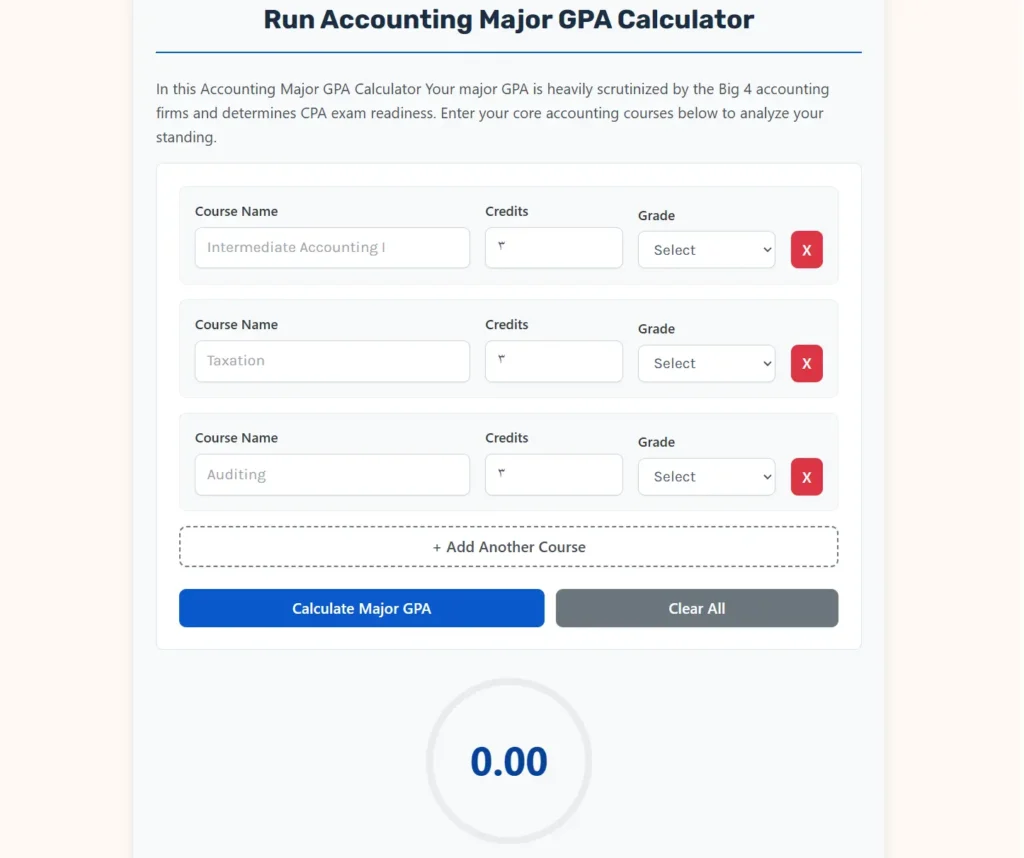
Run Accounting Major GPA Calculator
In this Accounting Major GPA Calculator Your major GPA is heavily scrutinized by the Big 4 accounting firms and determines CPA exam readiness. Enter your core accounting courses below to analyze your standing.
How Your GPA is Calculated
Your Grade Point Average (GPA) is determined by dividing your Total Quality Points by your Total Credits attempted.
Quality Points for a single course are calculated as:
Points = (Course Credits) × (Grade Value)
Example: An ‘A’ (4.0) in a 3-credit Financial Accounting course yields 12 Quality Points (3 × 4.0).
Why Accounting GPA Matters
1. Big 4 Recruiting (Deloitte, PwC, EY, KPMG)
Top accounting firms typically look for a minimum Major GPA of 3.3 to 3.5. Because overall GPAs can be inflated by easy electives, recruiters isolate your Major GPA to see how well you handle rigorous accounting principles (Tax, Audit, Intermediate Accounting).
2. CPA Exam Eligibility
While the CPA exam requires a specific number of total credit hours (often 150), state boards look closely at your academic standing in core accounting and business law courses. Falling behind in major courses can indicate you are not adequately prepared for the rigor of the CPA exam.
Navigating the Accounting Major GPA: Sizing Up Academic Metrics for Professional Success
In undergraduate business education, few metrics carry as much weight, scrutiny, and professional consequence as the Accounting Major Grade Point Average. While a student’s cumulative grade point average provides a broad overview of their general academic performance across various disciplines, the major GPA serves as a targeted diagnostic tool. It isolates performance in rigorous, specialized accounting courses to evaluate technical competence, work ethic, and suitability for the professional services sector.
For students aspiring to enter public accounting, corporate finance, or government auditing, this accounting major gpa calculator functions as a critical career planning instrument. It converts standard letter grades and credit hours into a precise major GPA. By isolating core accounting coursework, students can view their academic standing through the same lens used by elite corporate recruiters and public accounting firms.
Cumulative GPA vs. Accounting Major GPA: The Crucial Distinction
To navigate the recruiting landscape successfully, students must understand that a high cumulative GPA can sometimes mask difficulties in their primary field of study. Academic institutions require a variety of general education courses, ranging from introductory humanities to basic social sciences. While these courses contribute to a well-rounded education, they often have different grading curves and lower cognitive demands than upper-division accounting coursework.
Recruiters, particularly those from international public accounting networks, look past the overall GPA to evaluate the major GPA. A student who maintains a $3.80$ cumulative GPA but holds a $2.90$ major GPA across intermediate financial accounting, tax, and audit may be viewed as a high risk for professional placement. Conversely, a student with a $3.20$ cumulative GPA who boasts a $3.60$ major GPA demonstrates a strong trajectory in their chosen field, showing that they thrive when faced with complex technical challenges.
The following table outlines how these two metrics differ in focus, calculation parameters, and professional weight:
| Metric | Calculation Parameters | Primary Audience | Professional Significance |
| Cumulative GPA | Every course completed at the institution, including general education and electives. | University administrators, general scholarship boards, graduate school admissions. | Serves as an initial cut-off point for general resumes and university honors. |
| Accounting Major GPA | Only courses with an accounting prefix (e.g., ACCT, ACC) or designated major electives. | Public accounting recruiters, corporate controllers, state boards of accountancy. | Serves as the primary indicator of technical proficiency and readiness for the CPA examination. |
The Mathematics of Grade Point Averages: Formulas and Derivations
Calculating a grade point average is a weighted mathematical process. Because courses carry different credit hour weights, a simple average of grades is insufficient. To calculate the major GPA, we must first determine the Quality Points earned for each individual course.
1. Individual Course Quality Points
The quality points for any given course are determined by multiplying the course’s credit hours by the numerical value assigned to the letter grade.$$QP_i = C_i \times G_i$$
Variable Definitions:
➜ $QP_i$: The total Quality Points earned for a single course $i$.
➜ $C_i$: The number of credit hours assigned to course $i$ (typically $3$ or $4$ credits).
➜ $G_i$: The numerical grade point value associated with the letter grade received in course $i$ (e.g., $A = 4.0$, $B = 3.0$).
2. Weighted Major GPA Calculation
Once the quality points for each major course are calculated, they are summed and divided by the total number of major credit hours attempted.$$GPA_{Major} = \frac{\sum_{i=1}^{n} (C_i \times G_i)}{\sum_{i=1}^{n} C_i}$$
Variable Definitions:
➜ $GPA_{Major}$: The final weighted Grade Point Average for the accounting major.
➜ $C_i$: The credit hours for course $i$.
➜ $G_i$: The numerical grade point value for course $i$.
➜ $n$: The total number of major-specific courses included in the calculation.
➜ $\sum$: The mathematical summation of all individual course metrics from $i = 1$ to $n$.
3. Step-by-Step Practical Sizing Example
To illustrate the precision of this formula, let us calculate the major GPA for an undergraduate student who has completed four core accounting courses under a standard four-point grading scale.
- Course 1: Intermediate Accounting I ($3$ Credits) — Grade: B ($3.0$ Value)
- Course 2: Individual Income Tax ($3$ Credits) — Grade: A- ($3.7$ Value)
- Course 3: Cost Accounting ($3$ Credits) — Grade: B+ ($3.3$ Value)
- Course 4: Accounting Information Systems ($4$ Credits) — Grade: A ($4.0$ Value)
We begin by calculating the Quality Points ($QP$) for each course:
➜ $\text{Intermediate I Quality Points} = 3 \times 3.0 = 9.0$
➜ $\text{Individual Tax Quality Points} = 3 \times 3.7 = 11.1$
➜ $\text{Cost Accounting Quality Points} = 3 \times 3.3 = 9.9$
➜ $\text{AIS Quality Points} = 4 \times 4.0 = 16.0$
Next, we sum the Quality Points and the attempted credit hours:
$$\sum QP = 46.0$$
$$\sum C = 13.0$$
Calculations Breakdown:
Total Major Credits ($\sum C$): $3 + 3 + 3 + 4$
Quality Points ($\sum QP$): $9.0 + 11.1 + 9.9 + 16.0$
Finally, we apply the weighted GPA formula to find the final Major GPA:$$GPA_{Major} = \frac{46.0}{13.0} \approx 3.54$$
This result ($3.54$ GPA) positions the student in a highly competitive tier for major firms, demonstrating balanced competency across financial accounting, taxation, management accounting, and systems design.
The Corporate Scrutiny: Why Accounting Firms Prioritize the Major GPA
Public accounting firms, particularly the “Big Four” (Deloitte, PwC, EY, and KPMG), operate in a high-compliance, intellectually demanding environment. New hires are expected to quickly grasp complex regulatory frameworks, audit procedures, and tax codes. Because of this, recruiters use the major GPA as a proxy for a student’s cognitive capability, focus, and resilience.
➜ The Intermediate Accounting Filter
Intermediate Financial Accounting I and II are widely considered the benchmark courses for accounting majors. These classes transition students from basic bookkeeping rules to the conceptual frameworks of accrual accounting, revenue recognition, lease structures, and financial instrument valuations.
A student’s performance in these specific courses is highly predictive of their long-term professional success. A grade of C or lower in Intermediate Accounting indicates a conceptual gap that will likely cause difficulties in advanced courses and on the Uniform CPA Examination. Recruiters look closely at these specific grades, making a strong major GPA even more valuable.
➜ The Risk of Grade Inflation
Grade inflation in general electives is a recognized phenomenon in higher education. A high cumulative GPA can sometimes be achieved by taking less demanding courses outside of the business school. By isolating the major GPA, accounting firms can bypass this inflation. They want to see how a student performs when everyone in the room is highly motivated and the subject matter is objectively challenging.
CPA Exam Readiness and Academic Accreditation
The relationship between academic performance in major-specific coursework and success on the Uniform Certified Public Accountant (CPA) Examination is well-documented. The CPA exam is a rigorous four-part assessment covering auditing and attestation, financial accounting and reporting, regulation, and business analysis.
The Correlation with Exam Performance
Studies in accounting education consistently show that the major GPA is the single best predictor of first-time pass rates on the CPA exam. The exam does not test general knowledge; it tests the exact concepts taught in upper-division accounting major courses.$$P_{\text{Pass}} \propto GPA_{Major}$$
The probability of passing the CPA exam on the first attempt is directly proportional to a student’s major GPA. A student who maintains a major GPA of $3.50$ or higher has a significantly higher probability of passing all four sections of the exam within the designated $18$-month window compared to a student with a major GPA below $3.00$.
AACSB Accreditation and Academic Standards
Universities that hold specialized accounting accreditation from the Association to Advance Collegiate Schools of Business (AACSB) maintain high standards for their accounting programs. These programs design their major courses to align with the CPA Evolution model, ensuring that the curriculum reflects the current needs of the profession. Consequently, a major GPA earned at an AACSB-accredited institution carries high credibility with employers, as it indicates the student has completed a validated and rigorous course of study.
Strategic Guidance: Best Practices for Managing and Raising Your GPA
Managing an accounting major GPA requires a strategic approach to course loading, study habits, and academic recovery. Because the curriculum is cumulative, a poor foundation in early classes can create difficulties in advanced coursework.
➜ Strategic Course Sequencing
One of the most common mistakes students make is taking too many demanding core courses in a single semester. Spreading out difficult classes can help you manage your study load.
➜ Poor Scheduling: Enrolling in Intermediate Accounting II, Taxation, and Auditing in the same term can overwhelm even high-achieving students.
➜ Strategic Scheduling: Pairing a difficult course like Intermediate Accounting II with a systems-based or management-focused accounting course, alongside general business requirements, allows for more balanced study time.
➜ Shift from Memorization to Conceptual Understanding
Introductory accounting courses can sometimes be navigated through rote memorization of debits and credits. However, upper-level accounting is conceptual and analytical.
➜ The Strategy: Focus on the “why” behind accounting treatments rather than just the “how.” Understand the economic substance of transactions. For example, do not just memorize the journal entry for a lease; understand how the lease structure alters the balance sheet risk and financial ratios of both the lessee and the lessor.
➜ Utilize Professional and Academic Networks
Accounting is a collaborative profession. Successful students do not study in isolation.
➜ Beta Alpha Psi: Joining the international honor organization for financial information professionals provides access to peer tutoring, senior mentors, and exclusive recruiting events.
➜ Professor Office Hours: Accounting faculty members are often experienced CPAs or active researchers. Building a relationship with your professors can provide valuable clarification on difficult concepts and open doors for internships and letters of recommendation.
Glossary of Critical Academic and Professional Terms
- AACSB: The Association to Advance Collegiate Schools of Business, the premier global accrediting body for business and accounting programs.
- Big Four: The four largest international professional services networks (Deloitte, PwC, EY, and KPMG), which collectively audit the majority of public companies globally.
- CPA (Certified Public Accountant): The premier professional designation in accounting, requiring a combination of education, experience, and passing the Uniform CPA Exam.
- Intermediate Accounting: A rigorous two-part course sequence that serves as the foundation of financial reporting and the primary screening tool for recruiters.
- Quality Points: The numerical points assigned to a course grade, calculated by multiplying the grade value by the course credit hours.
- Uniform CPA Examination: The four-section, $16$-hour professional exam required to obtain a CPA license.
Scientific Reference and Academic Citation
To understand the predictive power of major-specific grading metrics and their impact on professional readiness, refer to the following peer-reviewed study:
Source: Conant, Terry, & Loehr (Journal of Accounting Education). “The Predictive Value of Grade Point Average in Determining CPA Examination Success.“
Relevance: This academic study examines the correlation between undergraduate academic performance and success on the Uniform CPA Examination. The researchers found that while cumulative GPA has some predictive value, the major GPA—specifically in upper-division financial accounting and auditing courses—is the most reliable predictor of a candidate’s probability of passing the CPA exam on their first attempt. This research supports the emphasis public accounting recruiters place on the major GPA during campus interviews.
Accounting Major and Accountant Salaries E-book Guide
You can download your Accounting Major and Accountant Salaries E-book Guide here.
Final Summary Checklist for Accounting Majors
Before submitting your resume for internships or full-time associate positions, use this checklist to assess your academic profile:
✓ Have you calculated your accounting-specific GPA separately from your cumulative university GPA?
✓ Is your major GPA above the target threshold ($3.30$ to $3.50$) for major public accounting firms?
✓ Have you identified any core courses where your grade fell below a B, and taken steps to review those concepts before starting CPA prep?
✓ Are you scheduling your remaining upper-division accounting courses to allow sufficient study time for each subject?
✓ Are you actively involved in professional student organizations to complement your GPA with strong leadership and communication skills?
By focusing on your accounting major gpa calculator and understanding the mathematical and professional principles behind it, you can make informed decisions about your education. A strong major GPA is more than just a number on a resume; it is a clear indicator of your technical competence, professional drive, and readiness to enter a demanding and rewarding field.