Run Punch Force Calculator
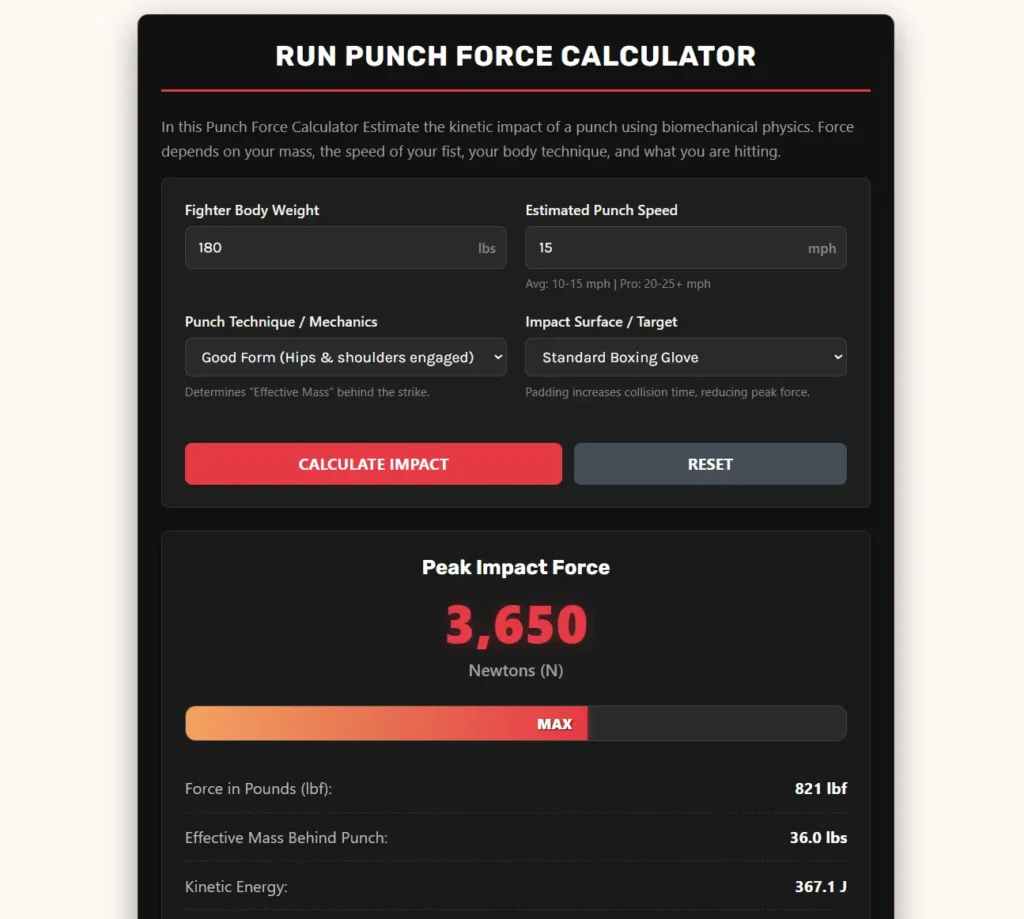
In this Punch Force Calculator Estimate the kinetic impact of a punch using biomechanical physics. Force depends on your mass, the speed of your fist, your body technique, and what you are hitting.
The Physics of a Strike
Force and Momentum
In physics, force is the rate of change of momentum. A punch’s force relies on how much “effective mass” you can put into motion, how fast it is moving, and how quickly it stops upon impact.
- Effective Mass: You don’t hit with your whole body weight. A poor punch only uses the arm (10% of body weight). A professional punch transfers energy from the foot, through the hips, and into the fist (up to 35% of body weight).
- Velocity: Speed kills. Because Kinetic Energy equals 0.5 × m × v2, doubling your punch speed quadruples the destructive energy.
- Δ Time (Collision Duration): Gloves were invented to protect hands and brains by extending the time of the collision. Bare knuckle strikes stop almost instantly (0.01s), causing a massive, destructive spike in peak force.
Biomechanics of Impact: The Physics of Punch Force
In combat sports, sports medicine, and martial arts engineering, quantifying striking power has transitioned from subjective evaluation to rigorous physical measurement. While a powerful punch is often attributed simply to a fighter’s size or muscularity, the actual force delivered is governed entirely by the laws of classical mechanics and biomechanics. A strike is the physical culmination of a highly coordinated kinetic chain, where force is generated at the floor, transferred through the core, and delivered via the hand.
This Punch Force Calculator acts as an analytical bridge between physical parameters and real-world impact dynamics. By modeling the physics of a collision, this tool helps athletes, coaches, and researchers calculate the peak impact force, effective striking mass, and kinetic energy of different punches. Understanding these variables allows fighters to optimize their technique, design safer protective gear, and systematically train for maximum impact efficiency.
The Concept Behind Strike Dynamics
To understand how a punch generates force, one must define what a strike is in the language of physics. A punch is an inelastic collision where a moving mass (the fighter’s fist, forearm, and recruited body mass) transfers momentum to a target over a specific, microscopic duration.
The primary determinant of damage or displacement in a strike is not merely the velocity of the hand, but the deceleration profile of that hand upon impact. If a fist travels at high speed but lacks solid bodily structure behind it, the target will easily push the hand back, resulting in a low transfer of force. Conversely, if a punch is backed by structured skeletal alignment, the target is forced to absorb the entirety of the moving body’s momentum, yielding a high-velocity, high-impact collision.
The Core Physics: Impulse, Force, and Energy
The physical impact of a punch is determined by three interlocking principles of classical mechanics: the Impulse-Momentum Theorem, Newton’s Second Law of Motion, and the conservation of Kinetic Energy.
1. The Impulse-Momentum Theorem
In a collision, average force is defined as the rate of change of momentum over time. When a fist strikes a target, its velocity drops from its peak speed to zero. This transition is governed by the following mathematical relationship:$$F_{\text{avg}} = \frac{\Delta p}{\Delta t}$$
Variable Definitions:
➜ $F_{\text{avg}}$: The average impact force exerted during the collision, measured in Newtons ($N$).
➜ $\Delta p$: The change in linear momentum of the striking mass, measured in kilogram-meters per second ($kg \cdot m/s$).
➜ $\Delta t$: The duration of the impact, or collision time, measured in seconds ($s$).
This equation reveals that force is inversely proportional to collision time. If you decrease the time it takes for the punch to stop, the force increases exponentially.
2. Momentum Derivation
Momentum ($p$) is the product of mass and velocity. In a strike, the change in momentum is calculated assuming the fist comes to a complete stop upon maximum compression of the target:$$\Delta p = M_{\text{eff}} \times v$$
Variable Definitions:
➜ $\Delta p$: The total momentum transferred to the target ($kg \cdot m/s$).
➜ $M_{\text{eff}}$: The effective striking mass recruited behind the punch ($kg$).
➜ $v$: The linear velocity of the hand immediately prior to impact ($m/s$).
3. Kinetic Energy vs. Peak Force
Kinetic energy ($KE$) represents the total mechanical work potential stored within the moving strike. It is calculated using the classical kinetic energy equation:$$KE = \frac{1}{2} \times M_{\text{eff}} \times v^2$$
Variable Definitions:
➜ $KE$: The kinetic energy of the strike, measured in Joules ($J$).
➜ $M_{\text{eff}}$: The effective moving mass ($kg$).
➜ $v$: The velocity of the fist ($m/s$).
Because velocity is squared in this equation, minor increases in punch speed yield massive increases in kinetic energy. However, how much of this energy translates into destructive force depends entirely on the stiffness of the impact and the collision duration ($\Delta t$).
Biomechanical Mechanics: The Kinetic Chain
A common misconception in combat sports is that punching power comes primarily from the arms and chest. Biomechanical studies show that elite punchers generate the majority of their power from their lower body and trunk. This sequence of energy transfer is known as the Kin Kinetic Chain.
  [ Ground Reaction Force ]  -->  Generated by back foot driving into the floor.
            |
            v
  [ Axial Rotation ]         -->  Transferred through hip drive and core rotation.
            |
            v
  [ Scapular Glide ]         -->  Amplified by shoulder extension and back expansion.
            |
            v
  [ Terminal Stiffening ]    -->  Skeletal alignment locked at the moment of impact.
➜ Ground Reaction Force (GRF)
The strike begins when the fighter drives their rear foot into the ground. According to Newton’s Third Law, the ground pushes back with equal and opposite force. This ground reaction force is directed upward through the leg, serving as the raw energy source for the punch.
➜ Axial Core Rotation
The energy from the lower body is transferred to the pelvis and core. The rapid, sequential rotation of the hips and shoulders acts as a rotational sling, accelerating the torso and whipping the shoulder of the striking arm forward.
➜ Scapular Extension and Lead
The shoulder muscle group, specifically the serratus anterior and deltoid, extends the scapula forward. This extension adds length and velocity to the punch immediately before impact.
➜ Terminal Stiffening (Skeletal Lock)
At the exact microsecond of impact, a professional fighter undergoes a brief, full-body muscular contraction. This contraction, known as terminal stiffening, locks the joints (wrist, elbow, shoulder, spine, and hips) into a solid structural column. This momentary stabilization prevents joint collapse and ensures that the mass of the entire torso is physically linked to the fist, maximizing the effective mass ($M_{\text{eff}}$) behind the blow.
Effective Mass vs. Actual Body Mass
When you punch, you do not hit with your entire body weight. Only a fraction of your physical mass is actually transferred into the target. This fraction is called the Effective Mass ($M_{\text{eff}}$).
The percentage of body weight recruited as effective mass varies dramatically based on punch technique and joint alignment:
| Punch Technique | Mass Coefficient (μ) | Percentage of Body Weight | Biomechanical Description |
| Arm Only (Jab) | $0.05 – 0.10$ | $5\% – 10\%$ | Flicking strike; elbow is loose; no rotation of hips or shoulder. |
| Standard Cross | $0.15 – 0.22$ | $15\% – 22\%$ | Good amateur form; hips engage; moderate body weight transfer. |
| Elite Knockout Hook | $0.28 – 0.35$ | $28\% – 35\%$ | Full kinetic chain; back heel drives; core is completely locked at impact. |
By utilizing proper skeletal alignment, a lighter fighter can deliver a punch with the same effective mass as a much heavier, poorly trained fighter.
The Role of Collision Duration ($\Delta t$)
The duration of the collision ($\Delta t$) is the most critical variable governing the transition from average force to peak force. It represents the time window from the first touch of the glove to the maximum compression of the target.
➜ Bare Knuckle vs. Gloved Impacts
The human hand is composed of small, fragile bones. When hitting a hard object like a skull bare-knuckle, the collision stops almost instantly, typically within $0.005$ to $0.01$ seconds. This rapid stop creates an incredibly sharp, high-magnitude peak force spike, increasing the risk of bone fractures for both the striker and the target.
When a boxing glove is introduced, the foam padding compresses during the collision. This compression extends the impact time to $0.03$ or $0.05$ seconds. By spreading the deceleration over a longer time window, the peak force is systematically lowered, protecting the facial bones of the target and the hand bones of the striker.
Mathematical Equations and Biomechanical Derivations
The formulas utilized by this calculator are derived from classical momentum and energy conservation laws.
1. Calculating Effective Striking Mass ($M_{\text{eff}}$)
To calculate the exact mass behind the punch, we scale the fighter’s body weight by the technical execution coefficient.$$M_{\text{eff}} = M_{\text{body}} \times \mu$$
Variable Definitions:
➜ $M_{\text{eff}}$: The effective striking mass, measured in kilograms ($kg$) or pounds ($lbs$).
➜ $M_{\text{body}}$: The total body mass of the fighter.
➜ $\mu$: The biomechanical transmission coefficient (based on selected technique).
2. Calculating Peak Impact Force ($F_{\text{peak}}$)
Assuming a standard linear deceleration curve where the force rises to a peak and declines back to zero, the peak force ($F_{\text{peak}}$) is roughly double the average force calculated by the impulse equation.$$F_{\text{peak}} = \frac{2 \times M_{\text{eff}} \times v}{\Delta t}$$
Variable Definitions:
➜ $F_{\text{peak}}$: The peak impact force achieved during the strike, measured in Newtons ($N$) or pounds-force ($lbf$).
➜ $M_{\text{eff}}$: The effective striking mass ($kg$).
➜ $v$: The velocity of the fist prior to impact ($m/s$).
➜ $\Delta t$: The duration of the collision ($s$).
Step-by-Step Practical Sizing Examples
To illustrate how these formulas perform in real-world scenarios, let us analyze two contrasting fighter profiles.
Example 1: The Elite Welterweight Hook
An elite welterweight fighter is throwing a left hook with full kinetic body transfer.
- Fighter Body Weight ($M_{\text{body}}$): $170 \text{ lbs}$ ($77.1 \text{ kg}$)
- Punch Speed ($v$): $25 \text{ mph}$ ($11.17 \text{ m/s}$)
- Technique Coefficient ($\mu$): Pro Kinetic Chain ($0.35$ or $35\%$)
- Impact Target ($\Delta t$): Standard Boxing Glove ($0.03 \text{ seconds}$)
➜ Step A: Calculate Effective Striking Mass ($M_{\text{eff}}$):$$M_{\text{eff}} = 77.1 \text{ kg} \times 0.35 = 26.985 \text{ kg}$$
The fighter puts roughly $59.5 \text{ lbs}$ of their structural mass directly behind the fist.
➜ Step B: Calculate Peak Impact Force ($F_{\text{peak}}$):
$$F_{\text{peak}} \approx 20,098\text{ N}$$
$$F_{\text{peak}} \approx 4,518\text{ lbf}$$
Calculations Breakdown:
- $F_{\text{peak}}$ (Newtons): $\frac{2 \times 26.985 \times 11.17}{0.03}$
- $F_{\text{peak}}$ (Pounds-force): $20,098 \times 0.224809$
Where:
0.03 s: Impact Duration (Time)
26.985 kg: Mass
11.17 m/s: Velocity
This strike delivers an incredible $4,518 \text{ pounds-force}$ of peak impact.
➜ Step C: Calculate Kinetic Energy ($KE$):
$$KE = \frac{1}{2} \times m \times v^2 \approx 1,683\text{ J}$$
Where:
$v$: Velocity ($11.17\text{ m/s}$, squared as $124.7689$)
$KE$: Kinetic Energy
$m$: Mass ($26.985\text{ kg}$)
Example 2: The Arm-Only Heavyweight Jab
A novice heavyweight fighter throws a jab relying only on their arm muscles, without rotating their hips or transferring their body weight.
- Fighter Body Weight ($M_{\text{body}}$): $240 \text{ lbs}$ ($108.9 \text{ kg}$)
- Punch Speed ($v$): $12 \text{ mph}$ ($5.36 \text{ m/s}$)
- Technique Coefficient ($\mu$): Arm Only ($0.10$ or $10\%$)
- Impact Target ($\Delta t$): Thick Padding ($0.05 \text{ seconds}$)
➜ Step A: Calculate Effective Striking Mass ($M_{\text{eff}}$):$$M_{\text{eff}} = 108.9 \text{ kg} \times 0.10 = 10.89 \text{ kg}$$
Despite their large size, the poor technique results in only $24 \text{ lbs}$ of mass behind the punch.
➜ Step B: Calculate Peak Impact Force ($F_{\text{peak}}$):
$$F_{\text{peak}} \approx 2,333\text{ N}$$
$$F_{\text{peak}} \approx 524\text{ lbf}$$
Calculations Breakdown:
- $F_{\text{peak}}$ (Newtons): $\frac{2 \times 10.89 \times 5.36}{0.05}$
- $F_{\text{peak}}$ (Pounds-force): $2,333 \times 0.224809$
Where:
0.05 s: Impact Duration (Time)
10.89 kg: Mass
5.36 m/s: Velocity
Because of slow speed and poor weight recruitment, this heavyweight delivers only $524 \text{ pounds-force}$ of impact, showing why technique is vastly superior to raw body size.
Best Practices for Maximizing Punching Power
To systematically increase your striking force, incorporate these biomechanical guidelines into your training regimen:
- Drive from the Back Foot: Always begin the punch by pushing off the floor with your rear leg. This action is the primary generator of ground reaction force.
- Relax Until the Moment of Impact: Keeping your muscles tense during the punch’s travel slows down your movement, reducing velocity ($v$). Keep your arm relaxed as it flies, only clenching your fist and locking your body at the split-second of collision.
- Rotate the Hips and Torso: Ensure your hips turn completely before your arm fully extends. This rotational force acts as an energy multiplier.
- Punch Through the Target: Never aim for the surface of the target. Always visualize your target as being two inches inside the bag or pad. This focus ensures you do not decelerate your hand prematurely before making contact.
- Maintain Wrist Alignment: Keep your wrist perfectly straight at impact. Any bend in the wrist joint acts as a mechanical energy leak, absorbing force that should have been transferred to the target while increasing the risk of injury.
Glossary of Biomechanical Terms
➜ Effective Mass ($M_{\text{eff}}$): The portion of a fighter’s total body weight that is structurally connected to the fist at the moment of impact.
➜ Ground Reaction Force (GRF): The force exerted by the ground on a body in contact with it, which serves as the origin of striking power.
➜ Impulse: The product of force and the time interval over which it acts, which equals the total change in momentum.
➜ Kinetic Chain: The sequential activation of muscle groups and joints to transfer energy from the ground to the hand.
➜ Terminal Stiffening: The momentary full-body muscular contraction that locks the skeletal structure at the moment of contact.
➜ Newton (N): The international unit of force, defined as the force needed to accelerate one kilogram of mass at a rate of one meter per second squared.
Scientific Reference and Biomechanical Standards
The mathematical models and biomechanical coefficients used in this guide are aligned with the standards established by sports science and clinical kinesiology researchers.
Relevance: This landmark scientific study analyzed the punching forces and biomechanical structures of elite, intermediate, and novice boxers. The researchers determined that elite boxers derive up to $39\%$ of their punching power from leg drive, compared to only $16\%$ for novices, proving the mathematical validity of the kinetic chain and providing the scientific basis for the technique multipliers ($\mu$) used in modern strike calculations.
Final Summary Checklist for Fighters and Coaches
Before analyzing striking data or selecting protective equipment, review this functional checklist:
✓ Is the fighter’s weight measured accurately to ensure the baseline mass is correct?
✓ Has the punch speed been estimated realistically based on the fighter’s skill level?
✓ Are you using the correct impact target duration ($\Delta t$) to represent gloves, bare knuckles, or heavy pads?
✓ Is the fighter training to improve lower-body explosive power to increase ground reaction forces?
✓ Have you integrated wrist-strengthening exercises to prevent energy leaks and stabilize the skeletal lock?
By applying these mathematical standards and biomechanical frameworks in Punch Force Calculator, you transform striking from an unmeasured physical act into a controlled, highly optimized scientific discipline. Precision in biomechanical alignment is the foundation of devastating striking power and long-term athletic durability.