Run Protein Molecular Weight Calculator
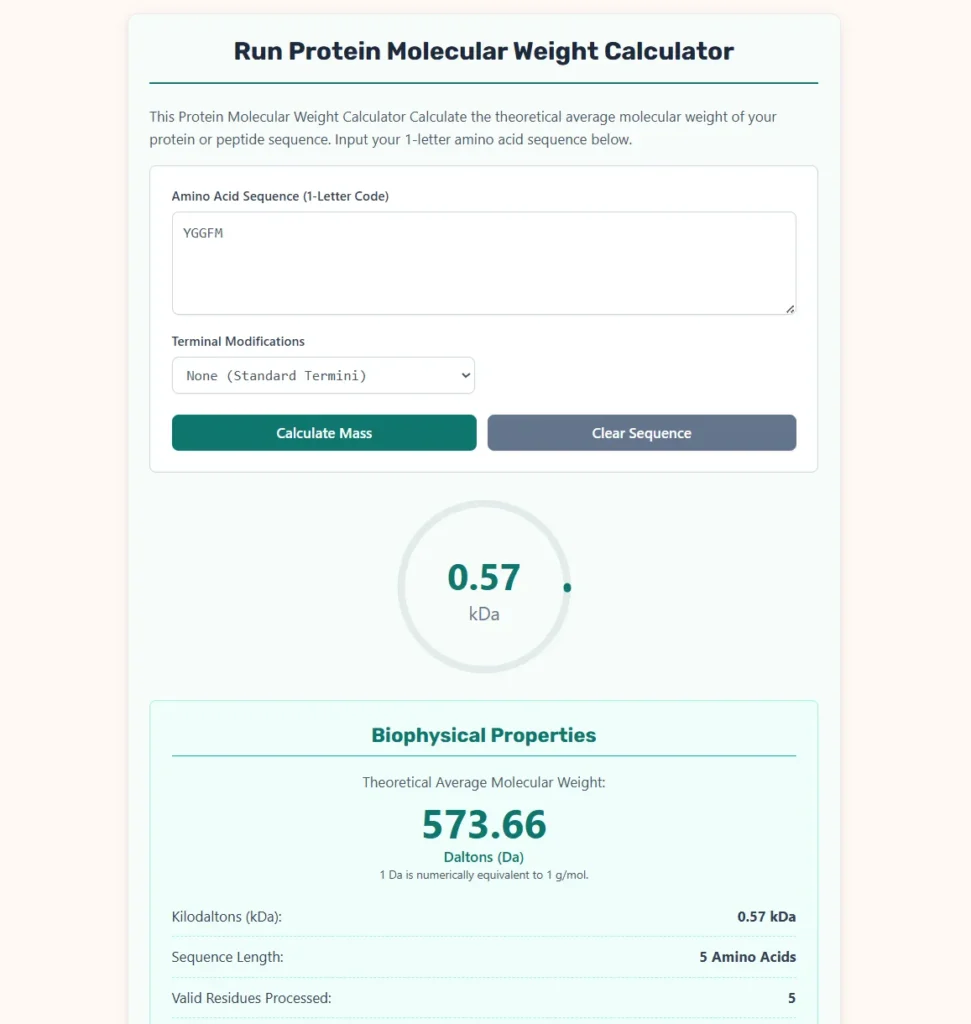
This Protein Molecular Weight Calculator Calculate the theoretical average molecular weight of your protein or peptide sequence. Input your 1-letter amino acid sequence below.
How It Works
Calculation Methodology
The molecular weight is calculated by summing the average mass of each amino acid residue in the sequence and adding the mass of terminal H and OH groups. When amino acids form peptide bonds, a molecule of water is lost for every bond. Therefore, the formula is:
Molecular Weight = Σ (Residue Masses) + H2O
Our tool adds the exact mass of terminal H and OH groups (H2O = 18.015 Da) to the final residue sum.
Amino Acid Residue Data
Average Amino Acid Residue Masses (Daltons)
- A (Ala): 71.08
- R (Arg): 156.19
- N (Asn): 114.10
- D (Asp): 115.09
- C (Cys): 103.14
- E (Glu): 129.12
- Q (Gln): 128.13
- G (Gly): 57.05
- H (His): 137.14
- I (Ile): 113.16
- L (Leu): 113.16
- K (Lys): 128.17
- M (Met): 131.19
- F (Phe): 147.18
- P (Pro): 97.12
- S (Ser): 87.08
- T (Thr): 101.11
- W (Trp): 186.21
- Y (Tyr): 163.18
- V (Val): 99.13
The Biophysics of Peptide Mass: Mastering Protein Molecular Weight Calculations
The molecular weight of a protein is one of its most fundamental physical properties. Whether a researcher is verifying the expression of a recombinant enzyme on an SDS-PAGE gel, characterizing a therapeutic antibody using mass spectrometry, or calculating the molar concentration of a peptide solution, an accurate determination of molecular mass is required.
A protein’s molecular weight is a direct consequence of its primary amino acid sequence. However, calculating this value is not as simple as adding the individual masses of free amino acids. The process of peptide bond formation, the chemical nature of isotopic distributions, and the presence of terminal modifications introduce mathematical nuances that must be carefully modeled.
This guide provides a comprehensive overview of the biophysical chemistry, mathematical formulas, and analytical applications that govern protein molecular weight calculations.
The Chemical Foundations: Amino Acids versus Residues
To calculate the mass of a polypeptide chain, one must first distinguish between a free amino acid and an amino acid residue. A free amino acid in solution exists as a zwitterion containing a protonated amino group ($\text{NH}_3^+$), a deprotonated carboxyl group ($\text{COO}^-$), a central alpha-carbon, and a variable side chain.
The Condensation Reaction
When two amino acids are joined by a ribosome during translation, or synthetically during solid-phase peptide synthesis, they undergo a condensation reaction. The carboxyl group of the first amino acid reacts with the amino group of the second, releasing a molecule of water ($\text{H}_2\text{O}$) and forming a covalent peptide bond ($\text{CONH}$).
  Free Amino Acid 1             Free Amino Acid 2
    H   H   O                 H   H   O
    |   |   ||                |   |   ||
  N - C - C - OH            N - C - C - OH
    |   |                     |   |
    H   R1                    H   R2
         \                     /
          \                   /
           v                 v
           [Condensation Reaction] ---> Releases H2O
                     |
                     v
             Peptide Di-Residue
               H   H   O   H   H   O
               |   |   ||  |   |   ||
             N - C - C - N - C - C - OH
               |   |       |   |
               H   R1      H   R2
Because a water molecule is lost for every peptide bond formed, the mass of the amino acid within a polypeptide chain is reduced. The remaining portion of the amino acid is referred to as a residue.
The mass of an amino acid residue can be expressed mathematically as:$$M_{\text{residue}} = M_{\text{amino\_acid}} – M_{\text{H}_2\text{O}}$$
Variable Definitions:
➜ $M_{\text{residue}}$: The molecular weight of the amino acid residue in Daltons.
➜ $M_{\text{amino\_acid}}$: The molecular weight of the free, unbound amino acid in Daltons.
➜ $M_{\text{H}_2\text{O}}$: The molecular weight of water, which is approximately $18.01524\text{ Da}$.
Consequently, a polypeptide chain of $N$ residues has undergone $N-1$ condensation reactions, meaning it has lost $N-1$ water molecules. The fully assembled unmodified protein retains a hydrogen atom ($\text{H}$) at its N-terminus and a hydroxyl group ($\text{OH}$) at its C-terminus, which together equal the mass of one water molecule.
Web App.
Average Mass versus Monoisotopic Mass
A critical decision in biophysical calculations is whether to use average molecular weight or monoisotopic molecular weight. The choice depends entirely on the analytical method being used.
Isotopic Abundances
Every element in a protein—carbon, hydrogen, nitrogen, oxygen, and sulfur—exists in nature as a mixture of stable isotopes. For example, carbon is primarily Carbon-12 ($^{12}\text{C}$), but approximately $1.1\%$ of natural carbon is Carbon-13 ($^{13}\text{C}$). Similarly, nitrogen contains a small fraction of Nitrogen-15 ($^{15}\text{N}$).
➜ Monoisotopic Mass: This is calculated using the exact mass of the most abundant, lightest stable isotope for each element. For a standard protein, these are $^{12}\text{C}$, $^{1}\text{H}$, $^{14}\text{N}$, $^{16}\text{O}$, and $^{32}\text{S}$.
➜ Average Mass: This is calculated using the weighted average of all naturally occurring stable isotopes for each element, based on their global terrestrial abundances.
The table below contrasts the elemental masses used for both calculation types:
| Element | Symbol | Monoisotopic Mass (Da) | Standard Average Atomic Weight (Da) |
| Hydrogen | $\text{H}$ | $1.007825$ | $1.00794$ |
| Carbon | $\text{C}$ | $12.000000$ | $12.0107$ |
| Nitrogen | $\text{N}$ | $14.003074$ | $14.0067$ |
| Oxygen | $\text{O}$ | $15.994915$ | $15.9994$ |
| Sulfur | $\text{S}$ | $31.972071$ | $32.0650$ |
Analytical Application Rules
The selection of the appropriate mass metric is governed by the resolution of the analytical instrument being used:
➜ Gel Electrophoresis and Chromatography: When running an SDS-PAGE gel or analyzing proteins via Size-Exclusion Chromatography (SEC), millions of molecules are measured simultaneously. These methods evaluate the average mass of the bulk population.
➜ Low-Resolution Mass Spectrometry: On older or benchtop mass spectrometers where individual isotopic peaks cannot be resolved, the instrument records an average envelope. Average mass must be used for these calculations.
➜ High-Resolution Mass Spectrometry (HRMS): On modern instruments such as Orbitraps, Q-TOFs, or FT-ICR mass spectrometers, individual isotopic peaks are fully resolved. For small peptides (under $3\text{ kDa}$), the monoisotopic peak is the tallest and easiest to identify.
➜ The Isotopic Shift in Large Proteins: For large proteins (above $10\text{ kDa}$), the probability of a molecule containing at least one heavy $^{13}\text{C}$ atom approaches $100\%$. Consequently, the monoisotopic peak becomes extremely small, and the tallest peak in the resolved isotopic cluster shifts toward the average mass. For intact protein mass spectrometry, average mass remains highly relevant.
The Fundamental Protein Mass Formula
To calculate the standard, unmodified average molecular weight of a protein from its primary sequence of single-letter amino acid codes, we sum the average residue masses and add the mass of a terminal water molecule.$$MW_{\text{protein}} = \sum_{i=1}^{N} R_i + M_{\text{H}_2\text{O}}$$
Variable Definitions:
➜ $MW_{\text{protein}}$: The total average molecular weight of the unmodified protein in Daltons.
➜ $R_i$: The average residue mass of the $i$-th amino acid in the sequence.
➜ $N$: The total number of amino acids in the sequence (sequence length).
➜ $M_{\text{H}_2\text{O}}$: The molecular weight of water, which is $18.01524\text{ Da}$ (accounting for the terminal N-terminal $\text{H}$ and C-terminal $\text{OH}$).
Reference Data: Canonical Amino Acid Residues
The following table contains the 20 standard amino acids, their abbreviations, chemical formulas of their residues, average residue masses, and monoisotopic residue masses. The residue formula represents the amino acid minus the elements of water ($\text{H}_2\text{O}$).
| One-Letter | Three-Letter | Amino Acid Name | Residue Formula | Average Residue Mass (Da) | Monoisotopic Residue Mass (Da) |
| A | Ala | Alanine | $\text{C}_3\text{H}_5\text{N}\text{O}$ | $71.08$ | $71.03711$ |
| R | Arg | Arginine | $\text{C}_6\text{H}_{12}\text{N}_4\text{O}$ | $156.19$ | $156.10111$ |
| N | Asn | Asparagine | $\text{C}_4\text{H}_6\text{N}_2\text{O}_2$ | $114.10$ | $114.04293$ |
| D | Asp | Aspartic Acid | $\text{C}_4\text{H}_5\text{N}\text{O}_3$ | $115.09$ | $115.02694$ |
| C | Cys | Cysteine | $\text{C}_3\text{H}_5\text{N}\text{O}\text{S}$ | $103.14$ | $103.00919$ |
| E | Glu | Glutamic Acid | $\text{C}_5\text{H}_7\text{N}\text{O}_3$ | $129.12$ | $129.04259$ |
| Q | Gln | Glutamine | $\text{C}_5\text{H}_8\text{N}_2\text{O}_2$ | $128.13$ | $128.05858$ |
| G | Gly | Glycine | $\text{C}_2\text{H}_3\text{N}\text{O}$ | $57.05$ | $57.02146$ |
| H | His | Histidine | $\text{C}_6\text{H}_7\text{N}_3\text{O}$ | $137.14$ | $137.05891$ |
| I | Ile | Isoleucine | $\text{C}_6\text{H}_{11}\text{N}\text{O}$ | $113.16$ | $113.08406$ |
| L | Leu | Leucine | $\text{C}_6\text{H}_{11}\text{N}\text{O}$ | $113.16$ | $113.08406$ |
| K | Lys | Lysine | $\text{C}_6\text{H}_{12}\text{N}_2\text{O}$ | $128.17$ | $128.09496$ |
| M | Met | Methionine | $\text{C}_5\text{H}_9\text{N}\text{O}\text{S}$ | $131.19$ | $131.04049$ |
| F | Phe | Phenylalanine | $\text{C}_9\text{H}_9\text{N}\text{O}$ | $147.18$ | $147.06841$ |
| P | Pro | Proline | $\text{C}_5\text{H}_7\text{N}\text{O}$ | $97.12$ | $97.05276$ |
| S | Ser | Serine | $\text{C}_3\text{H}_5\text{N}\text{O}_2$ | $87.08$ | $87.03203$ |
| T | Thr | Threonine | $\text{C}_4\text{H}_7\text{N}\text{O}_2$ | $101.11$ | $101.04768$ |
| W | Trp | Tryptophan | $\text{C}_{11}\text{H}_{10}\text{N}_2\text{O}$ | $186.21$ | $186.07931$ |
| Y | Tyr | Tyrosine | $\text{C}_9\text{H}_9\text{N}\text{O}_2$ | $163.18$ | $163.06333$ |
| V | Val | Valine | $\text{C}_5\text{H}_9\text{N}\text{O}$ | $99.13$ | $99.06841$ |
The Structural Impact of Terminal Modifications
In nature and synthetic chemistry, peptide termini are frequently modified. These modifications alter the charge, stability, and chemical properties of the protein, and they must be accounted for in mass calculations.
1. N-terminal Acetylation
N-terminal acetylation is a highly common in vivo modification, occurring on more than $80\%$ of human proteins. Chemically, it involves the transfer of an acetyl group ($\text{CH}_3\text{CO}$) from acetyl-coenzyme A to the alpha-amino group of the N-terminal amino acid. This process replaces one hydrogen atom ($\text{H}$) with an acetyl group, neutralizing the positive charge of the N-terminus.$$MW_{\text{acetylated}} = MW_{\text{standard}} + 42.0106\text{ Da}$$
Variable Definitions:
➜ $MW_{\text{acetylated}}$: The molecular weight of the N-terminally acetylated protein.
➜ $MW_{\text{standard}}$: The molecular weight of the unmodified protein.
➜ $42.0106\text{ Da}$: The net average mass change resulting from replacing an N-terminal hydrogen with an acetyl group ($\text{C}_2\text{H}_3\text{O}$ minus $\text{H}$).
2. C-terminal Amidation
Many peptide hormones (such as oxytocin, vasopressin, and neuropeptide Y) require C-terminal amidation for full biological activity. This post-translational modification replaces the C-terminal carboxyl hydroxyl group ($\text{OH}$) with an amino group ($\text{NH}_2$). This process neutralizes the negative charge of the C-terminus, often protecting the peptide from enzymatic degradation.$$MW_{\text{amidated}} = MW_{\text{standard}} – 0.9840\text{ Da}$$
Variable Definitions:
➜ $MW_{\text{amidated}}$: The molecular weight of the C-terminally amidated protein.
➜ $MW_{\text{standard}}$: The molecular weight of the unmodified protein.
➜ $-0.9840\text{ Da}$: The net average mass change resulting from replacing the C-terminal hydroxyl group ($\text{OH}$) with an amino group ($\text{NH}_2$).
Step-by-Step Practical Calculation Examples
To demonstrate how the calculator compiles these values, we can examine two distinct peptide calculation scenarios.
Example A: Sizing the Met-Enkephalin Peptide (YGGFM)
Met-enkephalin is an endogenous opioid peptide involved in pain regulation. It has the primary sequence: YGGFM.
Step 1: Identify the residue masses.➜ $\text{Y (Tyr)} = 163.1760\text{ Da}$➜ $\text{G (Gly)} = 57.0519\text{ Da}$➜ $\text{G (Gly)} = 57.0519\text{ Da}$➜ $\text{F (Phe)} = 147.1766\text{ Da}$➜ $\text{M (Met)} = 131.1926\text{ Da}$
Step 2: Sum the residue masses.
$$\sum M = 555.6490\text{ Da}$$
Calculations Breakdown:
$\sum M$ (Total Mass): $163.1760 + 57.0519 + 57.0519 + 147.1766 + 131.1926$
Step 3: Add the terminal water mass ($18.0152\text{ Da}$).
$$MW_{\text{standard}} = 573.6642\text{ Da}$$
Calculations Breakdown:
- $MW_{\text{standard}}$ (Molecular Weight): $555.6490 + 18.0152$
Where:
18.0152 Da: Terminal water mass ($H_2O$)
555.6490 Da: Sum of residue masses
The unmodified average molecular weight of Met-enkephalin is approximately $573.66\text{ Da}$.
Example B: Sizing an Acetylated and Amidated Pentapeptide (Ac-ACDEF-NH2)
We will now calculate the molecular weight of a synthetic peptide with the sequence ACDEF, containing both N-terminal acetylation and C-terminal amidation.
Step 1: Identify and sum the residue masses.➜ $\text{A (Ala)} = 71.0788\text{ Da}$➜ $\text{C (Cys)} = 103.1388\text{ Da}$➜ $\text{D (Asp)} = 115.0886\text{ Da}$➜ $\text{E (Glu)} = 129.1155\text{ Da}$➜ $\text{F (Phe)} = 147.1766\text{ Da}$
$$\sum M = 565.5983\text{ Da}$$
Calculations Breakdown:
$\sum M$ (Total Mass): $71.0788 + 103.1388 + 115.0886 + 129.1155 + 147.1766$
Step 2: Add the terminal water mass ($18.0152\text{ Da}$).
$$MW_{\text{unmodified}} = 583.6135\text{ Da}$$
Calculations Breakdown:
- $MW_{\text{unmodified}}$ (Unmodified Molecular Weight): $565.5983 + 18.0152$
Where:
18.0152 Da: Terminal water mass ($H_2O$)
565.5983 Da: Sum of residue masses
Step 3: Apply the N-terminal acetylation delta ($+42.0106\text{ Da}$).
$$MW_{\text{acetylated}} = 625.6241\text{ Da}$$
Calculations Breakdown:
- $MW_{\text{acetylated}}$ (Acetylated Molecular Weight): $583.6135 + 42.0106$
Where:
42.0106 Da: Mass shift of an acetyl group ($C_2H_2O$)
583.6135 Da: Unmodified molecular weight
Step 4: Apply the C-terminal amidation delta ($-0.9840\text{ Da}$).
$$MW_{\text{final}} = 625.6241 – 0.9840 = 624.6401\text{ Da}$$
This modified synthetic peptide has a final theoretical average molecular weight of approximately $624.64\text{ Da}$.
Biophysical Applications of Molecular Weight Sizing
Determining the molecular weight of a protein is a foundational step in various analytical workflows across academia and industrial biotechnology.
➜ SDS-PAGE Gel Electrophoresis
In gel electrophoresis, proteins are denatured and coated with SDS, giving them a uniform negative charge. They migrate through a polyacrylamide gel matrix toward an anode at a rate inversely proportional to the logarithm of their molecular weight. By running a protein ladder of known molecular weights beside an unknown sample, researchers can estimate the sample’s size based on its migration distance.
➜ Mass Spectrometry Verification
In structural biology, Mass Spectrometry (MS) is used to verify the identity of proteins with high precision.
➜ ESI-MS (Electrospray Ionization): Gently ionizes intact proteins in solution, producing a spectrum of multiply-charged ions ($[M + zH]^{z+}$). Deconvolution algorithms analyze these peaks to calculate the intact average molecular weight with an accuracy of $0.01\%$.
➜ MALDI-TOF (Matrix-Assisted Laser Desorption/Ionization Time-of-Flight): Typically used for rapid peptide mass fingerprinting. Proteins are digested with an enzyme like trypsin, and the resulting peptide masses are compared against a theoretical database using tools like Mascot to identify the parent protein.
➜ Concentration and Molarity Conversions
Preparing exact concentrations of proteins for biochemical assays requires converting mass concentration (e.g., $mg/mL$) to molarity (e.g., micromolar, $\mu\text{M}$).$$C_{\text{molar}} = \frac{C_{\text{mass}}}{MW_{\text{protein}}}$$
Variable Definitions:
➜ $C_{\text{molar}}$: The molar concentration of the protein in moles per liter ($\text{mol/L}$ or $\text{M}$).
➜ $C_{\text{mass}}$: The mass concentration of the protein in grams per liter ($\text{g/L}$).
➜ $MW_{\text{protein}}$: The calculated molecular weight of the protein in Daltons or grams per mole ($\text{g/mol}$).
Natural Factors That Alter Real-World Molecular Weight
While this calculator provides an excellent theoretical baseline, real-world biological proteins are often chemically modified in vivo. These modifications can cause significant differences between the theoretical and observed molecular weights.
➜ Post-Translational Modifications (PTMs): * Phosphorylation: Adds a phosphate group ($\text{PO}_3$), increasing the mass of serine, threonine, or tyrosine residues by $+79.98\text{ Da}$.
- Glycosylation: Covalent attachment of complex carbohydrate chains (glycans) to asparagine (N-linked) or serine/threonine (O-linked) residues. This can add thousands of Daltons to a protein’s weight and create significant heterogeneity.➜ Disulfide Bond Formation: In oxidizing environments, the sulfhydryl groups of two cysteine residues can react to form a disulfide bridge ($\text{S-S}$). This reaction releases two hydrogen atoms, reducing the protein’s molecular weight by $-2.016\text{ Da}$ per disulfide bond.➜ Proteolytic Processing: Many proteins are synthesized as inactive precursors (pro-proteins or zymogens) that require proteolytic cleavage to become active. For example, insulin is synthesized as preproinsulin, which undergoes several cleavages to yield active insulin, significantly reducing its final molecular weight.
Glossary of Biophysical Terms
➜ Average Mass: The molecular weight of a molecule calculated using the weighted average of all naturally occurring stable isotopes for each element.
➜ Dalton (Da): A standard unit of mass defined as one-twelfth of the mass of a single carbon-12 atom in its ground state, equivalent to $1\text{ g/mol}$.
➜ Monoisotopic Mass: The molecular weight of a molecule calculated using the exact mass of the most abundant, lightest stable isotope for each element.
➜ Peptide Bond: The covalent amide bond formed between the carboxyl group of one amino acid and the amino group of another, accompanied by the loss of a water molecule.
➜ Post-Translational Modification (PTM): Covalent chemical modifications made to a protein after its translation by the ribosome.
➜ Residue: The remaining portion of an amino acid after it has formed peptide bonds and lost the elements of water.
Scientific Reference and Official Standards
The mass values, constants, and naming conventions used in this tool align with international standards in chemistry and biochemistry.
Relevance: This publication establishes the internationally recognized single-letter and three-letter codes for amino acids, as well as the standard atomic weights used in molecular biology. By adhering to these standards, this calculator ensures that its theoretical mass values are consistent with those used in global databases such as UniProt and NCBI.
Final Summary Checklist for Researchers
Before using theoretical molecular weight values in your experimental planning, verify your parameters against this checklist:
✓ Have you cleaned your sequence of any non-sequence text, such as FASTA headers or numbers?
✓ Does your sequence contain only standard amino acid single-letter codes?
✓ Have you accounted for terminal modifications, such as N-terminal acetylation or C-terminal amidation?
✓ If analyzing your sample via high-resolution mass spectrometry, are you comparing your data against the monoisotopic mass rather than the average mass?
✓ Does your concentration calculation account for potential post-translational modifications like glycosylation or phosphorylation?
✓ Have you adjusted your mass calculations if your protein is known to contain active disulfide bonds?
By utilizing these mathematical standards and biophysical insights in this Protein Molecular Weight Calculator, you can transition from speculative mass estimation to precise experimental planning. Accurate molecular weight calculations are the foundation of quantitative biochemistry, ensuring reproducibility and clarity in scientific research.
Video Explain Protein Molecular Weight
here more explaining for this concept: