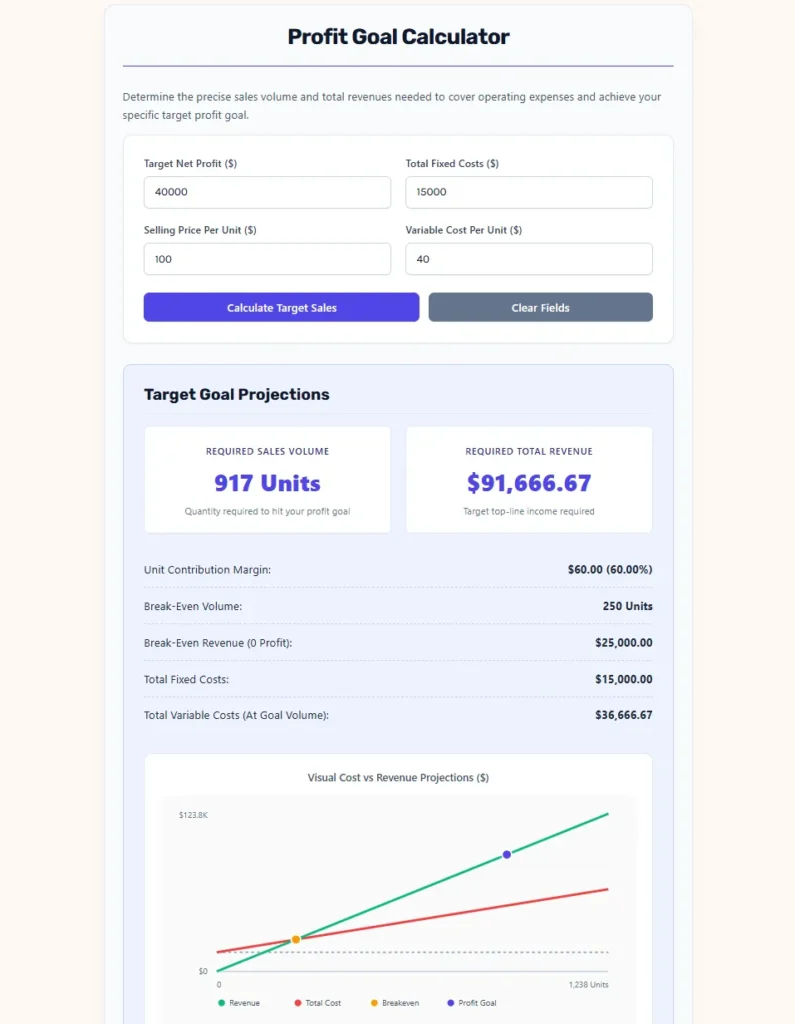
Run Profit Goal Calculator
In this Profit Goal Calculator Determine the precise sales volume and total revenues needed to cover operating expenses and achieve your specific target profit goal.
Profit Goal Equations Explained
Fundamental Business Volume Metrics
Target profit sales mapping uses unit-level contribution dynamics to identify how much sales activity must be generated to satisfy both operational fixed structures and top-line profitability requirements:
Unit Contribution Margin: The share of revenue from each individual item sold that contributes directly to covering fixed operational overhead.
Unit Contribution Margin = Selling Price − Variable Cost
Required Target Sales Volume (Units): Calculates exactly how many individual unit units must be processed to meet both costs and target goals.
Target Sales Units = (Fixed Costs + Target Net Profit) ÷ Unit Contribution Margin
Required Target Sales Revenue ($): The gross top-line commercial sales volume needed to achieve target profit criteria.
Target Revenue = Target Sales Units × Selling Price
Operational Strategies
Actions to Achieve Profit Goals
- Pricing Elasticity: Raising prices increases the unit contribution margin, significantly reducing the target sales volume requirement (assuming overall demand remains relatively constant).
- Overhead Optimization: Reducing fixed operational overhead costs directly reduces the breakeven starting floor, shifting target goals down.
- Unit Variable Efficiency: Streamlining direct supply chains, production labor, or component packaging material costs widens the unit profitability margin.