Pro Network Mask Calculator
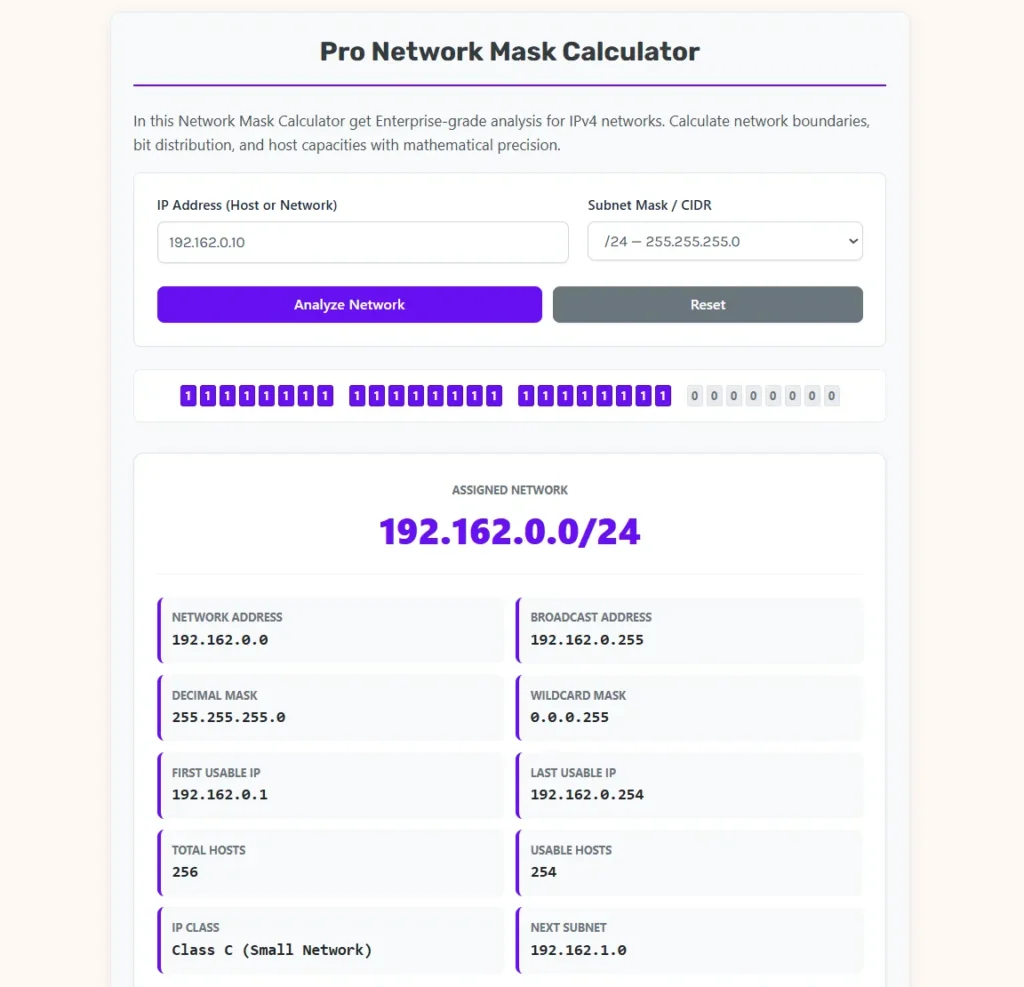
In this Network Mask Calculator get Enterprise-grade analysis for IPv4 networks. Calculate network boundaries, bit distribution, and host capacities with mathematical precision.
Understanding the Logic
Binary Masking: The network address is calculated using a bitwise AND operation between the IP address and the subnet mask.
Host Capacity: The number of addresses in a subnet is calculated by 2(32 – n), where n is the CIDR prefix. To get the usable host count, we subtract 2 (the network and broadcast IDs).
Visualizer: The purple boxes represent “Network Bits” (fixed by the mask), while grey boxes represent “Host Bits” (assignable to devices).
What is the Subnet Mask?
The subnet mask serves as the primary logical filter for the Internet Protocol version 4 (IPv4). While the physical infrastructure of a network consists of routers, switches, and fiber optics, the logical structure is defined entirely by binary masking. A network mask is a 32-bit sequence that determines which portion of an IP address identifies the network and which portion identifies the unique host.
This Pro Network Mask Calculator is a specialized engineering utility. It translates human-readable dotted-decimal IP addresses into their binary counterparts to perform bitwise calculations. By accurately defining the “mask,” network administrators can partition large address spaces into smaller, manageable, and secure segments. This process is the cornerstone of modern network efficiency, security, and traffic management.
The Conceptual Framework of Logical Masking
To understand the results provided by this calculator, one must first grasp the concept of the “mask” itself. Imagine an IP address as a piece of digital information. The subnet mask acts like a physical stencil placed over that information. The “holes” in the stencil (the ones in binary) reveal the network ID, while the “covered” parts (the zeros in binary) represent the space available for individual devices.
This segmentation is not merely an organizational preference; it is a technical necessity. Without subnetting, every device on the internet would reside in a single “flat” network, leading to catastrophic levels of broadcast traffic and total communication failure. Masking localizes traffic, ensuring that a data packet meant for a printer in a specific office does not flood the entire corporate backbone.
The Mathematical Engine: Binary Logic and Bitwise Operations
The calculation of network boundaries relies on bitwise logic. When you enter an IP address and a CIDR prefix into the calculator, the system performs a mathematical process known as “ANDing.” This is the process where the IP address and the mask are compared bit-by-bit to determine the Network Address.
1. The Network Address Formula
The Network Address is the starting point of any subnet. It is derived by comparing each bit of the IP address with the corresponding bit of the subnet mask.
$$N = IP \text{ AND } M$$
Variable Definitions: ➜ $N$: The resulting Network Address. ➜ $IP$: The host IP address in binary format. ➜ $M$: The subnet mask in binary format. ➜ $\text{AND}$: The bitwise operator where a result is $1$ only if both input bits are $1$.
2. The Total Host Capacity Formula
The size of a network is determined by the number of bits remaining in the 32-bit address after the mask has been applied.
$$C = 2^{(32 – n)}$$
Variable Definitions: ➜ $C$: The total number of addresses in the subnet (including network and broadcast). ➜ $n$: The CIDR prefix length (e.g., $24$ for a standard Class C). ➜ $32$: The total bit-length of an IPv4 address.
3. The Usable Host Formula
In a standard network configuration, the first and last addresses are reserved for specific functions. The usable host count represents the actual number of devices that can be assigned an IP.
$$H = 2^{(32 – n)} – 2$$
Variable Definitions: ➜ $H$: The number of usable host addresses available for assignment. ➜ $n$: The CIDR prefix length. ➜ $- 2$: The subtraction of the Network ID (first address) and the Broadcast ID (last address).
Decoding the CIDR Prefix and Decimal Masks
Before the implementation of Classless Inter-Domain Routing (CIDR), network masks were rigid and based on “Classes” (A, B, or C). Modern networking uses the CIDR notation, represented by a forward slash followed by a number ($/n$). This number indicates how many bits are “masked” as the network portion.
| CIDR Prefix | Subnet Mask | Total Addresses | Network Type |
| $/32$ | $255.255.255.255$ | 1 | Host/Loopback |
| $/30$ | $255.255.255.252$ | 4 | Router-to-Router |
| $/28$ | $255.255.255.240$ | 16 | Small Office VLAN |
| $/24$ | $255.255.255.0$ | 256 | Standard Branch |
| $/20$ | $255.255.240.0$ | 4,096 | Data Center Segment |
| $/16$ | $255.255.0.0$ | 65,536 | Corporate Core |
| $/8$ | $255.0.0.0$ | 16,777,216 | ISP/Global Infrastructure |
The Physics of Information Flow: Broadcast and Wildcard Masks
Beyond basic network identification, this calculator provides two critical technical metrics: the Broadcast Address and the Wildcard Mask.
➜ The Broadcast Address
This is the “final” address in a subnet range. It is used to communicate with every device in the subnet simultaneously. In binary terms, it is the Network Address with all host bits set to $1$.
$$B = N \text{ OR } (\text{NOT } M)$$
Variable Definitions:
➜ $B$: The Broadcast Address.
➜ $N$: The Network Address.
➜ $M$: The Subnet Mask.
➜ $\text{OR}$: A bitwise operator where the result is $1$ if either bit is $1$.
➜ $\text{NOT}$: The inversion of bits (turning ones to zeros and vice versa).
➜ The Wildcard Mask
Used extensively in Access Control Lists (ACLs) and OSPF routing protocols, the Wildcard Mask is the mathematical opposite of the Subnet Mask. It indicates which bits of an IP address must match a rule and which bits can be ignored.
$$W = 255.255.255.255 – M$$
Variable Definitions:
➜ $W$: The Wildcard Mask (e.g., $0.0.0.255$).
➜ $M$: The Decimal Subnet Mask.
Strategic Use Cases for Network Masking
Effective masking is the differentiator between a chaotic network and an enterprise-grade infrastructure. Professionals utilize these calculations for several high-stakes scenarios.
➜ Multi-Floor VLAN Segmentation
In a skyscraper office, each floor typically receives its own subnet. An engineer might use this calculator to divide a $/22$ block into four $/24$ segments, ensuring that broadcast traffic from the 10th floor does not affect the performance of the 12th floor.
➜ Internet of Things (IoT) Isolation
IoT devices are often less secure than standard workstations. By calculating a specific $/27$ or $/28$ mask for an IoT VLAN, an administrator can apply strict firewall rules to that specific range, preventing “lateral movement” if a smart device is compromised.
➜ Variable Length Subnet Masking (VLSM)
VLSM is the art of maximizing IP efficiency. Instead of giving every department the same size network, VLSM allows for custom masks. You might assign a $/25$ ($126$ hosts) to the Engineering department while assigning a $/30$ ($2$ hosts) to the link between two distant routers.
The Role of IP Classes in Modern Networking
While CIDR has made classful networking largely obsolete, the “Class” of an IP address still dictates its default behavior and private/public status.
➜ Class A ($1.0.0.0$ to $126.0.0.0$): Designed for massive organizations. The default mask is $/8$, providing over $16$ million addresses.
➜ Class B ($128.0.0.0$ to $191.255.0.0$): Designed for medium to large enterprises. The default mask is $/16$, providing $65,534$ usable hosts.
➜ Class C ($192.0.0.0$ to $223.255.255.0$): Designed for small businesses and home offices. The default mask is $/24$, providing $254$ usable hosts.
Step-by-Step Practical Calculation Example
To demonstrate the precision of the calculator, consider the following technical scenario for a mid-sized network deployment.
Goal: Analyze the IP $172.16.50.100$ with a $/26$ mask.
1. Determine the Subnet Mask
A $/26$ prefix means $26$ network bits. The mask is $255.255.255.192$.
2. Convert to Binary (Partial)
The last octet of the IP is $100$ ($01100100$). The last octet of the mask is $192$ ($11000000$).
3. Perform the AND Operation
$$\text{Result} = 01100100 \text{ AND } 11000000 = 01000000$$
The binary $01000000$ equals $64$. Therefore, the network address is $172.16.50.64$.
4. Identify the Range
➜ Network Address: $172.16.50.64$.
➜ First Usable: $172.16.50.65$.
➜ Last Usable: $172.16.50.126$.
➜ Broadcast Address: $172.16.50.127$.
Glossary of Technical Networking Terms
➜ CIDR (Classless Inter-Domain Routing): The modern standard for IP allocation that allows for flexible network sizes rather than rigid classes.
➜ Default Gateway: The IP address of the router interface that acts as the exit point for traffic leaving the local subnet.
➜ Hops: The number of routers a packet passes through on its way from source to destination.
➜ Loopback: The address $127.0.0.1$, used for testing the network software on a local machine without sending data across a physical network.
➜ Public IP: An address that is globally unique and routable on the public internet.
➜ Private IP: Addresses reserved for internal networks (e.g., $10.x.x.x, 192.168.x.x$) that cannot be reached directly from the internet.
➜ VLAN (Virtual Local Area Network): A logical sub-network created on a physical switch to group devices regardless of their physical location.
Best Practices for Enterprise Network Design
To ensure the longevity and stability of your network, adhere to these professional guidelines when utilizing the mask calculator:
- Account for Scalability: Never size a subnet exactly to your current number of hosts. Always leave at least $20\%$ to $30\%$ overhead for new devices and guests.
- Utilize Standard Boundaries: While it is mathematically possible to use a $/23$ mask, using standard $/24$ boundaries often makes documentation and troubleshooting more intuitive for human operators.
- Document Every Prefix: Maintain a master spreadsheet of every subnet mask and CIDR prefix in your environment to prevent address overlapping.
- Prioritize Private Ranges: For internal corporate traffic, always use the RFC 1918 private address spaces to conserve public IPv4 addresses and add an extra layer of security.
- Consider Management VLANs: Keep your network hardware (routers, switches, APs) on a separate subnet with its own unique mask, isolated from standard user traffic.
Scientific Reference and Official Standards
The mathematical models and binary logic utilized in this calculator are derived from the official standards set by the Internet Engineering Task Force (IETF).
Relevance: RFC 1519 is the definitive document that established the CIDR architecture. It provides the rigorous scientific foundation for how subnet masks are calculated and how routing tables aggregate data. By following the standards in RFC 1519, this tool ensures that the generated masks and ranges are fully compatible with enterprise hardware from manufacturers like Cisco, Juniper, and Palo Alto Networks.
Download HANDBOOK
The full guide of network mask can be downloaded here.
Final Summary Checklist for Network Administrators
Before applying a new network mask to your production environment, verify the following:
➜ Does the usable host count meet the requirements for both current devices and planned expansion?
➜ Is the network address unique within your internal routing table to avoid overlapping?
➜ Have you correctly identified the Default Gateway within the usable host range?
➜ Is the Wildcard Mask calculated for use in your firewall security policies?
➜ Have you used the bit visualizer to confirm the distribution between network and host bits?
By applying these mathematical frameworks and strategic principles, you transform a simple set of IP addresses into a high-performance, secure, and logically structured communications architecture. Precision in network masking is the primary defense against internal congestion and external vulnerability.
network mask video
If you want to know what and how calculate network mask, then watch this video below: