Run Greenhouse Heater Calculator
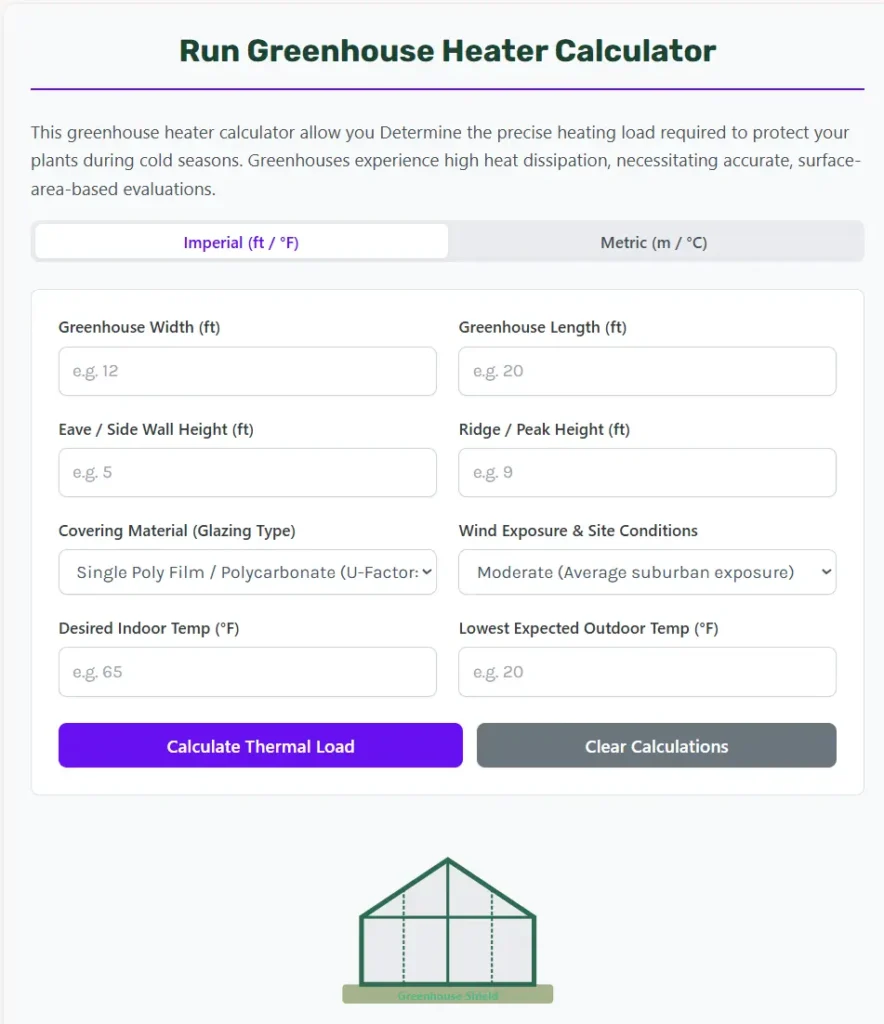
This greenhouse heater calculator allow you Determine the precise heating load required to protect your plants during cold seasons. Greenhouses experience high heat dissipation, necessitating accurate, surface-area-based evaluations.
Greenhouse Thermal Dynamics
Heat Loss Formula
Unlike conventional structures where heat loss is volume-dependent, greenhouse heat loss occurs primarily through conduction across its highly-transmissive glazing surface area:
H = A × ΔT × U × W
- H: Required Heat Output in BTU/hr
- A: Total exterior surface area (sides, ends, and roof combined) in square feet
- ΔT: Temperature Difference (Target Indoor Temp − Minimum Outdoor Temp)
- U: The Heat Loss Coefficient (U-factor) of your glazing material
- W: Wind and site exposure correction multiplier
Electrical Conversion
If you choose to heat using electric heaters, convert thermal BTUs to electrical Kilowatts:
kW = BTU / 3412.14
Expert Cold-Protection Tips
- Thermal Blankets: Pulling horizontal energy curtains at eave-level overnight can reduce your structural heating load by up to 35% by trapping air.
- Circulation (HAF) Fans: Keep horizontal air flow fans running to prevent cold microclimates near ground level and avoid stale heat pockets in the peak.
- Soil Warmth: Consider under-bench root zone heating. Keeping root zones warm allows you to safely maintain ambient air temperatures several degrees lower.
Understand Greenhouse Heater Sizing
Cultivating crops within a controlled environment is one of the most significant achievements of modern agricultural engineering. By utilizing a transparent or translucent envelope, growers can capture solar radiation, shield plants from adverse weather, and extend the natural production season. However, this architectural design introduces a unique thermodynamic challenge. The highly transmissive materials required to let light inside—such as glass, polyethylene film, and polycarbonate structured panels—are also highly efficient conductors of heat.
During the winter months or cold nights, a greenhouse acts as a massive thermal radiator, rapidly dissipating heat energy into the surrounding atmosphere. Maintaining the delicate physiological balance required for plant survival demands a reliable, mathematically optimized heating system.
This greenhouse heater calculator serves as a professional engineering tool to quantify this thermal dissipation. By translating the complex three-dimensional geometry of a gable-style greenhouse, the insulative qualities of various glazing materials, and regional wind exposure into a precise thermal load, the tool replaces agricultural guesswork with rigorous thermodynamic metrics.
Why Greenhouse Sizing Protocols Differ From Conventional Buildings
To understand the calculations performed by this tool, one must first recognize why standard residential or commercial HVAC (Heating, Ventilation, and Air Conditioning) guidelines do not apply to protected agricultural structures.
➜ Surface Area Over Volume
In a standard residential home, heat loss calculations are heavily dependent on the total volume of the air inside the structure, as the building envelope consists of dense, well-insulated materials with high R-values (thermal resistance). In contrast, a greenhouse consists almost entirely of a thin, highly transmissive boundary layer. The primary mechanism of heat loss in a greenhouse is conductive transfer across this transparent skin. Consequently, the total external surface area of the glazing—not the internal volume of the air—is the dominant variable governing thermal demand.
➜ Sol-Air Temperature and Nocturnal Cooling
During daylight hours, a greenhouse acts as a natural solar collector. Solar radiation passes through the glazing and is absorbed by the soil, benches, plants, and structural elements, warming the interior. However, as the sun sets, this process reverses. Greenhouses experience rapid radiant cooling, often dropping to temperatures below the ambient outdoor air due to clear-sky radiation. This makes a precise nighttime heat loss calculation the critical baseline for equipment sizing, as night is when the thermal load reaches its absolute peak.
The Geometric Foundation: Calculating Exposed Surface Area
Before calculating heat loss, the physical surface area of the structure must be determined with extreme precision. This calculator focuses on the classic “Gable-style” greenhouse, which consists of a rectangular footprint with vertical sidewalls and a double-sloping triangular roof.
The total external surface area ($A_{total}$) is the sum of the combined end walls, side walls, and sloping roof sections.
1. Combined Gable End Walls ($A_{end}$)
The two vertical end walls are identical. Each consists of a lower rectangular section and an upper triangular gable peak.$$A_{end} = 2 \times \left( (W \times H_{e}) + \frac{W \times (H_{r} – H_{e})}{2} \right)$$
Variable Definitions:
➜ $A_{end}$: The combined surface area of both end walls in square feet ($ft^2$) or square meters ($m^2$).
➜ $W$: The width of the greenhouse footprint.
➜ $H_{e}$: The vertical height of the eave (side wall) from the foundation.
➜ $H_{r}$: The vertical height of the ridge (highest peak) from the foundation.
Note on Simplification: The formula mathematically simplifies to:$$A_{end} = W \times (H_{e} + H_{r})$$
2. Combined Side Walls ($A_{side}$)
The side walls are simple rectangles running the length of the structure.$$A_{side} = 2 \times L \times H_{e}$$
Variable Definitions:
➜ $A_{side}$: The combined surface area of both vertical side walls.
➜ $L$: The horizontal length of the greenhouse.
➜ $H_{e}$: The vertical eave height.
3. Combined Sloping Roof Planes ($A_{roof}$)
Calculating the surface area of the roof requires determining the length of the sloping rafters (the hypotenuse of the triangle formed by the ridge height, eave height, and half-width of the structure).
First, the sloping roof run ($S_{r}$) is calculated:$$S_{r} = \sqrt{\left(\frac{W}{2}\right)^2 + (H_{r} – H_{e})^2}$$
Variable Definitions:
➜ $S_{r}$: The actual length of the sloping roof rafter.
➜ $W$: The total width of the greenhouse.
➜ $H_{r}$: The ridge height.
➜ $H_{e}$: The eave height.
Using the sloping run, the total roof surface area is computed:$$A_{roof} = 2 \times L \times S_{r}$$
Variable Definitions:
➜ $A_{roof}$: The combined surface area of both sloping roof planes.
➜ $L$: The horizontal length of the structure.
➜ $S_{r}$: The sloping roof run calculated above.
4. Total Structural Surface Area ($A_{total}$)
The unified surface area exposed to heat dissipation is the sum of these three values:$$A_{total} = A_{end} + A_{side} + A_{roof}$$
Floor area is completely ignored in this equation, as the ground below is a heat sink that operates under different thermal dynamics and does not contribute to convective atmospheric heat dissipation.
The Thermodynamic Sizing Equation: Calculating Conductive Heat Loss
Once the total exposed surface area is established, the tool applies the fundamental engineering formula for steady-state conductive heat transfer.$$Q = A_{total} \times \Delta T \times U \times W_{e} \times B_{s}$$
Variable Definitions:
➜ $Q$: The total required heat output of the system in British Thermal Units per hour ($BTU/hr$).
➜ $A_{total}$: The total structural surface area in square feet.
➜ $\Delta T$: The temperature difference between the interior and exterior environments.
➜ $U$: The heat loss coefficient ($U$-factor) of the chosen glazing.
➜ $W_{e}$: The wind and site exposure multiplier.
➜ $B_{s}$: The safety buffer for infiltration drafts (constant value of $1.10$, representing a $10\%$ margin).
Defining the Temperature Delta ($\Delta T$)
The temperature difference represents the maximum thermal lift the heating system must achieve during the coldest period of the year.$$\Delta T = T_{target} – T_{outdoor\_low}$$
Variable Definitions:
➜ $\Delta T$: The temperature difference in degrees Fahrenheit ($^{\circ}F$) or Celsius ($^{\circ}C$).
➜ $T_{target}$: The minimum survival or growth temperature required for the specific crop being cultivated.
➜ $T_{outdoor\_low}$: The lowest expected regional outdoor design temperature, typically sourced from local climate data or historical winter averages.
Glazing Material Science: The Physics of U-Factors
The $U$-factor (heat loss coefficient) is the mathematical representation of how easily thermal energy travels through a specific material. It is the reciprocal of the $R$-value ($U = 1/R$). A lower $U$-factor indicates superior insulative properties, meaning less heat escapes.
In a greenhouse, the choice of glazing directly determines the continuous operating cost of the facility.
| Glazing Material Type | U-Factor (Imperial) | U-Factor (Metric) | Relative Heat Loss Rate |
| Single-Layer Glass | $1.13$ | $6.41$ | Very High |
| Single Polyethylene / Polycarbonate Film | $1.15$ | $6.53$ | Extreme |
| Double Polyethylene Film (Air-Inflated) | $0.70$ | $3.97$ | Moderate |
| Double Glass / 8mm Twin-Wall Polycarbonate | $0.62$ | $3.52$ | Low |
| Triple-Wall Polycarbonate Sheet | $0.45$ | $2.55$ | Very Low |
The Physics of Air Gaps and Double Layering
Notice the significant performance increase between single-layer polyethylene ($U = 1.15$) and double-layer polyethylene ($U = 0.70$). This drop in heat loss is not due to the plastic itself, but due to the thin boundary layer of dead air trapped between the two sheets. Air is an exceptionally poor conductor of heat when kept stationary. In double-layer systems, a small fan inflates the space between the sheets, creating a quiet, highly insulating air mattress over the entire structure.
Wind Exposure and Air Infiltration Multipliers
Calculating conductive heat loss under lab conditions is insufficient for real-world applications. Greenhouses are exposed to atmospheric currents that accelerate convective cooling.
➜ The Wind Exposure Multiplier ($W_{e}$)
As wind blows across the smooth surface of a greenhouse, it strips away the microscopic boundary layer of warm air clinging to the outer glazing. This dramatically increases the temperature gradient at the surface, speeding up heat transfer.$$W_{e} = [1.00 \text{ to } 1.25]$$
➜ Sheltered ($1.00$): Structures heavily surrounded by mature windbreaks, dense forests, or adjacent commercial buildings.
➜ Moderate ($1.10$): Typical suburban locations with average exposure to seasonal winds.
➜ Exposed ($1.25$): Open plains, hilltop sites, or coastal zones subjected to severe, unobstructed winter winds.
➜ The Draft and Infiltration Factor ($B_{s}$)
Greenhouses are not hermetically sealed. Gaps between glazing panels, overlapping film seams, and around ventilation fans allow cold outdoor air to leak inside. The calculator integrates an industry-standard safety buffer ($B_{s} = 1.10$) to account for this natural air exchange, adding $10\%$ to the conductive total to guarantee the heater can handle cold draft infiltration.
Electrical Equivalent Conversions
For growers implementing modern electric heating systems, the raw thermal BTU requirement must be converted into electrical power units (kilowatts) to allow for electrical service sizing.$$P_{kW} = \frac{Q}{3412.14}$$
Variable Definitions:
➜ $P_{kW}$: The equivalent electrical power requirement in kilowatts ($kW$).
➜ $Q$: The calculated thermal heating requirement in $BTU/hr$.
➜ $3412.14$: The thermal-to-electrical constant representing the number of BTUs produced by one kilowatt-hour of electric resistance heat.
For metric operations, the thermal load can also be expressed in kilocalories per hour ($kcal/hr$), representing the metric standard for heat energy.$$Q_{kcal} = Q_{BTU} \times 0.252$$
Variable Definitions:
➜ $Q_{kcal}$: The metric thermal energy requirement in kilocalories per hour ($kcal/hr$).
➜ $Q_{BTU}$: The calculated thermal requirement in $BTU/hr$.
➜ $0.252$: The physical conversion constant between BTUs and kilocalories.
Comparative Practical Sizing Scenarios
To illustrate the mathematical sensitivity of these formulas, let us examine two contrasting scenarios, each featuring a greenhouse of identical floor dimensions ($12 \times 20$ feet) under different configurations.
Scenario A: The High-Efficiency Suburban Hobbyist
- Dimensions: Width = $12 \text{ ft}$, Length = $20 \text{ ft}$, Eave Height = $5 \text{ ft}$, Ridge Height = $9 \text{ ft}$.
- Glazing: Double Glass / 8mm Twin-Wall ($U = 0.62$).
- Exposure: Moderate ($1.1$).
- Target Interior Temp: $65^{\circ}F$.
- Minimum Outdoor Temp: $20^{\circ}F$ ($\Delta T = 45^{\circ}F$).
Calculation Steps:
- Surface Area Calculation:
- $A_{end} = 12 \times (5 + 9) = 168 \text{ sq ft}$
- $A_{side} = 2 \times 20 \times 5 = 200 \text{ sq ft}$
- $halfWidth = 6 \text{ ft}$, $ridgeDifference = 4 \text{ ft}$
- $S_{r} = \sqrt{6^2 + 4^2} = \sqrt{52} \approx 7.21 \text{ ft}$
- $A_{roof} = 2 \times 20 \times 7.21 = 288.4 \text{ sq ft}$
- $A_{total} = 168 + 200 + 288.4 \approx 656 \text{ sq ft}$
- $A_{end} = 12 \times (5 + 9) = 168 \text{ sq ft}$
- Heat Load Calculation:
- $Q_{base} = 656 \times 45 \times 0.62 \times 1.1 \approx 20,136 \text{ BTU/hr}$
- $Q_{final} = 20,136 \times 1.10 \text{ (Draft Safety)} = 22,150 \text{ BTU/hr}$
- $Q_{base} = 656 \times 45 \times 0.62 \times 1.1 \approx 20,136 \text{ BTU/hr}$
- Electrical Conversion:
- $P_{kW} = 22,150 / 3412.14 \approx 6.49 \text{ kW}$
- $P_{kW} = 22,150 / 3412.14 \approx 6.49 \text{ kW}$
Scenario B: The Exposed Single-Poly Commercial Nursery
- Dimensions: Width = $12 \text{ ft}$, Length = $20 \text{ ft}$, Eave Height = $5 \text{ ft}$, Ridge Height = $9 \text{ ft}$ (Identical footprint).
- Glazing: Single Poly Film ($U = 1.15$).
- Exposure: Exposed Open Plains ($1.25$).
- Target Interior Temp: $65^{\circ}F$.
- Minimum Outdoor Temp: $20^{\circ}F$ ($\Delta T = 45^{\circ}F$).
Calculation Steps:
- Surface Area Calculation:
- $A_{total} \approx 656 \text{ sq ft}$ (Identical geometry).
- Heat Load Calculation:
- $Q_{base} = 656 \times 45 \times 1.15 \times 1.25 \approx 42,444 \text{ BTU/hr}$
- $Q_{final} = 42,444 \times 1.10 \text{ (Draft Safety)} = 46,688 \text{ BTU/hr}$
- $Q_{base} = 656 \times 45 \times 1.15 \times 1.25 \approx 42,444 \text{ BTU/hr}$
- Electrical Conversion:
- $P_{kW} = 46,688 / 3412.14 \approx 13.68 \text{ kW}$
- $P_{kW} = 46,688 / 3412.14 \approx 13.68 \text{ kW}$
Analysis of Scenarios:
Notice that simply by changing the glazing material and leaving the structure exposed to wind, the required heater capacity more than doubled (from $22,150 \text{ BTU/hr}$ to $46,688 \text{ BTU/hr}$). This highlights why selecting the correct parameters in the calculator is crucial for preventing system under-sizing.
Architectural Best Practices for Energy Conservation
To lower your calculated BTU requirement and save on seasonal fuel bills, consider implementing these professional heat-retention strategies.
- Implement Thermal Curtains: Pulling horizontal aluminized fabrics across the eave-line at night traps warm air near the crop zone, reducing the effective volume of space that must be heated and cutting nighttime fuel costs by up to $30\%$.
- Insulate North Walls: The north wall of a greenhouse receives negligible direct sunlight in the northern hemisphere. Covering the north wall with solid, insulated foam boards instead of transparent glazing drastically lowers structural heat loss without sacrificing light.
- Maintain Horizontal Air Flow (HAF): Keep small circulation fans running continuously. This gentle air movement prevents thermal stratification (heat pooling at the ridge) and ensures warmth is delivered evenly to the plant canopy.
- Apply Base Wall Insulation: Install insulated boards around the bottom perimeter (knee-wall) of the greenhouse. This prevents heat loss near the soil line where plant roots are located.
Scientific Reference and Official Standards
The mathematical models and glazing heat transfer coefficients utilized in this calculator are derived from the official standards set by the leading global authorities on agricultural engineering.
Relevance: This engineering standard dictates the equations for greenhouse surface area calculations, the accepted $U$-factors for commercial glazing, and the wind and draft factors used by professional engineers to design commercial horticultural operations. By aligning with ASABE EP406.4, this calculator ensures that your sizing recommendations are mathematically robust and compliant with modern agricultural engineering protocols.
Final Summary Checklist for Growers
Before purchasing or installing your new greenhouse heating system, verify your parameters against this checklist:
✓ Is the ridge height measured precisely from the soil to the highest peak?
✓ Did you select the lowest expected outdoor design temperature, rather than the average winter temperature, to ensure winter protection?
✓ Have you matched your glazing type precisely to the manufacturer specification sheet?
✓ Is the heater capacity positioned in an area with sufficient horizontal airflow to distribute heat evenly?
✓ Have you checked local building and electrical codes to ensure your service panel can handle the calculated kilowatt load?
By applying these mathematical principles and strategic insights in our greenhouse heater calculator, you transform your greenhouse into a controlled, highly efficient biological haven capable of sustaining vibrant plant life through the most challenging winter climates.