Run Daily Habit Tracker
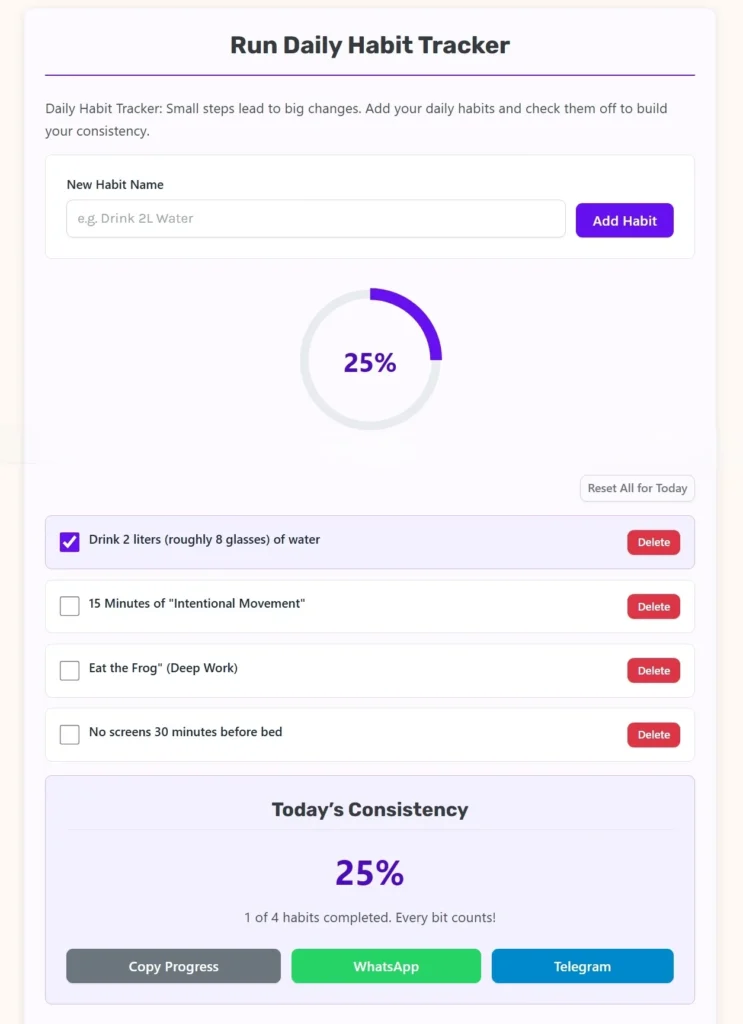
Daily Habit Tracker: Small steps lead to big changes. Add your daily habits and check them off to build your consistency.
The Power of Consistency
Why Track Habits?
Tracking provides immediate visual proof of your progress. It reinforces your identity as someone who follows through. In mathematics, growth can be modeled as:
Result = (1 + Consistency)Time
Improving by just 1% every day results in being 37 times better by the end of the year.
The interactive Daily Habit Tracker provided is more than a simple checklist. It is a behavioral ledger designed to leverage the psychological principles of visual reinforcement and incremental progress. By transforming abstract goals into a quantifiable consistency rate, this application bridges the gap between intention and action.
The following guide provides a comprehensive analysis of habit formation, the mathematical models of consistency, and the strategic implementation of tracking to achieve long-term neurological change.
Mastering the Daily Habit Tracker
In the domain of behavioral psychology, a habit is a redundant set of automatic, unconscious thoughts, behaviors, and emotions that are acquired through repetition. The Daily Habit Tracker serves as a precision instrument to monitor this acquisition process. By utilizing a digital interface to record daily actions, individuals can move from a state of mindless routine to a state of deliberate practice.
This tool functions as a feedback loop. Every time a habit is checked off, the brain receives a visual cue of success, which triggers a localized release of dopamine. This neurotransmitter is the currency of motivation, reinforcing the neural pathways associated with that specific behavior. Over time, these pathways become more robust, eventually reaching a threshold where the behavior requires less cognitive energy to initiate. This is the biological definition of “autopilot.”
The Concept Behind Behavioral Tracking
The primary philosophy of the tracker is the “Seinfeld Strategy,” also known as “don’t break the chain.” The objective is to build a visual representation of consistency so compelling that the psychological cost of breaking the streak exceeds the physical effort required to perform the habit.
The Daily Habit Tracker addresses the “intention-behavior gap.” Most people fail to reach their goals not because they lack the desire, but because they lack a reliable system to manage their focus. This tool provides that system by externalizing your willpower. Instead of relying on how you feel in the moment, you rely on the commitment displayed on your screen.
The Mathematical Framework of Consistency
To understand the profound impact of daily habits, one must look at the mathematics of compounding. Growth is rarely linear; it is exponential. While the results of a single day of effort are often invisible, the cumulative effect over time is transformative.
1. The Compounding Growth Formula
The power of improving by just $1\%$ every day is modeled by the standard compound interest equation. If you improve $1\%$ daily, you do not simply end up $365\%$ better at the end of a year. You end up nearly $38$ times better.
$$V_{f} = V_{i} \times (1 + r)^{t}$$
Variable Definitions:
➜ $V_{f}$: The final value or level of proficiency achieved.
➜ $V_{i}$: The initial starting point or current level of performance.
➜ $r$: The daily rate of improvement (expressed as a decimal, e.g., $0.01$).
➜ $t$: The time elapsed in days (typically $365$ for a yearly cycle).
If we set $r = 0.01$ and $t = 365$, the result is $(1.01)^{365} \approx 37.78$. Conversely, if you decline by $1\%$ every day, your proficiency drops to almost zero: $(0.99)^{365} \approx 0.03$.
2. The Consistency Rate Calculation
This Daily Habit Tracker determines your daily success using a simple ratio. This percentage is your “Consistency Score,” a real-time reflection of your reliability for the current $24$-hour period.
$$C = \frac{H_{c}}{H_{t}} \times 100$$
Variable Definitions:
➜ $C$: The consistency rate expressed as a percentage.
➜ $H_{c}$: The number of habits successfully completed.
➜ $H_{t}$: The total number of habits in your active list.
Understanding the Neurological Feedback Loop
Every habit consists of a four-stage loop: Cue, Craving, Response, and Reward. The Daily Habit Tracker intervenes at the “Reward” stage.
➜ Cue: A trigger that tells your brain to go into automatic mode.
➜ Craving: The motivational force behind every habit.
➜ Response: The actual behavior or thought you perform.
➜ Reward: The end goal of every habit that satisfies your craving.
By using the tracker, you create a secondary reward system. The act of clicking the checkbox becomes a mini-reward that satisfies the craving for progress. This reinforces the “Response” and makes the “Cue” more visible the following day.
Strategic Use Cases for Habit Tracking
The versatility of the tracker allows it to be applied to diverse areas of life, from professional optimization to physical health and cognitive development.
➜ Physical Health and Vitality
Tracking inputs like water consumption, daily steps, or sleep hygiene ensures that the foundational pillars of health are not neglected.
➜ Example: A habit named “Consume $64$ oz of water” provides a clear binary success metric.
➜ Cognitive and Professional Growth
Deep work, skill acquisition, and reading require sustained focus.
➜ Example: A habit named “Write $500$ words of code” ensures that creative output remains consistent regardless of inspiration.
➜ Mental Well-being and Mindfulness
Habits such as meditation or gratitude journaling are easily skipped during stressful periods. The tracker acts as an anchor, bringing the individual back to these stabilizing practices.
The Science of “Habit Stacking”
One of the most effective ways to use this Daily Habit Tracker is in conjunction with the principle of “Habit Stacking.” This technique involves pairing a new habit with an existing one. The mathematical model for this is a sequence of dependent events.
$$A_{target} = A_{anchor} + H_{new}$$
Variable Definitions:
➜ $A_{target}$: The resulting behavioral cluster.
➜ $A_{anchor}$: An established habit that is already automatic (e.g., brushing teeth).
➜ $H_{new}$: The new habit you wish to acquire.
By adding these “stacks” to your tracker, you create a path of least resistance for your brain to follow.
Best Practices for Habit Implementation
To maximize the effectiveness of the Daily Habit Tracker, consider the following strategic guidelines:
- Start Small: The common mistake is adding $10$ complex habits at once. Start with two or three “keystone” habits that are so easy you cannot say no to them.
- Focus on the Identity, Not the Goal: Instead of tracking “Run $5$ miles,” track “Put on my running shoes.” The goal is to become the type of person who never misses a workout, rather than just hitting a specific mileage once.
- Never Miss Twice: Life is unpredictable. If you miss a day, your primary objective the next day is to ensure you do not miss again. Missing once is an accident; missing twice is the start of a new habit.
- Use Implementation Intentions: Be specific. Instead of “Exercise,” use “Exercise for $20$ minutes in the living room at $7:00$ AM.”
- Review and Prune: Every month, evaluate your list. If a habit has become truly automatic (meaning you would feel strange NOT doing it), you can remove it from the tracker to make room for a new challenge.
Advanced Behavioral Insights: The Plateau of Latent Potential
Many users become frustrated when they track habits for weeks without seeing significant physical changes. This is known as the “Plateau of Latent Potential.” In the early stages of any habit, the results are often delayed.
$$R(t) = \int_{0}^{t} E(x) dx$$
Variable Definitions:
➜ $R(t)$: Cumulative results over time.
➜ $E(x)$: The effort exerted at any given point.
➜ $dx$: The incremental passage of time.
This integral shows that results are the sum of all previous efforts. The tracker is essential during this “dark period” because it proves that you are still putting in the work, even if the results have not yet manifested.
Glossary of Behavioral Terms
➜ Keystone Habit: A behavior that leads to a cascade of other positive habits (e.g., exercise often leads to better eating and sleep).
➜ Friction: The physical or psychological barrier to performing a habit. Decreasing friction (e.g., setting out workout clothes) increases success.
➜ Binary Success: A habit that is either done or not done, leaving no room for “partial” credit which can lead to self-deception.
➜ Implementation Intention: A plan you make beforehand about when and where to act.
➜ Dopamine Loop: The cycle of seeking and receiving rewards that drives human motivation.
Scientific Reference and Empirical Evidence
The methodology of the Daily Habit Tracker is supported by extensive research in the field of health psychology and behavioral science.
Relevance: This landmark study conducted at University College London examined the time it takes for a behavior to reach “automaticity.” The research found that it takes, on average, $66$ days for a new habit to become automatic, though this varies from $18$ to $254$ days depending on the complexity. The study highlights the necessity of consistent daily tracking to bridge the gap between initial effort and eventual automaticity.
Final Summary Checklist for Users
Before you commit to your new list of habits, verify the following:
➜ Are these habits truly important to your long-term identity?
➜ Have you reduced the friction for each habit to its absolute minimum?
➜ Is your list small enough that you can realistically achieve a $100\%$ consistency rate today?
➜ Have you defined the exact time and place for each activity?
➜ Are you prepared to “never miss twice” if a day does not go as planned?
By applying these mathematical standards and psychological frameworks, you transform a simple digital checklist into a powerful engine for personal evolution. Consistency is the foundation upon which all great achievements are built. Use this Daily Habit Tracker not just to track what you do, but to define who you are becoming.