Run Celsius to Fahrenheit Converter
Celsius to Fahrenheit Converter: Convert °C to °F or °F to °C instantly with the exact formula, step-by-step working, and the equivalent temperature in kelvin.
Temperature Conversion Math Explained
Two Different Scales
Water freezes at 0 °C and 32 °F, and boils at 100 °C and 212 °F at standard pressure. That 100-degree Celsius range equals 180 Fahrenheit degrees, so each Celsius degree is 1.8 Fahrenheit degrees.
°F = (°C × 1.8) + 32
°C = (°F − 32) ÷ 1.8
K = °C + 273.15
Quick Check
The two scales meet at −40, where −40 °C equals −40 °F.
How Do You Convert Celsius to Fahrenheit?
A Celsius to Fahrenheit converter changes a temperature from degrees Celsius (°C) to degrees Fahrenheit (°F), or the reverse. The conversion uses one exact formula: multiply the Celsius value by 1.8 and add 32.
Celsius is used for weather, cooking, and science in most of the world, while Fahrenheit remains the everyday scale in the United States. Recipes, oven settings, weather forecasts, medical thermometers, and technical documents often need to be converted between the two.
This converter works in both directions, shows the formula and the arithmetic, and also gives the equivalent temperature in kelvin, the SI unit of temperature.
Below you will find the formulas, conversion tables for weather, body temperature, and cooking, and quick mental-math shortcuts.
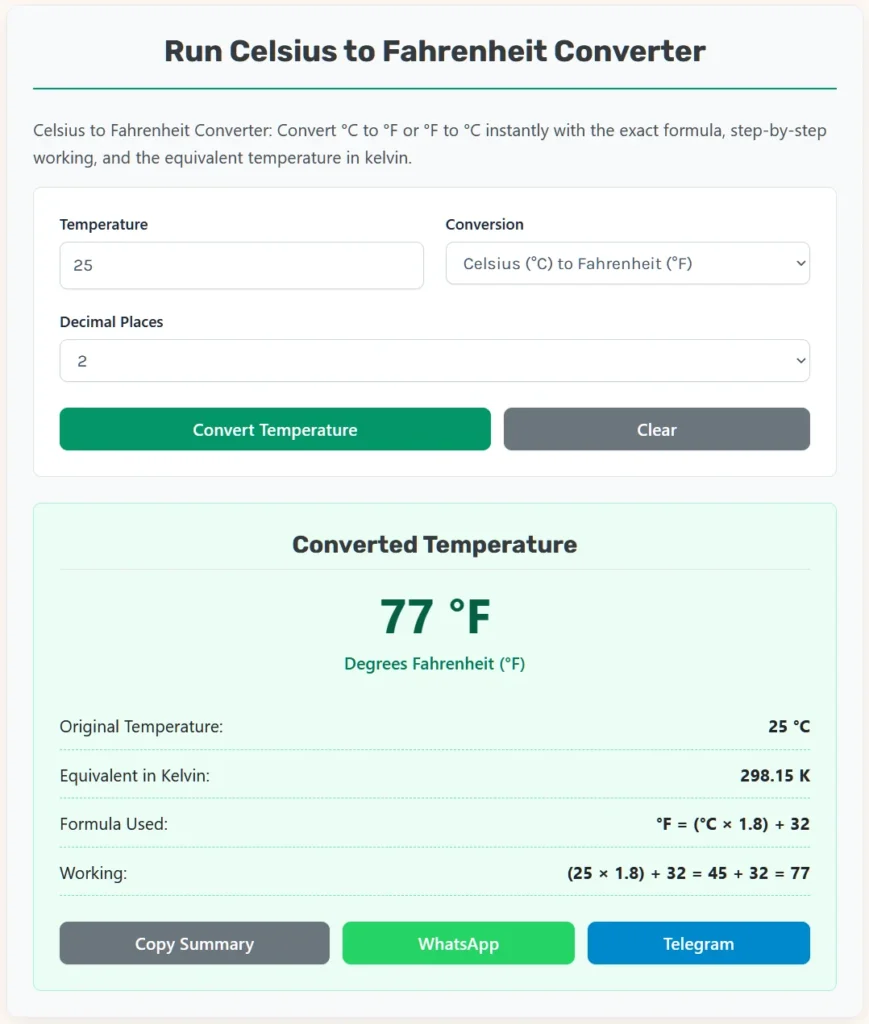
The Celsius to Fahrenheit Formula
°F = (°C × 1.8) + 32
The same formula is often written with a fraction:
°F = (°C × 9/5) + 32
The two forms are identical because 9 ÷ 5 = 1.8. The National Institute of Standards and Technology (NIST) lists this as the exact conversion between the two scales.
The Fahrenheit to Celsius Formula
°C = (°F − 32) ÷ 1.8
°C = (°F − 32) × 5/9
Notice the order of operations. When converting to Fahrenheit, you multiply first and add 32 second. When converting to Celsius, you subtract 32 first and divide second.
Why the Formula Has Both × 1.8 and + 32
The two scales differ in two ways: the size of each degree and the position of zero.
- Degree size: Between the freezing and boiling points of water there are 100 Celsius degrees but 180 Fahrenheit degrees. Each Celsius degree is therefore 180 ÷ 100 = 1.8 Fahrenheit degrees.
- Zero point: Water freezes at 0 °C but at 32 °F, so the Fahrenheit value is offset by 32.
Because of the offset, temperature conversion is not a simple multiplication like converting meters to feet. A temperature difference, however, converts with the factor alone: a change of 10 °C is a change of 18 °F.
How Does the Converter Work?
- Choose a direction: Celsius to Fahrenheit or Fahrenheit to Celsius.
- Check the input: Values below absolute zero (−273.15 °C or −459.67 °F) are rejected because they are physically impossible.
- Apply the formula: The calculator multiplies and adds, or subtracts and divides, in the correct order.
- Show the working: Each step of the arithmetic is displayed.
- Convert to kelvin: K = °C + 273.15.
Celsius to Fahrenheit Example: 25 °C
Step 1: Multiply by 1.8
25 × 1.8 = 45
Step 2: Add 32
45 + 32 = 77 °F
25 °C, a warm room or a pleasant spring day, equals 77 °F.
Fahrenheit to Celsius Example: 350 °F
350 °F is a common oven temperature in American recipes.
Step 1: Subtract 32
350 − 32 = 318
Step 2: Divide by 1.8
318 ÷ 1.8 ≈ 176.67 °C
Many recipes round this to 175 °C or 180 °C.
Example: Body Temperature
37 × 1.8 + 32 = 66.6 + 32 = 98.6 °F
The familiar 98.6 °F is simply 37 °C converted. Normal body temperature varies between individuals and through the day, so 37 °C is a typical reference value rather than an exact standard.
Example: Where Celsius Equals Fahrenheit
The two scales give the same number at one temperature. Setting °F = °C in the formula:
x = 1.8x + 32 → −0.8x = 32 → x = −40
So −40 °C equals −40 °F. This is a handy check: if your conversion of −40 does not return −40, the formula has been applied incorrectly.
Celsius to Fahrenheit Conversion Table
| Celsius | Fahrenheit | Reference |
|---|---|---|
| −40 °C | −40 °F | Scales are equal |
| −18 °C | −0.4 °F | Typical freezer |
| 0 °C | 32 °F | Water freezes |
| 10 °C | 50 °F | Cool day |
| 20 °C | 68 °F | Room temperature |
| 25 °C | 77 °F | Warm room |
| 30 °C | 86 °F | Hot day |
| 37 °C | 98.6 °F | Typical body temperature |
| 40 °C | 104 °F | Very hot day |
| 100 °C | 212 °F | Water boils at sea level |
| 180 °C | 356 °F | Moderate oven |
| 200 °C | 392 °F | Hot oven |
| 220 °C | 428 °F | Very hot oven |
Oven Temperature Conversion Table
| Fahrenheit | Exact Celsius | Common Recipe Value |
|---|---|---|
| 325 °F | 162.78 °C | 160–165 °C |
| 350 °F | 176.67 °C | 175–180 °C |
| 375 °F | 190.56 °C | 190 °C |
| 400 °F | 204.44 °C | 200–205 °C |
| 425 °F | 218.33 °C | 220 °C |
| 450 °F | 232.22 °C | 230 °C |
Fan (convection) ovens are often set about 20 °C lower than conventional ovens. Follow your oven manufacturer’s guidance.
Quick Mental Math Shortcuts
Celsius to Fahrenheit: Double and Add 30
Doubling the Celsius value and adding 30 gives a fast estimate. For 20 °C: 20 × 2 + 30 = 70 °F, close to the exact 68 °F. The estimate drifts further from the exact value at very high or very low temperatures.
Fahrenheit to Celsius: Subtract 30 and Halve
For 80 °F: (80 − 30) ÷ 2 = 25 °C. The exact answer is 26.67 °C.
Use the shortcuts for weather and casual conversation, and the exact formula for cooking, science, and medicine.
Kelvin: The Scientific Temperature Scale
The kelvin (K) is the SI base unit of temperature. It uses the same degree size as Celsius but starts at absolute zero, the lowest possible temperature.
K = °C + 273.15
K = (°F + 459.67) ÷ 1.8
Room temperature of 20 °C is 293.15 K. The converter displays the kelvin equivalent of every result.
Converting Temperature Differences
When converting a change in temperature rather than a temperature reading, use only the factor 1.8 and ignore the 32 offset.
- A rise of 5 °C is a rise of 5 × 1.8 = 9 °F.
- A drop of 18 °F is a drop of 18 ÷ 1.8 = 10 °C.
Applying the full formula to a temperature difference is a common error in weather reports and technical documents.
A Short History of the Two Scales
The Fahrenheit scale was proposed in the early 1700s by Daniel Gabriel Fahrenheit, a physicist and instrument maker who built reliable mercury thermometers. His scale was later defined so that water freezes at 32 degrees and boils at 212 degrees, with 180 degrees between them.
The Celsius scale is based on the work of the Swedish astronomer Anders Celsius in the 1740s. It places the freezing and boiling points of water 100 degrees apart, which made it a natural fit for the decimal metric system. For many years it was called the centigrade scale, meaning “100 steps.”
Today, both scales are formally defined through the kelvin, the SI unit of thermodynamic temperature. A temperature in degrees Celsius is the kelvin temperature minus 273.15, and the Fahrenheit scale is defined from the Celsius scale using the exact factor 1.8 and offset 32.
Who Uses Fahrenheit Today?
The United States uses Fahrenheit for everyday purposes such as weather forecasts, home thermostats, cooking, and body temperature. A small number of other countries and territories also use it in daily life. Science, medicine in research settings, and most international communication use Celsius and kelvin.
This is why travelers, students, and anyone following American recipes or weather reports regularly need a reliable Celsius to Fahrenheit conversion.
Scientific and Practical Reference Temperatures
| Description | Celsius | Fahrenheit |
|---|---|---|
| Absolute zero | −273.15 °C | −459.67 °F |
| Boiling point of liquid nitrogen | −196 °C | −320.8 °F |
| Dry ice (sublimation point) | −78.5 °C | −109.3 °F |
| Refrigerator setting | 4 °C | 39.2 °F |
| Comfortable room | 21 °C | 69.8 °F |
| Hot bath water | 40 °C | 104 °F |
| Water boils at sea level | 100 °C | 212 °F |
All values in the table were converted with the exact formula. Refrigerator and bath values are typical examples rather than standards.
Reading Weather Temperatures
If you are used to one scale, the other can be hard to interpret. A few anchor points help:
- Around 0 °C (32 °F): near freezing, possible ice and frost.
- Around 10 °C (50 °F): cool, jacket weather.
- Around 20 °C (68 °F): mild and comfortable.
- Around 30 °C (86 °F): hot summer weather.
- Around 40 °C (104 °F): extreme heat.
Remembering these five pairs makes it easy to estimate any weather temperature in between.
Common Temperature Conversion Mistakes
Adding 32 Before Multiplying
(25 + 32) × 1.8 = 102.6 is wrong. Multiply first, then add: 25 × 1.8 + 32 = 77.
Forgetting to Subtract 32
Dividing 350 °F by 1.8 gives 194.4, which is wrong. Subtract 32 first: (350 − 32) ÷ 1.8 = 176.67 °C.
Using 2 Instead of 1.8 for Exact Work
The “double it” shortcut is only an estimate.
Applying the Offset to Differences
A 10 °C difference is 18 °F, not 50 °F.
Rounding Too Early
Round only the final answer, especially for scientific or medical values.
Frequently Asked Questions About Celsius and Fahrenheit
What is the formula to convert Celsius to Fahrenheit?
°F = (°C × 1.8) + 32. Multiply the Celsius temperature by 1.8, then add 32.
What is the formula to convert Fahrenheit to Celsius?
°C = (°F − 32) ÷ 1.8. Subtract 32 from the Fahrenheit temperature, then divide by 1.8.
What is 25 °C in Fahrenheit?
25 °C equals 77 °F.
What is 37 °C in Fahrenheit?
37 °C equals 98.6 °F, the commonly cited typical body temperature.
What is 350 °F in Celsius?
350 °F equals about 176.67 °C. Recipes often round it to 175 °C or 180 °C.
At what temperature are Celsius and Fahrenheit equal?
The two scales are equal at −40 degrees: −40 °C = −40 °F.
What is 0 °C in Fahrenheit?
0 °C equals 32 °F, the freezing point of water.
What is 100 °C in Fahrenheit?
100 °C equals 212 °F, the boiling point of water at standard sea-level pressure.
How do I convert Celsius to kelvin?
Add 273.15 to the Celsius temperature. For example, 25 °C = 298.15 K.
Is there a quick way to estimate Fahrenheit?
Double the Celsius value and add 30. It is a rough estimate; use the exact formula when accuracy matters.
What the Converter Does Not Determine
- Whether a body temperature is normal or a fever for a specific person
- Cooking times or doneness of food
- Boiling points at altitudes other than sea level
- Conversions to historical scales such as Réaumur or Rømer
Best Practices for Temperature Conversion
- Use the exact formula for cooking, science, and health.
- Keep the order of operations correct.
- Use the factor alone for temperature differences.
- Round only at the end.
- Check your method with −40, which should convert to −40.
Scientific Basis and Reliable Sources
The converter uses the exact relationships °F = (°C × 1.8) + 32 and K = °C + 273.15, and rejects values below absolute zero (0 K, −273.15 °C, −459.67 °F).
National Institute of Standards and Technology — SI Units: Temperature
NIST explains the kelvin and degree Celsius and provides the exact conversion formulas between Celsius, Fahrenheit, and kelvin.
Final Temperature Conversion Checklist
- Correct direction selected (°C → °F or °F → °C)
- Multiply before adding when converting to Fahrenheit
- Subtract before dividing when converting to Celsius
- Offset ignored for temperature differences
- Result rounded only at the end
With the Celsius to Fahrenheit converter, you can switch between temperature scales accurately for weather, cooking, health, and science.