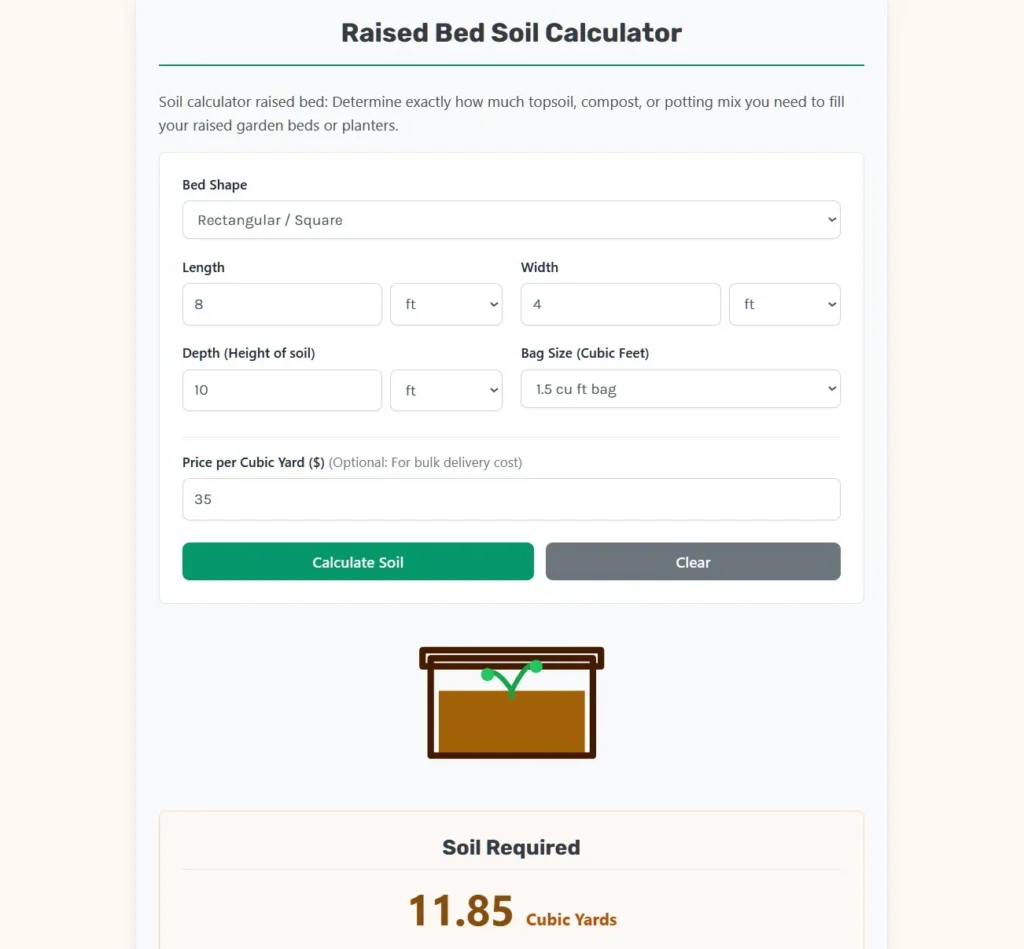
Raised Bed Soil Calculator
Soil calculator raised bed: Determine exactly how much topsoil, compost, or potting mix you need to fill your raised garden beds or planters.
Gardening Math Explained
Cubic Yards vs. Cubic Feet
Soil volume is calculated in three dimensions: Length × Width × Depth.
If you are buying soil in bulk (delivered by a dump truck), it is sold by the Cubic Yard. A cubic yard is a block of dirt that is 3 feet long, 3 feet wide, and 3 feet deep (which equals 27 cubic feet).
1 Cubic Yard = 27 Cubic Feet
Buying Bags at the Store
If you are picking up soil at a hardware store, it is sold in bags measured in Cubic Feet (cu ft). Standard bag sizes are 1.0, 1.5, or 2.0 cubic feet. Because bagged soil can settle and compact, it is always recommended to round up and buy 1 or 2 extra bags to ensure your raised bed is filled completely to the top!
How Much Soil Do I Need for a Raised Bed?
A raised bed soil calculator helps you determine how much growing medium is required to fill a garden bed or planter to a chosen depth. The calculation is based on the three-dimensional space inside the bed, so the result depends on the bed’s length, width, shape, and soil depth.
Knowing the required volume before buying soil makes garden planning much easier. It can help you estimate the amount of topsoil, compost, raised-bed mix, or other growing medium required, compare bagged soil with bulk deliveries, estimate project costs, and avoid making a last-minute trip to purchase additional material.
The key idea is simple: determine the volume of the space that needs to be filled, convert that volume into practical purchasing units, and then choose the most suitable way to buy the material.
What Is a Raised Bed Soil Calculator?
A raised bed soil calculator is a gardening volume calculator designed to estimate the amount of soil needed for a raised bed, planter, or similar growing space.
Unlike a soil weight calculator, it measures volume, not mass. This distinction is important because soil products vary considerably in density. A cubic foot of moist topsoil does not necessarily weigh the same as a cubic foot of compost, sand, or a lightweight growing mix.
The calculator therefore answers a practical question:
How much space does my growing medium need to occupy?
Once that volume is known, it can be expressed in several forms, including:
| Measurement | Main purpose |
|---|---|
| Cubic feet | Useful for smaller projects and bagged soil |
| Cubic yards | Commonly used when ordering bulk soil |
| Cubic meters | Useful for metric measurements and larger projects |
| Number of bags | Helps determine how many packages to purchase |
| Estimated bulk cost | Helps with preliminary project budgeting |
The calculator covered here supports both rectangular or square beds and circular planters, with dimensions entered in feet, inches, meters, or centimeters. It also converts the calculated result into multiple volume units and estimates the number of bags required based on the selected bag size.
How Does a Raised Bed Soil Calculator Work?
The calculation is based on ordinary geometric volume.
A three-dimensional space has volume, and volume is calculated differently depending on its shape. A rectangular raised bed is treated as a rectangular prism, while a round planter is treated as a cylinder.
Before calculating volume, the dimensions must be expressed in compatible units.
For example, multiplying:
8 feet × 4 feet × 10 inches
directly would be incorrect because the three measurements are not using the same unit.
The 10 inches must first be converted to feet:
10 inches ÷ 12 = 0.8333 feet
The calculation can then be performed consistently.
The calculator handles these unit conversions automatically. Its conversion logic converts inches, meters, and centimeters into feet before determining the soil volume.
This approach reduces one of the most common sources of error in soil-volume calculations: mixing incompatible units.
Raised Bed Soil Calculator Formula for Rectangular Beds
Most traditional raised vegetable beds are rectangular or square.
The required soil volume is calculated by multiplying:
Length × Width × Depth
The general formula is:
Volume = Length × Width × Depth
Where:
- Length is the inside length of the soil-filled area.
- Width is the inside width of the soil-filled area.
- Depth is the intended soil depth.
- Volume is the amount of space that the soil will occupy.
When all three measurements are expressed in feet, the result is cubic feet.
Example: An 8 × 4 Raised Bed
Suppose a raised bed measures:
- Length = 8 feet
- Width = 4 feet
- Soil depth = 1 foot
The calculation is:
Volume = 8 × 4 × 1
Volume = 32 cubic feet
So the geometric volume of the bed is 32 cubic feet.
That is the amount of space that the growing medium must occupy at the specified depth.
How to Calculate Soil for a Square Raised Bed
A square bed follows exactly the same principle as a rectangular bed. The only difference is that the length and width are equal.
For a bed measuring 4 feet × 4 feet with a depth of 1 foot:
Volume = 4 × 4 × 1
Volume = 16 cubic feet
For a 6-foot × 6-foot bed that is 1 foot deep:
Volume = 6 × 6 × 1
Volume = 36 cubic feet
The calculation does not change merely because the dimensions happen to be equal.
Soil Calculator Formula for a Circular Raised Bed
A circular planter has a different geometry. Instead of multiplying length by width, the calculation treats the planter as a cylinder.
The first step is to determine the radius.
Radius = Diameter ÷ 2
The cylinder-volume formula is:
Volume = π × Radius² × Depth
Where:
- π is approximately 3.141592653589793
- Radius is half of the planter’s diameter
- Depth is the soil depth
The calculator implements this cylindrical formula after converting the diameter and depth to feet.
Example: A 3-Foot Diameter Planter
Suppose a round planter has:
- Diameter = 3 feet
- Depth = 1 foot
First calculate the radius:
Radius = 3 ÷ 2 = 1.5 feet
Then:
Volume = π × 1.5² × 1
Volume ≈ 7.07 cubic feet
Therefore, the planter needs approximately 7.07 cubic feet of growing medium at a depth of 1 foot.
Why Soil Depth Makes Such a Big Difference
Depth is one of the most important variables in a raised bed soil calculation.
Because volume is directly proportional to depth, doubling the depth doubles the required soil volume when the length and width remain unchanged.
For example, consider the same 8-foot × 4-foot bed:
| Soil depth | Depth in feet | Required volume |
|---|---|---|
| 6 inches | 0.5 ft | 16 ft³ |
| 12 inches | 1 ft | 32 ft³ |
| 18 inches | 1.5 ft | 48 ft³ |
| 24 inches | 2 ft | 64 ft³ |
This relationship is useful when designing a new garden.
A deeper raised bed may provide additional root space, but it also requires more material and can increase the cost of the project. The appropriate depth should therefore reflect the plants being grown, the site, drainage conditions, accessibility, and whether plant roots can extend into the soil below the bed.
University of Minnesota Extension notes that raised-bed design should take plant needs and practical considerations into account, and it also discusses how raised beds can have different watering requirements depending on their construction and height.
How to Measure a Raised Bed Correctly
The accuracy of the final result depends on the accuracy of the measurements.
For a rectangular bed, measure the inside length and inside width of the area that will actually contain soil. Using outside dimensions may slightly overestimate the volume if the bed walls are thick.
The same principle applies to depth. Measure the intended depth of the soil rather than automatically using the total height of the bed walls.
For example, a bed may have walls that are 14 inches high but only be intended to hold 12 inches of soil. In that case, use 12 inches, not 14 inches.
For circular planters, measure the diameter straight across the center of the planting area.
Measurement Checklist
Before using a raised bed soil calculator:
- Measure the usable interior length.
- Measure the usable interior width.
- Measure the actual intended soil depth.
- Record the unit used for each dimension.
- Check whether the bed has internal dividers or areas that will remain empty.
- Use the circular measurement option when working with a round planter.
- Recheck unusual or irregular dimensions before ordering material.
Converting Inches, Centimeters, and Meters to Feet
The calculator allows measurements to be entered in several common units.
The basic conversions are:
Feet = Inches ÷ 12
Feet = Centimeters ÷ 30.48
Feet = Meters × 3.280839895
NIST publishes the corresponding U.S. customary and metric conversion factors. For example, NIST identifies 1 foot as 30.48 centimeters and 1 meter as approximately 3.28 feet.
Using consistent units is essential because multiplying mixed units produces a misleading result.
For example:
8 feet × 4 feet × 10 inches
should become:
8 feet × 4 feet × 0.833333 feet
before the multiplication is performed.
How Many Cubic Feet of Soil Do I Need?
The answer depends entirely on the dimensions of the raised bed.
For a rectangular bed:
Cubic feet = Length × Width × Depth
For example:
8 ft × 4 ft × 1 ft = 32 ft³
Therefore, an 8 × 4 bed that is 1 foot deep requires a calculated volume of 32 cubic feet.
A useful way to think about this is that one cubic foot is a volume measuring:
1 foot × 1 foot × 1 foot
The calculator simply determines how many such cubic-foot units are contained in the entire growing space.
How Many Cubic Yards of Soil Do I Need?
Bulk landscape materials are commonly sold by the cubic yard.
The relationship is:
1 cubic yard = 27 cubic feet
Therefore:
Cubic yards = Cubic feet ÷ 27
Using the previous example:
32 ÷ 27 = 1.185185… cubic yards
Rounded to two decimal places:
1.19 cubic yards
The calculator uses this same relationship when converting its cubic-foot result into cubic yards.
NIST independently provides the cubic-foot and cubic-yard relationships to cubic meters, supporting the unit-conversion basis of the calculation.
How Many Bags of Soil Do I Need?
Bagged soil is generally sold by volume, such as 1 cubic foot, 1.5 cubic feet, 2 cubic feet, or another package size.
The basic calculation is:
Exact number of bags = Required volume ÷ Bag volume
Because retailers sell whole bags, the result must be rounded upward.
Example Using 1.5 Cubic-Foot Bags
Suppose the raised bed requires:
32 cubic feet
and each bag contains:
1.5 cubic feet
Then:
32 ÷ 1.5 = 21.333… bags
Since 21 bags would not provide enough volume, the required purchase quantity is:
22 bags
The calculator applies the same principle by using the ceiling function to round the exact bag requirement upward to a whole bag.
Why You Should Check the Bag Size Carefully
Not all soil bags contain the same volume.
One product may contain 1 cubic foot, another 1.5 cubic feet, and another 2 cubic feet. The number of bags therefore cannot be determined simply by counting packages without checking the volume printed on the label.
For example, a requirement of 30 cubic feet would mean:
| Bag size | Exact requirement | Bags to buy |
|---|---|---|
| 1.0 ft³ | 30 bags | 30 |
| 1.5 ft³ | 20 bags | 20 |
| 2.0 ft³ | 15 bags | 15 |
| 3.0 ft³ | 10 bags | 10 |
This is why comparing cost per cubic foot or cost per cubic yard is more useful than comparing the price of individual bags.
Should I Buy Bagged Soil or Bulk Soil?
The better purchasing method depends on project size, local pricing, delivery availability, and convenience.
For a small planter or a few containers, bags may be practical because they are easy to transport and can be purchased as needed.
For a large raised-bed project, bulk material can be more economical. University of Minnesota Extension specifically notes that high-quality topsoil purchased in bulk by the cubic yard is generally much cheaper than purchasing individual bags.
When comparing the two options, use equivalent quantities.
For example, compare:
Price per cubic foot
or:
Price per cubic yard
rather than comparing a $7 bag with a bulk delivery price without accounting for the quantity represented by each price.
Delivery charges should also be considered when comparing bulk purchases.
How to Estimate the Cost of Bulk Soil
If a supplier gives you a price per cubic yard, the estimated material cost can be calculated as:
Estimated cost = Required cubic yards × Price per cubic yard
For example, if your calculated requirement is:
1.19 cubic yards
and the quoted price is:
$40 per cubic yard
then:
1.19 × $40 = $47.60
The estimated material cost is approximately $47.60.
This is only an estimate of the material portion of the purchase. Actual invoices may include delivery fees, minimum-order requirements, taxes, fuel charges, or other supplier-specific costs.
The calculator includes an optional price field for this type of bulk-material estimate.
How Much Topsoil Do I Need for a Raised Bed?
The calculator determines the total volume required. It does not automatically determine the ideal composition of that volume.
This distinction matters because a gardener may fill a bed with:
- Purchased raised-bed mix
- Topsoil and compost
- A locally recommended soil mixture
- Another growing medium appropriate for the crop and site
Once the total volume is known, that quantity can be divided according to the selected soil recipe.
For example, if a project requires 2 cubic yards of total material, the gardener can determine how many cubic yards of each component are needed based on the chosen mixture.
There is no universal mixture that is ideal for every raised bed, crop, climate, or soil condition.
Penn State Extension currently recommends a soil and compost mixture of approximately 70% soil and 30% compost for raised beds, while also emphasizing the importance of using quality materials from reputable sources.
University of Minnesota Extension gives somewhat different guidance, discussing mixtures of roughly one-half to two-thirds topsoil with one-third to one-half plant-based compost and warning that excessive compost can create water-management problems.
These recommendations illustrate an important point: calculate the total volume first, then choose the appropriate soil composition using reliable local horticultural guidance.
Can I Use Potting Soil in a Raised Bed?
Potting soil and raised-bed soil serve different purposes.
University of Minnesota Extension notes that potting soil is appropriate for pots and seedlings but is not generally suitable for filling raised beds because it can dry out too quickly. The same source recommends looking for products specifically labeled as raised-bed mix when purchasing bagged material for raised beds.
The calculator itself does not evaluate product quality or decide which material is appropriate. Its purpose is to calculate the required volume.
Soil Volume and Soil Weight Are Not the Same Thing
A common mistake is to assume that a volume calculation can automatically determine the weight of the soil.
It cannot.
Volume tells you how much space the material occupies.
Weight depends on density.
The relationship is:
Mass = Volume × Density
Because soil density can vary with moisture content, texture, organic-matter content, and material type, two products with the same volume can have different weights.
For that reason, a raised bed requiring 2 cubic yards does not automatically have one fixed weight.
If weight matters for transportation, structural considerations, or delivery, use the density information supplied for the specific product.
What Happens When Soil Settles?
A geometric calculation describes the volume of the space being filled at the time of calculation. Real growing media can settle after installation.
Organic materials can decompose, particles can compact, and soil can move into small gaps within the bed. As a result, the soil level may drop after the bed has been filled.
University of Minnesota Extension discusses settling as a normal consideration in raised beds and notes that additional material may be needed over time.
This is one reason gardeners should retain some suitable material for future top-ups instead of assuming that the initial soil level will remain unchanged indefinitely.
Should I Buy Extra Soil?
The mathematical volume gives you the quantity required to fill the measured space.
The practical amount to purchase may depend on several additional factors, including:
- How the material settles after installation
- Whether the soil will be filled exactly to the intended height
- Whether the bed has an irregular base
- Whether some material will be used elsewhere
- Whether the supplier sells only in minimum quantities
- Whether the project requires future replenishment
For bagged soil, the calculator already rounds the bag count upward because whole bags are required. However, the decision to purchase additional bags beyond that amount should be based on the project rather than applying an arbitrary percentage to every calculation.
How to Calculate Soil for Multiple Raised Beds
If several beds have identical dimensions, calculate the volume of one bed and multiply it by the number of beds.
The formula is:
Total project volume = Volume of one bed × Number of beds
For example, suppose one bed requires:
24 cubic feet
and the garden contains:
6 identical beds
Then:
24 × 6 = 144 cubic feet
Convert that to cubic yards:
144 ÷ 27 = 5.333… cubic yards
So the project requires approximately:
5.33 cubic yards
For beds with different dimensions, calculate each bed separately and then add the results together.
How to Calculate Soil for an L-Shaped Raised Bed
An irregular bed does not have to be impossible to calculate.
A useful method is to divide the shape into smaller rectangular sections.
For example:
Total volume = Section A volume + Section B volume
Calculate each section using:
Length × Width × Depth
Then add the results.
This method can also be used for:
- L-shaped beds
- U-shaped beds
- Multiple connected rectangles
- Beds with different depths
- Complex garden layouts
The important rule is to avoid counting the same space twice.
How to Calculate Soil for Several Different Beds
When beds have different sizes, treat each one as a separate calculation.
For example:
Bed A = 24 ft³
Bed B = 18 ft³
Bed C = 32 ft³
Then:
24 + 18 + 32 = 74 ft³
Convert the total:
74 ÷ 27 ≈ 2.74 yd³
This method is more reliable than using an average size when the beds are significantly different.
Common Raised Bed Soil Calculation Mistakes
Mixing Different Units
One of the most frequent mistakes is multiplying feet, inches, centimeters, or meters without converting them.
The solution is simple: convert all measurements to one unit before performing the multiplication.
Using the Outside Dimensions
If the bed walls have substantial thickness, the outside measurements may produce an overestimate.
Measure the interior soil-filled area.
Using Wall Height Instead of Actual Soil Depth
A bed can have tall walls without being filled completely.
Use the intended soil-fill depth.
Confusing Diameter and Radius
For a circular planter:
Radius = Diameter ÷ 2
Using the diameter directly as the radius produces a major error because the radius is squared in the formula.
Rounding Bag Counts Down
If the calculation produces 18.2 bags, 18 bags are insufficient.
The correct whole-bag requirement is:
19 bags
Confusing Soil Volume With Soil Weight
Cubic feet and cubic yards describe volume, while pounds and kilograms describe mass.
Do not use one as a substitute for the other.
Assuming Every Soil Product Is Equivalent
A cubic foot of one material is not necessarily horticulturally equivalent to a cubic foot of another.
The volume calculator determines quantity, not product quality.
What Is the Best Soil Depth for a Raised Bed?
There is no single depth that is ideal for every raised bed.
The right depth depends on:
- The plants being grown
- Root-system requirements
- The condition of the native soil
- Drainage
- Bed construction
- Accessibility
- Available budget
- Water-management needs
A shallow bed built over healthy, usable ground can function differently from a deep bed constructed over compacted or unsuitable soil.
Before choosing a depth solely to maximize growing space, consider what the plants actually need.
Why Raised Bed Width Matters
Width is not only a mathematical issue. It is also a usability issue.
A very wide raised bed may require you to step into the growing area to reach the center. Doing so can compact the soil and make routine maintenance more difficult.
A bed should therefore be designed around both:
Growing requirements + Human access
This is particularly important for vegetable gardens, where planting, harvesting, weeding, and watering occur frequently.
Soil, Compost, and Raised Bed Design
Raised beds give gardeners greater control over the growing medium, including soil texture, drainage, and organic matter.
Penn State Extension describes raised beds as an opportunity to manage soil health by controlling properties such as texture, drainage, and organic matter.
However, more organic material is not automatically better.
University of Minnesota Extension cautions that excessive compost can contribute to water-management problems and recommends using high-quality materials.
This makes the volume calculation only one part of good raised-bed planning.
The complete process is better understood as:
1. Measure the space → 2. Calculate the volume → 3. Select the growing medium → 4. Compare purchasing options → 5. Fill and maintain the bed
When Is a Raised Bed Soil Calculator Useful?
A soil calculator can help with many gardening and landscaping projects, including:
- New vegetable gardens
- Flower beds
- Herb gardens
- Community gardens
- School gardens
- Backyard raised beds
- Circular planters
- Large container planters
- Soil replacement
- Compost planning
- Bulk soil orders
- Bagged-soil purchases
- Garden renovation projects
It can also be useful during the design stage, before the bed is built, because the expected soil requirement can influence the size and depth of the project.
Quick Reference: Raised Bed Soil Formulas
| Calculation | Formula |
|---|---|
| Rectangular bed volume | Length × Width × Depth |
| Circular radius | Diameter ÷ 2 |
| Circular planter volume | π × Radius² × Depth |
| Cubic yards | Cubic feet ÷ 27 |
| Cubic meters from cubic feet | Cubic feet ÷ 35.3146667 |
| Exact bags required | Required volume ÷ Bag volume |
| Whole bags to purchase | Round upward to the next whole bag |
| Bulk material cost | Cubic yards × Price per cubic yard |
NIST provides authoritative volume-conversion factors, including the relationship between cubic feet, cubic yards, and cubic meters.
Raised Bed Soil Calculator Example
Consider a rectangular raised bed measuring:
8 feet long × 4 feet wide × 10 inches deep
First convert the depth:
10 ÷ 12 = 0.833333 feet
Then calculate volume:
8 × 4 × 0.833333 = 26.6667 cubic feet
Convert to cubic yards:
26.6667 ÷ 27 ≈ 0.99 cubic yards
Now assume the soil is sold in 1.5-cubic-foot bags:
26.6667 ÷ 1.5 = 17.7778 bags
Round upward:
18 bags
So the calculation gives approximately:
| Result | Amount |
|---|---|
| Cubic feet | 26.67 ft³ |
| Cubic yards | 0.99 yd³ |
| 1.5-ft³ bags | 18 bags |
This example demonstrates why the input unit does not matter as long as it is converted correctly before calculating the volume.
Frequently Asked Questions About Raised Bed Soil
How do I calculate how much soil I need for a raised bed?
Measure the usable length, width, and intended soil depth. Convert the measurements to the same unit and multiply them.
For a rectangular bed:
Volume = Length × Width × Depth
Then convert the result into cubic yards or bags depending on how you plan to purchase the soil.
How many cubic feet of soil does a raised bed need?
It depends on the dimensions.
For example, an 8-foot × 4-foot × 1-foot bed requires:
8 × 4 × 1 = 32 cubic feet
How many bags of soil do I need for a raised bed?
Divide the required cubic-foot volume by the cubic-foot volume of one bag and round the result upward.
For example:
32 ÷ 1.5 = 21.33
Therefore:
22 bags
How much soil do I need for a 4 × 8 raised bed?
At a 1-foot depth:
4 × 8 × 1 = 32 cubic feet
That is approximately:
1.19 cubic yards
At a 6-inch depth:
4 × 8 × 0.5 = 16 cubic feet
The required amount therefore depends heavily on the selected depth.
How much soil do I need for a 2 × 4 raised bed?
At a 1-foot depth:
2 × 4 × 1 = 8 cubic feet
At a 6-inch depth:
2 × 4 × 0.5 = 4 cubic feet
How much soil do I need for a 3 × 6 raised bed?
At a 1-foot depth:
3 × 6 × 1 = 18 cubic feet
To convert to cubic yards:
18 ÷ 27 = 0.67 cubic yards
How much soil do I need for a 6 × 3 raised bed?
At a 1-foot depth:
6 × 3 × 1 = 18 cubic feet
The order of the length and width does not change the result.
How much soil do I need for an 8 × 4 × 1 raised bed?
The calculation is:
8 × 4 × 1 = 32 cubic feet
That equals:
32 ÷ 27 ≈ 1.19 cubic yards
What is the ideal soil ratio for a raised bed?
There is no single ratio suitable for every situation.
Penn State Extension currently recommends approximately 70% soil and 30% compost for raised beds, while University of Minnesota Extension gives a somewhat different range and emphasizes quality topsoil, plant-based compost, and avoiding excessive compost.
The appropriate choice should therefore consider local conditions, the crops being grown, the characteristics of the materials, and available horticultural recommendations.
Is bulk soil cheaper than bags?
For sufficiently large projects, bulk soil can often be more economical. University of Minnesota Extension specifically notes that purchasing high-quality topsoil in bulk by the cubic yard is generally much cheaper than buying individual bags.
However, always compare the final delivered cost rather than only the listed unit price.
Does this calculator calculate soil weight?
No. It calculates volume.
Weight requires a density value specific to the material:
Mass = Volume × Density
Because soil density varies, the weight cannot be determined accurately from volume alone.
Best Practices for Buying Soil for a Raised Bed
Before placing an order, check the following:
✓ Measure the inside dimensions of the bed.
✓ Use the actual intended soil depth.
✓ Make sure all dimensions are converted consistently.
✓ Select the correct geometric shape.
✓ Check the calculated cubic-foot requirement.
✓ Convert to cubic yards when comparing bulk suppliers.
✓ Check the exact volume printed on every bag.
✓ Round bag quantities upward.
✓ Compare bulk and bagged prices using equivalent volumes.
✓ Check whether delivery is included in the bulk price.
✓ Consider that growing media may settle after installation.
✓ Choose the soil composition separately from the volume calculation.
✓ Use reputable horticultural or extension guidance when selecting soil and compost.
What This Raised Bed Soil Calculator Does Not Tell You
A volume calculator is intentionally focused on quantity.
It does not automatically determine:
- The best soil product for your crop
- Soil pH
- Nutrient levels
- Fertilizer requirements
- Soil density
- Soil weight
- Moisture content
- Drainage quality
- The long-term rate of soil settling
- The exact soil mixture required for a particular plant
These are separate horticultural questions.
The best approach is to use the calculator to establish how much material is needed, then use reliable horticultural information to decide what material should be used.
Scientific Basis and Reliable Sources
The mathematical foundation of a raised bed soil calculator comes from standard geometry and established measurement conversions.
NIST publishes authoritative conversion factors for volume measurements, including cubic feet, cubic yards, and cubic meters, as well as length conversions between feet, centimeters, and meters.
For the horticultural side of raised-bed planning, university extension services provide practical guidance based on soil management and gardening research. University of Minnesota Extension discusses raised-bed dimensions, soil and compost considerations, bulk purchasing, settling, and plant-related design considerations. Penn State Extension discusses soil health in raised beds and the management of soil texture, drainage, and organic matter.
These sources provide a useful distinction between mathematical soil-volume estimation and horticultural soil management, which should be treated as related but separate decisions.
Recommended authoritative references
National Institute of Standards and Technology (NIST)
NIST Guide to the SI and official conversion factors for length and volume.
University of Minnesota Extension
Raised bed gardens, including guidance on soil, compost, bed design, and purchasing soil.
Penn State Extension
Soil health in raised beds, including soil and compost management.
Final Raised Bed Soil Checklist
Before buying or ordering your soil, verify:
✓ Length
✓ Width
✓ Soil depth
✓ Bed shape
✓ Measurement units
✓ Cubic feet required
✓ Cubic yards required
✓ Bag size
✓ Number of whole bags
✓ Bulk price per cubic yard
✓ Delivery charges
✓ Soil or compost composition
✓ Expected settling and future maintenance
A good calculation gives you a reliable starting point for purchasing. The final gardening decision then comes from combining that volume estimate with the needs of the plants, the characteristics of the growing medium, and the conditions of the garden.