Time Card Calculator
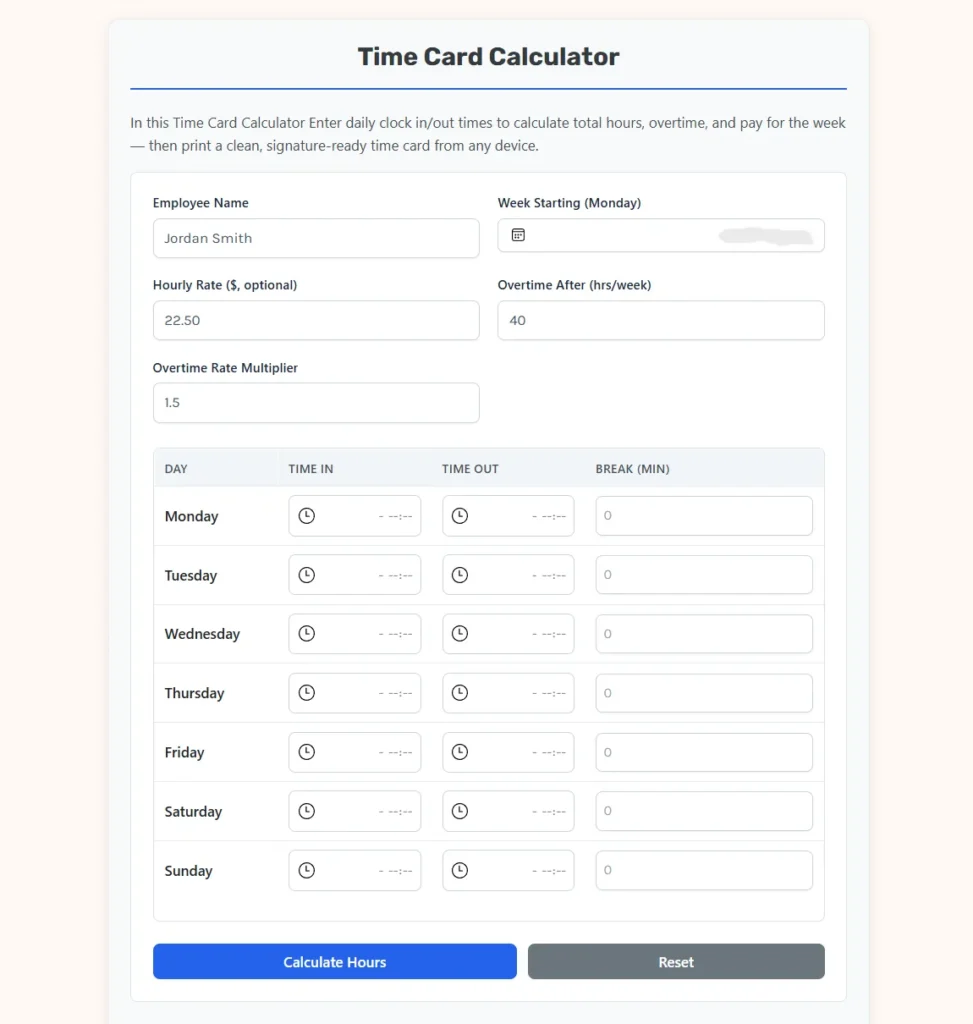
In this Time Card Calculator Enter daily clock in/out times to calculate total hours, overtime, and pay for the week — then print a clean, signature-ready time card from any device.
How Hours Are Calculated
Daily Hours Formula
Hours Worked = (Time Out − Time In) − Break Minutes ÷ 60
If Time Out is earlier than Time In, the shift is treated as overnight and 24 hours are added automatically — useful for night shifts that cross midnight.
Overtime Rule
Hours up to the weekly threshold (default 40) are paid at the regular rate. Hours beyond that are paid at the overtime rate, calculated as your hourly rate × the overtime multiplier (commonly 1.5×, known as “time and a half”).
Printing Your Time Card
Works on Any Device
- Desktop: Click “Print Time Card” to open your browser’s print dialog — print directly or save as PDF.
- Mobile (iOS/Android): The same button opens your device’s native print/share sheet, where you can print or export a PDF.
- The printed version is a clean, formatted table with signature lines — separate from the on-screen form.
Time Card Calculations and Labor Compliance: Mathematical and Regulatory Guide
Accurate tracking of labor hours serves as the bedrock of organizational efficiency, legal compliance, and trust between employers and employees. While primitive ledger books and physical mechanical punch clocks once defined industrial workspaces, the contemporary digital era demands high-precision, decimal-based time calculation.
A standardized time card calculator acts as a regulatory diagnostic and financial planning tool. By converting traditional clock time (hours and minutes) into standardized decimal hours, these utilities allow payroll departments to execute exact wage calculations, account for unpaid breaks, isolate overtime liabilities, and maintain flawless compliance with federal, state, and local labor statutes.
This guide provides an exhaustive analysis of the mathematical formulations, accounting principles, federal standards, and practical scenarios associated with professional time tracking.
The Regulatory Framework of Time Tracking
To build a legally compliant timecard workflow, it is necessary to examine the underlying labor laws that govern employee time tracking. In the United States, the Fair Labor Standards Act (FLSA) serves as the primary federal statute regulating recordkeeping, minimum wage, and overtime requirements.
Under FLSA provisions, employers must maintain accurate records of hours worked for all non-exempt employees. This tracking is not merely for internal financial auditing, but also to protect the organization against wage-and-hour lawsuits and regulatory investigations.
Key legal requirements include:
$\checkmark$ The Workweek Definition: A workweek is a fixed, regularly recurring period of $168$ hours (seven consecutive $24$-hour periods). It does not need to coincide with the calendar week, but it must remain consistent once established.
$\checkmark$ The Definition of Hours Worked: Hours worked include all time during which an employee is required to be on the employer’s premises, on duty, or at a prescribed workplace. This includes prep time, clean-up activities, and certain travel times that occur during the workday.
$\checkmark$ Record Retention: Employers are legally required to retain basic timecards and payroll sheets for at least three years, demonstrating a clear history of hours worked and compensation paid.
Decoupling Compensable and Non-Compensable Time
A major source of confusion in payroll administration is distinguishing between compensable hours (hours that must be paid) and non-compensable hours (hours that can be excluded from payroll).
1. Short Rest Breaks vs. Long Meal Breaks
Under federal guidelines established by the US Department of Labor (29 CFR Part 785), rest periods of short duration (typically lasting $5$ to $20$ minutes) must be counted as compensable hours worked. These short breaks are considered beneficial to employee productivity and cannot be deducted from payroll.
Conversely, bona fide meal periods (typically lasting $30$ minutes or longer) are non-compensable. For a meal period to be unpaid, the employee must be completely relieved from duty for the purpose of eating regular meals. If the employee is required to perform any duties while eating, such as answering phones or monitoring machinery, the entire period must be paid.
2. Waiting Time and On-Call Shifts
Determining if on-call time is compensable depends on whether the employee is “engaged to wait” or “waiting to be engaged.”
- Engaged to Wait (Compensable): An employee who is required to remain on the premises or so close to it that they cannot use the time effectively for their own purposes is working.
- Waiting to be Engaged (Non-Compensable): An employee who is merely required to leave word at their home or with company officials where they can be reached is not working, as they can use the time for personal activities.
The Mathematical Conversion of Clock Time to Decimal Time
The primary mathematical challenge of time card management is that time is recorded in sexagesimal notation (base $60$), while financial calculations are executed in decimal notation (base $100$). Directly multiplying clock minutes by an hourly rate leads to severe financial errors. For example, multiplying $40\text{ hours and }30\text{ minutes}$ by an hourly rate of $\$20.00$ as $40.30 \times 20$ yields $\$806.00$, whereas the mathematically correct compensation for $40.5\text{ hours}$ is $\$810.00$.
Convert Minutes to Decimal Values
To convert any clock-based minute value to its exact decimal equivalent, the minute portion must be divided by sixty.
The conversion equation is:$$\text{D} = \frac{\text{M}}{60}$$
Where:
- $\rightarrow$ $\text{D}$ represents the resulting decimal fraction of an hour.
- $\rightarrow$ $\text{M}$ represents the elapsed clock minutes (ranging from $0$ to $59$).
Below is the standard reference index for common minute intervals converted to their exact decimal equivalents:
| Minutes | Decimal Conversion | Minutes | Decimal Conversion |
| $15\text{ min}$ | $0.25\text{ hours}$ | $45\text{ min}$ | $0.75\text{ hours}$ |
| $30\text{ min}$ | $0.50\text{ hours}$ | $60\text{ min}$ | $1.00\text{ hours}$ |
| $5\text{ min}$ | $0.0833\text{ hours}$ | $20\text{ min}$ | $0.3333\text{ hours}$ |
| $10\text{ min}$ | $0.1667\text{ hours}$ | $40\text{ min}$ | $0.6667\text{ hours}$ |
| $50\text{ min}$ | $0.8333\text{ hours}$ | $55\text{ min}$ | $0.9167\text{ hours}$ |
Mathematical Architecture of Daily and Weekly Calculations
To ensure proper rendering on mobile layouts and small screen boxes, the calculations for daily timecards are broken down into single, narrow, step-by-step formulas.
Daily Clock-In and Clock-Out Conversions
To find the time elapsed during a shift, we first convert the clock-in time and clock-out time into absolute minutes from midnight.
Let $H_{in}$ represent the clock-in hour (on a $24$-hour scale).
Let $M_{in}$ represent the clock-in minute.
The absolute minutes from midnight for the clock-in event ($T_{in}$) is calculated as:$$T_{in} = (H_{in} \times 60) + M_{in}$$
Where:
- $\rightarrow$ $T_{in}$ represents the clock-in time expressed in absolute minutes from midnight.
- $\rightarrow$ $H_{in}$ is the hour portion of the clock-in time (value from $0$ to $23$).
- $\rightarrow$ $M_{in}$ is the minute portion of the clock-in time (value from $0$ to $59$).
We repeat this process for the clock-out event:
Let $H_{out}$ represent the clock-out hour (on a $24$-hour scale).
Let $M_{out}$ represent the clock-out minute.
The absolute minutes from midnight for the clock-out event ($T_{out}$) is calculated as:$$T_{out} = (H_{out} \times 60) + M_{out}$$
Where:
- $\rightarrow$ $T_{out}$ represents the clock-out time expressed in absolute minutes from midnight.
- $\rightarrow$ $H_{out}$ is the hour portion of the clock-out time (value from $0$ to $23$).
- $\rightarrow$ $M_{out}$ is the minute portion of the clock-out time (value from $0$ to $59$).
Handling Overnight Shifts (Midnight Boundary Crossings)
If the clock-out time is earlier than or equal to the clock-in time, the shift crosses the midnight boundary. In this scenario, we must add a $24$-hour bias to the clock-out time.
The adjusted clock-out time calculation is:$$T_{out} = T_{out} + 1440$$
Where:
- $\rightarrow$ $T_{out}$ represents the adjusted clock-out absolute minutes.
- $\rightarrow$ $1440$ is the total number of minutes in a standard $24$-hour day ($24 \times 60$).
Subtracting Unpaid Breaks
Once the clock-in and clock-out absolute times are established, we can calculate the decimal hours worked for the day by subtracting any unpaid breaks.$$H_{day} = \frac{T_{out} – T_{in} – B}{60}$$
Where:
- $\rightarrow$ $H_{day}$ represents the total decimal hours worked for the day.
- $\rightarrow$ $T_{out}$ represents the absolute clock-out minutes.
- $\rightarrow$ $T_{in}$ represents the absolute clock-in minutes.
- $\rightarrow$ $B$ represents the total duration of unpaid breaks in minutes.
Weekly Hours Aggregation
The total hours worked during the week is the sum of the decimal hours worked each day.$$H_{total} = \sum_{i=1}^{n} H_{i}$$
Where:
- $\rightarrow$ $H_{total}$ represents the total hours worked for the week.
- $\rightarrow$ $H_{i}$ represents the decimal hours worked on day $i$.
- $\rightarrow$ $n$ is the number of days worked (up to $7$).
Overtime and Compensation Formulations
Once the total weekly hours are calculated, payroll systems must split those hours into regular and overtime components based on statutory thresholds.
1. Regular Hours Isolation
The regular hours ($H_{reg}$) represent the hours worked up to the statutory overtime threshold.$$H_{reg} = \min(H_{total}, \text{Th})$$
Where:
- $\rightarrow$ $H_{reg}$ represents the regular hours for the week.
- $\rightarrow$ $H_{total}$ represents the total weekly hours worked.
- $\rightarrow$ $\text{Th}$ represents the statutory weekly threshold (typically $40$ hours).
2. Overtime Hours Isolation
The overtime hours ($H_{ot}$) are any hours worked beyond the weekly threshold.$$H_{ot} = \max(0, H_{total} – \text{Th})$$
Where:
- $\rightarrow$ $H_{ot}$ represents the overtime hours for the week.
- $\rightarrow$ $H_{total}$ represents the total weekly hours worked.
- $\rightarrow$ $\text{Th}$ represents the statutory weekly threshold.
3. Regular Pay Calculation
Regular earnings are calculated by multiplying regular hours by the base hourly wage.$$P_{reg} = H_{reg} \times R$$
Where:
- $\rightarrow$ $P_{reg}$ represents the gross regular pay.
- $\rightarrow$ $H_{reg}$ represents the regular decimal hours.
- $\rightarrow$ $R$ represents the base hourly wage rate.
4. Overtime Pay Calculation
Overtime earnings are calculated by multiplying overtime hours by the base wage rate and the overtime multiplier.$$P_{ot} = H_{ot} \times R \times M$$
Where:
- $\rightarrow$ $P_{ot}$ represents the gross overtime pay.
- $\rightarrow$ $H_{ot}$ represents the overtime decimal hours.
- $\rightarrow$ $R$ represents the base hourly wage rate.
- $\rightarrow$ $M$ represents the statutory overtime multiplier (typically $1.5$ for time-and-a-half).
5. Total Gross Pay
The total gross pay before taxes and withholding is the sum of regular and overtime earnings.$$P_{gross} = P_{reg} + P_{ot}$$
Where:
- $\rightarrow$ $P_{gross}$ represents the total gross weekly pay.
- $\rightarrow$ $P_{reg}$ represents the regular pay.
- $\rightarrow$ $P_{ot}$ represents the overtime pay.
The Federal 7-Minute Rounding Rule (29 CFR § 785.48)
In high-volume shifts, employers often use automated rounding systems to simplify timecard management. The IRS and the US Department of Labor allow employers to round employee starting and stopping times to the nearest quarter of an hour (15 minutes). This is governed by the “7-minute rule,” which dictates how punch times are rounded:
- Punches from $1$ to $7$ minutes past the quarter-hour are rounded down to the previous quarter-hour.
- Punches from $8$ to $14$ minutes past the quarter-hour are rounded up to the next quarter-hour.
The table below outlines how punch times round under this federal system:
| Minutes past the hour | Rounded Value (Minutes) | Impact on Employee Time |
| $00$ to $07$ minutes | $00\text{ minutes}$ | Rounds down to the previous hour |
| $08$ to $14$ minutes | $15\text{ minutes}$ | Rounds up to the quarter-hour |
| $15$ to $22$ minutes | $15\text{ minutes}$ | Rounds down to the quarter-hour |
| $23$ to $29$ minutes | $30\text{ minutes}$ | Rounds up to the half-hour |
| $30$ to $37$ minutes | $30\text{ minutes}$ | Rounds down to the half-hour |
| $38$ to $44$ minutes | $45\text{ minutes}$ | Rounds up to the three-quarter hour |
| $45$ to $52$ minutes | $45\text{ minutes}$ | Rounds down to the three-quarter hour |
| $53$ to $59$ minutes | $00\text{ minutes}$ | Rounds up to the next full hour |
Regulatory Compliance Warning
Under federal guidelines, rounding practices must not systematically underpay employees over time. The rounding policy must be applied consistently to both clock-ins and clock-outs. It cannot be configured to only round in favor of the employer, as doing so violates FLSA regulations and can lead to penalties.
Real-World Calculation Scenarios
To see how these rules apply in practice, we can analyze two detailed case studies: a standard daytime shift worker and an overnight worker with multiple shifts and varying break times.
Case Study A: The Standard Day Shift
An administrative assistant works a standard daytime schedule.
- $\rightarrow$ Hourly Rate ($R$) = $\$22.50$
- $\rightarrow$ Weekly Threshold ($\text{Th}$) = $40.00\text{ hours}$
- $\rightarrow$ Overtime Multiplier ($M$) = $1.5$
The weekly hours worked are:
- Monday: Clock In at $08:00$, Clock Out at $17:00$, Break = $60\text{ minutes}$
- Tuesday: Clock In at $08:30$, Clock Out at $17:00$, Break = $30\text{ minutes}$
- Wednesday: Clock In at $08:00$, Clock Out at $17:30$, Break = $45\text{ minutes}$
- Thursday: Clock In at $08:00$, Clock Out at $16:30$, Break = $30\text{ minutes}$
- Friday: Clock In at $08:00$, Clock Out at $17:00$, Break = $60\text{ minutes}$
We calculate the decimal hours for each day:
- Monday:
$$T_{in} = (8 \times 60) + 0 = 480$$$$T_{out} = (17 \times 60) + 0 = 1020$$$$H_{Mon} = \frac{1020 – 480 – 60}{60} = 8.00\text{ hours}$$ - Tuesday:
$$T_{in} = (8 \times 60) + 30 = 510$$$$T_{out} = (17 \times 60) + 0 = 1020$$$$H_{Tue} = \frac{1020 – 510 – 30}{60} = 8.00\text{ hours}$$ - Wednesday:
$$T_{in} = (8 \times 60) + 0 = 480$$$$T_{out} = (17 \times 60) + 30 = 1050$$$$H_{Wed} = \frac{1050 – 480 – 45}{60} = 8.75\text{ hours}$$ - Thursday:
$$T_{in} = (8 \times 60) + 0 = 480$$$$T_{out} = (16 \times 60) + 30 = 990$$$$H_{Thu} = \frac{990 – 480 – 30}{60} = 8.00\text{ hours}$$ - Friday:
$$H_{Fri} = 8.00\text{ hours}$$
Next, we sum the daily totals to find the weekly hours worked ($H_{total}$):$$H_{total} = 8.00 + 8.00 + 8.75 + 8.00 + 8.00 = 40.75\text{ hours}$$
We then split the hours and calculate pay:
- Regular Hours worked:
$$H_{reg} = \min(40.75, 40) = 40.00\text{ hours}$$ - Overtime Hours worked:
$$H_{ot} = \max(0, 40.75 – 40) = 0.75\text{ hours}$$ - Gross Regular Pay earned:
$$P_{reg} = 40.00 \times 22.50 = \$900.00$$ - Gross Overtime Pay earned:
$$P_{ot} = 0.75 \times 22.50 \times 1.5 = \$25.31$$ - Total Gross Pay earned:
$$P_{gross} = 900.00 + 25.31 = \$925.31$$
Case Study B: The Overnight Shift
A healthcare professional works night shifts that cross midnight, with varying hours and short breaks.
- $\rightarrow$ Hourly Rate ($R$) = $\$35.00$
- $\rightarrow$ Weekly Threshold ($\text{Th}$) = $40.00\text{ hours}$
- $\rightarrow$ Overtime Multiplier ($M$) = $1.5$
The weekly hours worked are:
- Shift 1: Clock In Monday $19:30$, Clock Out Tuesday $06:15$, Break = $45\text{ minutes}$
- Shift 2: Clock In Tuesday $20:00$, Clock Out Wednesday $07:30$, Break = $60\text{ minutes}$
- Shift 3: Clock In Wednesday $19:45$, Clock Out Thursday $06:00$, Break = $30\text{ minutes}$
- Shift 4: Clock In Thursday $20:00$, Clock Out Friday $08:00$, Break = $60\text{ minutes}$
We calculate the decimal hours for each overnight shift:
- Shift 1:
$$T_{in} = (19 \times 60) + 30 = 1170$$$$T_{out} = (6 \times 60) + 15 = 375$$Since $375 \le 1170$ (crossing midnight):
$$T_{out} = 375 + 1440 = 1815$$$$H_{S1} = \frac{1815 – 1170 – 45}{60} = 10.00\text{ hours}$$ - Shift 2:
$$T_{in} = (20 \times 60) + 0 = 1200$$$$T_{out} = (7 \times 60) + 30 = 450$$Since $450 \le 1200$ (crossing midnight):
$$T_{out} = 450 + 1440 = 1890$$$$H_{S2} = \frac{1890 – 1200 – 60}{60} = 10.50\text{ hours}$$ - Shift 3:
$$T_{in} = (19 \times 60) + 45 = 1185$$$$T_{out} = (6 \times 60) + 0 = 360$$Since $360 \le 1185$ (crossing midnight):
$$T_{out} = 360 + 1440 = 1800$$$$H_{S3} = \frac{1800 – 1185 – 30}{60} = 9.75\text{ hours}$$ - Shift 4:
$$T_{in} = (20 \times 60) + 0 = 1200$$$$T_{out} = (8 \times 60) + 0 = 480$$Since $480 \le 1200$ (crossing midnight):
$$T_{out} = 480 + 1440 = 1920$$$$H_{S4} = \frac{1920 – 1200 – 60}{60} = 11.00\text{ hours}$$
Next, we sum the daily totals to find the weekly hours worked ($H_{total}$):$$H_{total} = 10.00 + 10.50 + 9.75 + 11.00 = 41.25\text{ hours}$$
We then split the hours and calculate pay:
- Regular Hours worked:
$$H_{reg} = \min(41.25, 40) = 40.00\text{ hours}$$ - Overtime Hours worked:
$$H_{ot} = \max(0, 41.25 – 40) = 1.25\text{ hours}$$ - Gross Regular Pay earned:
$$P_{reg} = 40.00 \times 35.00 = \$1,400.00$$ - Gross Overtime Pay earned:
$$P_{ot} = 1.25 \times 35.00 \times 1.5 = \$65.63$$ - Total Gross Pay earned:
$$P_{gross} = 1400.00 + 65.63 = \$1,465.63$$
Best Practices for Payroll Administrators
To minimize errors, ensure legal compliance, and streamline administrative workflows, payroll departments should implement several best practices:
- Implement a Standard Rounding Policy: If you choose to round employee time, ensure your software is configured to apply the 7-minute rule consistently across all shifts.
- Require Approval for Extra Hours: Implement a clear authorization process for overtime. While unauthorized overtime must still be paid under federal law, having an approval policy helps keep labor costs predictable.
- Keep Detailed Shift Notes: Encourage employees to leave brief notes on their timecards to explain any unusual schedule changes, such as late arrivals, early departures, or missed breaks.
- Perform Regular Audits: Conduct monthly audits to compare recorded schedule hours against actual punch times. This helps catch discrepancies before they impact payroll processing.
- Maintain Clear Document Trails: Retain copies of signed paper timecards and archived digital shift records for at least three years to ensure you are prepared for regulatory compliance audits.
Academic References and Foundations
This guide is built on the core labor policies and financial accounting frameworks established in:
- United States Department of Labor. (2016). Fact Sheet #21: Recordkeeping Requirements Under the Fair Labor Standards Act (FLSA). Wage and Hour Division.
- For official regulatory guidance on employee hour tracking and federal labor laws, consult the United States Department of Labor (DOL) resource database.
Download Best timecard Template Kit
You can download Timecard Template here.