Run Aquarium Size & Volume Calculator
By this aquarium size calculator you can Calculate the exact volume and filled weight of your tank. Essential for planning filtration, dosing, and ensuring your floor can handle the weight.
Mathematical Formulas
Rectangular Tank
Volume = L × W × H
Cylindrical Tank
Volume = π × r2 × H
Hexagonal Tank
Volume = (3√3 / 2) × s2 × H
Where s is the length of one side of the hexagon.
Critical Tips
- Filled Weight: Water is heavy. Fresh water weighs approx. 1 kg per Liter (8.34 lbs per Gallon). Don’t forget the weight of the glass, stand, and substrate!
- Displacement: Your actual water volume will be less once you add substrate, rocks, and decorations.
- Floor Safety: Large tanks (over 55 gallons / 200 liters) may require floor reinforcement depending on the structure of your home.
Science of Precision Tank Sizing
The successful maintenance of an aquarium begins not with the livestock, but with the fundamental mathematics of the vessel itself. An aquarium is more than a glass container; it is a pressurized biological reactor where volume dictates every critical parameter, from chemical stability to thermal inertia. Understanding the exact volume and weight of a system is the primary prerequisite for calculating filtration rates, pharmaceutical dosages, and structural safety requirements for the floor upon which the tank resides.
This aquarium size calculator serves as a high-precision engineering utility. It bridges the gap between raw physical dimensions and the complex realities of aquatic maintenance, such as water displacement and static load distribution. By utilizing geometric formulas for rectangular, cylindrical, and hexagonal prisms, this tool provides the data-driven foundation necessary for long-term aquatic health.
The Conceptual Importance of Volume in Ecology
In the context of freshwater or marine ecology, volume is the primary buffer against entropy. A larger volume of water changes its chemistry and temperature more slowly than a smaller volume. This concept, known as “environmental stability,” is why larger aquariums are often recommended for beginners despite their size. A small error in feeding or a brief heater failure in a $5$-gallon tank can lead to a lethal spike in ammonia or a catastrophic temperature drop within minutes. In a $100$-gallon system, the same error is diluted by a factor of twenty, providing a crucial window for correction.
Furthermore, volume determines the “biological carrying capacity.” Every organism produces metabolic waste (ammonia), which must be processed by beneficial bacteria. The concentration of these wastes is a direct function of the water volume. Precision in volume calculation ensures that the aquarist does not exceed the limit of what the nitrogen cycle can manage.
The Mathematical Framework of Aquarium Shapes
Aquariums are manufactured in various shapes to accommodate aesthetic preferences and spatial constraints. Each shape requires a specific geometric derivation to determine its internal capacity.
1. The Rectangular Prism (Standard Tanks)
The rectangular or square tank is the most common shape in the industry. Its volume is derived from three linear dimensions.
$$V = L \times W \times H$$
Variable Definitions:
➜ $V$: The total internal volume.
➜ $L$: The horizontal length of the aquarium.
➜ $W$: The front-to-back width (depth) of the aquarium.
➜ $H$: The vertical height from the bottom glass to the water surface.
2. The Cylindrical Column
Cylindrical tanks provide a seamless $360$-degree view but require consideration of the radius.
$$V = \pi \times r^2 \times H$$
Variable Definitions:
➜ $V$: The total internal volume.
➜ $\pi$: Archimedes’ constant (approximately $3.14159$).
➜ $r$: The radius (half of the diameter).
➜ $H$: The vertical height.
3. The Hexagonal Prism
Hexagonal tanks are popular for corners and focal points. The volume depends on the length of a single side.
$$V = \frac{3\sqrt{3}}{2} \times s^2 \times H$$
Variable Definitions:
➜ $V$: The total internal volume.
➜ $s$: The length of one of the six identical sides.
➜ $H$: The vertical height.
Understanding Surface Area and Gas Exchange
While volume is critical for chemical dilution, surface area is the variable that dictates oxygenation. The interface between the water and the atmosphere is where gas exchange occurs. Carbon dioxide ($CO_2$) exits the water, and oxygen ($O_2$) enters it.
A tank with a high surface-area-to-volume ratio, such as a “long” or “breeder” style tank, will naturally support more active fish than a “column” tank of the same volume. Column tanks have deep vertical depths but small surface areas, which can lead to hypoxic (low oxygen) conditions at the bottom if artificial aeration is not aggressive.
| Tank Type | Volume (Approx) | Surface Area (Approx) | Gas Exchange Potential |
| Standard 20 Gallon | $20$ gal | $288$ $\text{in}^2$ | Moderate |
| 20 Gallon Long | $20$ gal | $360$ $\text{in}^2$ | High |
| 20 Gallon High | $20$ gal | $240$ $\text{in}^2$ | Low |
The Physics of Water Weight and Floor Loading
One of the most frequently overlooked aspects of aquarium planning is the immense weight of the system. Water is an exceptionally dense substance, and when combined with the weight of the glass, the stand, and the substrate, the total mass can easily exceed the structural limits of residential flooring.
1. Mass Density of Fresh vs. Saltwater
The weight of an aquarium is not a constant; it varies based on salinity. Saltwater is denser than freshwater due to the dissolved minerals.
$$M = V \times \rho$$
Variable Definitions:
➜ $M$: Total mass (weight).
➜ $V$: Volume of the water.
➜ $\rho$: Density of the liquid.
➜ Freshwater Density: Approximately $8.34 \text{ lbs/gal}$ or $1.0 \text{ kg/L}$.
➜ Saltwater Density: Approximately $8.55 \text{ lbs/gal}$ or $1.025 \text{ kg/L}$.
2. The “Dead Load” Buffer
A filled aquarium creates what structural engineers call a “dead load”—a permanent, non-moving weight. The total load on your floor includes:
➜ The weight of the water itself.
➜ The weight of the glass or acrylic (which can be $15\%$ to $25\%$ of the water weight).
➜ The weight of the substrate (sand or gravel is much denser than water).
➜ The weight of the cabinetry (the stand).
Aquarium size calculator includes a $15\%$ buffer in its “Total Estimated Load” calculation to account for these variables, ensuring users have a realistic understanding of the structural requirements.
The Principle of Displacement: The “Net” vs. “Gross” Volume
It is a common mistake to assume that a “$55$-gallon tank” actually holds $55$ gallons of water. In practice, the actual water volume is always significantly less than the gross dimensions suggest. This is due to three factors:
- Glass Thickness: External dimensions include the thickness of the glass ($6\text{mm}$ to $19\text{mm}$ or more). A large tank can lose $2$ to $3$ gallons of capacity simply to the space occupied by the walls of the vessel.
- Substrate Displacement: Adding $2$ inches of gravel or sand displaces water. Because substrate is denser than water, it takes up volume without providing biological dilution.
- The Air Gap: Most aquariums are not filled to the very brim. A $1$-inch gap at the top of a $48$-inch long tank represents a loss of nearly $2$ gallons of water.
➜ The Golden Rule of Dosing: When applying medications or water conditioners, always dose based on the “Net” volume (the actual water in the tank) rather than the “Gross” volume advertised on the box. Over-dosing is a common cause of livestock mortality.
Strategic Use Cases for Volume Calculation
The data provided by this tool is essential for several advanced aquatic management strategies.
➜ Pharmaceutical and Chemical Dosing
Medications for bacterial infections or parasites often have narrow margins of safety. For example, Copper-based treatments in marine tanks must be maintained at a specific parts-per-million (ppm) level. If you overestimate your volume by $20\%$, you may under-dose, rendering the treatment ineffective. If you underestimate, you may reach toxic levels.
➜ Structural Engineering and Placement
Standard residential floors in the United States are typically designed to support a live load of $40$ pounds per square foot (psf). A large aquarium can easily create a load of $200$ to $300$ psf. This calculator allows you to determine if you need to place your tank across multiple floor joists or near a load-bearing wall to prevent structural sagging or failure.
➜ Thermal Management
Heater sizing is directly proportional to volume. To raise the temperature of a tank by $10^{\circ}\text{F}$ above room temperature, you generally need $3$ to $5$ watts of power per gallon. Without an accurate volume count, you risk purchasing an underpowered heater that runs constantly, increasing the risk of mechanical failure.
Measurement Best Practices for Maximum Accuracy
To get the most reliable results from the calculator, follow these professional measurement techniques:
- Measure Internally if Possible: If the tank is empty, measure the inside length and width. This eliminates the error caused by glass thickness.
- Account for the Water Line: Measure the height from the top of the substrate to the actual water line, not to the top of the glass frame.
- Verify Levels: Ensure the tank is perfectly level before measuring. A tank that is tilted will have different water heights at each end, complicating the volume math.
- The Bucket Test: For very small or irregular tanks, the most accurate way to verify the calculator’s result is to fill the tank using a pre-measured $1$-liter or $1$-gallon container.
Glossary of Aquatic Measurement Terms
➜ Gross Volume: The total theoretical capacity based on external dimensions.
➜ Net Volume: The actual amount of liquid water inside the tank after accounting for displacement.
➜ Displacement: The volume of water pushed aside by solids like rocks, sand, and wood.
➜ Internal Dimensions: The measurements taken from the inside faces of the glass.
➜ Specific Gravity (SG): A measure of the density of water compared to pure water, used to determine salinity.
➜ Footprint: The amount of floor or stand space the tank occupies ($L \times W$).
Scientific Reference and Official Standards
The geometric and physical constants used in this calculator are based on standardized fluid dynamics and architectural loading codes.
Relevance: The ASCE 7-16 provides the standard for “Dead Loads” and “Live Loads” in residential and commercial buildings. This document establishes the criteria for how static weights, such as large bodies of water, interact with wood-frame and concrete-slab construction. By adhering to these engineering standards, the calculator provides a reliable baseline for users to assess the safety of their aquarium installations within a built environment.
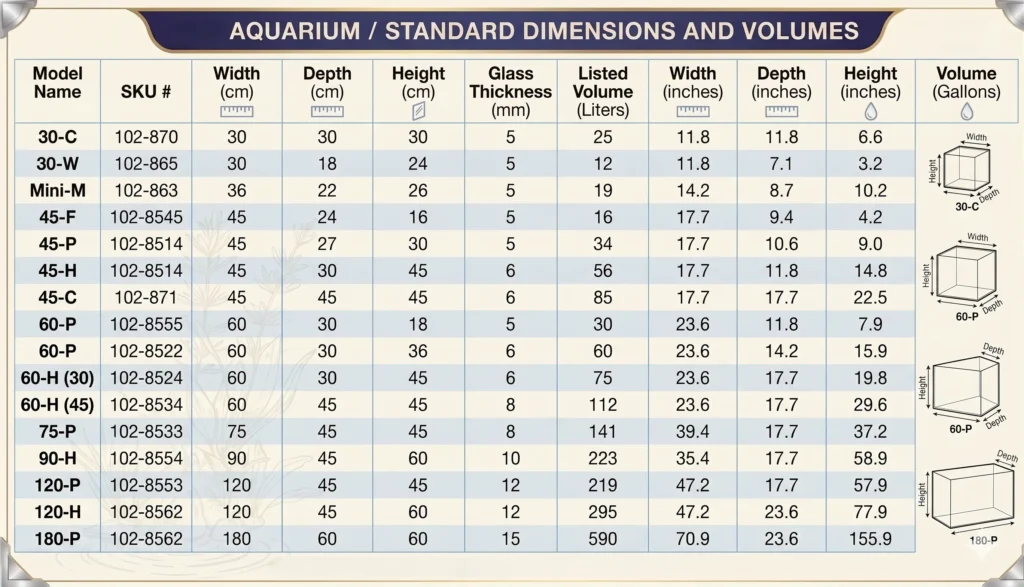
aquarium sizes and char Guide E-book
Stop guessing and start building your dream underwater world! Whether you’re a beginner or a seasoned aquarist, choosing the wrong tank size is a costly mistake. This comprehensive E-book features detailed aquarium size charts, weight calculations, and stocking guides for standard, breeder, and custom tanks. Learn how to match the right species to the right volume and ensure your floor can handle the weight. Get the precision you need for a thriving aquatic ecosystem.
download the aquarium sizes and char Guide E-book here.
Final Summary Checklist for Users
Before you finalize your aquarium setup based on these calculations, verify the following:
➜ Have you used the internal dimensions to account for glass thickness?
➜ Does your estimated weight include a $15\%$ buffer for substrate and the stand?
➜ Is the chosen location for the tank capable of supporting the “Total Estimated Load”?
➜ Have you measured to the actual intended water line rather than the glass rim?
➜ Are you prepared to adjust your chemical dosages based on “Net” water volume?
By applying these rigorous mathematical principles and structural frameworks, you transform a hobby into a controlled scientific environment. Accurate volume and weight data are the primary safeguards against the most common failures in the aquatic industry. Understanding the physics of your tank is the first step toward becoming a master aquarist.