Z-Score Calculator
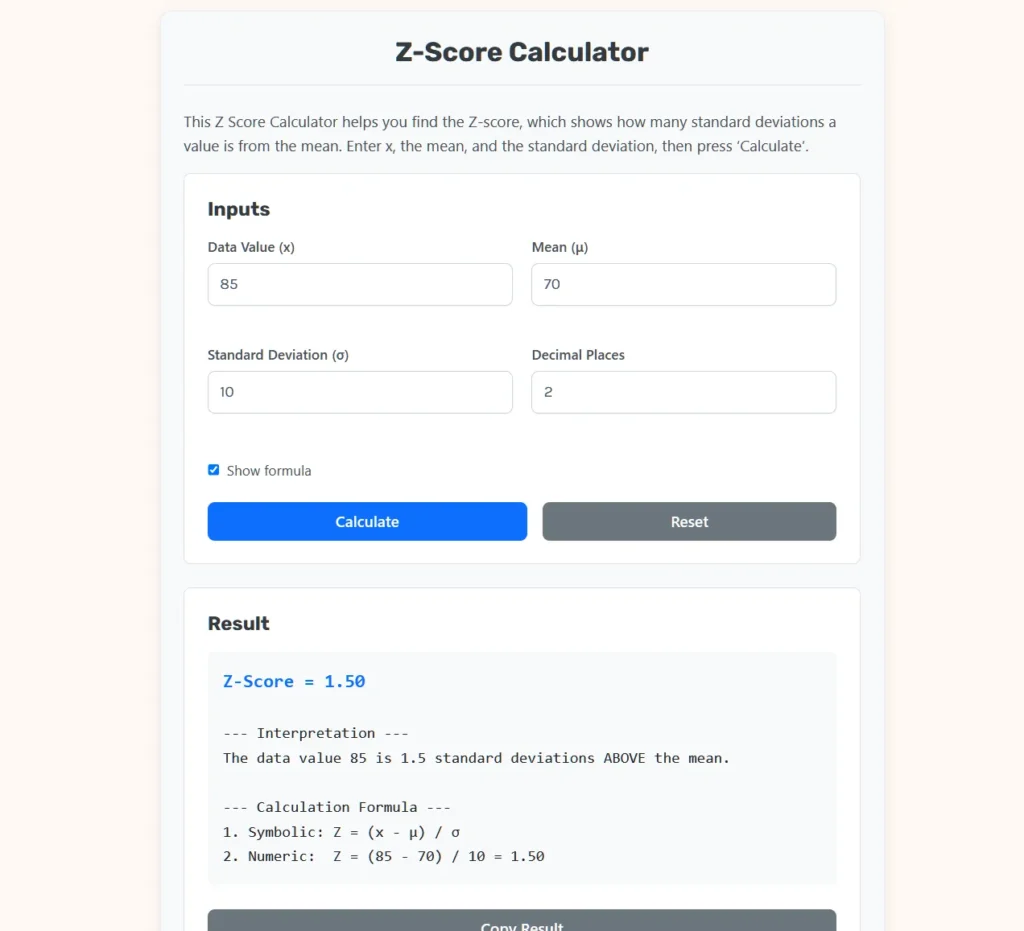
This Z Score Calculator helps you find the Z-score, which shows how many standard deviations a value is from the mean. Enter x, the mean, and the standard deviation, then press ‘Calculate’.
Example
The Z-score (or standard score) indicates how many standard deviations a data point is from the mean of its distribution. A positive Z-score means the value is above the mean, while a negative score means it’s below.
[Image of a standard deviation bell curve]Example Calculation
If a student scores 85 on a test (x), where the class mean (μ) is 70 and the standard deviation (σ) is 10:
Z-Score = (85 - 70) / 10 = 1.5.
This Z-score of 1.5 means the student’s score is 1.5 standard deviations above the class average.
The Standard Score: Mastering the Z-Score
In statistics, raw numbers can be misleading. A score of 85 might be excellent on a difficult exam where the average was 60, but poor on an easy exam where the average was 95. To compare “apples to oranges,” statisticians use the Z-Score (also known as the Standard Score).
This calculator is a normalization engine. It translates a raw data point ($x$) into a standardized value ($Z$) by factoring in the context of the dataset’s center (Mean) and its spread (Standard Deviation). This resulting score tells you exactly where a specific value sits relative to the rest of the population.
The Mathematical Model: Standardization
The Z-Score formula essentially measures distance in units of volatility rather than units of raw value.$$Z = \frac{x – \mu}{\sigma}$$
- $x$ (Data Point): The raw value you are analyzing (e.g., a test score, a height, a salary).
- $\mu$ (Mean): The average value of the entire dataset.
- $\sigma$ (Standard Deviation): The measure of how spread out the data is.
Interpreting the Result
The output of this calculator is a dimensionless number that describes position.
1. The Sign (+/-)
- Positive Z-Score ($Z > 0$): The data point is above the average.
- Negative Z-Score ($Z < 0$): The data point is below the average.
- Zero ($Z = 0$): The data point is exactly equal to the average.
2. The Magnitude
The value tells you how “unusual” the data point is.
- Between -1 and +1: Completely normal. 68% of all data points usually fall in this range.
- Between -2 and +2: Typical. 95% of data falls here.
- Beyond -3 or +3: An Outlier. This is a statistically significant deviation, occurring in less than 0.3% of cases in a normal distribution.
Practical Applications
1. “Apples to Oranges” Comparisons
Imagine two students take different college entrance exams.
- Student A (SAT): Score 1200. (Mean = 1000, SD = 200).
- $Z = (1200 – 1000) / 200 = \mathbf{1.0}$
- $Z = (1200 – 1000) / 200 = \mathbf{1.0}$
- Student B (ACT): Score 26. (Mean = 21, SD = 5).
- $Z = (26 – 21) / 5 = \mathbf{1.0}$
- $Z = (26 – 21) / 5 = \mathbf{1.0}$
Despite the wildly different scales, the calculator reveals that both students performed exactly the same relative to their peers ($1.0\sigma$ above average).
2. Quality Control
In manufacturing, a part is often considered “defective” if its dimensions fall outside a specific Z-score range (typically $\pm 3\sigma$, known as Six Sigma standards). If a bolt is meant to be 10mm but has a Z-score of +4.5, it is rejected immediately as a significant outlier.
3. Pediatrics and Health
Doctors use Z-scores to track child growth. A weight-for-age Z-score of -2.0 alerts a pediatrician that a child is significantly underweight compared to the global population standard, triggering medical intervention.
Frequently Asked Questions (FAQ)
Q: Can a Z-Score be zero?
A: Yes. If your data point ($x$) is exactly the same as the mean ($\mu$), the numerator becomes zero, and the Z-score is 0.
Q: Why can’t Standard Deviation be zero?
A: Standard deviation represents the “spread” of data. If $\sigma = 0$, it means every single number in the dataset is identical (no spread). Mathematically, you cannot divide by zero, so a Z-score cannot be calculated for a dataset with no variation.
Q: What is a “good” Z-Score?
A: It depends on what you are measuring.
- If measuring Income or Test Scores, a high positive Z-score (+3.0) is “good.”
- If measuring Golf Scores or Debt, a low negative Z-score (-3.0) is “good.”
- If measuring Blood Pressure, a Z-score near 0 is “good” (healthy), while extreme positives or negatives indicate health risks.
Scientific Reference and Citation
For the foundational theory of probability and the normal distribution:
Source: Fisher, R.A. (1925). “Statistical Methods for Research Workers.” Oliver & Boyd.
Relevance: Sir Ronald Fisher is the father of modern statistics. This classic text standardized the use of standard deviation and critical values (like$Z=1.96$for$95\%$confidence), forming the basis for how we use Z-scores in hypothesis testing today.