Simple Water Hardness Calculator
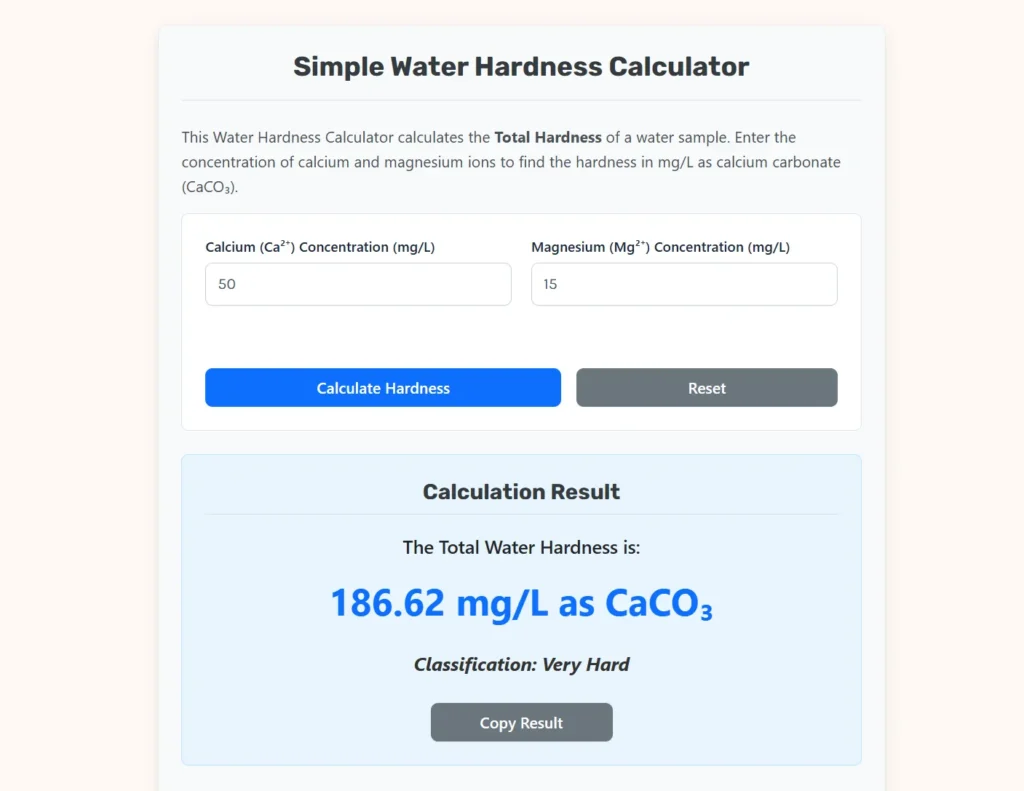
This Water Hardness Calculator calculates the Total Hardness of a water sample. Enter the concentration of calcium and magnesium ions to find the hardness in mg/L as calcium carbonate (CaCO₃).
What is Water Hardness?
The Minerals in Your Water
Water hardness is a measure of the amount of dissolved minerals in water, specifically calcium (Ca²⁺) and magnesium (Mg²⁺). While not a health risk, hardness can cause various issues.
Effects of Hard Water
- Soap Scum: Hard water reacts with soap to form a sticky residue, reducing the soap’s lathering ability and leaving a film on skin, hair, and surfaces.
- Limescale: When hard water is heated, the minerals can precipitate out of the water and form a hard, chalky deposit called limescale. This can clog pipes, reduce the efficiency of water heaters, and damage appliances.
How This Calculator Works
The “As Calcium Carbonate” Standard
Since both calcium and magnesium contribute to hardness, we need a single, uniform way to express the total. The industry standard is to report hardness as an “equivalent” amount of calcium carbonate (CaCO₃).
This calculator converts the concentration of each ion into its CaCO₃ equivalent using the ratio of their molar masses:
Total Hardness = ([Ca²⁺] × 2.50) + ([Mg²⁺] × 4.12)
Hardness Classification (USGS)
The final value is used to classify the water:
- 0 – 60 mg/L: Soft
- 61 – 120 mg/L: Moderately Hard
- 121 – 180 mg/L: Hard
- > 180 mg/L: Very Hard
The Chemistry of Scale: Measuring Water Hardness
Water is often called the “universal solvent,” meaning it picks up impurities easily. As groundwater moves through soil and rock, it dissolves small amounts of naturally occurring minerals. The two most common minerals found in solution are Calcium ($Ca^{2+}$) and Magnesium ($Mg^{2+}$).
The measure of these dissolved minerals is referred to as Water Hardness. While generally safe to drink, hard water is a nuisance for homeowners and a critical variable for industrial engineers. It prevents soap from lathering, leaves spots on glassware, and, most critically, forms scale deposits that can destroy boilers and plumbing systems.
This calculator translates the raw chemical concentrations of Calcium and Magnesium into a standardized “Total Hardness” value, expressed as equivalent milligrams of Calcium Carbonate per Liter ($mg/L \text{ as } CaCO_3$).
The Mathematical Model: Equivalents
You cannot simply add the mass of Calcium to the mass of Magnesium because their atoms have different weights. To combine them, we must convert them into a common unit. That unit is Calcium Carbonate ($CaCO_3$).
The standard formula used by hydrogeologists is:$$\text{Total Hardness} = 2.50 \times [Ca^{2+}] + 4.12 \times [Mg^{2+}]$$
- $[Ca^{2+}]$: The concentration of Calcium in $mg/L$.
- $[Mg^{2+}]$: The concentration of Magnesium in $mg/L$.
- The Constants: These multipliers account for the ratio of the molar mass of $CaCO_3$ ($100.1 \text{ g/mol}$) to the molar masses of Calcium ($40.1 \text{ g/mol}$) and Magnesium ($24.3 \text{ g/mol}$).
Interpreting the Results: The Hardness Scale
The calculator not only computes the number but also classifies the water. According to the U.S. Geological Survey (USGS), water hardness is categorized as follows:
| Hardness (mg/L as CaCO₃) | Classification | Practical Implications |
| 0 – 60 | Soft | Feels “slippery.” Soap lathers easily. Can be corrosive to pipes if too soft (low pH). |
| 61 – 120 | Moderately Hard | Acceptable for most household uses. Minor scaling may occur over long periods. |
| 121 – 180 | Hard | Soap scum forms. Laundry may feel stiff. Scale buildup visible on faucets. |
| > 180 | Very Hard | Rapid scale accumulation in water heaters. Requires a water softener for appliance longevity. |
Grains per Gallon (gpg) vs. mg/L
You may see hardness reported in “Grains per Gallon” (gpg), especially on older water softener settings.
- 1 gpg = 17.1 mg/L
This calculator outputs in mg/L (which is equivalent to Parts Per Million, or ppm). To convert the result to grains per gallon, simply divide the calculator’s result by 17.1.
Why Only Calcium and Magnesium?
While other polyvalent cations like Iron ($Fe^{2+}$), Manganese ($Mn^{2+}$), and Strontium ($Sr^{2+}$) technically contribute to hardness, they are typically present in such trace amounts that they are negligible for standard calculations. However, if you have high iron water (red staining), it will interfere with water softeners even if the “calculated hardness” seems manageable.
Practical Applications
1. Setting a Water Softener
Water softeners work by ion exchange. To program the unit correctly, you must enter the total hardness.
- Input too low: The softener regenerates too infrequently, letting hard water bleed through.
- Input too high: The softener regenerates too often, wasting salt and water.
2. Aquarium Keeping
Fish and aquatic plants are sensitive to hardness (often referred to as GH or General Hardness in the hobby).
- Soft Water Fish: Discus, Tetras (Amazonian species).
- Hard Water Fish: African Cichlids (Rift Lake species).Using this calculator helps aquarists blend tap water with Reverse Osmosis (RO) water to hit the exact target for their livestock.
3. Coffee Brewing
The Specialty Coffee Association standards recommend a hardness of 50-175 mg/L.
- Too Soft: Coffee tastes flat, sour, or hollow.
- Too Hard: Coffee tastes bitter and chalky; scale ruins the espresso machine boiler.
Frequently Asked Questions (FAQ)
Q: Is hard water bad for my health?
A: Generally, no. The World Health Organization states there is no convincing evidence that water hardness causes adverse health effects in humans. In fact, hard water can be a supplemental source of dietary calcium and magnesium.
Q: My report says “CaCO3 Hardness.” Do I still use the formula?
A: No. If your report already lists “Total Hardness as CaCO3,” the math has already been done. This calculator is for when you have the separate ion concentrations (Ca and Mg) and need to combine them.
Q: Does boiling water remove hardness?
A: It removes Temporary Hardness (bicarbonates) by precipitating them out as scale, but it does not remove Permanent Hardness (sulfates/chlorides). Boiling is not an effective way to soften water for household use.
Scientific Reference and Citation
For the definitive standards on water quality parameters:
Source: United States Geological Survey (USGS). “Water-Quality Information: Water Hardness and Alkalinity.”
Relevance: This is the primary federal source defining the hardness classification scale used by municipalities and environmental engineers across the United States.
Video explains Water Hardness
this educational video explains more about the subject: