Wainscoting & Board and Batten Calculator
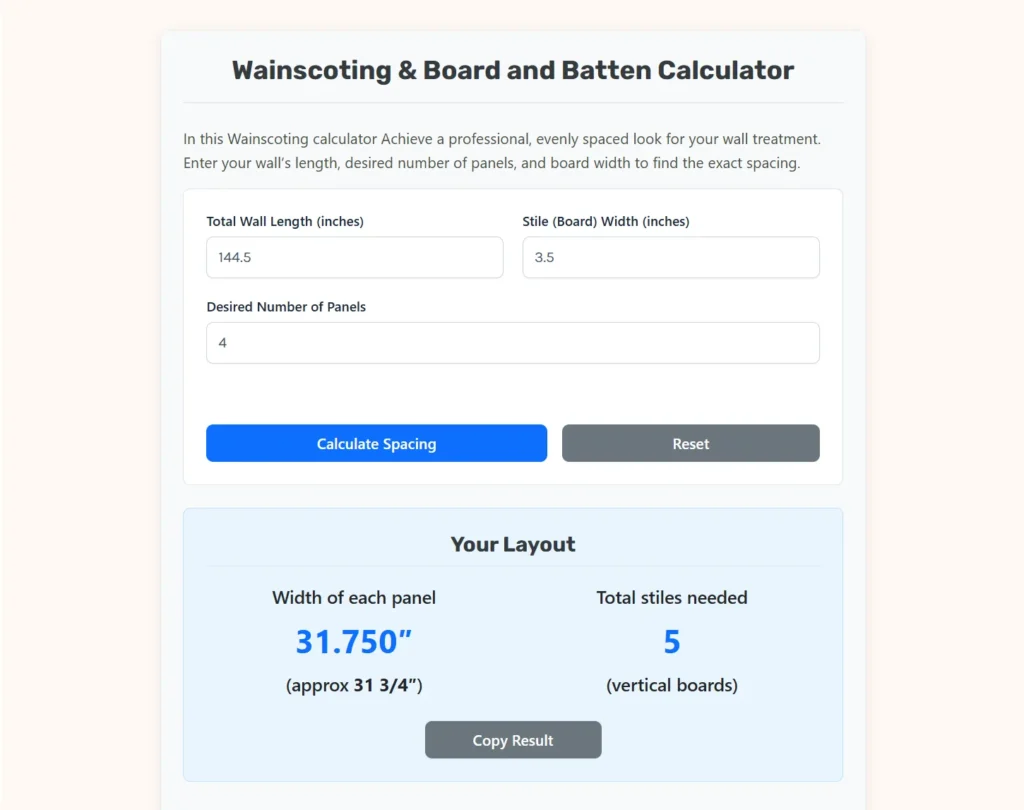
In this Wainscoting calculator Achieve a professional, evenly spaced look for your wall treatment. Enter your wall’s length, desired number of panels, and board width to find the exact spacing.
Understanding the Layout
Key Terminology
- Stile: The vertical boards or battens that create the frame.
- Panel: The space on the wall between two stiles. This is the dimension you need for perfectly even spacing.
- Rail: The horizontal boards at the top (top rail) and bottom (baseboard/bottom rail) of the wainscoting.
How It’s Calculated
The Spacing Formula
The math is designed to ensure every panel on your wall is exactly the same width.
- Count the Stiles: For a standard wall that starts and ends with a stile, the number of stiles is always one more than the number of panels.
Total Stiles = Number of Panels + 1 - Calculate Space Used by Stiles: We find the total width taken up by all the vertical boards.
Total Stile Width = Total Stiles × Stile Width - Find Remaining Space: This amount is subtracted from the total wall length to find the total space available for all panels.
Remaining Space = Wall Length - Total Stile Width - Determine Panel Width: The remaining space is divided equally among the number of panels you want.
Panel Width = Remaining Space ÷ Number of Panels
The Mathematics of Elegance: Perfectly Spaced Wainscoting
Wainscoting, specifically the Board and Batten style, is a timeless architectural detail that adds depth and character to a room. However, the difference between a professional installation and an amateur one lies entirely in the math. Uneven panel sizes or a stile landing awkwardly in a corner can ruin the visual symmetry.
This Wainscoting Calculator serves as a layout engine. It solves the classic “Fencepost Error” problem: determining how to space vertical boards (stiles) evenly across a fixed wall length so that every single panel is identical in width.
The Layout Logic: Solving the Fencepost Problem
To use this tool effectively, visualize your wall not as a blank canvas, but as a series of alternating voids (panels) and solids (stiles).
The calculator assumes a standard, symmetrical layout:
- Start with a Stile: The wall begins with a vertical board in the left corner.
- End with a Stile: The wall ends with a vertical board in the right corner.
- Repeat: Panels and stiles alternate in between.
The Relationship:
If you want $N$ panels, you mathematically need $N + 1$ stiles.
- Example: 1 Panel requires 2 Stiles (left and right). 3 Panels require 4 Stiles.
The Algorithm
The calculator performs the following operations to derive the exact spacing:
- Calculate Total Stile Width:$$W_{stiles} = (N_{panels} + 1) \times \text{Stile Width}$$This represents the total horizontal wall space occupied by the wood itself.
- Calculate Remaining Space:$$\text{Space}_{void} = \text{Total Wall Length} – W_{stiles}$$This is the “empty” space that needs to be divided into panels.
- Determine Panel Width:$$\text{Panel Width} = \text{Space}_{void} \div N_{panels}$$
Critical Inputs for Precision
1. Wall Length
Measure the total length of the wall from corner to corner.
- Tip: Measure at the height of the wainscoting (e.g., 4 feet up), not just at the floor. Walls are rarely perfectly plumb; use the smallest measurement if there is a discrepancy to avoid gaps.
2. Stile Width
This is the actual width of the vertical board you are purchasing.
- Nominal vs. Actual: A “1×4” board is not 4 inches wide; it is 3.5 inches wide. Always measure your material with a tape measure before inputting this value. Entering “4” instead of “3.5” will throw off your layout by several inches across a long wall.
3. Desired Panels
This is the design variable. You adjust this number until you find a panel width that looks aesthetically pleasing.
- The Golden Ratio: A good rule of thumb is to aim for panels that are taller than they are wide (portrait orientation), often mimicking the ratio of the windows in the room.
Interpreting the Results
The calculator provides two critical outputs:
- Panel Width: This is your “spacer” dimension. Cut a piece of scrap wood to this exact length. You will use this spacer to place every single stile, ensuring perfectly consistent gaps without measuring every time.
- Total Stiles: This tells you exactly how many vertical boards you need to buy/cut for that specific wall.
Dealing with Obstacles (Outlets and Windows)
Real walls have interruptions. A common frustration is calculating a perfect layout, only to find a stile lands directly on top of an electrical outlet.
The Adjustment Strategy:
- Run the calculator with your initial guess (e.g., 5 panels).
- Mark the stile locations on the wall with painter’s tape.
- If a stile hits an outlet, change the “Desired Number of Panels” in the calculator to 4 or 6.
- Recalculate. Changing the panel count shifts the location of every stile, often moving the conflict away from the outlet.
Frequently Asked Questions (FAQ)
Q: What if my wall length is a decimal?
A: Precision is key. Enter 144.5 for 144 and 1/2 inches. The calculator handles decimals accurately.
Q: Does this calculate the rails (horizontal boards)?
A: No. This tool calculates the vertical spacing. The top rail and bottom rail (baseboard) run the full length of the wall and are separate from this calculation.
Q: What if I don’t want a stile in the corner?
A: The math changes. If you are abutting another wall that already has a corner piece, you might need $N$ stiles instead of $N+1$. In that case, subtract one stile width from your “Total Wall Length” input to trick the calculator into solving for the remaining space correctly.
Scientific Reference and Citation
For a deeper dive into architectural proportions and the classical orders that dictate traditional molding layouts:
Source: Ware, W. R. (1994). “The American Vignola: A Guide to the Making of Classical Architecture.” Dover Publications.
Relevance: This text is a reprint of the classic 1904 guide. It outlines the mathematical ratios used in classical architecture for pedestals, columns, and paneling, providing the historical context for why certain wainscoting proportions feel “correct” to the human eye.
Video explains Wainscoting
here is some extra information’s about this subject: