Use Vinyl Fence Cost Calculator
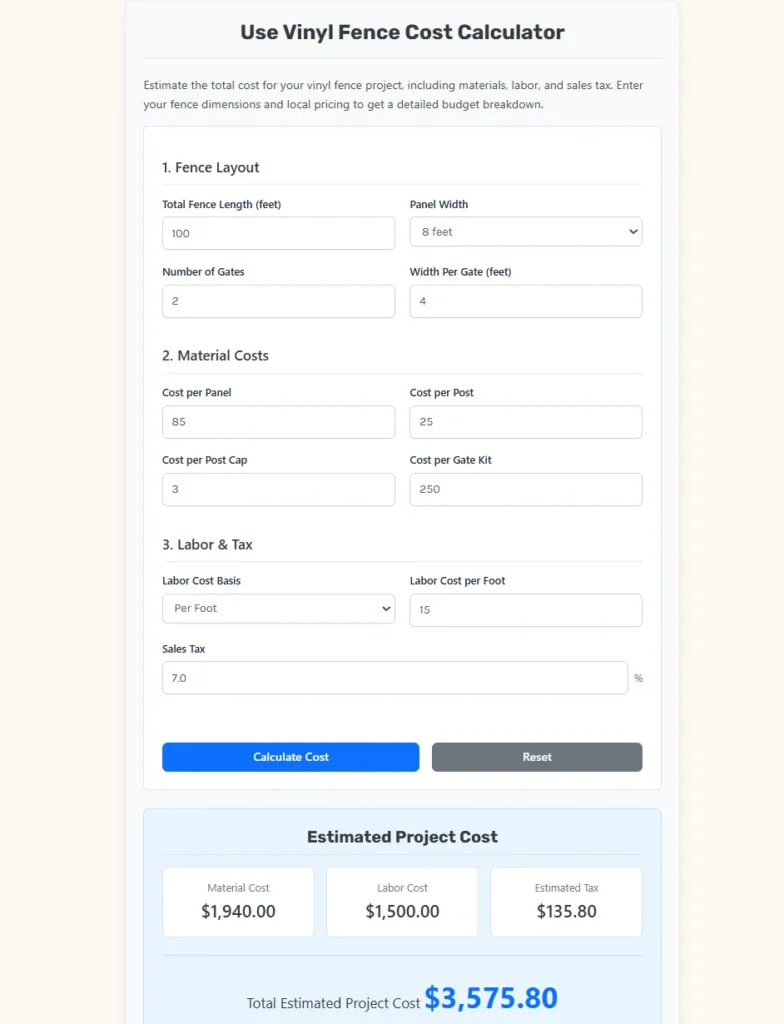
Estimate the total cost for your vinyl fence project, including materials, labor, and sales tax. Enter your fence dimensions and local pricing to get a detailed budget breakdown.
Other Factors That Influence Cost
What This Calculator Doesn’t Include
This estimate is for a straightforward installation on flat, clear ground. Remember to budget for other potential costs:
- Old Fence Removal: Disposing of an existing fence will add to labor costs.
- Ground Conditions: Rocky, hard-to-dig soil will increase labor time and may require special equipment.
- Permits: Your city or HOA may require permits for fence installation, which have associated fees.
- Extra Hardware: This includes concrete for setting posts, screws, and gate hardware if not included in the kit.
The Economics of Privacy: Estimating Vinyl Fence Costs
Vinyl (PVC) fencing is a significant investment in property value. While the upfront cost is higher than wood, its longevity and lack of maintenance often make it cheaper over a 20-year lifecycle. However, the initial sticker shock can be daunting.
This Vinyl Fence Cost Calculator serves as a project estimator. It breaks down the total cost into its constituent parts: the hard materials (panels, posts, gates), the soft costs (labor), and the inescapable taxes. By itemizing these expenses, homeowners can audit contractor quotes or plan a DIY budget with precision.
Deconstructing the Bill of Materials
To get an accurate estimate, you need accurate unit prices. Prices vary wildly by region and quality (e.g., “box store” vinyl vs. “professional grade” vinyl).
1. The Panels
- Standard: $60 – $100 per panel.
- Premium: $120 – $200 per panel (thicker walls, textured “wood grain”).
- The Math: The calculator determines the integer number of panels needed to cover the length and multiplies by your input price.
2. The Posts
- Line/End Posts: $20 – $40 each.
- Gate Posts: $50 – $100 each (these require internal aluminum stiffeners to support the weight of the gate).
- The Math: $N_{panels} + N_{gates} + 1$.
3. The Gates
- Cost: $200 – $500 per gate kit.
- Hidden Cost: Gates are the most expensive single item. Adding a second gate for convenience can increase the project cost by $500+ once labor is factored in.
The Labor Factor: Per Foot vs. Lump Sum
Labor is often 50% of the total project cost. This calculator offers two ways to estimate it:
- Per Foot: The industry standard for quick estimates.
- Low End: $10 – $15 per linear foot (simple soil, flat ground).
- High End: $25 – $40 per linear foot (rocky soil, hills, removal of old fence).
- Total Project: Use this if you have a flat quote from a handyman or if you are doing it DIY (enter $0 or the cost of pizza/beer for your helpers).
Hidden Costs to Consider
While the calculator covers the main components, a true budget must account for the “invisible” costs.
- Concrete: You need 1-2 bags per post. At $5/bag, a 20-post fence adds $150 in concrete alone.
- Permits: Most municipalities require a fence permit, costing $50 – $200.
- Auger Rental: If DIYing, renting a power auger costs $100/day.
- Disposal: If replacing an old fence, dump fees for the old wood/chain link can run $200 – $500.
DIY vs. Pro Installation
Is it worth doing yourself?
- Pros: You save the Labor Cost (potentially thousands).
- Cons: Digging holes is back-breaking work. Setting posts perfectly plumb and in a straight line is a skill that takes time to master. Vinyl is unforgiving; if a post is off by 1 inch, the rail won’t snap in.
Financial Analysis:
If the calculator shows Materials = $2,000 and Labor = $2,000, ask yourself: Is my weekend time and physical health worth $2,000?
Frequently Asked Questions (FAQ)
Q: Why is professional installation so expensive?
A: You aren’t just paying for digging. You are paying for the warranty, the insurance (in case they hit a gas line), and the efficiency of a crew that can do in 2 days what would take you 2 weekends.
Q: Does color affect price?
A: Yes. White is the cheapest. Tan/Beige is typically 10-15% more. Darker colors (Gray/Clay) require special UV inhibitors to prevent fading and warping, often costing 20-30% more than white.
Q: How do I find the “Cost per Panel”?
A: Check the website of your local big-box store or fencing supply distributor. Use the price of a 6ft high x 8ft wide privacy panel as your baseline for a standard fence.
Scientific Reference and Citation
For construction cost estimating standards:
Source: RSMeans Data. “Residential Repair & Remodeling Costs.” Gordian.
Relevance: RSMeans is the North American standard for construction cost estimation. Contractors and insurance adjusters use their databases to determine fair market value for labor rates and material costs by zip code.
Video about Vinyl Fence Cost
more Information here: