Vapor Pressure Deficit VPD Calculator
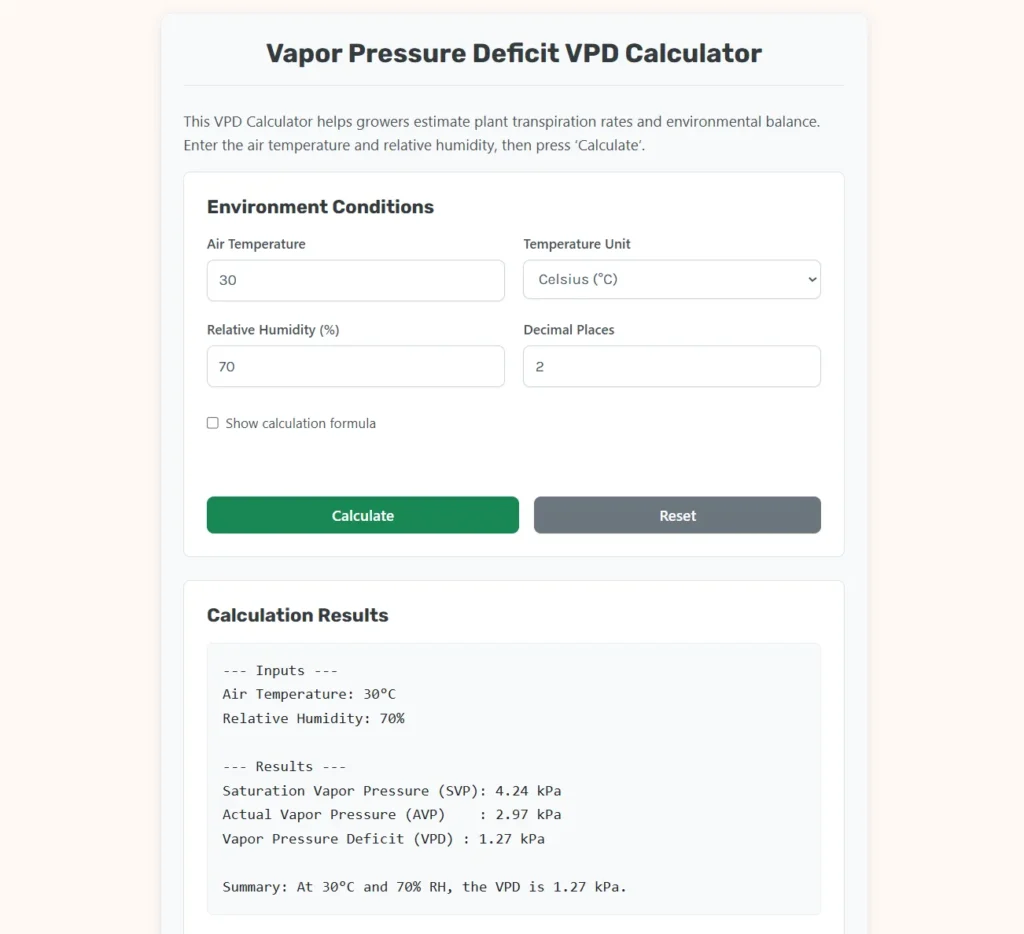
This VPD Calculator helps growers estimate plant transpiration rates and environmental balance. Enter the air temperature and relative humidity, then press ‘Calculate’.
Understanding VPD
Vapor Pressure Deficit (VPD) is a key metric for optimizing plant growth. It represents the “drying power” of the air. A low VPD means the air is humid, reducing transpiration. A high VPD means the air is dry, increasing transpiration, which can stress the plant if too high.
Example Calculation
For an environment at 25°C with 70% relative humidity:
- Saturation Vapor Pressure (SVP): At 25°C, the air can hold about 3.17 kPa of water vapor.
- Actual Vapor Pressure (AVP): With 70% RH, the air currently holds 3.17 kPa × 0.70 = 2.22 kPa.
- Vapor Pressure Deficit (VPD): The deficit is 3.17 kPa – 2.22 kPa = 0.95 kPa.
A VPD between 0.8 and 1.2 kPa is generally considered a good range for healthy vegetative growth in many plant species.
Mastering Vapor Pressure Deficit (VPD)
In the precision agriculture and horticulture industries, “humidity” is a metric of the past. Advanced growers, botanists, and environmental control engineers rely on Vapor Pressure Deficit (VPD).
This VPD Calculator is not just a humidity converter; it is a tool for measuring the “drying power” of the atmosphere. It calculates the difference between the amount of water vapor the air can hold at saturation and the amount it currently holds. This pressure difference is the exact force that pulls water through a plant—from the roots, up the xylem, and out the stomata.
The Physics: Capacity vs. Load
To understand VPD, you must understand the relationship between air, temperature, and water.
1. Saturation Vapor Pressure (SVP)
Air is like a sponge. The warmer the air, the bigger the sponge becomes. SVP represents the maximum pressure water vapor would exert if the air were 100% saturated at a specific temperature.
- Cold Air: Small sponge (Low SVP).
- Hot Air: Giant sponge (High SVP).
This calculator uses the Magnus Formula to determine this limit:$$SVP = 0.6108 \times \exp\left(\frac{17.27 \times T}{T + 237.3}\right)$$
(Where $T$ is temperature in Celsius and the result is in kilopascals).
2. Actual Vapor Pressure (AVP)
This is the amount of water actually in the air right now. It is derived from the Relative Humidity ($RH$).$$AVP = SVP \times \frac{RH}{100}$$
3. The Deficit (VPD)
This is the gap between the two.$$VPD = SVP – AVP$$
If the VPD is zero, the air is saturated (100% RH). There is no room for more water, so water cannot evaporate. If the VPD is high, there is a massive vacancy for water molecules, creating a strong vacuum effect on any wet surface—including plant leaves.
Why Relative Humidity (RH) Is Misleading
Why not just use a hygrometer measuring percentages? Because Relative Humidity is relative to temperature.
- Scenario A: 20°C at 50% RH.
- Scenario B: 35°C at 50% RH.
A novice grower might think these conditions are identical because the humidity is “50%.” However, the air in Scenario B has a vastly higher capacity to hold water. Consequently, the “suction” force on the plant in Scenario B is much more aggressive than in Scenario A, potentially causing the plant to wilt even though the “humidity” looks the same. VPD standardizes this metric into a single, absolute pressure value (kPa).
Plant Physiology and the VPD “Sweet Spot”
Plants manage their water loss through microscopic pores called stomata
- Low VPD (< 0.4 kPa): The air is too humid. The “sponge” is full. Transpiration (water movement) slows to a halt. Without transpiration, calcium and other immobile nutrients cannot be pulled up from the roots. Result: Mold, rot, and nutrient deficiencies.
- High VPD (> 1.6 kPa): The air is too dry. The “sponge” is pulling water out of the leaf faster than the roots can replace it. The plant protects itself by closing its stomata. Result: Stopped photosynthesis (CO2 cannot enter closed stomata), wilting, and tip burn.
- The Goldilocks Zone (0.8 – 1.2 kPa): The pressure is just right. Stomata remain fully open to absorb CO2, while water flows steadily through the plant, delivering nutrients and cooling the leaves.
Target VPD Ranges by Growth Stage
Different stages of plant life require different environmental stresses. Use this guide to interpret your calculator results:
| Growth Stage | Ideal VPD Range | Biological Goal |
| Propagation / Clones | 0.4 – 0.8 kPa | Clones have no roots. High humidity (low VPD) minimizes water loss while they focus energy on root development. |
| Vegetative | 0.8 – 1.1 kPa | Robust growth requires high metabolic activity. A moderate VPD encourages steady transpiration and rapid nutrient uptake. |
| Flowering / Fruit | 1.2 – 1.5 kPa | Lower humidity (higher VPD) is preferred to prevent fungal pathogens like Botrytis (bud rot) inside dense canopy structures. |
Practical Application for Growers
1. HVAC Calibration
If you calculate a high VPD (e.g., 2.0 kPa), you know you need to add moisture. Turning on a humidifier is the obvious fix, but lowering the temperature is often more effective because it shrinks the SVP (the capacity of the air).
2. Leaf Temperature Offset (LTO)
This calculator assumes leaf temperature is equal to air temperature. In reality, transpiring leaves are often 1-2°C cooler than the surrounding air due to evaporative cooling. Professional growers use an infrared thermometer to measure leaf temperature and adjust the VPD calculation slightly to account for the microclimate at the leaf surface.
3. Nighttime Management
Plants “rest” at night. Transpiration isn’t necessary for photosynthesis (as there is no light). Therefore, allowing VPD to drop slightly lower at night allows the plant to rehydrate, provided it doesn’t drop low enough to encourage dew formation.
Frequently Asked Questions (FAQ)
Q: Why is the result in kilopascals (kPa)?
A: The pascal is the SI unit of pressure. Kilopascals provide a convenient scale where 1.0 represents a standard, balanced atmosphere for biology. Some older charts use millibars (mb), where 1 kPa = 10 mb.
Q: Can I calculate VPD from Dew Point?
A: Yes. Dew Point is simply another way of expressing Actual Vapor Pressure. If you know the Dew Point and the Air Temperature, you can derive the VPD without knowing the Relative Humidity.
Q: Why does the calculator show negative VPD?
A: Mathematically, VPD cannot be negative. The lowest it can go is zero (saturation). If a calculation suggests a negative number, it usually implies a measurement error where the inputs describe a physically impossible state (like having more water in the air than the air can physically hold).
Scientific Reference and Citation
For the seminal research regarding water relations in controlled environments:
Source: Prenger, J.J., & Ling, P.P. (2000). “Greenhouse Condensation Control: Understanding and Using Vapor Pressure Deficit (VPD).” Ohio State University Extension Fact Sheet.
Relevance: This publication is a cornerstone of modern horticultural engineering. It details the derivation of the VPD formulas and provides the foundational guidelines for managing crop health through pressure deficit manipulation rather than simple humidity percentages.
VPD chart E-book Guide
You can download VPD chart E-book Guide here.