Tree Diameter Calculator
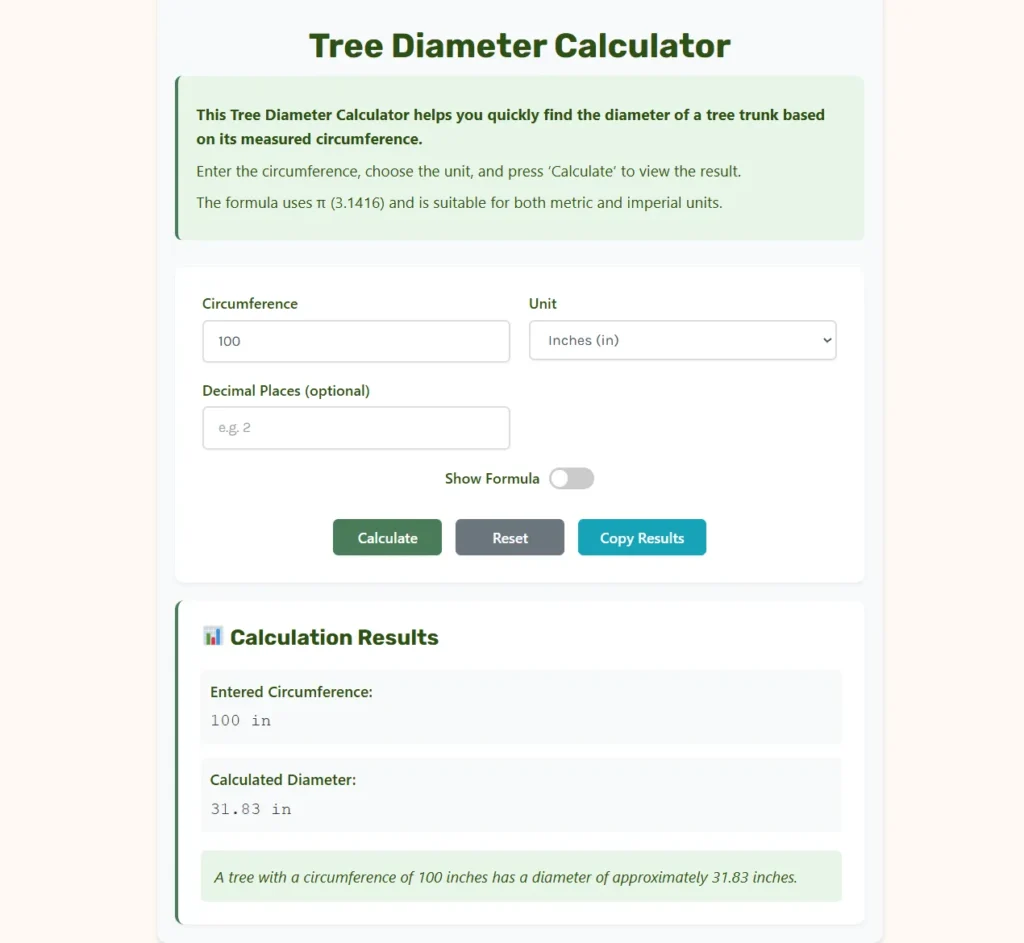
This Tree Diameter Calculator helps you quickly find the diameter of a tree trunk based on its measured circumference.
Enter the circumference, choose the unit, and press ‘Calculate’ to view the result.
The formula uses π (3.1416) and is suitable for both metric and imperial units.
The Geometry of Forestry: Converting Girth to Diameter
In the world of arboriculture and forestry, the physical dimensions of a tree are more than just numbers; they are indicators of health, age, volume, and economic value. While the circumference (the distance around the trunk) is the easiest dimension to measure physically, the diameter (the distance through the center) is the standard metric used for scientific calculations, timber estimation, and construction planning.
This Tree Diameter Calculator serves as a digital bridge between the physical act of measuring girth and the analytical requirement of knowing the diameter. By applying the fundamental laws of geometry to organic structures, we can derive precise data without the need for specialized forestry equipment like calipers or diameter tapes.
The Mathematical Foundation
At the core of this tool is one of the oldest and most important constants in mathematics: Pi ($\pi$).
Trees, while rarely perfect circles, are biologically programmed to grow radially. This radial symmetry allows us to model a tree trunk as a cylinder. Therefore, the relationship between the trunk’s girth and its thickness is governed by the circle formula:
$$C = \pi \times d$$
Where:
- $C$ represents the Circumference.
- $d$ represents the Diameter.
- $\pi$ is the constant ratio, approximately 3.14159.
To find the diameter when the circumference is known, we rearrange the equation:
$$d = \frac{C}{\pi}$$
This calculation is what the tool above performs instantly. While a manual calculation using $3.14$ is often “close enough” for a backyard estimate, this calculator utilizes a more precise float value for $\pi$, ensuring that errors do not compound when measuring massive specimen trees.
The Standard of Measurement: Diameter at Breast Height (DBH)
To ensure consistency across the globe, foresters and arborists do not measure trees at random heights. The universal standard is known as DBH, or Diameter at Breast Height.
Understanding DBH is essential because almost all data regarding tree health, age, and value is calibrated to this specific height. If you measure at the ground, root flare will distort your data. If you measure too high, the natural taper of the trunk will result in an underestimation.
The 4.5-Foot Rule
In the United States and countries using the Imperial system, DBH is strictly defined as the diameter of the trunk measured at 4.5 feet (1.37 meters) above the ground level on the uphill side of the tree.
Why this specific height?
- Ergonomics: It is a comfortable height for most adults to measure without bending or stretching.
- Avoidance of Buttress Roots: Most trees have a “flare” at the base where roots enter the ground. Measuring above this flare provides a more accurate representation of the stem’s actual volume.
- Understory Clearance: This height is typically above the dense brush and undergrowth found in natural forests, making the trunk accessible.
Critical Note for Users: When using this calculator to input circumference, ensure your tape measure was wrapped around the tree at exactly 4.5 feet from the ground to obtain a valid DBH result.
Complex Measurement Scenarios
Nature is rarely uniform. While the calculator handles the math perfectly, the quality of the result depends on the quality of the input measurement. Trees often grow on slopes, lean, or split into multiple stems, creating challenges for standard measurement.
Refer to this guide for handling irregularities to ensure your calculator input is accurate:
| Scenario | Correct Measurement Technique |
| Trees on Slopes | Always measure 4.5 feet up from the ground on the uphill side of the tree. Measuring from the downhill side will result in a measurement that is effectively too low on the trunk (inflating the size). |
| Leaning Trees | Measure 4.5 feet up the trunk along the axis of the lean. The measurement should be taken at a right angle (perpendicular) to the trunk, not perpendicular to the ground. |
| Swelling or Bumps | If a burl, branch whorl, or canker exists exactly at 4.5 feet, move the measurement point to the narrowest point of the trunk immediately above or below the deformity. |
| Multi-Stemmed Trees | If the tree splits below 4.5 feet, measure each stem individually as if they were separate trees. If the fork is above 4.5 feet, measure it as a single tree below the swelling of the fork. |
| Obstructions | If vines or heavy moss cover the trunk, they must be gently moved aside or accounted for. A thick layer of ivy can add several inches to the circumference, significantly skewing the calculated diameter. |
The Importance of Diameter in Arboriculture
Why do we convert circumference to diameter? Why not just stick with girth? The preference for diameter in the scientific community is driven by several practical applications.
1. Calculation of Basal Area
In forestry ecology, Basal Area is the cross-sectional area of a tree trunk. It is used to determine the density of a forest stand. Basal area is derived directly from the diameter.
$$Area = \pi \times (\frac{d}{2})^2$$
Foresters use this to decide if a forest is overcrowded and needs thinning to reduce competition for light and nutrients.
2. Critical Root Zone (CRZ) Determination
For construction projects near trees, protecting the root system is paramount. The protected area is calculated based on the diameter. A common rule of thumb is the “foot per inch” rule: for every inch of trunk diameter, there should be one foot of protected radius from the trunk.
- Example: A tree with a 20-inch diameter (calculated from a ~63-inch circumference) requires a protection zone with a 20-foot radius.
3. Lumber Volume Estimation
The lumber industry relies on the “Doyle Scale” or “Scribner Scale” to estimate how many “board feet” of timber can be produced from a log. These scales are exclusively based on the diameter inside the bark at the small end of the log. While standing tree measurement differs slightly, the diameter is the primary variable in predicting yield.
4. Tree Age Estimation
As detailed in other tools, the Growth Factor Method for estimating tree age relies on multiplying the diameter by a species-specific coefficient. Using circumference directly would require a much more complex set of multipliers.
Tools of the Trade vs. The Calculator
Professional foresters often use a specialized tool called a Diameter Tape (D-tape).
- How a D-tape works: One side of the tape has standard inch markings. The other side has markings that are “stretched” by a factor of $\pi$ ($3.14$). When the forester wraps the tape around the tree, they read the “stretched” side, which automatically performs the division, showing the diameter directly.
- How this Calculator works: It serves as a digital D-tape. It allows you to use a standard sewing tape, construction tape, or even a piece of string and a ruler, to achieve the same result without purchasing specialized equipment. This makes it an invaluable tool for homeowners, hobbyists, and students who do not carry forestry gear.
Accuracy Considerations: The Bark Factor
When using this tool, remember that the result represents the Diameter Outside Bark (DOB).
For biological studies or timber sales, the Diameter Inside Bark (DIB) is often required, as the bark itself is not usable wood.
- Thick-barked species: Trees like Cottonwood, Sequoia, or mature Oaks can have bark that is 1 to 3 inches thick.
- Thin-barked species: Trees like Beech, Birch, or Cherry have very thin bark.
To estimate DIB from the calculator’s result, one would typically subtract the estimated bark thickness (doubled) from the total diameter.
$$DIB = DOB – (2 \times \text{Bark Thickness})$$
For general landscaping, aesthetic, and age estimation purposes, the Diameter Outside Bark (DOB) calculated here is the correct and standard metric.
Glossary of Terms
To fully utilize the data provided by this calculator, familiarity with these terms is beneficial:
- Bole: The main trunk or stem of the tree.
- Caliper: A specialized instrument with two parallel arms used to measure diameter directly. Often used for smaller nursery trees (under 6 inches).
- Meristem: The tissue in most plants containing undifferentiated cells (meristematic cells), found in zones of the plant where growth can take place.
- Secondary Growth: The growth that results from cell division in the cambial, causing the stems and roots to thicken. This is what increases diameter over time.
- Recruitment: The process of small trees growing large enough to be measured during a forest inventory (usually crossing a specific diameter threshold).
Scientific Reference and Citation
For those seeking to deepen their understanding of forest biometrics and measurement standards, the following source provides the authoritative protocols used by government and scientific bodies.
- Relevance: This document outlines the federally mandated procedures for measuring DBH, handling irregularities in trunk shape, and classifying tree conditions. It establishes the 4.5-foot standard used in this calculator’s methodology.
video explains Tree Diameter
here are more explain for this subject: