Use Ramp Slope Calculator
Calculate the gradient, ratio, and angle of a ramp to ensure safety and compliance with building standards.
Ramp Slope Standards
ADA Accessibility (USA)
For commercial use, the Americans with Disabilities Act (ADA) requires a maximum slope of 1:12. This means for every 1 unit of rise, you need 12 units of run. This is equivalent to an 8.33% slope.
General Comfortable Slopes
- 1:20 (5%): Ideal and very comfortable for all users.
- 1:12 (8.3%): Maximum permitted for commercial ramps.
- 1:10 (10%): Often used for residential but feels steep for manual wheelchair users.
The Formula
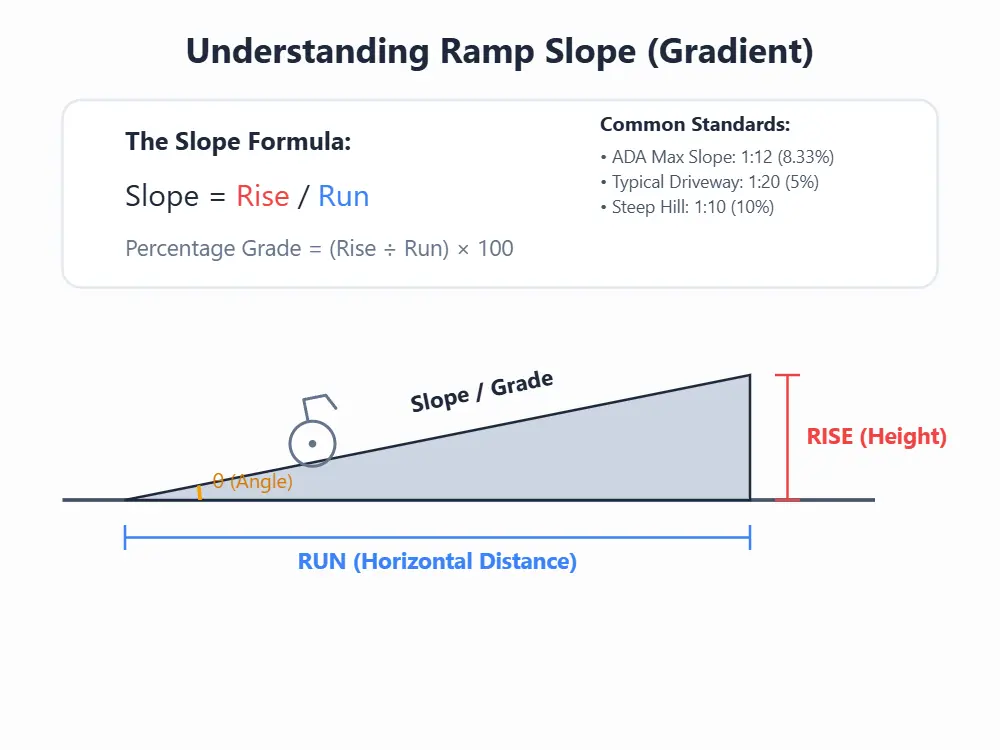
Ramp slope is calculated using the following relationships:
- Percent Slope: (Rise / Run) × 100
- Ratio: 1 : (Run / Rise)
- Angle: tan-1(Rise / Run)
The Geometry of Access: Mastering Ramp Slope Calculations and Compliance
Architectural accessibility is defined by the seamless transition between varying elevations. Whether designing a residential entrance or a sprawling commercial complex, the calculation of a ramp slope is the primary factor determining the safety, usability, and legal compliance of a structure. A ramp is more than a slanted path; it is a precision-engineered inclined plane that must balance the laws of physics with the ergonomic limitations of human mobility.
This guide provides an exhaustive analysis of ramp geometry, the mathematical foundations of slope calculation, and the international standards that govern accessible design. By utilizing the provided calculator, designers and homeowners can bridge the gap between abstract measurements and functional, life-enhancing infrastructure.
Defining the Fundamentals: Rise, Run, and Gradient
To understand how a ramp functions, one must first master the three core components of its geometry. These terms form the basis of every calculation performed by the tool.
- The Rise ($h$): This represents the vertical height change that the ramp must overcome. It is the distance from the lower level to the upper level. Accurate measurement of the rise is critical, as even a quarter-inch discrepancy can significantly alter the required length of the ramp under strict compliance standards.
- The Run ($d$): This is the horizontal distance the ramp covers. In a standard calculation, the run does not account for the diagonal length of the ramp surface itself, but rather the “footprint” on the ground.
- The Slope ($m$): The slope is the relationship between the rise and the run. It can be expressed as a ratio (e.g., 1:12), a percentage (e.g., 8.33%), or an angle (e.g., 4.76 degrees).
$\rightarrow$ Critical Distinction: In professional construction, the “Run” refers to the horizontal projection, while the “Slope Surface” refers to the actual material length. This calculator focuses on the horizontal run to ensure ground-level planning is accurate.
The Core Mathematics of Incline
The calculation of a ramp involves fundamental trigonometry and algebraic ratios. The calculator performs these operations instantly, but understanding the underlying formulas is essential for verification and professional reporting.
1. The Slope Ratio
The ratio is the most common way to describe a ramp in building codes. It is expressed as $1:n$, where $1$ is the unit of rise and $n$ is the corresponding units of horizontal run.$$\text{Ratio} = 1 : \left( \frac{\text{Run}}{\text{Rise}} \right)$$
2. The Slope Percentage
Percentage is often used in civil engineering and landscaping to describe the “grade” of a path.$$\text{Slope Percentage} = \left( \frac{\text{Rise}}{\text{Run}} \right) \times 100$$
3. The Angle of Inclination
For specialized engineering, the angle of the slope (theta) is calculated using the arctangent function. This provides the degree of the slope relative to the horizon.$$\theta = \tan^{-1} \left( \frac{\text{Rise}}{\text{Run}} \right)$$
International Standards and ADA Compliance
The Americans with Disabilities Act (ADA) provides the most widely recognized set of standards for ramp design. These regulations are not arbitrary; they are based on the mechanical torque required for a manual wheelchair user to propel themselves upward and the stability required to prevent tipping backward.
The 1:12 Golden Rule
For public accommodations and commercial buildings, the ADA mandates a maximum slope of 1:12.
$\checkmark$ This translates to 1 inch of rise for every 12 inches of run.
$\checkmark$ In percentage terms, this is 8.33%.
$\checkmark$ In degrees, this is approximately 4.76°.
Beyond the Maximum: Preferred Slopes
While 1:12 is the legal maximum, it is often considered the “steepest” acceptable path. For users with limited upper-body strength or for areas prone to ice and rain, a shallower slope is preferred.
| Slope Ratio | Percentage | Description |
| 1:20 | 5.00% | The “Ideal” slope; often classified as a walkway rather than a ramp. |
| 1:16 | 6.25% | A comfortable, low-effort incline for most manual wheelchair users. |
| 1:12 | 8.33% | The legal maximum for ADA compliance in commercial settings. |
| 1:10 | 10.00% | Permissible in some residential settings, but requires high effort. |
| 1:8 | 12.50% | Generally unsafe for independent wheelchair use; restricted to very short rises. |
Why the 1:12 Ratio is the Industry Standard
The science behind the 1:12 ratio involves the center of gravity and the coefficient of friction. When a wheelchair occupies an incline, the user’s center of mass shifts toward the rear wheels. If the slope exceeds 1:12, the risk of a “rear-tip” accident increases exponentially, especially during the initial push phase where the user applies maximum force to the handrims.
Furthermore, the descent on a ramp steeper than 1:12 poses significant dangers. A user’s ability to control their speed via friction against the handrims is compromised on steeper grades, potentially leading to a loss of control. The 1:12 standard ensures that gravity does not overcome the manual braking capabilities of the average user.
Calculating for Safety: The Role of Landings and Turns
A common error in ramp estimation is forgetting that a ramp is rarely a single, continuous straight line. The ADA and other international codes (such as the UK Part M or Australian AS 1428) require “Rest Landings” to prevent exhaustion and provide safety buffers.
- Maximum Rise Between Landings: In the United States, a single ramp run cannot exceed a rise of 30 inches ($760 \text{ mm}$). If the total rise is 60 inches, you must have at least two ramp runs separated by a level landing.
- Landing Dimensions: Landings must be level and at least as wide as the ramp. A standard landing should be at least $60 \text{ inches} \times 60 \text{ inches}$ to allow a wheelchair user to stop, rest, and turn if necessary.
- Changes in Direction: If a ramp “switches back” or turns 90 degrees, the landing at that turn must be large enough to accommodate the turning radius of a standard wheelchair (typically a 60-inch diameter circle).
Practical Applications and Real-World Scenarios
To illustrate the utility of the calculator, consider the following use cases where precision is non-negotiable.
Case Study 1: The Residential Porch
A homeowner needs to install a ramp for a porch that is 24 inches above the sidewalk.
$\rightarrow$ Using the 1:12 ratio:$$\text{Run} = \text{Rise} \times 12$$$$\text{Run} = 24 \times 12 = 288 \text{ inches (24 feet)}$$
The homeowner discovers they only have 15 feet of straight-line space. The calculator would show that a 15-foot run for a 24-inch rise results in a 1:7.5 ratio (13.3%), which is dangerously steep. The solution would be a “switchback” ramp with a landing in the middle to achieve the necessary 24 feet of run within the 15-foot space.
Case Study 2: The Small Threshold
For a small 2-inch threshold at a storefront, a short “wedge” ramp is needed.
$\rightarrow$ Using the 1:12 ratio:$$\text{Run} = 2 \times 12 = 24 \text{ inches}$$
The calculator confirms that even a small 2-inch bump requires a 2-foot long ramp to remain compliant and safe for a customer using a walker or wheelchair.
Best Practices for Material Selection and Durability
The slope calculation is only the first step. The physical manifestation of that slope must maintain its integrity under various conditions.
- Surface Texture: The ramp surface must be “slip-resistant.” Common materials include brushed concrete, specialized non-slip grip tapes, or expanded metal grates. The steeper the slope (closer to 1:12), the more critical the texture becomes.
- Edge Protection: Ramps and landings with drop-offs must have curbs or “edge protection” to prevent wheelchair casters from slipping off the side. A 2-inch high curb is the standard minimum.
- Handrail Requirements: For any ramp with a rise greater than 6 inches, handrails are required on both sides. These must be continuous and extend 12 inches beyond the top and bottom of the ramp to provide a stable transition point.
- Drainage: For outdoor ramps, a “level” landing is permitted to have a 1:48 slope ($2.08\%$) for water drainage to prevent pooling and ice formation.
Common Mistakes in Ramp Construction
- Measuring the Slope Surface Instead of the Run: As noted, the mathematical ratio is based on the horizontal distance. If you measure 12 feet along the slanted surface for a 1-foot rise, the actual horizontal run is slightly less than 12 feet (calculated via the Pythagorean theorem), meaning your ramp is slightly steeper than 1:12.
$$d = \sqrt{\text{Surface}^2 – h^2}$$ - Ignoring the “Bottom Flare”: The point where the ramp meets the ground must be flush. A “lip” or “bump” at the bottom of a perfectly calculated 1:12 ramp can still stop a wheelchair caster in its tracks.
- Inadequate Width: While the slope might be correct, a ramp that is too narrow (less than 36 inches between handrails) creates a feeling of claustrophobia and increases the risk of hand injuries against the rails.
Environmental Factors and Dynamic Friction
The calculator provides a static geometric result, but real-world variables must be considered.
- Temperature: Metal ramps can expand in heat, potentially causing “bowing” which changes the slope in specific sections.
- Load Bearing: A ramp must support a minimum of 600 pounds to accommodate a heavy power chair and the user. If the ramp flexes under weight, the “instantaneous slope” increases as the user reaches the center of the span.
- Maintenance: Over time, wooden ramps may warp. Regular checks with a digital level are recommended to ensure that the 1:12 ratio has not shifted into a steeper, non-compliant state due to environmental wear.
Scientific Source and Reference
To ensure the highest level of accuracy and legal compliance, always refer to the official documentation provided by governing bodies. The standards mentioned in this guide are derived from the following authoritative source:
Source: United States Access Board. “ADA Accessibility Guidelines (ADAAG) – Chapter 4: Accessible Routes.”
Relevance: This is the primary federal document that defines the legal requirements for ramp slope, width, and landing specifications in the United States. It serves as the scientific and legal basis for accessibility standards globally.
$\rightarrow$ Professional Consultation: While this calculator provides precise mathematical outputs, it is recommended to consult with a certified accessibility specialist or structural engineer for large-scale public projects to ensure all local building codes and “Universal Design” principles are satisfied.
Summary of Best Practices for Beginners and Experts
$\checkmark$ Always aim for the shallowest slope possible: If you have the space for 1:15 or 1:20, take it. Your users will thank you.
$\checkmark$ Measure twice, build once: Verify the total rise at multiple points, as ground levels are rarely perfectly flat.
$\checkmark$ Consider the power source: Manual wheelchair users need shallower slopes than users of high-torque electric power chairs.
$\checkmark$ Integrate landings strategically: Use landings not just for rest, but to navigate around obstacles or change views.
By adhering to these mathematical principles and utilizing our Ramp Slope Calculator, you are contributing to a world that is more inclusive and accessible for everyone. Geometry, when applied with empathy and precision, becomes a tool for human dignity.