Run Prime Number Calculator
In this Prime Number Calculator Quickly check if a number is prime and explore prime number patterns
How to Use
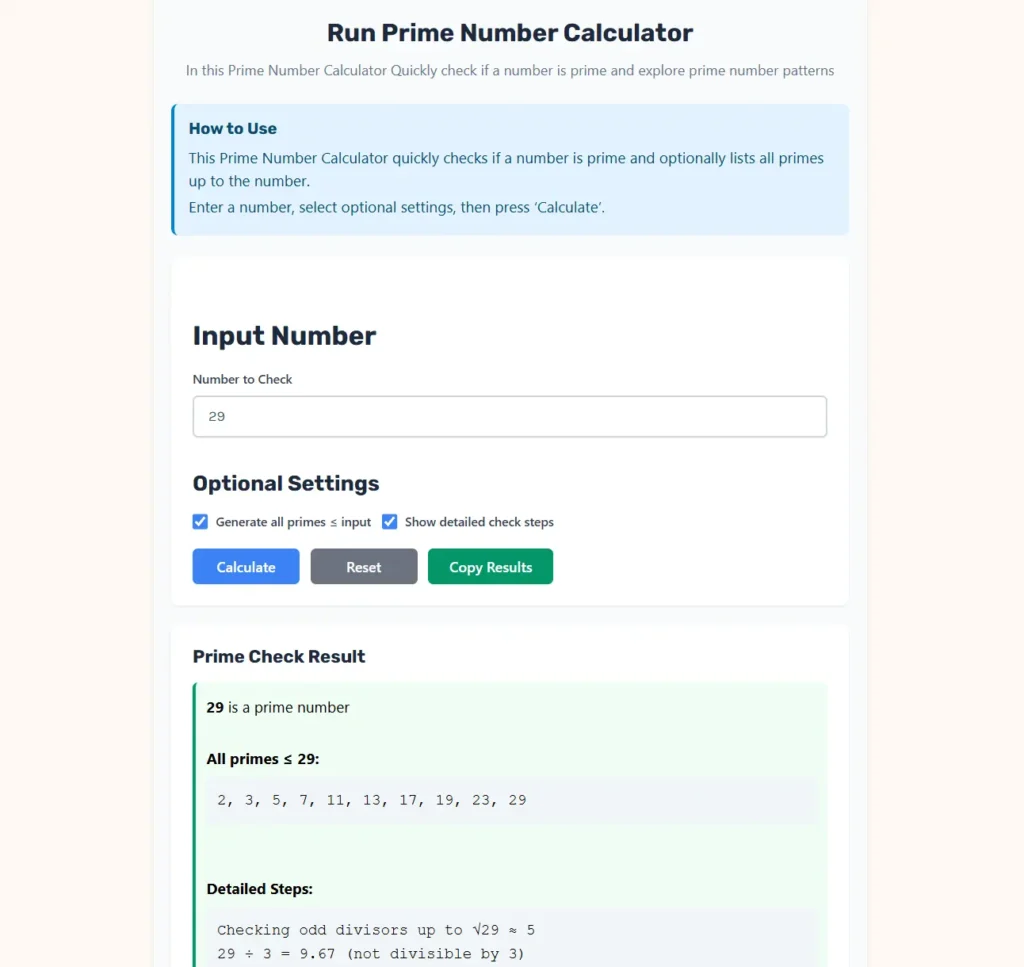
This Prime Number Calculator quickly checks if a number is prime and optionally lists all primes up to the number.
Enter a number, select optional settings, then press ‘Calculate’.
Input Number
Optional Settings
Guide to Primality Testing, Sieve Algorithms, and Cryptographic Applications
Prime numbers serve as the fundamental building blocks of arithmetic. Like chemical elements that combine to form complex molecules, prime numbers are the multiplicative units that construct all positive integers. This mathematical property is formalized as the Fundamental Theorem of Arithmetic, which states that every integer greater than one is either a prime number itself or can be represented as a unique product of prime numbers.
To analyze these mathematical structures, educators, computer scientists, and cryptographers utilize digital diagnostic utilities. A specialized prime number calculator acts as a computational tool to execute primality checks, generate prime sequences, and evaluate modular factors. This guide explores the historical context, algorithmic mechanics, and modern cryptographic applications of prime number theory.
Introduction to Primes and the Foundations of Arithmetic
The study of prime numbers dates back to ancient civilizations, with systematic records appearing in ancient Greek mathematics. Around $300\text{ BCE}$, the mathematician Euclid proved two foundational concepts that continue to shape modern number theory: the infinitude of prime numbers and the unique factorization of composite integers.
To establish a clear mathematical framework, we must define the prime and composite classifications:
$\checkmark$ Prime Numbers: Any positive integer greater than $1$ that has exactly two positive divisors: $1$ and itself.
$\checkmark$ Composite Numbers: Any positive integer greater than $1$ that possesses more than two positive divisors.
$\checkmark$ The Unit (The Number 1): The number $1$ is classified as a unit and is strictly excluded from both the prime and composite categories.
Why the Number One is Excluded from Primes
A common point of confusion for beginners is why the number $1$ is not considered a prime number. If a prime is defined simply as a number divisible only by $1$ and itself, $1$ would seem to qualify. However, modern algebra requires $1$ to be excluded to preserve the uniqueness of prime factorization.
If $1$ were classified as a prime number, the Fundamental Theorem of Arithmetic would fail. For example, we can factor the number $6$ as a product of primes:$$6 = 2 \times 3$$
If $1$ were prime, we could write infinite, non-unique factorizations of $6$:$$6 = 1 \times 2 \times 3$$$$6 = 1 \times 1 \times 2 \times 3$$$$6 = 1^{k} \times 2 \times 3$$
To prevent this loss of uniqueness, mathematicians define $1$ as a unit. Under this definition, prime factorization is unique up to the order of the prime factors.
The Fundamental Theorem of Arithmetic
The structural role of prime numbers is defined by the Fundamental Theorem of Arithmetic. Every integer greater than $1$ can be expressed as a product of prime numbers in exactly one way, regardless of the scale of the integer.
The prime factorization equation is:$$n = \prod_{j=1}^{k} p_{j}^{a_{j}}$$
Where:
- $\rightarrow$ $n$ represents any positive integer greater than $1$.
- $\rightarrow$ $\prod$ represents the product operator.
- $\rightarrow$ $p_{j}$ represents a unique prime factor of the integer $n$.
- $\rightarrow$ $a_{j}$ represents the positive integer exponent of the prime factor $p_{j}$.
- $\rightarrow$ $k$ represents the total number of unique prime factors.
Algorithmic Mechanics of Primality Testing
To check if a number is prime, computer systems must execute algorithms that balance mathematical precision with computational efficiency.
1. Naive Trial Division
The most basic method to check if a number $n$ is prime is naive trial division. Under this approach, the computer tests if $n$ is divisible by every integer from $2$ up to $n – 1$. While conceptually simple, this method is highly inefficient, requiring $O(n)$ operations.
2. Optimized Trial Division
An optimized trial division algorithm improves performance by restricting divisibility checks to the square root of $n$. It also checks divisibility by $2$ first, allowing it to skip all subsequent even divisors.
To understand why we only need to check up to the square root of $n$, consider the following proof.
If $n$ is a composite number, it can be factored into two positive integers:$$n = a \times b$$
Where:
- $\rightarrow$ $n$ represents the composite number being checked.
- $\rightarrow$ $a$ represents the smaller divisor of the pair.
- $\rightarrow$ $b$ represents the larger divisor of the pair.
If both divisors $a$ and $b$ were strictly greater than the square root of $n$:$$a > \sqrt{n}$$$$b > \sqrt{n}$$
Multiplying these two inequalities yields:$$a \times b > \sqrt{n} \times \sqrt{n}$$
Which simplifies directly to:$$a \times b > n$$
This is a contradiction because we established that $a \times b = n$. Therefore, at least one of the divisors must be less than or equal to the square root of the number:$$a \le \sqrt{n}$$
Where:
- $\rightarrow$ $a$ represents the smaller divisor of the pair.
- $\rightarrow$ $n$ represents the target integer being checked.
By restricting our divisibility checks to the square root of the number, the time complexity of the algorithm drops significantly from $O(n)$ to $O(\sqrt{n})$, making it highly efficient for standard numbers.
Generating Prime Sequences: The Sieve of Eratosthenes
While trial division is ideal for checking individual numbers, it is inefficient for generating long lists of prime numbers. To find all primes up to a specific limit $N$, computer systems use a historical algorithm known as the Sieve of Eratosthenes.
The Procedural Steps of the Sieve
Created in ancient Greece, the Sieve of Eratosthenes works by systematically crossing out composite numbers:
- Step 1: Create a list of consecutive integers from $2$ up to $N$.
- Step 2: Let $p$ equal $2$, which is the first prime number.
- Step 3: Starting from $p^2$, mark all multiples of $p$ in the list as composite.
- Step 4: Find the first unmarked number in the list greater than $p$. This number is the next prime. Let $p$ equal this new prime.
- Step 5: Repeat steps 3 and 4 until the square of $p$ is greater than the limit $N$:
$$p^2 > N$$
Where:
- $\rightarrow$ $p$ represents the current prime number being evaluated.
- $\rightarrow$ $N$ represents the upper limit of the prime generation range.
All remaining unmarked numbers in the list are prime. This sieve algorithm operates with an efficient time complexity of:$$O(N \log \log N)$$
Where:
- $\rightarrow$ $N$ represents the upper bound threshold of the sequence.
Modern Applications of Prime Numbers
The unique properties of prime numbers make them essential to several areas of modern technology, particularly cryptography and data management.
1. Public-Key Cryptography (RSA Encryption)
Almost all secure internet communication—including credit card transactions, secure messaging, and online banking—relies on asymmetric encryption algorithms like RSA. The security of RSA is based on a mathematical asymmetry: it is easy to multiply two large prime numbers together, but extremely difficult to factor the resulting product back into its original primes.
The mathematical steps of the RSA algorithm include:
- Step 1: Select two distinct, massive prime numbers $p$ and $q$.
- Step 2: Calculate the public modulus $n$:
$$n = p \times q$$
Where:
- $\rightarrow$ $n$ represents the public modulus used as the encryption key.
- $\rightarrow$ $p$ represents the first massive private prime.
- $\rightarrow$ $q$ represents the second massive private prime.
- Step 3: Calculate Euler’s totient function $\phi(n)$:
$$\phi(n) = (p – 1) \times (q – 1)$$
Where:
- $\rightarrow$ $\phi(n)$ represents the count of integers up to $n$ that are coprime to $n$.
- $\rightarrow$ $p$ represents the first private prime.
- $\rightarrow$ $q$ represents the second private prime.
While computing $n$ is near-instantaneous for a computer, factoring a 2048-bit modulus $n$ back into $p$ and $q$ would require billions of years of computation using modern supercomputers. This mathematical barrier secures the digital world.
2. Hash Tables and Collision Reduction
In computer science, hash tables are used to store and retrieve data quickly. To minimize data collisions (where different keys generate the same index), software engineers set the size of hash tables to prime numbers. Because prime numbers are not divisible by other integers, they reduce repetitive patterns in hash calculations, resulting in a more even distribution of data.
Real-World Calculation Case Studies
To see how these primality checks work in practice, we can analyze three detailed case studies: an odd prime number, a composite number that is often mistaken for a prime, and a larger prime limit sequence.
Case Study A: Checking the Primality of 29
We want to determine if the number $29$ is prime using optimized trial division.
- $\rightarrow$ Input Number ($n$) = $29$
Step 1: Calculate the Maximum Divisor Limit
Find the square root of the input number and round it down:$$\text{Limit} = \lfloor \sqrt{29} \rfloor \approx \lfloor 5.385 \rfloor$$$$\text{Limit} = 5$$
Step 2: Check Divisibility by Permitted Divisors
Test divisibility by all integers from $2$ up to the limit of $5$:
- Check 2:
$$29 \pmod 2 = 1 \quad (\text{not divisible})$$ - Check 3:
$$29 \pmod 3 = 2 \quad (\text{not divisible})$$ - Check 4:Skipped because $4$ is an even number and we already checked $2$.
- Check 5:
$$29 \pmod 5 = 4 \quad (\text{not divisible})$$
Since $29$ is not divisible by any integer up to its square root, we confirm that $29$ is a prime number.
Case Study B: Checking the Primality of 91
We want to check if the number $91$ is prime. This is a classic test case because $91$ is often mistaken for a prime by students due to its odd appearance.
- $\rightarrow$ Input Number ($n$) = $91$
Step 1: Calculate the Maximum Divisor Limit$$\text{Limit} = \lfloor \sqrt{91} \rfloor \approx \lfloor 9.539 \rfloor$$$$\text{Limit} = 9$$
Step 2: Check Divisibility by Permitted Divisors
Test divisibility by the odd integers up to the limit of $9$:
- Check 2:
$$91 \pmod 2 = 1 \quad (\text{not divisible})$$ - Check 3:
$$91 \pmod 3 = 1 \quad (\text{not divisible})$$ - Check 5:
$$91 \pmod 5 = 1 \quad (\text{not divisible})$$ - Check 7:
$$91 \pmod 7 = 0 \quad (\text{divisible})$$
Since $91$ is divisible by $7$ ($7 \times 13 = 91$), it has more than two divisors. Therefore, we confirm that $91$ is a composite number.
Case Study C: Sieve of Eratosthenes Sequence Generation
We want to generate all prime numbers up to a limit of $20$.
- $\rightarrow$ Limit ($N$) = $20$
Step 1: List all numbers from 2 to 20
$$N = [2, 3, 4, \dots, 20]$$
Full Sequence:
$N$: $[2, 3, 4, 5, 6, 7, 8, 9, 10, 11, 12, 13, 14, 15, 16, 17, 18, 19, 20]$
Step 2: Process the first prime, $p = 2$
Mark all multiples of $2$ starting from $2^2 = 4$:
- Cross out $4, 6, 8, 10, 12, 14, 16, 18, 20$.
- Remaining list:
$$[2, 3, \text{x}, 5, \text{x}, 7, \text{x}, 9, \text{x}, 11, \text{x}, 13, \text{x}, 15, \text{x}, 17, \text{x}, 19, \text{x}]$$
Step 3: Process the next unmarked prime, $p = 3$
Mark all multiples of $3$ starting from $3^2 = 9$:
- Cross out $9, 12, 15, 18$. (Note that $12$ and $18$ were already crossed out).
- Remaining list:
$$[2, 3, \text{x}, 5, \text{x}, 7, \text{x}, \text{x}, \text{x}, 11, \text{x}, 13, \text{x}, \text{x}, \text{x}, 17, \text{x}, 19, \text{x}]$$
Step 4: Check if the next prime exceeds the limit
The next unmarked number is $5$. We check the termination condition:$$p^2 > N$$$$5^2 > 20$$$$25 > 20$$
Since the square of $5$ is greater than our limit of $20$, the algorithm terminates. All remaining unmarked numbers are prime.
The generated prime sequence is: [2, 3, 5, 7, 11, 13, 17, 19].
Advanced Primality Tests for High-Performance Computing
For the massive numbers used in modern cryptography (which are often hundreds of digits long), standard trial division is too slow. High-performance computing networks rely on advanced probabilistic and deterministic algorithms:
- Fermat’s Primality Test: Based on Fermat’s Little Theorem, this test checks if a number satisfies a specific modular relationship. While fast, it can occasionally misidentify composite numbers (known as Carmichael numbers) as prime.
- Miller-Rabin Primality Test: A highly efficient probabilistic test used in almost all cryptographic software. It runs multiple rounds of calculations to reduce the probability of a false positive to a negligible level (less than $1 \text{ in } 2^{100}$).
- AKS Primality Test: Developed in $2002$, this was the first algorithm discovered that can prove whether any number is prime in polynomial time without relying on probability.
Academic References and Foundations
This guide is built on the core mathematical principles and algorithmic theories detailed in:
- Hardy, G. H., & Wright, E. M. (2008). An Introduction to the Theory of Numbers. Oxford University Press.
- Cormen, T. H., Leiserson, C. E., Rivest, R. L., & Stein, C. (2009). Introduction to Algorithms. MIT Press.
- For official updates on cryptographic standards, prime generation parameters, and secure key requirements, consult the National Institute of Standards and Technology (NIST) databases.