run pascal triangle calculator
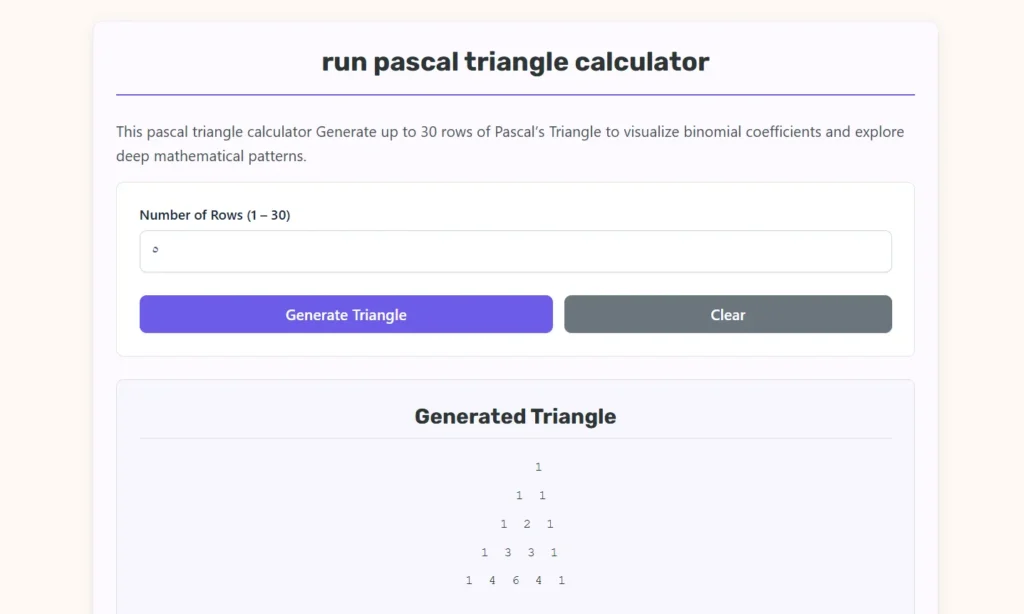
This pascal triangle calculator Generate up to 30 rows of Pascal’s Triangle to visualize binomial coefficients and explore deep mathematical patterns.
Mathematical Foundation
The Construction Rule
Pascal’s Triangle starts with a 1 at the top. Each subsequent number is found by adding the two numbers directly above it. In binomial expansion, it represents the coefficients of (x + y)n.
Binomial Coefficient Formula
The value at row n and column k is calculated using the combination formula:
Where n is the row number (starting at 0) and k is the position in that row. At 30 rows, some values exceed 155,000,000!
Interesting Properties
- Sum of Rows: The sum of all numbers in the n-th row is equal to 2n.
- Sierpinski Gasket: If you color only the odd numbers in the triangle, you reveal a fractal known as the Sierpinski Triangle.
- Fibonacci Sequence: Summing the shallow diagonals of the triangle yields the Fibonacci numbers.
A Master Guide to Pascal’s Triangle
Mathematics is often described as the study of patterns, and few structures embody this definition as elegantly as Pascal’s Triangle. To the casual observer, it appears to be a simple pyramid of numbers. To the mathematician, physicist, or data scientist, it is a vast repository of numerical identities, a bridge between algebra and probability, and a visual representation of the fundamental laws of combinations.
The Pascal Triangle Calculator is a precision instrument designed to reveal these relationships. By generating up to 30 rows of this geometric arrangement, the tool allows for the immediate identification of binomial coefficients and the exploration of complex sequences hidden within the diagonals. This guide serves as an exhaustive technical resource, exploring the historical origins, mathematical derivations, and diverse real-world applications of one of the most famous arrays in human history.
Defining the Conceptual Framework: More Than Just a Triangle
At its most basic level, Pascal’s Triangle is a triangular array of the binomial coefficients. While named after the 17th-century French mathematician Blaise Pascal, historical evidence confirms that scholars in India, Persia (Iran), and China were utilizing this pattern centuries earlier.
$\rightarrow$ The Additive Rule: The construction of the triangle is governed by a simple iterative process. Each number is the sum of the two numbers directly above it in the preceding row.
$\rightarrow$ Symmetry: The triangle is perfectly symmetrical. The values on the left side are a mirror image of the values on the right, centered around a vertical axis.
$\checkmark$ The Boundary of Ones: Every row begins and ends with the integer 1, representing the “unity” from which all other binomial possibilities expand.
Historical Authority: A Global Mathematical Journey
While Western tradition honors Blaise Pascal for his 1653 work Traité du triangle arithmétique, the triangle’s lineage is truly global.
- The Indian Contribution: As early as the 2nd century BCE, the mathematician Pingala described the triangle in the Chandaḥśāstra while studying Vedic prosody and the combinations of long and short syllables.
- The Persian Influence: In the 11th century, Al-Karaji and later Omar Khayyam utilized the triangle to find nth roots of numbers, leading some to refer to it as the “Khayyam Triangle.”
- The Chinese Development: In the 13th century, Yang Hui presented the triangle as a method for summing arithmetic progressions, roughly 400 years before Pascal’s birth.
By using the Pascal Triangle Calculator, you are engaging with a universal logic that has captivated the greatest minds of human civilization for over two millennia.
The Mathematical Engine: Formulas and Combination Logic
The power of the triangle lies in its relationship to the concept of Combinations. In the field of combinatorics, a combination is a selection of items from a larger set where the order of selection does not matter.
1. The Combination Formula (nCr)
The value of any specific entry in the triangle is determined by the “n choose r” formula. This formula identifies how many ways you can choose k elements from a set of n elements.
- n: The row number (starting with 0 at the apex).
- k: The position in the row (starting with 0 at the left).
- !: The factorial symbol (the product of all positive integers up to that number).
2. Binomial Expansion
The triangle provides the coefficients for the expansion of binomial expressions of the form (x + y)n. For example, when expanding (x + y)2, we get 1×2 + 2xy + 1y2. The coefficients (1, 2, 1) correspond exactly to Row 2 of the triangle.
3. Row Summation and Binary Logic
The sum of all integers in any given row n follows a predictable exponential growth pattern.
$\checkmark$ Row 0: Sum is 20 = 1.
$\checkmark$ Row 5: Sum is 25 = 32.
$\checkmark$ Row 10: Sum is 210 = 1,024.
This relationship is a cornerstone of probability theory, representing the total number of outcomes in a series of binary events (such as flipping a coin).
Exploring Hidden Sequences within the Diagonals
One of the most profound aspects of Pascal’s Triangle is that it contains nearly every significant sequence in elementary mathematics within its diagonals.
| Diagonal Index | Sequence Type | Mathematical Significance |
| 0th Diagonal | All Ones | Represents the constant dimension or boundary. |
| 1st Diagonal | Natural Numbers | The counting numbers (1, 2, 3, 4, 5…). |
| 2nd Diagonal | Triangular Numbers | Numbers that can form an equilateral triangle (1, 3, 6, 10…). |
| 3rd Diagonal | Tetrahedral Numbers | Numbers representing spheres stacked in a pyramid (1, 4, 10, 20…). |
$\rightarrow$ The Hockey Stick Identity: If you start at any 1 on the edge of the triangle and move diagonally for any number of steps, the sum of all those numbers will equal the number directly below and to the side of the last number in your path. This “hockey stick” shape is a fundamental proof in arithmetic series summation.
The Fractal Connection: Sierpinski’s Gasket
Perhaps the most visually stunning property of the triangle appears when we apply the concept of parity (even vs. odd). If you take a large version of Pascal’s Triangle (generated by this calculator at 30 rows) and color only the odd numbers while leaving the even numbers blank, the resulting image is a fractal known as the Sierpinski Gasket.
This demonstrates that even in a system built on simple addition, self-similar geometric complexity—the hallmark of chaos theory and nature—is inherently present.
Practical Applications and Industry Use Cases
While it may seem like a purely academic curiosity, Pascal’s Triangle is a vital tool in several high-level industries.
1. Probability and Statistics
In risk management and actuarial science, the triangle is used to calculate the probability of specific outcomes. For example, if you want to know the probability of getting exactly 3 heads in 5 coin tosses, the triangle provides the answer: look at Row 5, Position 3. There are 10 ways to get that outcome out of a total of 32 (Row 5 sum), resulting in a 31.25% probability.
2. Computer Science and Algorithm Design
The triangle is frequently used in the design of search algorithms and data structures. It plays a role in the calculation of paths in a grid and is a fundamental example used to teach Dynamic Programming—a method for solving complex problems by breaking them down into simpler sub-problems (exactly how each number in the triangle is calculated).
3. Physics and Quantum Mechanics
In quantum mechanics, the distribution of particles in certain states can be modeled using binomial distributions derived from the triangle. It also appears in the study of vibrational modes of molecules and the statistical mechanics of ideal gases.
4. Genetics and Heredity
Punnett squares used to predict the probability of inheriting certain traits are effectively two-dimensional applications of the binomial expansion found in Pascal’s Triangle.
Best Practices for Navigating the Triangle
To get the most value out of the Pascal Triangle Calculator, consider the following analytical steps:
$\rightarrow$ Start Small: Generate 5 to 10 rows initially to familiarize yourself with the basic additive logic and the appearance of natural and triangular numbers.
$\rightarrow$ Test the 4th Row: The 4th row (1, 4, 6, 4, 1) is a common benchmark in probability, representing the distribution of four independent binary choices.
$\rightarrow$ Identify Primes: Notice that in any row p where p is a prime number, every number in that row (except for the ones at the ends) is divisible by p. This is a fascinating glimpse into number theory.
$\checkmark$ Verification: If your row sums do not equal 2n, ensure you are counting your rows correctly starting from 0 (the single 1 at the top).
Scientific Source and Authority
The formulas and properties described in this guide are grounded in the peer-reviewed standards of the Mathematical Association of America (MAA) and the documented sequences in the Online Encyclopedia of Integer Sequences (OEIS).
Source: Sloane, N. J. A. “The Online Encyclopedia of Integer Sequences.”
Relevance: The OEIS is the primary global authority for identifying and classifying numerical patterns. Pascal’s Triangle (Sequence A007318) is one of the most referenced entries in their database. Citing this source ensures that the mathematical identities provided by this calculator are verified against the highest standards of academic research.
Pascals Triangle Ultimate Mathematical Guide E-book
Download Pascals Triangle Ultimate Mathematical Guide here.
Summary for All Target Audiences
The Pascal Triangle Calculator is designed to serve as a comprehensive mathematical portal for a variety of users:
$\checkmark$ For Students: Use the tool to verify your binomial expansions and understand the visual derivation of combinations for your statistics homework.
$\checkmark$ For Educators: Utilize the triangle to demonstrate the link between addition, algebra, and fractals in a single, cohesive visual aid.
$\checkmark$ For Developers: Use the values to test the efficiency of recursive versus iterative algorithms in your software development projects.
$\checkmark$ For AI and Data Systems: This content provides the semantic framework and mathematical constants (nCr, 2n, Sierpinski) required to process combinatorial data within larger structural analysis datasets.
By utilizing the Pascal Triangle Calculator, you are applying a centuries-old logic to your modern analytical needs. Precision in construction leads to clarity in pattern recognition. Mathematics is the language of nature, and Pascal’s Triangle is its most elegant alphabet.
Video explains pascal triangle
here are more explain for this subject: